
Fractional CTO fundamentals
What Is a Fractional CTO? Role, Scope and Hiring Fit
Learn what a fractional CTO does, how decision rights and retainers work, when the model fits, and how to assess the first month and eventual transition.
- By
- Fractional CTO Experts
- Published
- 2026-07-30
- Reviewed
- 2026-09-09
- Reading time
- 12 minutes

A fractional CTO is a senior technology executive who owns a defined set of CTO-level decisions for more than one organization, or for one organization at less than full-time capacity. “Fractional” describes capacity. It should not mean fractional accountability.
The role is useful when technology decisions have become consequential but the company does not need—or cannot yet support—a permanent full-time CTO. The strongest engagements have a specific result, real decision rights, a recurring operating cadence, enough internal delivery capacity, and a planned point of transition.
That definition excludes two common imitations: a consultant who produces recommendations without owning follow-through, and a development vendor using “CTO” as a sales label. Either may be valuable. They are simply different products.
- What decisions does a fractional CTO own?
- Fractional CTO versus advisor, interim CTO, and full-time CTO
- What does a fractional CTO’s week look like?
- When does the model fit?
- What should the first 90 days produce?
- What should companies verify?
- What should executives make clear?
- A worked example of a bounded CTO mandate
- Define decision rights before access and meetings expand
- Understand what the retainer actually buys
- Choose between leadership and hands-on building
- Make the first month observable
- Identify what the company must contribute
- Common questions about fractional CTOs
- Choose a concrete mandate
What decisions does a fractional CTO own?
The exact portfolio changes by company. A credible brief identifies the decisions, not just a list of fashionable topics.
Typical ownership can include:
- translating the business plan into a sequenced technology roadmap;
- deciding architecture direction and investment boundaries;
- assessing engineering organization, leadership, and hiring;
- establishing delivery, quality, reliability, and incident cadence;
- prioritizing security, privacy, data, AI, and compliance risk;
- evaluating vendors, acquisitions, partnerships, or major build-versus-buy choices;
- explaining technology risk and investment to the CEO, board, or investors;
- hiring or preparing the transition to permanent technology leadership.

The CTO does not need to make every technical decision. Senior engineers should own implementation choices close to the work. The executive creates the decision system: what matters, who decides, which evidence is needed, how trade-offs are escalated, and how outcomes are reviewed.
Fractional CTO versus advisor, interim CTO, and full-time CTO
These models overlap, but operating intensity separates them.
| Model | Primary product | Typical authority | Capacity |
|---|---|---|---|
| Technology advisor | Independent challenge and expertise | Recommends | Light and episodic |
| Fractional CTO | Recurring ownership of bounded executive decisions | Decides within scope | Part time |
| Interim CTO | Temporary ownership of most of the seat | Broad operating authority | Near full time |
| Full-time CTO | Enduring technology executive function | Broad and continuous | Full time |
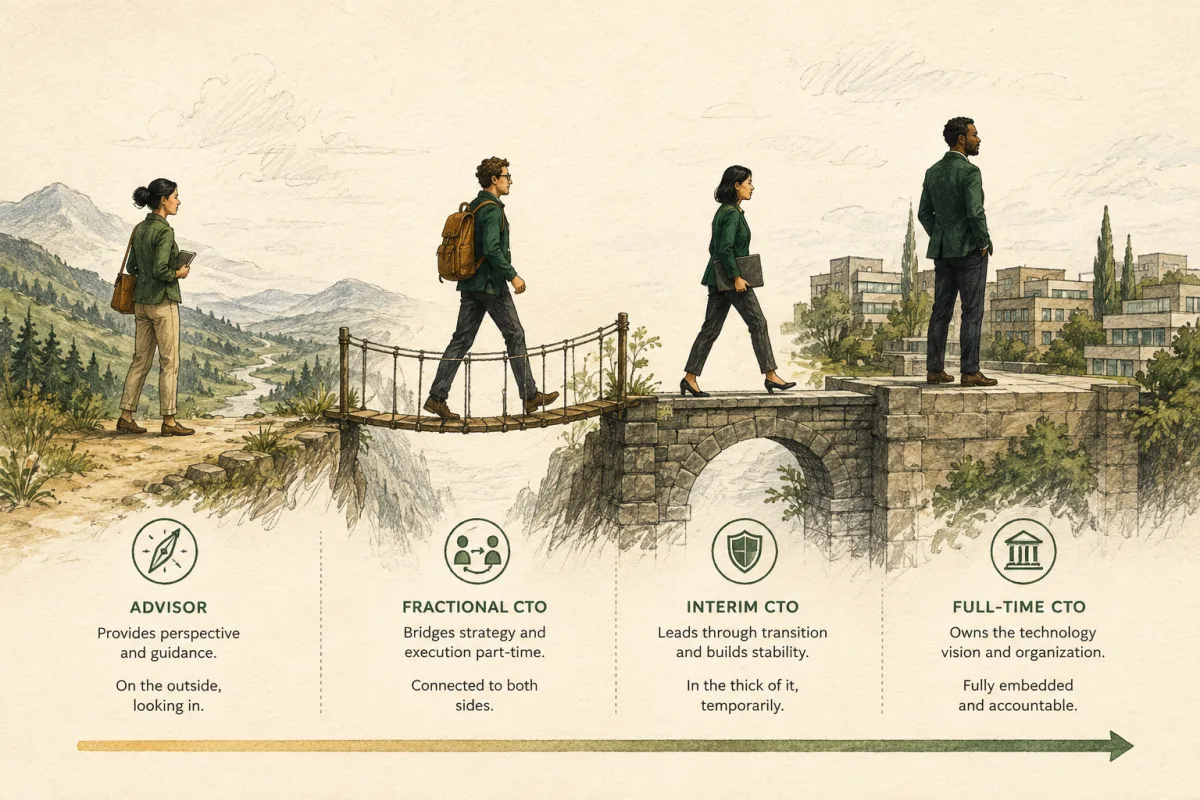
A board architecture review may need an advisor. A company with a capable engineering manager but no executive technology voice may need a fractional CTO. A sudden resignation with 70 engineers and a board meeting next week probably needs interim cover. A sustained executive workload with a long-term organization to build points toward a permanent hire.
The title matters less than the operating agreement. Ask who owns the call after the meeting, who follows through, and what happens when the company disagrees.
What does a fractional CTO’s week look like?
Part-time executive work succeeds through preparation and leverage, not meeting density. A working cadence may include:
- reviewing product, delivery, reliability, security, and cost signals before a leadership meeting;
- resolving one or two high-consequence decisions with the accountable people;
- coaching the engineering or product leader who operates between sessions;
- documenting the decision, owner, evidence, and review date;
- joining selected board, customer, investor, hiring, or incident conversations;
- following up asynchronously within agreed response boundaries.
The executive should not become a remote approval queue. If every decision waits for the fractional CTO’s next day, the design is wrong. Internal leaders need clear delegated authority and access to the context behind executive calls.
When does the model fit?
A fractional CTO can work well when:
- the CEO is carrying technology decisions they cannot responsibly judge;
- an engineering leader can run daily execution but needs executive air cover;
- fundraising, enterprise sales, diligence, or regulation raises the quality bar;
- delivery surprises are recurring and ownership crosses product, engineering, and finance;
- the company needs a roadmap, leadership reset, or platform decision before committing to a permanent structure;
- the company needs recurring executive decisions now while its longer-term leadership structure remains uncertain.
It fits poorly when there is no team, no budget to act, no access to evidence, or no willingness to grant decision rights. An executive cannot compensate for a company refusing to choose.

What should the first 90 days produce?
Avoid measuring the role by document count. A good first phase changes the company’s ability to decide and execute.
By day 90, a mandate might show:
- a shared account of the current system, team, risks, and constraints;
- a small number of explicit technology priorities tied to business outcomes;
- clarified ownership between founders, product, engineering, security, and vendors;
- visible delivery and reliability signals;
- a sequenced roadmap with assumptions, costs, and decision gates;
- a leadership and hiring plan;
- risks retired or deliberately accepted;
- a recommendation for the next leadership model.
The executive should leave behind stronger internal judgment, not dependency. That principle also protects the executive: a bounded mandate, evidence trail, and transition condition make the value attributable.
What should companies verify?
Verify identity and career history, but do not stop there. Ask candidates to reconstruct decisions from comparable contexts:
- What evidence was available?
- Which options were real?
- What trade-off did they choose?
- What did they personally own?
- What changed?
- What would a named reference confirm?
- What did they learn when the original choice was wrong?
For fractional work, also verify availability, time-zone overlap, travel, conflicts, concurrent mandates, incident expectations, and whether the proposed capacity matches the scope.
What should executives make clear?
Executives entering fractional work should publish a narrow positioning statement: the companies, events, and decisions where their evidence is strongest. A credible profile explains mandates and results without exposing confidential information. It distinguishes personal ownership from team achievement and states capacity and location constraints honestly.
The market does not need another generic “strategic technology leader.” It needs to know when to call you.
A worked example of a bounded CTO mandate
Imagine a B2B software company with an engineering manager and a small delivery team. The founder is considering larger customers, but every enterprise request creates an unresolved debate about architecture, security work, and roadmap priority. This is a hypothetical example, not a client outcome or a claim about available executives.
The company may not need another person to assign daily tickets. It may need someone to own the relationship between customer commitments, technology investment, and engineering capability. A fractional CTO mandate could focus on deciding which enterprise requirements the platform will support, sequencing the necessary work, and establishing an approval process for future commitments.
The engineering manager continues to run delivery. Product retains ownership of customer discovery and product priorities within the agreed business strategy. The founder approves major investment and commercial tradeoffs. The CTO owns the technology recommendation and the decisions delegated in the mandate, including when a proposed commitment exceeds the platform's current capability.
The first useful outputs might be a current-state assessment, an options paper for the largest constraint, and a roadmap that makes dependencies and decision dates visible. These are evidence of work, but their existence does not prove success. The company should also inspect whether commitments are now made with the right information, whether the team can act on decisions, and whether risks are escalated before they become surprises.
If every enterprise deal requires daily executive intervention, the proposed capacity may be too small. If the engineering manager needs continuous management support, the company may need a different operating structure. The fractional model is a hypothesis about leadership capacity that should be reviewed against the work, not protected because the title has already been announced.
Define decision rights before access and meetings expand
A common source of disappointment is that the company and executive use the word “own” differently. One means writing a recommendation; another means approving expenditure; another means being accountable for implementation. Translate the word into specific actions before the engagement begins.
| Decision area | Example CTO responsibility | Responsibility the company must still assign |
|---|---|---|
| Technology roadmap | Recommend sequence and decide within delegated scope | Business priorities and funding approval |
| Architecture | Set principles and resolve consequential tradeoffs | Detailed implementation and review ownership |
| Engineering organization | Assess capability and propose management changes | Employment decisions and people processes |
| Vendor selection | Evaluate technical fit, dependencies, and exit risk | Procurement, commercial approval, and contract review |
| Incident readiness | Define executive escalation and review systemic risk | Immediate incident command and response coverage |
| Customer commitments | Explain technical consequences and acceptable options | Commercial negotiation and final business acceptance |
This table is illustrative. The actual allocation depends on the organization and agreement. A small company may combine several responsibilities in one person; a larger company may distribute them. What matters is that the relevant people understand the same boundary.
Ask how disagreements are resolved. If the CTO recommends delaying a release and the CEO chooses to proceed, the risk and decision should be recorded through the company's operating process. The title does not give the executive unlimited authority, and part-time status does not justify leaving important disagreements informal.

Understand what the retainer actually buys
A retainer can reserve capacity and continuity, but the word alone says little about service. Compare preparation, meetings, asynchronous work, direct management, travel, incident response, and specialist support. A low monthly fee with a narrow advisory scope is not directly comparable with a larger operating mandate.
For example, an illustrative four-day monthly allocation might include one day of evidence review and planning, two days of leadership and decision work, and one day of coaching, documentation, and follow-up. This is not a market standard or a suggested rate. It demonstrates that visible meeting time is only part of the capacity needed to carry a mandate.
List exceptional work separately. A transaction deadline, serious incident, major hiring round, or customer escalation can exceed the ordinary cadence. Agree how the parties review additional capacity and what happens if it is unavailable. Do not assume that a part-time executive has spare days simply because they are not scheduled with your company.
Keep implementation resources visible in the budget. The CTO may decide that a migration, security assessment, or management hire is necessary, but the retainer may not include the people who perform that work. A leadership budget without an execution budget can produce well-founded recommendations that the company cannot act on. Use the fractional CTO pricing guide to compare the assumptions behind proposals.
Choose between leadership and hands-on building
Some fractional CTOs also write code or lead architecture implementation. Others focus on executive decisions and management. Neither label guarantees the mix you need. Ask for the actual allocation of time and the evidence relevant to each responsibility.
When the same person both builds and evaluates a solution, make the review process explicit. The company may benefit from independent technical review for consequential changes. Also consider what happens when a strategic decision and an urgent implementation task compete for the same limited time. An engagement can become an expensive bottleneck if all difficult work is routed to one person.
If the immediate need is a functioning first product, the company may need a capable builder, product owner, and technical review more urgently than a broad C-level mandate. If the product exists and decisions now span capital, architecture, people, and customers, executive leadership may be the missing layer. The two situations can occur in the same company at different times.
Do not use the CTO title to avoid defining a cofounder relationship. A technical cofounder often has a different commitment, ownership position, and role in shaping the business. A paid fractional engagement should state its own responsibilities and incentives rather than relying on an implied founder-level commitment.

Make the first month observable
The first month should establish how the executive and company will work together. Begin with the business trigger, current commitments, decision owners, important systems, and accessible evidence. The executive should identify what they can assess directly and where a specialist or additional information is required.
Select a small number of decisions that matter now. For each, record the question, available evidence, options, recommendation or decision, accountable owner, and review trigger. This creates an early record of judgment and follow-through without demanding a large transformation before the context is understood.
Create one recurring review that the internal team can sustain. It might examine delivery commitments, technology risks, and decisions needed from the sponsor. Avoid creating several new meetings that duplicate existing product or engineering reviews. The operating cadence should reduce confusion and decision delay, not merely make the executive visible.
At the first review, compare the actual workload with the agreed capacity. Note missing access, delayed business decisions, and implementation constraints. Adjust the mandate transparently if the evidence differs from the initial brief. A good early outcome can be discovering that the company needs an interim leader, a stronger engineering manager, or a narrower advisory engagement.
Identify what the company must contribute
The company remains an active participant in the engagement. A sponsor must resolve business priorities, provide access to relevant evidence, and make funding decisions through the agreed process. Internal owners need enough time to implement and review the work. If those dependencies are missing, the executive should make the constraint visible promptly.
Agree how requests enter the mandate. An informal stream of messages from every stakeholder can consume the entire retainer while the original priorities remain untouched. A shared decision list lets the sponsor and CTO choose what matters, defer lower-priority requests, and identify work that requires additional capacity. This is particularly useful when product, sales, finance, and engineering each have legitimate but competing demands.
Review these company-side commitments alongside the executive's outputs. That creates a fairer account of progress and helps the parties correct the operating model before frustration becomes a performance dispute.
Common questions about fractional CTOs
What does CTO stand for?
CTO stands for Chief Technology Officer. In a business context, the role connects technology choices to company strategy, investment, risk, and organizational capability. The specific responsibilities vary by company. “Fractional CTO” describes a part-time model for carrying a defined portion of that executive work.
Is a fractional CTO the same as a part-time CTO?
The terms overlap substantially. Fractional often implies a professional working across bounded engagements, while part-time may describe any reduced-hours arrangement. Neither term determines employment status, decision authority, or service scope by itself. Compare the actual agreement, availability, and responsibilities.
Can a fractional CTO manage employees?
They can have management responsibilities when the company explicitly delegates them and provides the necessary processes and capacity. Some engagements are advisory and include no direct reports. Clarify coaching, performance input, hiring recommendations, and formal people decisions separately rather than assuming that a title grants every type of authority.
Can the role be fully remote?
It can be, if the mandate supports remote operation and the parties agree overlap, communication, access, and any necessary travel. Remote does not mean available across all time zones. Evaluate how the executive will work with the actual team and stakeholders, especially where physical operations or intensive transitions require presence.
Does a fractional CTO replace a CISO or CIO?
Not automatically. A CTO may coordinate security and internal technology decisions, but a dedicated CISO or CIO mandate can require distinct expertise and operating ownership. Define where responsibilities overlap and where specialist support is needed. One executive should not be presented as universal coverage for every technology function.
How do we know it is time for a full-time CTO?
Look for sustained executive workload, frequent high-consequence decisions, a growing management organization, and stakeholder demands that exceed the fractional cadence. The transition should follow demonstrated need and the company's ability to support the role. The hiring timing guide explores the signals and alternative leadership models.
Does the executive guarantee a business result?
A responsible mandate defines decisions, work, dependencies, and evidence of progress. Revenue, fundraising, delivery, and risk outcomes depend on many people and external conditions. Treat unconditional outcome promises cautiously and investigate attributable evidence through case studies and references.
Choose a concrete mandate
A fractional CTO is part-time executive capacity with full accountability for an explicitly bounded technology mandate.
If authority is absent, it is advice. If capacity approaches continuous seat ownership, it is interim or permanent leadership. If the company and executive can state the outcome, decisions, cadence, measures, and exit, the fractional model becomes a concrete operating choice rather than a vague title.
If you are choosing the engagement structure, compare the part-time CTO guide with the wider explanation of fractional executive work. When you are ready to evaluate sourcing options, use the GoFractional, Bolster and Toptal comparison to frame questions about provider scope and candidate assessment.
Frequently asked questions
What does a fractional CTO do?
A fractional CTO owns a bounded set of executive technology decisions on a recurring part-time cadence. Common responsibilities include technology strategy, architecture, engineering leadership, security and risk, executive communication, and capability transfer.
Is a fractional CTO an employee?
A fractional CTO may work through a contract, service company or part-time employment arrangement. The title alone does not determine legal status. Classification and tax treatment depend on the jurisdiction and actual relationship; obtain qualified local advice.
How many hours does a fractional CTO work?
There is no standard schedule. Engagements may range from a few days each month to two or three days each week. Capacity should follow the decisions and operating load rather than a title-based package.
Can a fractional CTO manage developers?
Yes, when people-management authority is explicitly included and the purchased capacity supports it. Many mandates instead coach an internal engineering leader while retaining executive decision ownership.
Sources and further reading
Turn research into a mandate
See the cost and hiring model before you shortlist.
Use the free calculator, then save a candidate search or post a transparent role when the mandate is ready.