The Complete Fractional CTO Pricing Guide 2025
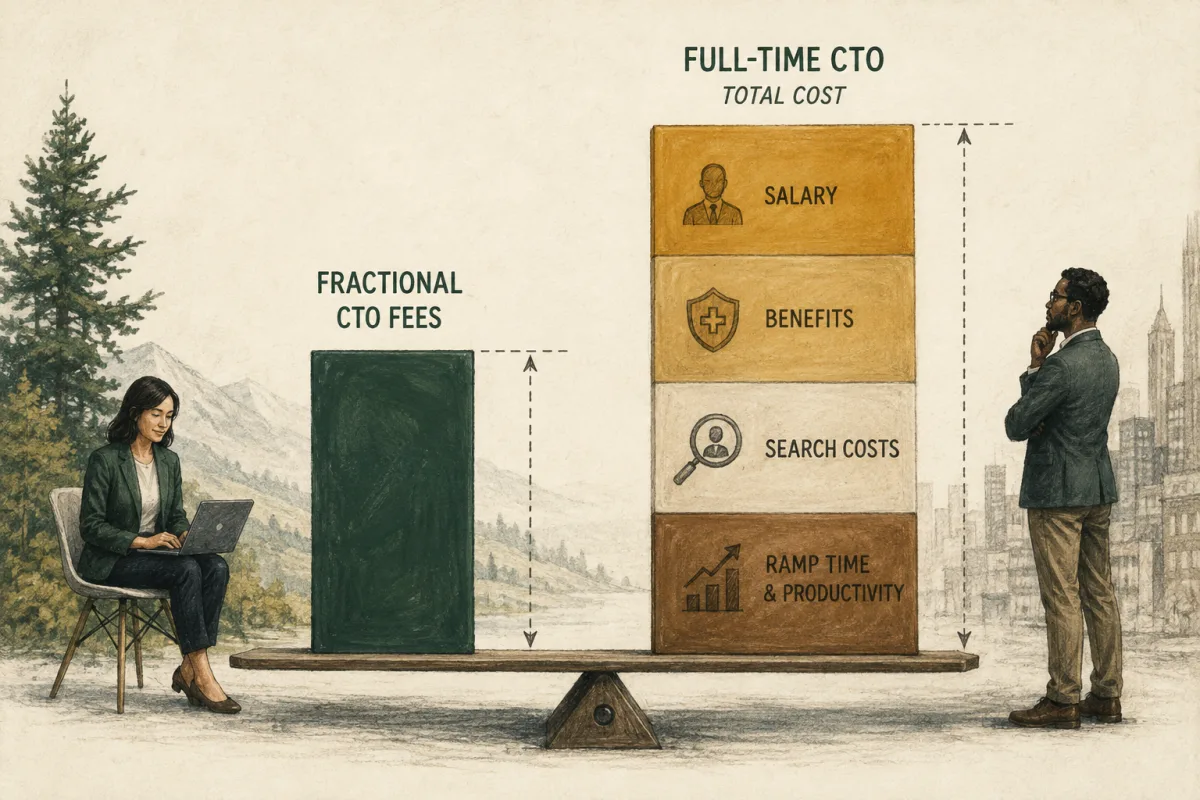
Fractional CTO pricing typically ranges from $8,000 to $25,000 per month, with most companies paying $12,000-$15,000/month for standard engagement. That's 50-70% less expensive than hiring a full-time CTO, while getting access to more experienced leadership.
But pricing varies significantly based on your company stage, industry, complexity, and needs. A pre-seed startup might pay $8,000/month for strategic guidance, while a Series B FinTech company might invest $20,000+/month for comprehensive CTO services including compliance oversight.
This comprehensive guide breaks down everything you need to know about fractional CTO pricing: the different models, what drives costs, typical packages by stage, hidden costs to avoid, and how to calculate ROI.
By the end, you'll know exactly what to budget and what you should get for your investment.
Why Fractional CTO Pricing Matters
Before diving into numbers, let's talk about why getting pricing right matters.
The Full-Time CTO Cost Reality:
- Base salary: $250K-$450K
- Benefits and taxes: +25-30% ($62K-$135K)
- Equity: 0.5-2.5% (worth $500K-$2M+ at exit)
- Recruiting fees: $50K-$90K (20-25% of salary)
- Total Year 1 Cost: $362K-$675K+
The Full-Time Risk:
- 6-month average hiring time (burning runway)
- 40% chance of executive hire not working out in first 18 months
- If it doesn't work, you've spent $200K-$400K+ and lost 12-18 months
Fractional CTO Alternative:
- Start in 2-4 weeks (not 6 months)
- Pay $96K-$300K/year (60-75% cost savings)
- Month-to-month flexibility (end engagement if not working)
- Access to more experienced talent (15-20 years vs. 8-12 years typical for affordable full-time)
Now let's break down exactly what you pay and what you get.
Fractional CTO Pricing Models
There are four main pricing models. Each works better for different situations.
Model 1: Monthly Retainer (Most Common - 80% of Engagements)
How It Works:
- Fixed monthly fee for specific scope of work
- Defined number of hours or days per month
- Predictable, recurring cost
- Usually 3-6 month minimum commitment
Typical Structure:
- Starter Package: $8K-$10K/month for 20-30 hours
- Standard Package: $12K-$15K/month for 40-50 hours
- Premium Package: $18K-$25K/month for 60-80 hours
What's Included:
- Regular strategic sessions (weekly or biweekly)
- Architecture reviews and decisions
- Team leadership and guidance
- Investor/board presentations
- Hiring support
- Emergency availability (within reason)
Pros:
- Predictable monthly cost
- Ongoing relationship and context
- Priority access to CTO
- Best value per hour (30-40% discount vs. hourly)
Cons:
- Monthly commitment (though usually flexible)
- Pay for retainer even in slower months
- May include more hours than you need initially
Best For:
- Ongoing strategic guidance (most startups)
- Companies 5-50 employees
- Seed through Series B stage
Real Example: Series A SaaS company, 12 engineers, paying $14K/month retainer:
- 2 days/week fractional CTO time (64 hours/month)
- Weekly strategy sessions (4 hours)
- Monthly board prep (4 hours)
- Architecture reviews (8 hours)
- Hiring support - technical interviews (8 hours)
- Team mentorship and 1-on-1s with leads (12 hours)
- Ad-hoc guidance via Slack (8 hours)
- Emergency availability
Effective Rate: $218/hour (vs. $300-400/hour on hourly model)
Model 2: Hourly Rate (15% of Engagements)
How It Works:
- Pay per hour used
- Track time precisely
- Invoice monthly for hours worked
- No minimum commitment (usually)
Typical Rates:
- Junior Fractional CTO (5-10 years): $200-$300/hour
- Mid-Level Fractional CTO (10-15 years): $300-$400/hour
- Senior Fractional CTO (15-20 years): $400-$500/hour
- Executive Fractional CTO (20+ years, previous exits): $500-$600/hour
What's Included:
- Only actual work time (meetings, reviews, deliverables)
- Usually NOT including async communication (Slack, email)
- Billed in 15-minute or 30-minute increments
Pros:
- Pay only for time used
- No monthly commitment
- Flexibility to scale up or down
- Good for one-time projects
Cons:
- Higher per-hour cost (30-40% more than retainer)
- Less predictable monthly cost
- CTO less invested (transactional relationship)
- Time tracking overhead
Best For:
- One-time projects (architecture review, tech due diligence)
- Uncertain or variable needs
- Very early stage (2-5 people) with limited budget
- Short-term engagements (1-3 months)
Real Example: Pre-seed startup, 3 engineers, needs architecture review before fundraising:
- 20 hours of work over 3 weeks
- Rate: $350/hour
- Total Cost: $7,000
- Deliverables: Architecture document, tech stack recommendation, investor presentation materials
When This Makes Sense: One-time need, not ongoing relationship. If engagement extends beyond 30-40 hours, retainer becomes more cost-effective.
Model 3: Project-Based Fixed Fee (3% of Engagements)
How It Works:
- Fixed price for specific deliverable or project
- Scope defined upfront
- Payment milestone-based (often 50% start, 50% completion)
- Timeline: 4-12 weeks typically
Typical Projects & Pricing:
| Project Type | Typical Duration | Fixed Fee Range |
|---|---|---|
| Architecture Review & Roadmap | 3-4 weeks | $15K - $30K |
| Technology Stack Evaluation | 2-3 weeks | $10K - $20K |
| Technical Due Diligence (for acquisition) | 2-4 weeks | $20K - $40K |
| Hiring & Recruiting Strategy | 4-6 weeks | $12K - $25K |
| Infrastructure & Security Audit | 3-5 weeks | $18K - $35K |
| Team Assessment & Reorganization | 3-4 weeks | $15K - $28K |
What's Included:
- All work to complete defined scope
- Specific deliverables (documents, presentations, recommendations)
- Usually 1-2 follow-up sessions after delivery
Pros:
- Know total cost upfront
- Clear deliverable and timeline
- No ongoing commitment
- Easy to budget
Cons:
- Scope creep can cause issues
- Less flexible than retainer
- Higher cost for equivalent hours (20-30% premium for project risk)
- Relationship ends after project
Best For:
- Specific, bounded projects
- Pre-fundraising technical prep
- M&A due diligence
- One-time strategic initiatives
Real Example: Series A company preparing for Series B fundraising:
- Project: Technical due diligence prep and investor materials
- Duration: 4 weeks
- Fixed Fee: $25,000
- Deliverables:
- Technical architecture documentation
- Security and compliance review
- Engineering metrics dashboard
- Technology roadmap presentation
- Investor Q&A preparation
- 2 follow-up sessions during fundraising
ROI: Raised $15M Series B, CTO documentation gave investors confidence. $25K investment to de-risk $15M raise.
Model 4: Equity or Equity + Cash (2% of Engagements)
How It Works:
- Fractional CTO takes partial or full payment in equity
- Usually equity + reduced cash (not pure equity)
- Equity: 0.25-1.5% typically
- Vesting: 1-2 years (faster than full-time 4-year vesting)
Typical Structures:
Option A: Reduced Cash + Equity
- Cash: $5K-$8K/month (40-50% discount)
- Equity: 0.5-1% with 1-2 year vest
- When: Pre-seed/seed with limited cash, strong upside potential
Option B: Deferred Cash (Converts to Equity)
- Bill normal rates ($12K-15K/month)
- Company can't pay, converts to equity at next round
- Equity valued at discounted rate (20-30% discount to next round)
- When: Pre-revenue, fundraising soon
Equity Ranges by Stage:
| Company Stage | Cash Reduction | Equity Grant | Total Annual Value |
|---|---|---|---|
| Pre-Seed | 50-60% off | 0.75% - 1.5% | $60K cash + equity |
| Seed | 30-40% off | 0.5% - 1% | $90K cash + equity |
| Series A | 20-30% off | 0.25% - 0.5% | $120K cash + equity |
| Series B+ | Rare | 0.1% - 0.25% | Usually full cash |
Pros (For Company):
- Preserve cash runway
- Align CTO with long-term success
- Get better talent than cash budget allows
Cons (For Company):
- Dilution
- CTO less motivated if equity value unclear
- Complicated cap table
Pros (For CTO):
- Upside if company succeeds
- Larger equity stake than full-time role
- Portfolio approach across multiple companies
Cons (For CTO):
- Most startups fail (equity worth $0)
- Illiquid for years
- Risk of not getting paid
Best For:
- Pre-seed/seed companies with <6 months runway
- Strong founding team and traction
- Clear path to fundraising or revenue
- CTO believes in massive upside
Real Example: Pre-seed startup, 2 founders + 2 engineers, 4 months runway:
- Normal Rate: $12K/month retainer
- Equity Deal: $6K/month + 1% equity (4-year vest, 1-year cliff)
- Engagement: 12 months
- Total: $72K cash + 1% equity
- Outcome: Company raised $3M seed at $12M valuation → equity worth $120K on paper
- If company hits $100M exit: $1M equity value
Risk Assessment:
- 70% chance equity worth $0 (company fails)
- 20% chance equity worth $50K-$200K (modest exit)
- 10% chance equity worth $500K-$2M+ (strong exit)
- Expected value: ~$70K-$150K (vs. $144K full cash)
When We Recommend: Only if you have <6 months runway AND strong indicators (revenue traction, founder track record, investor interest).
Average Fractional CTO Costs: By Package
Here's what most companies actually pay, broken down by engagement level.
Starter Package: $8,000 - $10,000/month
Typical Engagement:
- 20-30 hours per month (1-1.5 days/week)
- Monthly or biweekly strategic sessions
- Asynchronous support via Slack/email
- Occasional deep-dive sessions
What's Included:
- Technology strategy and roadmap (quarterly)
- Architecture review and guidance (monthly)
- Build vs. buy recommendations
- Hiring support (job descriptions, final interviews)
- Investor/board presentation prep (as needed)
- Emergency consultation (limited)
What's NOT Included:
- Daily team management
- Hands-on coding or implementation
- Weekly team meetings
- Extensive 1-on-1s with engineers
- 24/7 availability
Best For:
- Pre-seed to seed stage
- 2-8 engineers
- Technical founder who needs strategic sounding board
- Stable tech stack, no major architectural changes
- Limited budget (<$120K/year for fractional CTO)
Real Companies Using This:
- Early SaaS startups with technical founders
- Solo technical founders building MVP
- Bootstrapped companies with small teams
ROI Calculation:
- Cost: $96K-$120K/year
- vs. Full-Time CTO: Saves $240K-$350K/year
- Value Delivered: Strategic guidance prevents $50K-$200K+ in technical debt and wrong technology choices
Standard Package: $12,000 - $15,000/month
Typical Engagement:
- 40-50 hours per month (2-2.5 days/week)
- Weekly strategic sessions
- Regular team touchpoints
- Active Slack/email engagement
What's Included:
- Everything in Starter, plus:
- Weekly leadership team meetings
- Engineering team all-hands (monthly)
- 1-on-1s with engineering leads (monthly)
- Active hiring participation (screening, interviews, offers)
- Code and architecture reviews (weekly)
- Engineering metrics and reporting (monthly)
- Vendor evaluation and negotiation
- Incident response and post-mortems
- Regular availability (business hours, async)
What's NOT Included:
- Daily standups or sprint planning
- Hands-on coding (except critical architecture)
- Full-time people management
- 24/7 on-call
Best For:
- Seed to Series A stage
- 8-25 engineers
- Non-technical founder or technical founder too busy with business
- Growing team, establishing processes
- Making significant technical decisions
- Budget: $144K-$180K/year
Real Companies Using This:
- Series A SaaS companies scaling engineering
- FinTech/HealthTech with compliance needs
- Companies with VP Engineering who need strategic oversight
ROI Calculation:
- Cost: $144K-$180K/year
- vs. Full-Time CTO: Saves $180K-$270K/year
- Value Delivered:
- Better hiring (save $100K+ in bad hires avoided)
- Architecture decisions (save $200K+ in technical debt)
- Faster execution (20-30% velocity improvement = $150K+ value)
- Total Value: $450K+/year
This is our most popular package - see full details
Premium Package: $18,000 - $25,000/month
Typical Engagement:
- 60-80 hours per month (3-4 days/week)
- Near-daily engagement
- Deep team integration
- High-touch, strategic + operational
What's Included:
- Everything in Standard, plus:
- Daily or every-other-day team touchpoints
- Weekly 1-on-1s with all engineering leads
- Active sprint planning participation
- Hands-on architecture work (when needed)
- Extensive hiring (multiple roles simultaneously)
- Board meeting preparation and attendance
- Investor relations and technical due diligence
- Compliance and security oversight (FinTech, HealthTech)
- M&A technical due diligence
- Partner and vendor relationship management
- 24/7 emergency availability
What's NOT Included:
- Full-time presence (still 3-4 days, not 5)
- Individual contributor coding work
- Direct management of all engineers (they manage through leads)
Best For:
- Series A to Series C
- 25-50+ engineers
- Complex technical needs (compliance, security, scale)
- Regulated industries (FinTech, HealthTech)
- Rapid growth phase (doubling team in 6-12 months)
- Budget: $216K-$300K/year
Real Companies Using This:
- Series B FinTech with SOC2 and regulatory compliance
- HealthTech with HIPAA requirements
- High-growth SaaS scaling from 20 to 50 engineers in 12 months
- Companies preparing for acquisition
ROI Calculation:
- Cost: $216K-$300K/year
- vs. Full-Time CTO: Saves $100K-$200K/year
- vs. CTO + VP Engineering: Saves $300K-$400K/year
- Value Delivered:
- Expert-level CTO (15-20 years experience) at mid-level cost
- Compliance/security expertise (saves $150K+ consultant costs)
- Faster fundraising (technical credibility with investors)
- Total Value: $500K-$700K+/year
Custom/Enterprise Package: $25,000+/month
Typical Engagement:
- 80-120+ hours per month (4-6 days/week)
- Effectively full-time with flexibility
- Multiple company/portfolio engagements (some fractional CTOs)
What's Included:
- Fully customized scope
- May include multiple fractional executives (CTO + CISO, etc.)
- Full strategic and operational leadership
- Essentially full-time CTO without full-time commitment
Best For:
- Series B+ companies with unique needs
- Multiple portfolio companies (PE/VC firms)
- Temporary full-time CTO (search for permanent)
- Complex regulatory or compliance situations
Cost Comparison:
- Fractional (Custom): $300K-$400K+/year
- Full-Time CTO: $400K-$600K+/year
- Still Save: $100K-$200K/year + recruiting costs + flexibility
What Affects Fractional CTO Pricing: 6 Key Factors
Not all fractional CTO engagements cost the same. Here's what drives pricing up or down.
Factor 1: Company Stage and Maturity
Pre-Seed / Bootstrapped:
- Lower End Pricing: $8K-$12K/month
- Why: Simpler needs, less complexity, limited budget
- Typical Scope: Strategic guidance, architecture review, hiring help
Seed Stage:
- Mid-Range Pricing: $10K-$15K/month
- Why: Growing team, establishing processes, fundraising support
- Typical Scope: Regular strategic sessions, team leadership, investor prep
Series A:
- Standard Pricing: $12K-$18K/month
- Why: Scaling complexity, more engineers, significant technical decisions
- Typical Scope: Active team leadership, hiring, architecture, compliance
Series B+:
- Premium Pricing: $18K-$25K+/month
- Why: High complexity, compliance, scale challenges, board expectations
- Typical Scope: Comprehensive CTO services, regulatory, M&A, deep team engagement
Pricing by Stage Table:
| Stage | Team Size | Typical Monthly Cost | Annual Cost | Why |
|---|---|---|---|---|
| Pre-Seed | 2-5 | $8K - $10K | $96K - $120K | Strategic guidance only |
| Seed | 5-12 | $10K - $14K | $120K - $168K | Team building, processes |
| Series A | 12-25 | $14K - $18K | $168K - $216K | Scaling, hiring, compliance |
| Series B | 25-50 | $18K - $23K | $216K - $276K | Complexity, regulation, board |
| Series C+ | 50+ | $23K - $30K+ | $276K - $360K+ | Full CTO services |
Factor 2: Industry and Compliance Requirements
Some industries require more specialized expertise and carry higher compliance burdens.
Baseline Industries (1.0x pricing):
- General SaaS
- E-commerce
- Consumer apps
- Marketing tech
Typical Cost: $12K-$15K/month for standard package
Medium Complexity Industries (1.2-1.3x pricing):
- B2B SaaS with enterprise clients
- Data/analytics platforms
- Developer tools
- EdTech
Why More Expensive:
- Enterprise security requirements
- Data privacy (GDPR, CCPA)
- Integration complexity
- Higher technical standards
Typical Cost: $14K-$18K/month (+$2K-$3K/month)
High Complexity Industries (1.3-1.5x pricing):
- FinTech and payments
- HealthTech and digital health
- InsurTech
- Blockchain/crypto
Why More Expensive:
- Heavy regulatory compliance (SOC2, HIPAA, PCI-DSS, FinCEN, etc.)
- Security expertise required
- Audit preparation and ongoing compliance
- Risk management
- Specialized technical knowledge
Typical Cost: $16K-$22K/month (+$4K-$7K/month)
Industry Pricing Table:
| Industry | Compliance Needs | Monthly Premium | Total Monthly Cost |
|---|---|---|---|
| General SaaS | Basic (SOC2 optional) | Baseline | $12K - $15K |
| Enterprise SaaS | SOC2, GDPR | +$2K - $3K | $14K - $18K |
| FinTech | SOC2, PCI-DSS, FinCEN | +$4K - $6K | $16K - $21K |
| HealthTech | HIPAA, SOC2, FDA (devices) | +$5K - $7K | $17K - $22K |
| Crypto/Blockchain | FinCEN, AML, specialized tech | +$6K - $10K | $18K - $25K |
Real Example - FinTech: Series A payment processing startup, 15 engineers:
- Base Cost (if general SaaS): $14K/month
- FinTech Premium: +$5K/month for:
- PCI-DSS compliance guidance
- SOC2 audit preparation
- Banking partner technical requirements
- Payment security architecture
- Regulatory risk assessment
- Total Cost: $19K/month
- ROI: Compliance consultant would cost $200-$300/hour × 40 hours/month = $8K-$12K, plus lack strategic technology guidance
Factor 3: Technical Complexity and Architecture
Low Complexity (0.9-1.0x pricing):
- Standard web application (React/Node, Rails, Django)
- Established tech stack
- Minimal integrations
- Cloud-hosted (AWS/GCP standard services)
Cost Impact: $10K-$13K/month
Medium Complexity (1.0-1.2x pricing):
- Microservices architecture
- Multiple integrations (10-20 services)
- Real-time features (WebSocket, streaming)
- Mobile apps + web
- Multi-region deployment
Cost Impact: $12K-$16K/month
High Complexity (1.3-1.6x pricing):
- Complex distributed systems
- High-scale infrastructure (millions of users)
- Machine learning/AI components
- Real-time data processing (streaming, analytics)
- Custom protocols or deep infrastructure work
- Legacy system migration
Cost Impact: $16K-$24K/month
Why Complexity Matters: More complex systems require:
- Deeper technical expertise (rarer, more expensive CTOs)
- More time for architecture decisions
- Specialized knowledge (ML, distributed systems, etc.)
- Higher risk of costly mistakes
Factor 4: Geographic Location and Market
Fractional CTO pricing varies by location, though less than full-time salaries (fractional often works remotely).
Tier 1 Markets (1.2-1.3x pricing):
- San Francisco / Silicon Valley
- New York City
- Premium: +20-30% over baseline
Why: Higher cost of living, competitive market, local presence expectations
Standard Package: $15K-$20K/month (vs. $12K-$15K baseline)
Tier 2 Markets (1.0-1.1x pricing):
- Seattle, Austin, Boston, Los Angeles
- Premium: +0-10% over baseline
Standard Package: $12K-$17K/month
Tier 3 Markets / Remote (0.9-1.0x pricing):
- Other US cities
- Fully remote engagements
- Discount: 0-10% below baseline
Standard Package: $10K-$15K/month
Geographic Pricing Table:
| Location | Market Premium | Standard Package | Premium Package |
|---|---|---|---|
| SF / Palo Alto | +25% | $15K - $18K | $22K - $30K |
| NYC | +20% | $14K - $17K | $21K - $28K |
| Seattle / Austin | +10% | $13K - $16K | $19K - $25K |
| Remote / Other | Baseline | $12K - $15K | $18K - $24K |
Note: Remote work has reduced geographic pricing variation. Many fractional CTOs work remotely regardless of company location.
Factor 5: Engagement Hours and Commitment Level
More hours per month = higher total cost, but lower effective hourly rate.
Light Engagement (20-30 hours/month):
- Cost: $8K-$11K/month
- Effective Rate: $270-$370/hour
- Best For: Strategic advice only, stable teams
Standard Engagement (40-50 hours/month):
- Cost: $12K-$16K/month
- Effective Rate: $240-$320/hour (best value)
- Best For: Most companies, balance of strategy + engagement
Heavy Engagement (60-80 hours/month):
- Cost: $18K-$25K/month
- Effective Rate: $225-$315/hour
- Best For: High complexity, rapid growth, compliance needs
Near Full-Time (100-120 hours/month):
- Cost: $25K-$35K/month
- Effective Rate: $210-$290/hour
- Best For: Temporary full-time CTO, complex transformations
Pricing Efficiency:
| Hours/Month | Monthly Cost | Effective Hourly Rate | Savings vs. Pure Hourly |
|---|---|---|---|
| 20 hours | $8K | $400/hour | 0% (baseline) |
| 40 hours | $14K | $350/hour | 12% savings |
| 60 hours | $19K | $317/hour | 21% savings |
| 80 hours | $24K | $300/hour | 25% savings |
| 100 hours | $28K | $280/hour | 30% savings |
Commitment Length Impact:
Month-to-Month:
- No minimum commitment
- Highest monthly rate (no discount)
- Most flexibility
3-Month Minimum:
- 5-10% discount vs. month-to-month
- Standard for most engagements
6-Month Commitment:
- 10-15% discount
- CTO can plan longer-term initiatives
12-Month Commitment:
- 15-20% discount
- Best for ongoing strategic partnership
Example: Standard package, 50 hours/month:
- Month-to-month: $15K/month ($180K/year)
- 6-month commit: $13.5K/month ($162K/year) - Save $18K
- 12-month commit: $12.5K/month ($150K/year) - Save $30K
Factor 6: Fractional CTO Experience and Specialization
Not all fractional CTOs cost the same. Experience and specialization drive significant price variation.
Mid-Level Fractional CTO (8-12 years experience):
- Pricing: $8K-$12K/month standard package
- Background: Senior engineer, engineering manager, first-time CTO
- Best For: Seed stage, straightforward SaaS, limited budget
Senior Fractional CTO (12-18 years experience):
- Pricing: $12K-$18K/month standard package
- Background: Multiple CTO roles, scaled teams 10→50+, fundraising experience
- Best For: Series A-B, scaling challenges, moderate complexity
Executive Fractional CTO (18-25+ years experience):
- Pricing: $18K-$30K+/month standard package
- Background: CTO at successful exits, scaled teams to 100+, board experience
- Best For: Series B+, complex situations, high-stakes decisions
Specialized Fractional CTO:
- Pricing: +20-40% premium for deep specialization
- Examples:
- Machine Learning/AI CTO: +30% premium
- FinTech/Compliance CTO: +25% premium
- DevOps/Infrastructure CTO: +20% premium
- Security/CISO hybrid: +35% premium
- Blockchain/Web3 CTO: +40% premium
Experience Pricing Table:
| Experience Level | Years | Standard Package | Premium Package | Track Record |
|---|---|---|---|---|
| Mid-Level | 8-12 | $8K - $12K | $14K - $18K | 1-2 CTO roles |
| Senior | 12-18 | $12K - $18K | $18K - $25K | 2-4 CTO roles, scaled teams |
| Executive | 18-25+ | $18K - $25K | $25K - $35K | Multiple exits, 100+ teams |
| Specialized | 15+ | $15K - $30K | $24K - $40K | Deep domain expertise |
ROI of Experience:
Question: Is a $25K/month executive CTO worth 2x a $12K/month mid-level CTO?
Answer: Often yes, because:
Executive CTO Value:
- Prevents $500K-$2M in wrong architecture decisions (seen it before)
- Attracts better engineering talent (reputation and network)
- Commands investor/board confidence (fundraising advantage)
- Solves problems in 1/3 the time (pattern matching from experience)
Real Example: Series B company hired mid-level fractional CTO at $12K/month. After 6 months of slow progress and wrong technology decisions, switched to executive fractional CTO at $24K/month.
Result:
- Month 7-12 with executive CTO: Resolved 18 months of technical debt, restructured team, prepared successful Series C
- Cost Difference: +$72K over 6 months
- Value Gained: Series C raised $30M, CTO credibility was cited by investors as key factor
- ROI: Infinite (couldn't have raised without credible tech leadership)
Fractional CTO Pricing by Company Stage
Let's look at typical pricing for each stage, with real package details.
Pre-Seed Stage Pricing
Typical Company Profile:
- 1-2 founders + 0-5 engineers
- Pre-revenue or <$10K MRR
- Runway: 6-12 months
- Raising: Pre-seed or small angel round
Typical Needs:
- Technology strategy and stack selection
- Architecture guidance for MVP
- Hiring first engineers
- Investor pitch technical content
Recommended Package:
- Tier: Starter
- Hours: 20-30 hours/month (1-1.5 days/week)
- Pricing: $8K-$11K/month
- Commitment: Month-to-month or 3-month minimum
What You Get:
- Biweekly or monthly strategic sessions (2 hours each)
- Technology roadmap and architecture review
- Build vs. buy recommendations
- Hiring support (JDs, final interviews for first 2-3 engineers)
- Async support via Slack (limited)
- Investor presentation technical content
Alternative: Hourly for One-Time Projects If you just need architecture review before building:
- 15-20 hours over 2-3 weeks
- $300-$400/hour
- Total: $4,500-$8,000
Real Example: B2B SaaS pre-seed, 2 founders (non-technical CEO, technical CTO), building MVP:
- Package: $9K/month, 25 hours/month, 3-month commitment
- Outcome: Validated tech stack, hired 2 engineers, prepared technical investor materials, raised $750K angel round
- Cost: $27K over 3 months
- ROI: Technical credibility helped close angel round, avoided $50K+ in wrong technology choices
Seed Stage Pricing
Typical Company Profile:
- 3-12 engineers
- $10K-$100K MRR
- Raised seed round ($1M-$3M)
- Runway: 12-18 months
Typical Needs:
- Scaling engineering team (hiring 3-8 engineers)
- Establishing development processes
- Architecture for growth
- Series A preparation
Recommended Package:
- Tier: Standard
- Hours: 40-50 hours/month (2-2.5 days/week)
- Pricing: $11K-$15K/month
- Commitment: 3-6 month minimum
What You Get:
- Weekly strategic sessions (90-120 minutes)
- Monthly architecture reviews
- Engineering hiring (screening, technical interviews, offers)
- Process implementation (Agile, code review, testing)
- Engineering metrics and dashboards
- Monthly engineering all-hands
- Series A technical prep (last 2-3 months of engagement)
- Active Slack/email engagement
What You Don't Get:
- Daily standups
- Sprint planning (fractional CTO guides, team leads run)
- Individual engineer management (you hire engineering managers for this)
Real Example: SaaS startup, raised $2M seed, 5 engineers, technical founder CEO:
- Package: $13K/month, 45 hours/month, 6-month commitment
- Outcome:
- Hired 5 more engineers (grew to 10)
- Implemented Agile processes
- Prepared technical materials for Series A
- Achieved SOC2 compliance
- Series A raised successfully ($8M)
- Cost: $78K over 6 months
- ROI:
- Avoided 2 bad hires (saved $200K)
- SOC2 compliance opened enterprise deals ($500K pipeline)
- Series A technical credibility (priceless)
See our seed-stage packages in detail
Series A Stage Pricing
Typical Company Profile:
- 10-25 engineers
- $100K-$500K MRR
- Raised Series A ($5M-$15M)
- Runway: 18-24 months
Typical Needs:
- Scaling from 10→30 engineers
- Team structure and organization
- Engineering leadership (hiring VPs, Directors)
- Technical debt management
- Compliance (SOC2, HIPAA, etc.)
- Board and investor reporting
Recommended Package:
- Tier: Standard to Premium
- Hours: 50-70 hours/month (2.5-3.5 days/week)
- Pricing: $14K-$20K/month
- Commitment: 6-12 month minimum
What You Get:
- Weekly leadership team meetings
- Biweekly or monthly 1-on-1s with engineering leads
- Hiring support (especially senior roles like VP Eng, Directors)
- Architecture reviews and decisions
- Engineering metrics and reporting
- Board presentation prep (quarterly)
- Compliance oversight (SOC2, security, etc.)
- Vendor management and negotiation
- Team reorganization as needed
- Regular Slack/email engagement
- Emergency availability
Additional for Premium Tier:
- Weekly 1-on-1s with all leads
- Monthly engineering all-hands participation
- Daily Slack check-ins
- Active sprint planning involvement
Real Example: FinTech Series A, $8M raised, 18 engineers, non-technical founder:
- Package: Premium - $19K/month, 65 hours/month, 12-month commitment
- Why Premium: FinTech compliance (PCI-DSS, SOC2), non-technical founder needed more hands-on guidance
- Outcome:
- Scaled from 18→32 engineers
- Hired VP Engineering (fractional CTO managed search)
- Achieved SOC2 Type 2 and PCI-DSS compliance
- Reduced deployment time from 2 weeks to 2 days
- Prepared for Series B
- Cost: $228K over 12 months
- ROI:
- Compliance would have cost $150K+ in consultants
- VP Eng hire (fractional CTO saved $50K+ recruiting fees)
- Faster deployments (20% velocity increase = $300K+ value)
- Total ROI: $500K+ value for $228K cost
Series B+ Stage Pricing
Typical Company Profile:
- 25-75+ engineers
- $500K-$3M+ MRR
- Raised Series B or later ($15M-$50M+)
- Runway: 18-30+ months
Typical Needs:
- Scaling to 50-100+ engineers
- Multiple engineering teams and VPs
- Complex architecture and infrastructure
- Compliance and security at scale
- M&A technical due diligence
- IPO or exit preparation
Recommended Package:
- Tier: Premium or Custom
- Hours: 70-120+ hours/month (3.5-6 days/week)
- Pricing: $20K-$35K+/month
- Commitment: 12-month minimum
What You Get:
- Daily or near-daily engagement
- Weekly 1-on-1s with VP Engineering and other tech leaders
- Board meeting preparation and attendance
- Investor relations technical support
- Strategic initiatives (platform migrations, architectural evolution)
- M&A technical due diligence (buy or sell side)
- Engineering organization design
- Executive-level vendor and partner negotiations
- Compliance and security oversight
- Crisis management and incident response
- 24/7 emergency availability
When Fractional vs. Full-Time at This Stage:
Fractional Makes Sense When:
- You have strong VP Engineering handling day-to-day
- CTO role is strategic, not operational
- You want executive-level experience at lower cost
- Flexibility matters (month-to-month vs. full-time hire)
Full-Time Makes Sense When:
- You need 5+ days/week engagement
- Internal team needs full-time CTO presence
- Board expects full-time executive team
- Approaching IPO (usually need full-time CTO)
Real Example: Series C HealthTech, $40M raised, 55 engineers, preparing for acquisition:
- Package: Custom - $32K/month, 100 hours/month, 12-month engagement
- Why Custom: M&A preparation, HIPAA compliance, complex regulatory environment
- Outcome:
- Led technical due diligence preparation
- Achieved HIPAA and SOC2 Type 2 compliance
- Restructured engineering for scalability
- Supported acquisition process (technical buyer diligence)
- Company acquired for $180M
- Cost: $384K over 12 months
- ROI:
- Technical diligence readiness (buyers cited tech as key strength)
- Compliance (required for acquisition, would cost $300K+ in consultants)
- Acquisition success (technical issues can kill deals)
- ROI: Contributed to $180M exit
What's Included in Each Package: Detailed Breakdown
Let's detail exactly what deliverables and activities you get in each tier.
Starter Package ($8K-$11K/month) - Detailed Breakdown
Strategic Planning (30% of time):
- Quarterly technology roadmap sessions (4 hours)
- Annual technology strategy development (8 hours/year)
- Build vs. buy analysis for major decisions (2-4 hours per decision)
- Technology stack recommendations (one-time, 4-6 hours)
Architecture & Technical Leadership (25% of time):
- Monthly architecture review (2 hours)
- Code review of critical PRs (2-3 hours/month)
- Technical debt assessment (quarterly, 3 hours)
- Infrastructure and security guidance (as needed, 2-3 hours/month)
Hiring & Team Development (20% of time):
- Job description creation (1 hour per JD)
- Final-round technical interviews (1 hour per candidate, up to 4/month)
- Offer guidance and negotiation support (30 min per offer)
Stakeholder Management (15% of time):
- Monthly CEO/founder sync (1 hour)
- Investor technical content (as needed for fundraising, 3-5 hours)
- Board prep (if requested, 2-3 hours per board meeting)
Ad-Hoc Support (10% of time):
- Slack/email async support (limited, non-urgent)
- Emergency consultations (rare, 1-2 hours/month)
Total Time: 20-30 hours/month
Deliverables:
- Technology roadmap (quarterly)
- Architecture decision records (as needed)
- Hiring scorecards and recommendations
- Investor technical presentation (if fundraising)
Communication:
- Biweekly or monthly video calls (60-90 min)
- Slack channel access (async, response within 24-48 hours)
- Email support
- Emergency phone access (limited)
Standard Package ($12K-$16K/month) - Detailed Breakdown
Everything in Starter, plus:
Strategic Planning (25% of time):
- Weekly strategic sessions (90 min)
- Technology roadmap updates (monthly review, quarterly revision)
- OKR setting and tracking for engineering (quarterly)
Architecture & Technical Leadership (25% of time):
- Weekly architecture office hours (1 hour)
- Code review of critical features (4-6 hours/month)
- Monthly technical debt prioritization
- Infrastructure planning and cost optimization (monthly)
- Security and compliance guidance (ongoing)
Team Leadership & Development (25% of time):
- Monthly 1-on-1s with engineering leads (3-5 leads × 30 min)
- Monthly engineering all-hands (1 hour)
- Engineering metrics review (weekly or biweekly)
- Team health and culture check-ins
Hiring & Recruiting (15% of time):
- Hiring strategy and planning (ongoing)
- Job description and role definition (unlimited)
- Resume screening (up to 20/month)
- Technical phone screens (up to 8/month, 30 min each)
- Final interviews (up to 8/month, 60 min each)
- Offer creation and negotiation (unlimited)
Process & Operations (10% of time):
- Development process optimization
- Engineering metrics and dashboards setup
- Tool evaluation and selection
- Sprint/release planning guidance (monthly check-in)
Total Time: 40-50 hours/month
Deliverables:
- Weekly written updates to CEO
- Monthly engineering metrics report
- Quarterly technology roadmap
- Hiring scorecards and pipelines
- Architecture decision records
- Process documentation
Communication:
- Weekly video calls (90 min)
- Monthly extended strategy sessions (2 hours)
- Daily Slack access (response within 4-8 business hours)
- Email support (response within 24 hours)
- Emergency phone access (4-hour response)
This is the sweet spot for most Series A companies - learn more
Premium Package ($18K-$25K/month) - Detailed Breakdown
Everything in Standard, plus:
Strategic Planning (20% of time):
- Weekly strategic sessions (2 hours)
- Quarterly business-technology planning with leadership team
- Board-level reporting and presentations (monthly or quarterly)
Architecture & Technical Leadership (25% of time):
- Daily architecture office hours or Slack support
- Active participation in critical architecture decisions
- Hands-on code reviews for critical features (8-10 hours/month)
- Infrastructure and scaling planning (weekly)
- Security architecture and compliance oversight (weekly)
Team Leadership & Management (30% of time):
- Weekly 1-on-1s with all engineering leads (5-8 leads × 30 min)
- Biweekly engineering all-hands
- Monthly skip-level 1-on-1s (with individual contributors)
- Team performance and culture active management
- Conflict resolution and HR collaboration
Hiring & Recruiting (15% of time):
- Active hiring for multiple roles simultaneously
- Executive hiring (VP Eng, Directors) - full search support
- Unlimited technical interviews
- Offer negotiation and closing support
- Onboarding support for senior hires
Compliance & Governance (5% of time):
- SOC2/HIPAA/PCI-DSS preparation and audit support
- Security incident response planning
- Vendor security reviews
- Policy and documentation creation
Stakeholder Management (5% of time):
- Board meeting prep and attendance (quarterly)
- Investor updates and technical diligence
- Partner technical discussions
- Executive team meetings
Total Time: 60-80 hours/month
Deliverables:
- Daily Slack updates on critical items
- Weekly written updates to CEO
- Biweekly metrics dashboard
- Monthly engineering health report
- Quarterly board presentation
- Architecture documentation (ongoing)
- Compliance documentation and artifacts
- Hiring pipeline reports (weekly)
Communication:
- Daily Slack engagement (real-time during business hours)
- Weekly 1-on-1 with CEO/founder (60 min)
- Weekly team meetings
- Ad-hoc calls as needed (unlimited)
- Email support (response within 2-4 hours)
- Emergency phone/text (1-hour response, 24/7)
Hidden Costs: What to Watch For
Fractional CTO pricing should be transparent, but some engagements have hidden costs. Here's what to watch for.
What SHOULD Be Included (No Extra Cost):
- All strategic and architecture work within scope
- Normal communication (Slack, email, video calls)
- Regular meetings and 1-on-1s
- Standard deliverables (reports, roadmaps, docs)
- Hiring support (interviews, offers)
- Emergency availability (within reason)
What MIGHT Cost Extra:
1. Travel Expenses
- Common Charge: Actual costs (flights, hotels, meals)
- When: If fractional CTO needs to visit your office
- Typical: $1K-$3K per visit
- How to Handle: Discuss upfront. Many companies include 1-2 visits/year in base price.
2. Specialized Tools or Software
- Examples: Architecture diagramming tools, security scanning, compliance software
- Cost: $500-$2,000/year
- How to Handle: Usually included, but confirm. Company should provide tools.
3. Outside Experts or Consultants
- Examples: Security audit firm, specialized compliance consultant
- Cost: $5K-$50K+ depending on need
- When: Fractional CTO identifies need for specialized outside help
- How to Handle: Fractional CTO should disclose and get approval before engaging
4. Scope Creep
- What It Looks Like: Hours consistently exceeding package
- Why It Happens: Unclear scope, company needs grew, emergencies
- How to Handle:
- Monthly hours tracking
- Discuss if trending 20%+ over
- Adjust package or scope
5. Recruiting Fees (If Fractional CTO Also Recruits)
- Rare, but some fractional CTOs charge: 15-20% fee if they source and close candidates
- Our Take: Should NOT be charged. Hiring support is part of CTO services.
- How to Handle: Clarify upfront. Recruiting fees should only apply if you engage separate recruiter.
Red Flags - Pricing Issues to Avoid:
Red Flag 1: Extremely Low Pricing ($5K-$6K/month)
- Why It's Suspicious: True experienced CTOs can't profitably work for this rate
- What It Usually Means:
- Fractional CTO is junior (5-8 years experience)
- Low engagement (10-15 hours/month only)
- Offshore or non-US based (quality varies)
- Side gig, not primary focus
Red Flag 2: Nickel-and-Diming
- What It Looks Like: Extra charges for every meeting, every document, every call
- Why It's Bad: Destroys trust, unpredictable costs
- Better Model: All-inclusive retainer with clear scope
Red Flag 3: No Contract or Unclear Terms
- What to Watch: Handshake agreements without written scope
- Why It's Risky: No clarity on deliverables, hours, expectations, cancellation
- What You Need: Written agreement with scope, hours, deliverables, terms
Red Flag 4: Equity Required for Standard Services
- When It's OK: Pre-seed with limited cash, mutually agreed
- When It's Not: Fractional CTO demands equity for normal monthly work
- Our Take: Equity should reduce cash, not be required on top of market-rate cash
Red Flag 5: Automatic Annual Increases
- What It Looks Like: Contract includes automatic 10-20% annual increases
- Why It's Problematic: Your needs might decrease, not increase
- Better Approach: Renegotiate annually based on scope and value
Fractional CTO ROI & Payback Period
Is a fractional CTO worth the investment? Let's calculate actual ROI.
ROI Calculation Methodology
Total Cost:
- Monthly retainer × 12 months
- Any additional costs (travel, tools, etc.)
Total Value Delivered:
- Avoided Costs (wrong hires, technical debt, bad decisions)
- Accelerated Revenue (faster time-to-market, better product)
- Cost Savings (efficiency improvements, infrastructure optimization)
- Fundraising Impact (higher valuation, faster close)
- Opportunity Value (your time freed up for CEO duties)
ROI Formula:
ROI = (Total Value Delivered - Total Cost) / Total Cost × 100%
Real ROI Example 1: Seed Stage SaaS
Company Profile:
- Seed stage, $2M raised
- 8 engineers
- Non-technical founder CEO
- B2B SaaS product
Fractional CTO Engagement:
- Package: Standard ($14K/month)
- Duration: 12 months
- Total Cost: $168,000
Value Delivered:
1. Avoided Bad Hires ($180K value)
- Fractional CTO screening prevented 2 bad hires
- Cost per bad hire: $90K (6 months salary + recruiting + productivity loss)
2. Technical Debt Prevention ($200K value)
- Correct architecture from start
- Avoided costly rewrite that would have cost $200K+ in 18 months
3. Faster Product Development ($150K value)
- Better processes and team structure
- 25% faster delivery = 3 months saved
- Opportunity cost: $50K/month = $150K value
4. Series A Fundraising ($300K+ value)
- Technical credibility with investors
- Raised at higher valuation (+10% due to strong tech story)
- $10M raise at 10% higher valuation = $1M difference
- CTO contribution: ~30% of technical story = $300K value
5. CEO Time Saved ($120K value)
- CEO no longer managing technical decisions
- 10 hours/week saved × $250/hour × 48 weeks = $120K value
Total Value Delivered: $950,000
ROI Calculation:
ROI = ($950,000 - $168,000) / $168,000 × 100%
ROI = 465%
Payback Period: 2-3 months (based on avoided costs and faster development)
Real ROI Example 2: Series A FinTech
Company Profile:
- Series A, $12M raised
- 22 engineers
- Technical founder (but focused on business)
- FinTech product with compliance needs
Fractional CTO Engagement:
- Package: Premium ($19K/month)
- Duration: 12 months
- Total Cost: $228,000
Value Delivered:
1. Compliance Achievement ($250K value)
- SOC2 Type 2 and PCI-DSS
- External consultant would cost: $150K (SOC2) + $100K (PCI-DSS) = $250K
- Fractional CTO led internally with minimal external costs
2. Team Scaling ($300K value)
- Hired 14 engineers successfully (grew 22→36)
- Avoided 3 bad hires = $270K saved
- Plus fractional CTO improved hiring speed = $30K value (reduced recruiting costs)
3. VP Engineering Hire ($100K value)
- Fractional CTO led search and hire
- Avoided executive recruiter fee (25% of $280K salary = $70K)
- Plus ensured right hire (avoiding wrong VP = $200K+ value, conservatively $30K)
4. Infrastructure Cost Optimization ($180K value)
- Optimized AWS spend (reduced 30% through better architecture)
- Annual savings: $180K
5. Series B Preparation ($500K+ value)
- Technical diligence readiness
- Platform scalability improvements
- Raised Series B at strong valuation
- Technical strength contributed to $30M raise at favorable terms
6. Founder Time Freed ($200K value)
- Founder CEO no longer acting as CTO
- 20 hours/week freed × $300/hour × 48 weeks = $288K value
- Conservative estimate: $200K
Total Value Delivered: $1,530,000
ROI Calculation:
ROI = ($1,530,000 - $228,000) / $228,000 × 100%
ROI = 571%
Payback Period: 1-2 months (immediate compliance and infrastructure savings)
Real ROI Example 3: Pre-Seed Bootstrapped
Company Profile:
- Pre-seed, bootstrapped
- 3 engineers (founders + 1 hire)
- Technical founder CTO
- Needs strategic validation before scaling
Fractional CTO Engagement:
- Package: Starter ($9K/month)
- Duration: 6 months
- Total Cost: $54,000
Value Delivered:
1. Avoided Wrong Technology Stack ($100K value)
- Fractional CTO prevented migration to microservices (too early)
- Saved 3-4 months of wrong-direction work = $100K opportunity cost
2. Hiring First Engineers ($60K value)
- Hired 2 engineers correctly
- Avoided 1 bad hire = $60K saved
3. Investor Preparation ($150K+ value)
- Created technical pitch materials
- Validated technology approach
- Helped close $800K angel round
- Technical credibility: ~20% of close factor = $160K contribution value
4. Founder Confidence (Priceless)
- Technical validation from experienced CTO
- Avoided founder burnout from technical uncertainty
Total Value Delivered: $310,000
ROI Calculation:
ROI = ($310,000 - $54,000) / $54,000 × 100%
ROI = 474%
Payback Period: 3-4 months
When ROI Is Lower (But Still Positive)
Not every engagement delivers 400-500% ROI. Here's when ROI is lower:
Scenario: Stable company, no major challenges, just needs strategic check-in
Example:
- Profitable SaaS, $5M ARR
- 18 engineers, strong VP Engineering
- Fractional CTO for strategic guidance only
- Cost: $10K/month × 12 = $120K
- Value: Strategic advice ($50K), prevented 1 bad decision ($100K), infrastructure optimization ($40K)
- Total Value: $190K
- ROI: 58%
Still worth it? Yes - 58% ROI is excellent, and avoids downside risk of no CTO oversight.
How to Choose the Right Fractional CTO Package
Use this decision framework to select the right package and budget.
Step 1: Assess Your Company Stage and Size
| Stage | Team Size | Recommended Package | Budget Range |
|---|---|---|---|
| Pre-Seed | 0-5 | Starter or Hourly | $8K - $10K/month |
| Seed | 5-15 | Standard | $11K - $15K/month |
| Series A | 15-30 | Standard to Premium | $14K - $20K/month |
| Series B+ | 30-75+ | Premium or Custom | $20K - $35K+/month |
Step 2: Identify Your Primary Need
Strategic Guidance → Starter Package
- You have technical team, need occasional strategic input
- No major technical decisions imminent
- Team is executing well
Active Leadership → Standard Package
- Scaling team, hiring actively
- Need regular architecture and process guidance
- Want fractional CTO engaged with team weekly
Comprehensive CTO Services → Premium Package
- Complex technical challenges
- Compliance or regulatory requirements
- Rapid scaling or major technical initiatives
- Need near-daily CTO engagement
Step 3: Calculate Your Budget
Rule of Thumb: Budget 3-5% of engineering spend on fractional CTO
Example:
- Engineering team: 15 engineers
- Average loaded cost: $150K/engineer/year
- Total engineering spend: $2.25M/year
- Fractional CTO budget: 3-5% = $67K-$112K/year = $5.6K-$9.3K/month
This is too low for standard package, so either:
- Start with Starter package ($8K-$10K)
- Stretch budget to $12K-$14K for Standard (worth it)
Alternative Calculation: What are you saving vs. full-time CTO?
- Full-time CTO cost: $350K/year all-in
- Fractional CTO cost: $168K/year (Standard package)
- Savings: $182K/year
Can you justify $168K investment for strategic CTO guidance? For most Series A companies, absolutely yes.
Step 4: Match Package to Your Situation
Choose Starter If:
- Team < 10 engineers
- Technical founder who just needs validation
- Budget < $120K/year
- Stable technical environment
Choose Standard If:
- Team 10-30 engineers
- Growing actively (hiring 5-15 engineers in next 12 months)
- Non-technical founder OR technical founder focused on business
- Budget $144K-$216K/year
- Need active CTO engagement
Choose Premium If:
- Team 25+ engineers
- Complex technical challenges (compliance, scale, architecture)
- Regulated industry (FinTech, HealthTech)
- Non-technical founder needing heavy support
- Budget $216K-$300K+/year
- Near-daily CTO engagement needed
Step 5: Commitment Length Decision
Month-to-Month:
- Pros: Maximum flexibility, test the relationship
- Cons: 10-15% higher cost, less CTO commitment
- Best For: First 3 months, prove value before longer commit
3-6 Month Commitment:
- Pros: 5-10% discount, CTO more invested
- Cons: Minimal commitment, still flexible
- Best For: Most engagements, good balance
12-Month Commitment:
- Pros: 15-20% discount, full partnership
- Cons: Locked in (though most contracts allow exit with 30-60 days notice)
- Best For: Mature engagements, proven value, long-term strategic partnership
Our Recommendation: Start with 3-month commitment, extend to 12 months after proving value (and get discount).
Contract Terms: What to Expect
Standard fractional CTO contracts include these terms:
Engagement Terms
Duration:
- Month-to-month (30 days notice to cancel)
- 3-month minimum commitment
- 6-month or 12-month commitment (with discount)
Hours:
- Defined monthly hours (e.g., 40-50 hours/month)
- Rollover: Some contracts allow 10-20% rollover to next month
- Overage: Usually billed at hourly rate (typically 20-30% higher than effective rate)
Scope:
- Clear definition of what's included
- Examples of deliverables
- Communication expectations
Cancellation Terms
Standard:
- 30-60 days written notice
- Some contracts: If company cancels in first 90 days, pay 50% of remaining commitment
For Cause:
- Either party can cancel immediately for breach
- Examples: Non-payment, violation of confidentiality, gross negligence
Transition:
- 30-day knowledge transfer period
- Documentation handoff
- Team transition support
Payment Terms
Billing:
- Monthly invoicing (due net 15 or net 30)
- Auto-pay via ACH or credit card (common)
- Annual prepay (sometimes offered with 5-10% discount)
Rate Changes:
- Usually fixed for commitment period
- After initial term: Renegotiate or 5-10% annual increase
- Scope changes may trigger rate adjustment
Intellectual Property
Standard Terms:
- All work product belongs to company
- Company owns code, documents, inventions created during engagement
- Fractional CTO retains general knowledge and methodologies
Important: Confirm IP ownership is clear in contract.
Confidentiality
NDAs:
- Standard mutual NDA
- Fractional CTO can't disclose company confidential information
- Usually survives engagement termination (2-5 years)
Non-Compete:
- Rarely enforced for fractional (they work with multiple companies)
- Sometimes limited: Can't work with direct competitor in same market
- Our take: Non-competes inappropriate for fractional; conflicts of interest should be disclosed
Service Level Agreements (SLAs)
Response Times:
- Email: 24 hours (business days)
- Slack: 4-8 hours (business days)
- Emergency: 1-4 hours (24/7)
Availability:
- Defined meeting times (e.g., weekly 90-min sessions)
- Reasonable availability during business hours
- Emergency availability (with limitations)
Deliverables:
- Monthly reports by 5th business day of month
- Quarterly roadmap updates
- Board materials 1 week before board meeting
Liability and Indemnification
Limitation of Liability:
- Usually limited to fees paid in last 12 months
- Excludes gross negligence or willful misconduct
Indemnification:
- Fractional CTO indemnifies company for CTO's negligence
- Company indemnifies fractional CTO for company's actions
Insurance:
- Professional liability insurance (E&O)
- Many fractional CTOs carry $1M-$2M policy
Conflict Resolution
Disputes:
- Good faith negotiation first
- Mediation before litigation
- Jurisdiction and governing law (usually Delaware or company state)
Performance Issues:
- Monthly check-ins on engagement quality
- Either party can raise concerns
- 30-day cure period for performance issues
Frequently Asked Questions About Pricing
1. Is fractional CTO worth the cost?
For most startups from seed through Series B, yes. The ROI typically ranges from 200-500%+ because:
- Avoid costly mistakes: Wrong tech stack, bad hires, poor architecture ($200K-$500K+ saved)
- Move faster: Better decisions, clearer direction (20-30% velocity improvement)
- Better fundraising: Technical credibility with investors (can impact valuation by 10-20%)
- Cost savings vs. full-time: Save $150K-$300K/year vs. hiring full-time CTO
The question isn't "can you afford fractional CTO?" but "can you afford NOT to have strategic technical leadership?"
2. How much does a fractional CTO cost per hour?
Effective hourly rates range widely:
- Starter packages: $270-$400/hour (20-30 hours/month)
- Standard packages: $240-$320/hour (40-50 hours/month)
- Premium packages: $225-$315/hour (60-80 hours/month)
- Pure hourly billing: $300-$600/hour (no retainer)
Retainer packages offer 25-40% better value than pure hourly billing.
3. What's cheaper: fractional CTO or full-time CTO?
Fractional is 50-70% cheaper in Year 1, and you get more experienced leadership:
Full-Time CTO (First Year):
- Salary: $280K
- Benefits/taxes: $70K (25%)
- Recruiting fee: $70K (25% of salary)
- Equity: 1.5% (worth $1.5M at $100M exit)
- Total Year 1: $420K+ cash + significant equity
Fractional CTO (Standard Package):
- Monthly retainer: $14K
- Annual cost: $168K
- No recruiting fees, no benefits
- Minimal or no equity
- Total Year 1: $168K
Savings: $252K+ in year one
Plus: Fractional CTO typically has 15-20 years experience vs. 8-12 years for affordable full-time CTO.
4. Do I pay for fractional CTO during holidays or vacations?
Depends on contract structure:
Retainer Model (Most Common):
- Yes, you pay monthly retainer regardless
- Fractional CTO typically takes 2-4 weeks vacation/year
- They'll make up hours or provide coverage
Hourly Model:
- No, you only pay for hours worked
- No work during holidays = no charge
Our Approach: Retainer includes reasonable vacation (2-3 weeks/year). Hours are flexible month-to-month within ~20% range.
5. Can I negotiate fractional CTO pricing?
Yes, within reason:
What's Negotiable:
- Commitment length (12-month commit → 10-20% discount)
- Scope adjustments (fewer hours = lower price)
- Payment terms (annual prepay → 5-10% discount)
- Package customization
What's Usually Not Negotiable:
- Hourly or daily rate (experienced CTOs know their value)
- Large discounts (>20%) for standard services
- Equity in lieu of cash (unless pre-seed)
Best Negotiation Strategy: Focus on commitment length and value alignment, not just price reduction.
6. What if I need more or fewer hours than the package?
Most fractional CTO contracts are flexible:
Fewer Hours Needed:
- Some months you'll use 70-80% of hours (that's normal)
- Many contracts allow 10-20% hour bank or rollover
- If consistently under, renegotiate to smaller package
More Hours Needed:
- Bill overage at hourly rate (usually 20-30% premium over effective rate)
- If consistently over, upgrade to larger package
- Some contracts include 10-20% flex in either direction
Example: Standard package = 45 hours/month at $14K ($311/hour effective)
- Month 1: Used 38 hours (OK, within flex range)
- Month 2: Used 52 hours (7 hours overage × $400/hour = $2,800 extra)
- Month 3: Used 44 hours (on target)
7. Do fractional CTOs charge for Slack messages and emails?
Best Practice (and Ours): No. Async communication (Slack, email) is part of engagement, not separately billed.
What IS Included:
- Slack messages and threads
- Email correspondence
- Quick questions and answers
- Brief reviews and feedback
What MIGHT Be Billed:
- Extensive written work (e.g., 5-page architecture document taking 3 hours)
- Lengthy async discussions that exceed package hours
Red Flag: If fractional CTO bills per Slack message or email, find someone else. That's nickel-and-diming.
8. How long should I commit to fractional CTO engagement?
Minimum Recommended: 3 months
- Fractional CTO needs time to understand your business and tech
- Takes 4-6 weeks to ramp up and deliver value
- 3 months allows for strategy development and initial execution
Optimal Commitment: 6-12 months
- Allows for strategic initiatives to complete
- Gets best pricing (10-20% discount)
- Fractional CTO more invested in long-term success
When Shorter Engagements Make Sense:
- One-time project (architecture review, due diligence)
- Trial period to test fit
- Very specific, bounded need
When Longer Engagements Make Sense:
- Ongoing strategic partnership
- Scaling from 10 to 50+ engineers
- Complex technical transformations
Average: Most engagements last 9-18 months, with many extending indefinitely.
9. What's included in fractional CTO pricing vs. what costs extra?
Included in Retainer:
- All strategic and architecture work (within hours)
- Meetings, calls, video sessions
- Deliverables (roadmaps, reports, presentations)
- Slack and email communication
- Hiring support (interviews, offers)
- Team leadership and mentorship
- Emergency availability (reasonable)
Usually NOT Included (Costs Extra):
- Travel expenses (flights, hotels, meals)
- Specialized external consultants
- Tools and software (though company should provide)
- Out-of-scope work beyond package hours
Gray Area (Discuss Upfront):
- Extensive travel (multi-day on-site visits)
- Work significantly exceeding package hours
- Highly specialized work requiring outside expertise
Best Practice: Get detailed scope document outlining what's included and what's not.
10. Do fractional CTOs take equity? Should I offer it?
Common Approaches:
Cash-Only (70% of engagements):
- Standard monthly retainer, no equity
- Clean, simple relationship
- Fractional CTO works with multiple companies
Reduced Cash + Equity (25% of engagements):
- 30-50% cash discount + equity (0.25-1%)
- Usually pre-seed or seed stage with limited cash
- Mutual belief in significant upside
Equity-Only (5% of engagements, rare):
- Almost never done
- Only if company pre-revenue, near-zero runway, about to raise
Should You Offer Equity?
Offer equity if:
- Pre-seed with <6 months runway
- Fractional CTO provides exceptional strategic value
- You need to preserve cash
Don't offer equity if:
- You have 12+ months runway
- You can afford market-rate cash
- Fractional CTO is providing standard services
Equity Ranges:
- Pre-seed: 0.75-1.5% for 50% cash reduction
- Seed: 0.5-1% for 30-40% cash reduction
- Series A+: 0.1-0.5% (rare)
Vesting: 1-2 years (faster than full-time 4-year), often with 3-6 month cliff
11. How do I budget for fractional CTO in my financial plan?
Budgeting Approach:
Line Item: Professional Services - Fractional CTO (or Executive Consulting)
Amount: $8K-$25K/month depending on stage
Budget as:
- Fixed monthly cost (not variable)
- Part of "Leadership" or "G&A" budget (not engineering)
- Should be separate from engineering headcount budget
Example Budget:
Revenue: $2M ARR
Engineering Budget: $2.5M (15 engineers × $165K avg)
G&A Budget: $800K
- CEO: $200K
- CFO (fractional): $120K
- CTO (fractional): $168K
- Operations: $150K
- Legal/Accounting: $100K
- Other G&A: $62K
Runway Calculation: Include fractional CTO as fixed monthly burn:
Monthly Burn: $350K
Fractional CTO: $14K (4% of burn)
Runway: $4.2M / $350K = 12 months
12. Can I get fractional CTO services for less than $8K/month?
Rarely, and with significant tradeoffs:
Options Under $8K/Month:
1. Junior Fractional CTO ($5K-$7K/month)
- 5-10 years experience (vs. 15-20 years)
- Limited hours (15-20 hours/month)
- Good for: Very early stage, limited needs
2. Offshore/International ($4K-$6K/month)
- Based outside US (different time zones)
- May have communication challenges
- Quality varies widely
3. Hourly Consulting (Variable)
- $300/hour × 15 hours = $4,500/month
- But no ongoing relationship or retainer benefits
4. Advisor/Consultant (Not Fractional CTO)
- $2K-$5K/month for quarterly advice
- Much less involved than fractional CTO
- Good for: Very specific, limited guidance
Our Recommendation: If your budget is truly under $8K/month:
- Start with hourly consulting for specific projects
- Wait until you can afford $8K-$10K/month for proper fractional CTO engagement
- Consider advisor relationship ($2K-$3K/month) until ready
Cheap fractional CTO (<$5K/month) is usually false economy - you get what you pay for.
13. What's the difference between $12K and $20K/month fractional CTO?
$12K/Month Package (Standard):
- 40-50 hours/month (2-2.5 days/week)
- Weekly strategic sessions
- Monthly team touchpoints
- Hiring support
- Architecture reviews
- Response time: 4-8 hours
Best For: Series A, 10-25 engineers, standard SaaS
$20K/Month Package (Premium):
- 65-80 hours/month (3.5-4 days/week)
- Daily engagement
- Weekly 1-on-1s with all leads
- Compliance oversight
- Board presentation support
- Response time: 2-4 hours, 24/7 emergency
Best For: Series B, 25-50+ engineers, FinTech/HealthTech, complex needs
Is the $8K/month premium worth it?
Yes if you need:
- Daily fractional CTO engagement
- Compliance/regulatory support
- Rapid scaling (doubling team in 6-12 months)
- Board-level reporting
No if:
- Standard engagement is sufficient
- Team under 25 engineers
- General SaaS (not regulated industry)
Cost/Value Analysis:
- $8K extra/month = $96K/year
- If compliance alone saves $150K in consultants, pays for itself
- If extra engagement accelerates growth 10-15%, massive ROI
14. Do I still need fractional CTO if I have a VP Engineering?
Often yes - they serve different functions:
VP Engineering: Execution, team management, delivery Fractional CTO: Strategy, architecture, external relationships
Great Combination:
- VP Engineering (full-time): $220K-$300K
- Fractional CTO (2 days/week): $12K-$15K/month ($144K-$180K/year)
- Total: $364K-$480K/year
vs. Full-Time CTO + VP Engineering:
- CTO: $300K-$400K
- VP Eng: $220K-$300K
- Total: $520K-$700K/year
Savings: $140K-$220K/year with fractional model
When This Works:
- 15-40 engineers
- VP Eng handles day-to-day, fractional CTO handles strategy
- Series A-B stage
- Budget-conscious but need both strategic and execution leadership
Learn more about fractional CTO + VP Engineering collaboration
15. How do I know if I'm getting good value from my fractional CTO?
Metrics to Track:
Hard Metrics:
- Engineering velocity (story points, deployment frequency)
- Code quality (bug rates, tech debt trending down)
- Hiring success (time-to-hire, retention rate)
- Infrastructure costs (optimization savings)
Soft Metrics:
- Team satisfaction with technical direction (surveys)
- Stakeholder confidence (CEO, board, investors)
- Strategic clarity (everyone knows technology roadmap)
- Decision speed (faster architecture decisions)
Value Indicators:
You're Getting Good Value If:
- Fractional CTO delivers on commitments (reports, meetings, deliverables)
- Team respects and listens to fractional CTO
- You're making better, faster technical decisions
- Technical risks are identified and mitigated proactively
- Hiring quality improved
- Investors/board express confidence in technology
Red Flags (Not Getting Value):
- Fractional CTO frequently unavailable or cancels meetings
- Deliverables late or incomplete
- Team doesn't respect or follow fractional CTO guidance
- No measurable improvement in 3-6 months
- Fractional CTO not proactive (only reactive)
What to Do If Value Unclear:
- Monthly value reviews (what did we accomplish this month?)
- Quarterly ROI assessment
- Open feedback loop (both directions)
- Adjust scope or consider changing fractional CTO if not working
16. What payment methods do fractional CTOs accept?
Standard Payment Methods:
- ACH/wire transfer (most common)
- Credit card (some accept, may charge 2-3% processing fee)
- Check (rare, slow)
- Automated monthly billing (preferred)
Payment Schedule:
- Monthly invoicing (in advance or arrears)
- Net 15 or Net 30 terms
- Some offer annual prepay (with 5-10% discount)
Contracts:
- Usually W9 (US) - fractional CTO is independent contractor
- You'll need to issue 1099 at year end (if US-based, >$600 paid)
17. Can I pause fractional CTO engagement if I run low on cash?
Depends on contract terms:
Flexible Contracts:
- 30-60 days notice to pause or reduce hours
- Can scale down (e.g., Premium to Starter)
- Can pause with 30-day notice, resume later
Committed Contracts:
- 3-12 month minimum commitment
- Early cancellation may incur fee (e.g., 50% of remaining commitment)
- But can often renegotiate in good faith if cash crunch
Best Practice:
- Discuss cash flow concerns openly with fractional CTO
- Most will work with you (reduce hours, defer payment, etc.)
- Better to communicate early than ghost/default
Alternatives to Pausing:
- Scale down to lower package
- Move to hourly for 2-3 months
- Defer payment with repayment plan
Most fractional CTOs understand startup cash flow and will be flexible if you're transparent.
18. How do fractional CTO costs compare to hiring a full-time junior CTO?
Full-Time Junior CTO (5-8 years experience):
- Salary: $180K-$250K
- Benefits: $45K-$62K (25%)
- Recruiting: $45K-$62K (one-time)
- Equity: 1-2%
- Year 1 Total: $270K-$374K + equity
Experienced Fractional CTO (15-20 years):
- Monthly: $12K-$16K
- Annual: $144K-$192K
- No benefits, no recruiting fees
- Minimal equity (0-0.5%)
- Year 1 Total: $144K-$192K
Comparison:
- Cash Savings: $126K-$182K in year one
- Experience Gap: Fractional has 2x the experience
- Risk: Junior CTO might not work out (40% executive hire failure rate)
When Junior Full-Time Makes Sense:
- You need 5 days/week coverage
- Budget for $270K+ all-in
- Willing to accept less experience
When Fractional Makes Sense:
- 2-3 days/week sufficient
- Want more experienced leadership
- Prefer lower risk and cost
19. Do fractional CTO prices increase over time?
During Initial Contract:
- Usually fixed pricing for commitment period (3-12 months)
- Scope changes might trigger adjustments
Upon Renewal:
- Most fractional CTOs increase 5-10% annually
- Reflects market rate increases and value delivered
- Negotiable based on scope and relationship
Scope Expansion:
- If you grow from 15 to 40 engineers, may need premium vs. standard package
- Price increase reflects more work, not just time
Market Rate Changes:
- Fractional CTO rates have increased 15-20% over last 3 years
- Expect 5-7% annual increases on average
How to Manage:
- Lock in longer commitments (12 months) for rate stability
- Discuss rate changes proactively
- Evaluate value relative to cost annually
20. What's the best fractional CTO package for a seed-stage startup?
Typical Seed Stage Profile:
- Raised $1M-$3M
- 5-15 engineers
- 12-18 months runway
- Hiring 5-10 engineers in next 12 months
Recommended Package: Standard ($12K-$15K/month)
Why Standard (Not Starter):
- You're scaling team (need active hiring support)
- Establishing processes and culture (needs regular engagement)
- Weekly strategic sessions valuable during rapid growth
- Preparing for Series A (need ongoing tech diligence readiness)
Why Not Premium:
- Team under 20 engineers (don't need daily CTO engagement yet)
- Budget likely limited ($144K-$180K/year vs. $216K-$300K)
- VP Engineering not hired yet (so CTO doesn't need to manage VPs)
Budget Justification:
- Engineering budget: ~$1.5M-$2M (10-12 engineers × $150K avg)
- Fractional CTO: $168K/year (8.4% of engineering budget)
- vs. Full-time CTO: $350K+ (17.5% of engineering budget)
Expected ROI: 300-500% (see ROI examples above)
Duration: 12 months (covers scaling to Series A)
Next Steps: Get Custom Fractional CTO Pricing
Now you understand fractional CTO pricing: the models, the costs, what drives pricing, and how to calculate ROI.
Here's what to do next:
1. Determine Your Budget
- Engineering team size × $150K avg = total engineering spend
- Fractional CTO budget: 3-7% of engineering spend
- Or: Series A → $144K-$216K/year range
2. Identify Your Needs
- Strategic only → Starter ($8K-$11K/month)
- Active engagement → Standard ($12K-$16K/month)
- Comprehensive CTO → Premium ($18K-$25K/month)
3. Get Custom Quote Every company is different. We'll assess your specific needs and provide custom pricing.
What to expect in consultation:
- 30-minute discovery call (free)
- Assessment of your stage, team, technical needs
- Custom package recommendation
- Transparent pricing (no hidden costs)
- Sample deliverables and success metrics
Common packages we recommend:
Seed Stage Standard Package: $13,500/month
- 45 hours/month (2.5 days/week)
- Weekly strategic sessions
- Active hiring support
- Architecture and tech decisions
- Series A preparation
Series A Premium Package: $18,500/month
- 70 hours/month (3.5 days/week)
- Daily engagement
- Team leadership
- Compliance support
- Board presentation preparation
Ready to explore fractional CTO for your company?
Schedule free 30-minute consultation
View detailed pricing packages
Calculate your potential ROI with our calculator
Read case studies of fractional CTO ROI
About Fractional CTO Experts: We provide experienced fractional CTO services to startups from seed through Series C. Our CTOs average 18+ years of experience and have led engineering teams from 5 to 500+. We've worked with companies in SaaS, FinTech, HealthTech, and more, delivering measurable ROI through strategic technology leadership.
Transparent Pricing Guarantee: We provide upfront, transparent pricing with no hidden fees. Our contracts are flexible, fair, and designed for mutual success. If you're not satisfied in the first 90 days, we'll work with you to make it right or part ways professionally.