
Technology leadership models
Outsourced CTO Services: Models, Risks and How to Choose
Compare outsourced CTO models, supplier responsibilities, pricing, conflicts, access ownership, and handover before choosing external technology leadership.
- By
- Fractional CTO Experts
- Published
- 2026-07-30
- Reviewed
- 2026-09-09
- Reading time
- 12 minutes
Outsourced CTO services give a company access to technology leadership without immediately employing a permanent CTO. The term describes where the leadership comes from, not how much authority, time, or delivery is included.
An independent fractional executive, a curated network, a consulting firm, and a software agency can all sell “outsourced CTO.” The buyer must uncover the operating model and commercial incentive behind the label.
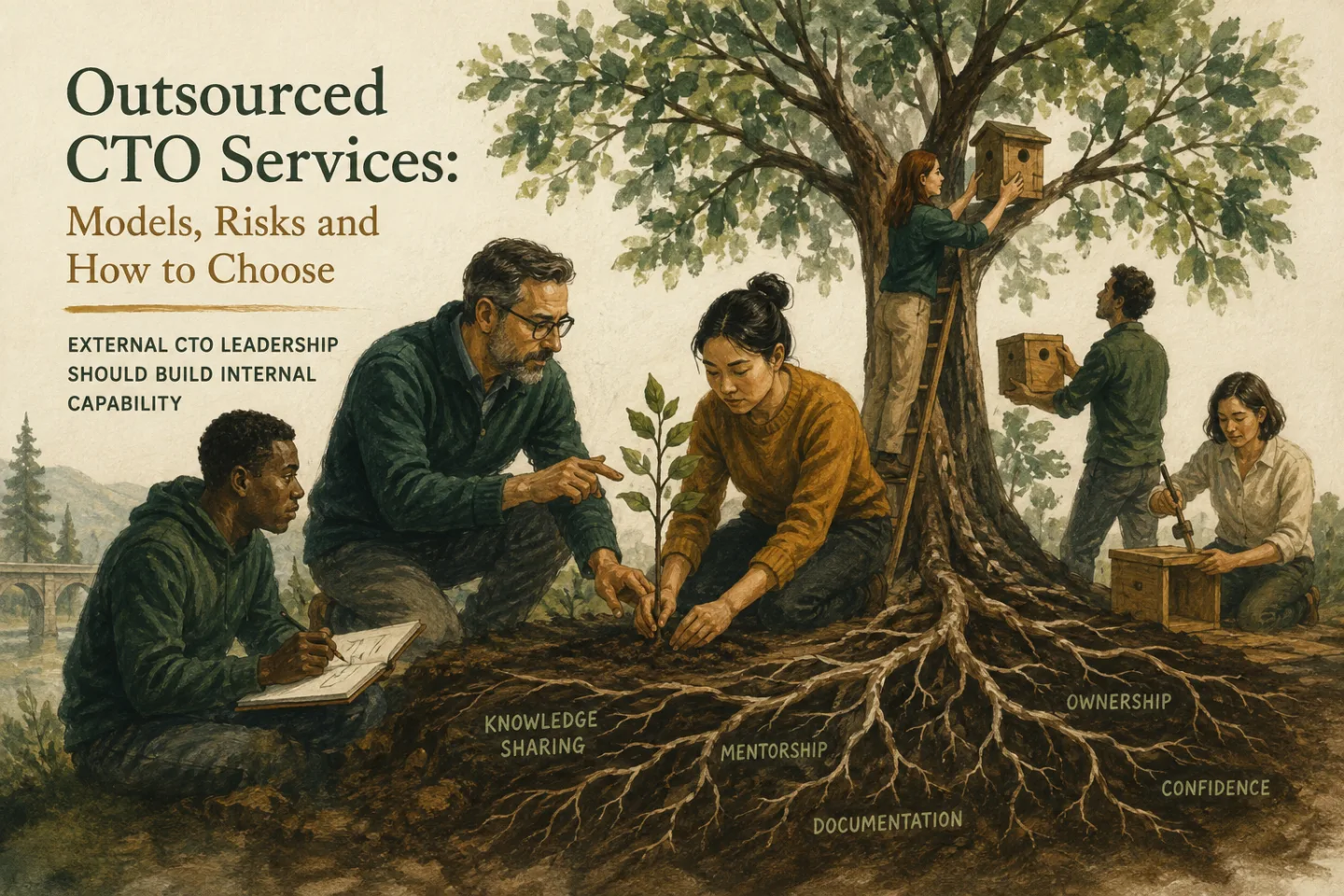
The durable principle is simple: external leadership should leave stronger internal decisions and capability, not a permanent external bottleneck.
- Outsourced, fractional, virtual, and interim
- Four provider models
- Define the ownership boundary
- What outsourced CTO services can include
- The dependency risk
- Separate judgment from delivery
- Pricing and commercial models
- How to vet an outsourced CTO
- Design the handover at the start
- Who is responsible when the CTO and developers are different suppliers?
- Protect independence when a provider also sells implementation
- Keep the company's technical assets under company control
- Test the working cadence against a real week
- Measure the service through decisions and business constraints
- Plan an exit while the relationship is healthy
- A practical example of governing an external development agency
- When outsourced CTO services fit
- Practical next step
Outsourced, fractional, virtual, and interim
These terms overlap but are not identical.
Outsourced CTO means the leadership is purchased from outside the company.
Fractional CTO means the executive works a defined part of the time and owns a bounded recurring mandate.
Virtual CTO usually emphasizes remote delivery. It does not explain authority or capacity.
Interim CTO means the executive temporarily holds most of a permanent seat through a transition.
An outsourced CTO can therefore be virtual and fractional, or outsourced and interim. Clarify each dimension instead of choosing a label.
Four provider models
Independent executive: the company contracts directly with one operator. This can make accountability clear and economics simple, but continuity and specialist coverage depend on one person.
Curated network: a platform or recruiter introduces candidates and may support matching, contracting, billing, or engagement health.
Consultancy: a firm provides leadership and access to specialists. This can support complex work but may create a broader project and blended margin.
Development agency: a technical leader governs a provider-owned delivery team. This can connect decisions to execution while increasing the need to audit build-versus-buy incentives.

No model is universally best. Choose based on the mandate, internal execution capability, confidentiality, specialist needs, and how much selection support the buyer can provide.
Define the ownership boundary
The board or CEO owns business strategy and executive accountability. The CTO should own the agreed technology decisions. Internal managers own team execution within their authority. Vendors own contractual delivery.
Problems begin when those boundaries blur.
A provider may recommend a migration and also sell the migration team. A founder may expect the outsourced CTO to manage employees without giving performance authority. An internal engineering lead may remain accountable for dates while the external CTO changes priorities.
Write down:
- decisions the CTO can make;
- decisions that need CEO or board approval;
- direct reports and management authority;
- vendor-selection and spend authority;
- responsibility for incidents and customer commitments;
- who turns decisions into delivery;
- who owns documentation and handover.
The boundary should appear in the operating cadence, not only the contract.
What outsourced CTO services can include
Common mandates include:
- technology roadmap and investment sequence;
- engineering delivery recovery;
- architecture and platform scale;
- AI and data strategy;
- security and enterprise readiness;
- hiring and organization design;
- vendor and outsourced-team governance;
- diligence and board reporting;
- permanent CTO search support;
- interim leadership after a departure.
Avoid a catalogue scope. “Strategy, architecture, DevOps, AI, security, product, hiring, and hands-on development” may describe a firm’s capabilities, but one executive cannot responsibly operate every function in a light retainer.
The dependency risk
Outsourcing can reduce commitment and expand access. It can also move critical knowledge and relationships outside the company.
Dependency appears when:
- only the provider understands the architecture;
- important decisions live in private messages;
- the provider controls production credentials;
- internal managers wait for the external CTO before acting;
- the same firm defines and sells every solution;
- customer and investor relationships attach to one contractor;
- no one rehearses operating without the provider.

Mitigate this through company-owned systems and accounts, visible decision records, internal co-owners, conflict disclosure, access reviews, coaching, and a transition test.
The answer is not excessive documentation. It is distributed operating capability.
Separate judgment from delivery
Some companies need decisions. Others need people to implement them. Many need both.
Ask four questions:
- Is the bottleneck executive judgment?
- Does the work require scarce specialist expertise?
- Is delivery capacity insufficient?
- Must capability remain permanently inside the company?
If judgment is missing, hire accountable leadership. If delivery capacity is missing, fund delivery. If both are missing, define who governs the combined service and how recommendations avoid commercial bias.
A strong outsourced CTO should sometimes recommend a provider other than their own firm.
Pricing and commercial models
Pricing may be hourly, daily, monthly retainer, fixed project, interim capacity, success fee, or a margin on a team.
Compare:
- executive fee;
- platform or recruiter fee;
- delivery-team margin;
- minimum term;
- travel and expenses;
- substitution rights;
- conversion or non-solicitation terms;
- termination and handover;
- professional insurance;
- ownership of work and accounts.
The cheapest visible rate can be expensive if the engagement creates a rewrite, vendor lock-in, or an unstaffed roadmap. The most senior proposal can be poor value if the company only needs a bounded architecture review.
How to vet an outsourced CTO
Use comparable mandate evidence.
Ask the candidate to reconstruct:
- the starting condition;
- their personal decision authority;
- evidence available at the time;
- alternatives and tradeoffs;
- resistance or failure;
- the result and measurement window;
- the internal owner after transition;
- an observer who can verify the work.
For a firm, also ask:
- Who is the named executive?
- Can the firm substitute them?
- How many clients do they serve?
- Which specialists are included?
- How are conflicts managed?
- Who owns the client relationship?
- What happens if the fit fails?
Do not let a polished firm deck replace a reference on the person who will do the work.
Design the handover at the start
An outsourced engagement should have an exit condition even if the relationship may renew.
The transition can be:
- authority moves to a permanent CTO;
- an internal Head of Engineering assumes the operating system;
- an interim role reduces to advisory;
- a project closes after acceptance and rehearsal;
- the company brings a vendor-managed capability in-house.
Use four stages:
Document: record decisions, ownership, risks, relationships, and operating routines.
Coach: let the internal owner lead while the external CTO observes.
Rehearse: run important meetings, incidents, and decisions without the provider as the default authority.
Transfer: change access, representation, reporting, and contracts deliberately.
Who is responsible when the CTO and developers are different suppliers?
A two-supplier arrangement needs a written division of responsibilities. The CTO may set architecture direction and assess delivery evidence, while an agency estimates and implements the work. The founder or product owner may retain control over priorities and budget. If these boundaries are not agreed, each supplier can reasonably believe the other owns an important decision.

Define how estimates become commitments. The CTO should be able to challenge assumptions and explain risks, but should not casually promise dates on behalf of a team they do not manage. The delivery supplier should make dependencies and uncertainties visible. The commercial sponsor should decide which tradeoffs are acceptable when cost, scope, and timing cannot all remain fixed.
Define acceptance separately from task completion. A supplier may finish a ticket while the business outcome remains unproven. For an integration, acceptance might include representative data, failure handling, operational ownership, and an agreed reconciliation procedure. For a migration, it might include a recovery rehearsal and evidence that business processes still work. The CTO helps establish these criteria; the person who accepts the deliverable must be named.
Finally, agree how disagreements are resolved. A technical dispute should identify the options, evidence, consequences, decision owner, and deadline. It should not become a competition between the executive's seniority and the supplier's commercial relationship. Record the decision in a place the company controls, including the reason for accepting any remaining risk.
Protect independence when a provider also sells implementation
A provider that supplies both advice and delivery can reduce coordination effort. It also has a commercial interest in the amount and type of implementation work recommended. That does not make its advice untrustworthy. It means the conflict should be visible and managed rather than ignored.

Ask whether the assessment can recommend keeping the existing system, reducing scope, or using another supplier. Ask whether there are referral payments, platform partnerships, or subcontracting relationships that could affect recommendations. For a major rebuild or migration, request alternatives with enough detail to compare the business consequences rather than receiving one preferred solution and two implausible options.
A staged agreement can help. Buy a bounded discovery phase with a written assessment and a decision meeting. Make any implementation phase a separate commitment. The company should retain the assessment and be able to obtain another opinion without losing access to the evidence. Avoid an arrangement in which the only usable output is a proposal to buy more services from the same provider.
For consequential decisions, consider an independent technical review of the recommendation. Keep its scope narrow: assess the assumptions, alternatives, migration risk, or cost model that matter to the decision. A second reviewer does not need to repeat the entire assessment or compete for the implementation work. Independence is most useful when it answers a specific unresolved question.
Keep the company's technical assets under company control
Before work begins, inventory the systems and accounts that support the product. Source repositories, cloud accounts, domains, deployment pipelines, package registries, app-store accounts, documentation, monitoring, and payment integrations may be controlled by different people. An outsourced leadership engagement is a good opportunity to make that ownership explicit.
The company should understand who can grant access, approve expenditure, change production, and recover an account. Use individual identities and permissions appropriate to the work rather than one shared administrator login. The goal is not to give the new executive every privilege immediately; it is to provide the access necessary for the mandate while preserving traceability and continuity.
Ask how new code, infrastructure definitions, architectural decisions, and operating procedures will be stored. If essential material exists only in a provider's private workspace, the company may struggle to change suppliers even when it technically owns the deliverable. Agree the handover format before the first project produces documents and repositories.
Intellectual-property and confidentiality terms require attention appropriate to the contract and jurisdiction. Operationally, the important question is whether the company can continue maintaining the product after the relationship ends. Have the relevant advisers review the legal terms while the technical team checks that the practical assets, access, and documentation match the intended arrangement.
Test the working cadence against a real week
Imagine a normal week in the proposed engagement. Product changes a priority, an engineer needs an architecture decision, a supplier raises a scope question, and the founder receives a customer security questionnaire. Which of these reaches the CTO, through which channel, and by when? If the answers depend on everyone attending one weekly meeting, the model may create avoidable waiting.
Ask the provider to reserve time for preparation and written decisions as well as meetings. A schedule filled entirely with calls leaves little room to examine evidence. Conversely, an executive who works only asynchronously may struggle where trust, disagreement, or organisational change requires conversation. The cadence should fit the assignment and the team's working hours.
For distributed teams, name the overlap windows needed for consequential decisions. Specify what can wait until the next scheduled session and what requires escalation to an internal owner. An outsourced CTO is not automatically a round-the-clock incident response service. If continuous coverage is required, arrange it explicitly with the people who will operate that service.
Review the cadence after the first month. Remove meetings that no longer change decisions and add documentation where the same question keeps returning. A good arrangement becomes easier to operate as shared context improves. If coordination costs keep rising, examine whether the mandate, capacity, or organisational structure needs to change.
Measure the service through decisions and business constraints
Choose a small set of evidence that connects the engagement to its purpose. A delivery-recovery assignment might track whether the team has a usable baseline, whether work is being started faster than it can finish, and whether commitments include known dependencies. An enterprise-readiness assignment might track unresolved technical questions, ownership of customer commitments, and the evidence available to support them.
Do not attribute every improvement to the external executive. Team changes, reduced scope, seasonality, product decisions, and infrastructure investment may also affect results. Record what changed and when, and ask the internal team whether the new operating model helped them act. Honest attribution is more useful than a dramatic percentage that cannot be explained.
The executive should also make uncertainty visible. A risk register is more useful when it distinguishes verified issues, plausible concerns, and questions awaiting evidence. A recommendation should state what would change it. That allows the company to update its decision when new information arrives instead of treating an early assessment as permanent truth.
Use the hiring scorecard to define evidence expectations before procurement and the pricing guide to compare the capacity and exclusions behind different fees. The same evidence can then support the first review of the engagement.
Plan an exit while the relationship is healthy
An outsourced CTO service should have a practical exit condition. The company may recruit a permanent CTO, promote an internal leader, finish a defined transformation, or reduce the assignment to occasional advice. Agree what a successful transition would look like while both parties are still aligned.

The handover should cover current decisions, unresolved risks, key relationships, architecture context, supplier commitments, access ownership, and the next operating cycle. A folder containing reports is not a complete handover if nobody understands which recommendations were accepted or which deadlines remain active. Include a discussion with the person who will inherit responsibility.
Rehearse continuity for an unexpected absence. Ask whether another authorised person can locate the deployment process, contact the critical supplier, understand a recent architecture decision, and escalate an incident. This is a test of organisational resilience, not a sign of mistrust. It also reveals where the engagement has accidentally concentrated too much context in one person.
When the service ends, use a coordinated access review rather than indiscriminately deleting accounts. Transfer ownership where necessary, confirm the company can recover its assets, and revoke permissions no longer required. Keep commercially and legally required records through the appropriate process. The strongest result is a company that can continue making sound technical decisions after the outsourced executive leaves.
A practical example of governing an external development agency
Imagine a founder whose agency proposes replacing an existing application because feature delivery has slowed. The founder hires an outsourced CTO to assess the recommendation while the agency continues maintaining the product. This is an illustrative buying scenario, not a report of a customer engagement.
The CTO should begin by identifying the claimed constraint. Is delivery slow because the application is difficult to change, because requirements keep moving, because the team is understaffed, or because release approval takes too long? These causes can coexist. A rewrite addresses only some of them and may temporarily make delivery harder by creating two systems to maintain.
The assessment should examine a representative sample of recent changes. Trace where time was spent, what failed, and which dependencies repeatedly blocked progress. Ask the agency to demonstrate the architectural limitation behind its recommendation. Ask internal product staff which decisions changed during the same period. This gives both parties a chance to explain the problem using evidence.
The CTO then presents credible alternatives: continue with targeted improvements, replace a bounded component, change the delivery process, or undertake a larger replacement. Each option should explain implementation capacity, business disruption, operating cost, and the evidence that would support proceeding. The founder owns the investment choice; the CTO owns the technical recommendation within the agreed mandate.
If a replacement is selected, the CTO and agency agree acceptance criteria before detailed implementation. Those criteria should include data continuity, critical customer journeys, operational support, and the point at which the old system can be retired. The agency estimates and delivers its work. The CTO challenges assumptions and reviews evidence without making unsupported commitments on the agency's behalf.
At the next review, the founder can ask concrete questions: Which uncertainty has been reduced? Which assumption changed? Is the selected option still the best use of the budget? What decision is needed now? This is a more useful governance arrangement than paying an external executive merely to attend the agency's status meeting.
When outsourced CTO services fit
The model is strong when a company needs senior judgment quickly, the mandate is bounded, a permanent hire is premature or in progress, and internal leaders will participate in execution and transfer.
It is weak when the company is trying to avoid a necessary full-time leader indefinitely, expects unlimited availability from a small retainer, withholds decision authority, or wants one provider to validate and sell a large program without independent challenge.
Buy the external capacity you need. Keep the evidence, accounts, decisions, and future capability inside the company.
If the underlying difficulty is offshore-team quality or knowledge concentrated in a few people, define those problems directly in the engagement brief. Changing the supplier arrangement alone does not establish better delivery or continuity.
Practical next step
Compare proposals using the technology vendor evaluation worksheet. Define the criteria before scoring providers, keep unknown evidence separate from a positive score, and compare equivalent scope, internal effort and ongoing costs.
Frequently asked questions
What is an outsourced CTO?
An outsourced CTO is an external provider of CTO-level judgment or leadership. The provider may be an independent executive, network, consultancy, or agency, and may offer advisory, fractional, interim, or combined delivery services.
What is the difference between outsourced and fractional CTO services?
Outsourced describes the external commercial relationship; fractional describes part-time operating capacity. A fractional CTO is often outsourced, while an outsourced CTO can also be advisory, interim, or agency-led.
Can an outsourced CTO manage developers?
Yes, when people authority, cadence, availability, employer responsibilities, and escalation paths are explicit. The agreement should distinguish management from vendor governance and individual technical delivery.
What is the biggest risk of outsourcing the CTO role?
A major risk is dependency: critical decisions, relationships and system knowledge stay with the provider. Its importance relative to other risks depends on the mandate. Reduce it through company-controlled evidence, internal owners, conflict disclosure and a tested handover.
Sources and further reading
Turn research into a mandate
See the cost and hiring model before you shortlist.
Use the free calculator, then save a candidate search or post a transparent role when the mandate is ready.