
Fractional CTO economics
Fractional CTO Cost in 2026: Rates, Retainers & Budgets
Compare fractional CTO rates, retainer scope and hidden costs. Use a worked budget, quote checklist and exit criteria to choose the right leadership model.
- By
- Fractional CTO Experts
- Published
- 2026-07-30
- Reviewed
- 2026-09-09
- Reading time
- 14 minutes

The useful answer is not a single rate. A fractional CTO can be a few hours of senior advice, a recurring two-day-a-week leadership role, a full-time interim seat, or a defined transformation mandate. Those are different products. Treating them as interchangeable is the main reason pricing conversations become vague.
Published provider examples span $100–$600 per hour at Shiny and $10,000–$20,000 monthly retainers at Go Fractional. These describe broader fractional executive offerings, not a measured CTO-only market average. Those figures are not a universal tariff. They show how wide the category is. Your price should be explained by the work, access, risk, and duration.
This guide gives you a budget model that is more durable than a list of anonymous rate anecdotes.
In this guide
- The short answer: what should you budget?
- What actually determines a fractional CTO rate?
- Hourly, daily, retainer, or fixed project?
- Compare total cost, not the invoice
- Three realistic budget scenarios
- What should a proposal include?
- How to negotiate without degrading the mandate
- A worked budget: compare the same amount of responsibility
- What belongs in a quote comparison sheet?
- Costs that a monthly retainer can hide
- When the cheaper proposal becomes more expensive
- What should you expect after the first month?
- Can equity replace a fractional CTO's cash fee?
- Questions to send before accepting a fractional CTO price
- The four-question budget test
The short answer: what should you budget?
For planning—not procurement—use three bands:
| Engagement | Typical shape | Planning range |
|---|---|---|
| Advisory | A few senior hours; no operating ownership | $2,000–$6,000/month |
| Fractional mandate | Recurring access and accountable decisions | $8,000–$20,000/month |
| Interim CTO | Near-full-time leadership for a defined period | $20,000–$40,000+/month |
These are budget hypotheses, not promised market averages. Geography, reputation, specialist scarcity, company complexity, and risk can move a proposal beyond them. A credible provider should be able to explain why.

The most important distinction is ownership. An advisor reacts to questions. A fractional CTO usually owns a defined set of decisions and an operating cadence. An interim CTO temporarily holds most of the seat. A full-time CTO builds an enduring leadership function.
What actually determines a fractional CTO rate?
1. Scope: how many outcomes are being purchased?
“Own technology” is not a scope. “Stabilize delivery, produce an investment-ready architecture plan, and install an engineering operating cadence by the end of Q4” is closer.
A narrow, consequential mandate can justify a senior rate while remaining economical. A wide collection of unrelated responsibilities creates meeting load, context switching, and hidden execution work. That requires more capacity.
2. Intensity: how much executive access is real?
Count the actual operating surface:
- recurring leadership and board meetings;
- one-to-ones with engineering leaders;
- hiring and performance decisions;
- customer, investor, or diligence calls;
- incident availability;
- written analysis and preparation;
- travel and time-zone overlap.
“One day a week” can quietly become two if every stakeholder assumes unlimited asynchronous access. Good pricing makes the access model explicit.
3. Risk: what happens if the decision is wrong?
A roadmap workshop and a pre-acquisition technical diligence carry different exposure. So do a marketing-site rebuild and a regulated data platform. Capital at risk, security impact, regulatory obligations, team size, and time pressure all affect who is qualified and what the engagement demands.

Use scope × intensity × risk as the basic pricing conversation. Seniority is then evidence that the executive can handle that combination—not a reason to charge more without context.
Hourly, daily, retainer, or fixed project?
Each model can work when it matches the product.
Hourly pricing is useful for office hours, expert review, and uncertain discovery. It becomes awkward when the company wants proactive leadership but watches every six-minute block.
Daily pricing makes capacity visible. It suits workshops, diligence, on-site work, and interim cover. It still needs rules for preparation and asynchronous support.
A monthly retainer is usually the cleanest model for a recurring fractional mandate. It buys a defined cadence and set of outcomes, not just a bucket of time. The agreement should still state the expected capacity.
Fixed-project pricing fits a bounded result: a diligence memo, architecture assessment, incident-readiness plan, or hiring scorecard. It fails when dependencies and decision authority remain undefined.
Avoid percentage-of-technology-budget compensation. It creates a reason to recommend more spend. Avoid success fees tied to fundraising unless legal, ethical, and causal questions have been reviewed carefully.
Compare total cost, not the invoice
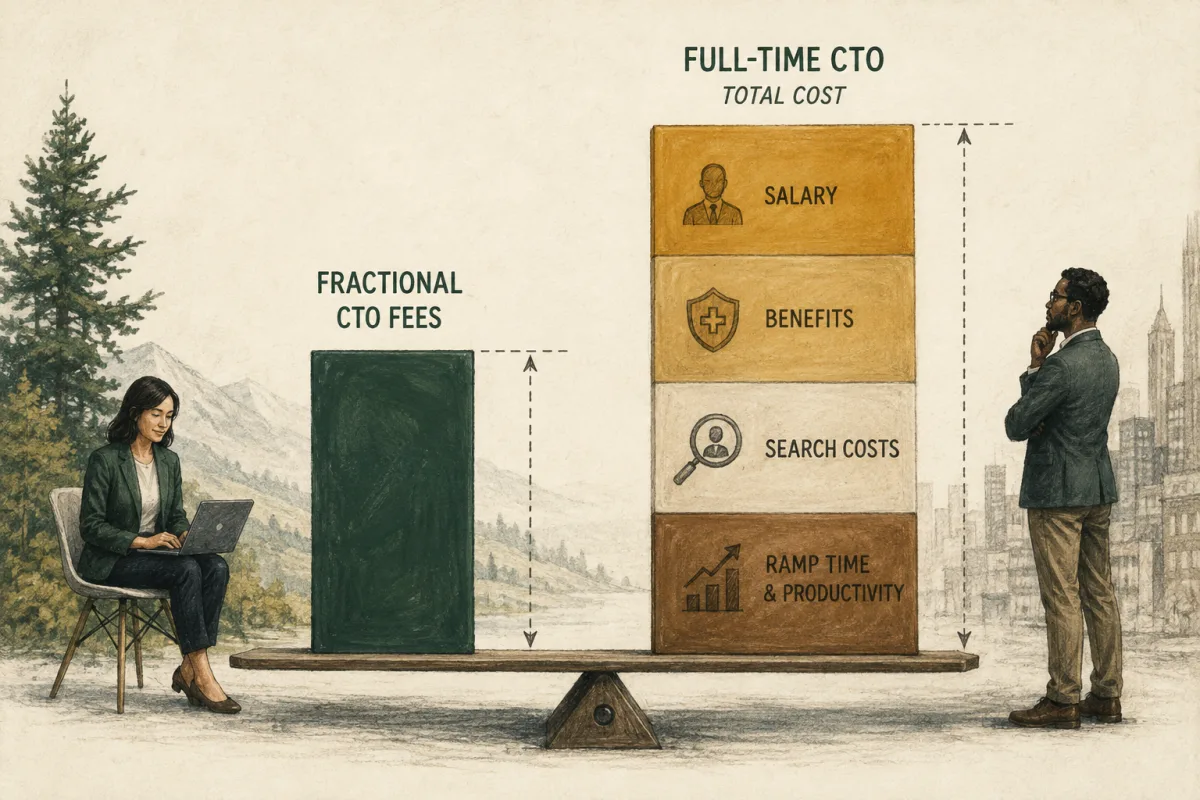
The U.S. Bureau of Labor Statistics reported a May 2025 mean annual wage of $269,630 for chief executives and $192,160 for computer and information systems managers. Neither category maps perfectly to CTOs, but both are useful reminders: salary is only the visible part of permanent executive cost.
A full-time decision can also include:
- employer taxes and benefits;
- equity or long-term incentives;
- retained-search or recruiting fees;
- interview time from founders and the board;
- notice periods and severance exposure;
- onboarding and ramp time;
- the cost of a mis-hire.
Illustrative cost components, not a statistical comparison.
Fractional leadership has its own hidden costs. The company needs an empowered internal owner, disciplined information flow, and enough team capacity to execute. If the organization cannot act between CTO sessions, an expensive executive can become an expensive commentator.
Three realistic budget scenarios
Scenario A: reset a struggling engineering function
A 50-person software company has missed three release commitments. The VP of Engineering left. The CEO needs delivery visibility, a team assessment, an architecture risk view, and a permanent-leader hiring plan.
This may begin as a high-intensity fractional or interim mandate. Capacity is heavier in the first month, then reduces after governance and internal leadership stabilize. A flat low retainer is unlikely to cover the diagnostic and people work honestly.
Scenario B: scale after funding
A Series A company has a capable engineering manager but no executive technology voice. It needs a 12-month platform plan, hiring sequence, security roadmap, and board reporting without hiring a permanent CTO prematurely.
This is a classic fractional mandate: recurring decisions, deliberately bounded capacity, and a planned transition as the internal organization matures.
Scenario C: cover a leadership gap
A permanent CTO resigns before a major customer launch. The company needs full-time continuity while a search runs.
That is interim leadership, not a light fractional retainer. Pricing should reflect concentrated availability and the opportunity cost of declining other work.
What should a proposal include?
A useful proposal lets a board member understand the purchase without decoding consulting language.
Require:
- The 90-day outcome. What will be observably different?
- Decision rights. What can the CTO decide, recommend, veto, or escalate?
- Included capacity. Days, hours, meeting cadence, response expectations, and travel.
- Named work products. Only where artifacts matter; do not confuse documents with outcomes.
- Dependencies. Data, internal owners, budget, access, and team participation.
- Success measures. Leading indicators and end-state evidence.
- Commercial boundaries. Fees, expenses, tax, payment timing, and out-of-scope work.
- Exit and transition. Termination notice, handover, and the point at which the model should change.
If the provider cannot state what would make the engagement end, be cautious. Fractional leadership should not manufacture permanent dependency.
How to negotiate without degrading the mandate
Do not begin by asking an executive to cut their rate while preserving every expectation. Change the product:
- reduce meeting load;
- narrow the outcome;
- assign a stronger internal operator;
- extend the timeline;
- separate advisory work from execution;
- convert an urgent phase into a lower-intensity steady state;
- remove deliverables that do not change a decision.
This is better than buying insufficient access and then blaming the model.
A worked budget: compare the same amount of responsibility
Consider a hypothetical software company with eight engineers, a founder acting as product owner, and an engineering lead who can run daily delivery. It needs a quarterly technology plan, help hiring one senior engineer, and clearer decisions about reliability. It does not need an external executive to supervise every ticket. These are illustrative assumptions, not a client case study or a quoted market rate.
The founder receives two proposals. Proposal A costs $8,000 per month for 32 reserved hours. Proposal B costs $11,000 for 48 reserved hours. Dividing the fee by reserved capacity produces $250 and approximately $229 per hour respectively. That does not make B better: the company might have no productive use for the extra time, or B might require the founder to prepare every decision. Capacity is only one comparison column.
Ask each provider to allocate the month. For example, A might reserve eight hours for leadership meetings, eight for architecture and delivery reviews, six for hiring, six for preparation and written decisions, and four for unexpected issues. That allocation totals 32 hours. A proposal that promises 32 hours but lists 40 hours of recurring obligations has a scope problem before the engagement begins.
Next, calculate the commitment over the period you actually intend to buy. Three months of A costs $24,000 before separately priced travel, taxes, or implementation. If a one-time discovery phase costs an assumed $3,000, the initial commitment becomes $27,000. Record the discovery fee separately so it does not disappear inside a monthly comparison. The executive's fee also does not replace the engineers' payroll or a development agency's delivery charges.
Finally, ask what could change the price. A departure, acquisition, serious incident, or additional product team may justify a new scope. A routine architecture discussion should not unexpectedly become an extra project when architecture ownership was the reason for the retainer. A useful agreement distinguishes ordinary variation from a material change in responsibility.
How to calculate a realistic effective rate
For a capacity-based proposal, divide the recurring fee by the explicitly reserved hours. For a day-based proposal, ask how a day is defined and whether preparation, travel, and asynchronous work consume it. Do not assume that a day means eight uninterrupted hours of work inside your company. Compare like units and retain the original assumptions beside the calculation.
For an outcome-based proposal, avoid inventing an hourly equivalent unless the provider gives a credible effort assumption. Instead compare acceptance criteria, decision authority, access, implementation responsibilities, and the cost of change. A fixed-fee assessment can be good value even if an experienced reviewer completes it quickly. Conversely, a lengthy report has little value if nobody can act on its recommendations.
What belongs in a quote comparison sheet?
A founder should be able to compare proposals without reverse-engineering sales language. Use one row per provider and request explicit answers in these columns:
| Comparison field | What to record | Why it changes the decision |
|---|---|---|
| Initial commitment | Discovery fee, recurring fee, minimum term | Establishes the cash obligation before exit is possible |
| Reserved capacity | Hours or days, preparation included or excluded | Reveals whether the promised work fits |
| Decision ownership | Architecture, hiring, budget, delivery, security | Separates accountable leadership from advice |
| Response expectations | Working hours, escalation channel, absence cover | Shows how the arrangement works between scheduled sessions |
| Delivery resources | Your staff, provider staff, separate agency | Prevents implementation costs being mistaken for executive fees |
| Handover | Decision log, roadmap, access inventory, successor briefing | Makes the company less dependent on one external person |
Do not reduce the comparison to a weighted score that gives a cheap but unsuitable candidate an automatic win. Set a few non-negotiable requirements first. For example, if the company needs a leader who has managed enterprise integration programmes, a lower-priced candidate without that experience should not compensate by collecting points for availability and presentation quality.
Document uncertainty as well. “Available two days a week, subject to another client's funding round” is different from two contractually reserved days. “Has worked in healthcare” is different from having owned technology decisions for a product with comparable data flows and operational consequences. Follow these claims with specific examples and references rather than treating them as interchangeable badges.
Costs that a monthly retainer can hide
The largest additional cost may be internal participation. Engineers, product leaders, finance staff, and the founder must explain constraints, provide access, and make decisions. A fractional CTO cannot reconstruct years of context without help. Budget time for onboarding and agree which existing meetings can be removed so the new operating cadence does not simply add more overhead.
Implementation is another frequent misunderstanding. A CTO can decide that backup restoration needs testing, but an engineer still has to run the exercise, document the result, and repair failures. A roadmap can recommend replacing an integration, but that recommendation is not a funded implementation team. Every major recommendation should identify its delivery owner, estimated effort, dependencies, and proposed funding source.
Specialist work may sit outside the engagement. Penetration testing, tax advice, employment advice, independent certification, and regulated assessments are not automatically covered by a technology leadership retainer. Ask where the executive coordinates specialists and where they personally deliver work. The distinction protects the budget and avoids assigning responsibilities to someone without the relevant competence or authority.
Travel, currency, taxes, software subscriptions, recruitment charges, and marketplace fees can also affect the final amount. Obtain the commercial terms that apply to your actual location and agreement. Compare provider fees and executive compensation separately. A marketplace introduction charge buys a different service from the leader's ongoing operating work.
When the cheaper proposal becomes more expensive
Suppose a low-fee advisor can attend a monthly meeting but cannot make decisions between meetings. That may be entirely appropriate for a capable internal CTO seeking a sounding board. It is a poor substitute when a founder is waiting daily for architecture, vendor, and hiring decisions. The visible fee is lower, but unresolved decisions continue to delay the business.

The opposite error is buying a prestigious executive when the work requires a hands-on engineering manager or specialist developer. If the bottleneck is code review, daily coaching, or a specific migration implementation, a broad CTO mandate may add distance between the problem and the person doing the work. Compare the engineering management model and cloud migration specialist scope before buying the more senior title.
Use a simple decision-cost test: which decision is currently blocked, who can unblock it, and what evidence will show that it is resolved? If neither provider can give a specific answer, another pricing negotiation is unlikely to solve the underlying problem. Clarify the mandate first, then ask both providers to price the same assignment.
What should you expect after the first month?
The first month should leave the business with a clearer view of its technology constraints and an agreed way of making decisions. Depending on the mandate, useful outputs might include a concise architecture map, a ranked risk register, a delivery baseline, a hiring scorecard, and a written set of immediate priorities. Those are examples to negotiate, not a universal list every executive must produce.
Review the outputs with the people who will use them. Can the engineering lead explain the next technical decision without the consultant in the room? Can the founder distinguish urgent operational risk from optional architectural improvement? Does the roadmap identify what has been deferred and why? The answers are better evidence of value than the number of meetings held or pages written.
At the end of the initial period, decide explicitly whether to continue, narrow, expand, or end the arrangement. Do not let a temporary leadership gap become an indefinite subscription through inertia. If the company now needs daily executive availability, assess a full-time or interim CTO engagement. If an internal leader can take over, use the remaining time to transfer context and authority.
Can equity replace a fractional CTO's cash fee?
Equity changes the economics; it does not remove the cost. A founder considering an equity component should separate payment for present services from long-term participation in the company's outcome. Both parties need a clear understanding of the instrument, vesting, termination, decision rights, and what happens when the workload changes. Obtain advice appropriate to the company's jurisdiction and circumstances before signing.
Avoid treating an internet percentage as a standard allocation. A few hours of advice, a recurring leadership mandate, and a genuine technical cofounder role involve different commitments and risks. Someone receiving an equity award does not automatically become responsible for everything a full-time founder would do. The scope must still be written down.
For initial comparison, ask for a cash-only proposal alongside any cash-and-equity alternative. That makes the tradeoff visible without pretending that a private company's future value is certain. If the provider cannot explain how the proposed equity changes the cash price and responsibilities, the agreement is not ready to evaluate.
Questions to send before accepting a fractional CTO price
Send the same short brief to every shortlisted provider. Explain the business stage, current team, immediate decision, expected engagement period, and budget constraints. Ask for the recurring fee, onboarding fee, reserved capacity, minimum term, exclusions, and named outputs. Include a request for one comparable example that can be discussed without exposing another client's confidential information.
Then ask three practical follow-ups: who covers an urgent issue when the executive is unavailable; who owns implementation of their recommendations; and what information will remain with the company when the engagement ends? These questions reveal whether the quoted service can actually operate inside your business.
Use the CTO cost calculator to organise assumptions, then follow the hiring guide to assess the person behind the proposal. The purpose of a budget is to make a sound leadership decision, not to find the smallest number beside the CTO title.
The four-question budget test
Before approving a proposal, ask:
- Is the outcome specific enough to score?
- Are the executive's decisions real?
- Is the purchased capacity enough for those decisions?
- Is the transition or exit condition defined?

Four “yes” answers do not guarantee a successful engagement. They do tell you whether the price describes an intelligible product.
The cheapest proposal is not necessarily economical. The most expensive executive is not necessarily qualified. The defensible choice is the smallest leadership model that can responsibly own the outcome.
Frequently asked questions
How much does a fractional CTO cost per month?
There is no single monthly rate. Published provider examples vary in role, reserved capacity and included services, and do not establish a CTO-only market average. Request a proposal that prices your decisions, time commitment, risk and duration, including separate implementation costs.
Is a fractional CTO cheaper than a full-time CTO?
Usually in total cash commitment when the company needs part-time, time-bound leadership. It can be poor value if the mandate actually requires continuous executive capacity, large-team management, or a permanent leadership seat.
Should a fractional CTO charge hourly or by retainer?
Hourly pricing fits bounded advisory access. A monthly retainer is usually clearer when the executive owns decisions, attends a regular operating cadence, and is accountable for an outcome.
What should be included in a fractional CTO retainer?
The agreement should define outcomes, decisions, access, expected days or hours, meeting cadence, deliverables, conflicts, expenses, termination, intellectual property, security obligations, and the transition or exit condition.
Sources and further reading
Turn research into a mandate
See the cost and hiring model before you shortlist.
Use the free calculator, then save a candidate search or post a transparent role when the mandate is ready.