
Technology leadership models
Part-Time CTO: Scope, Cost and Fractional Comparison
Design a part-time CTO role with realistic capacity, decision queues, response expectations, an internal counterpart, and a clear hiring and transition brief.
- By
- Fractional CTO Experts
- Published
- 2026-07-30
- Reviewed
- 2026-09-08
- Reading time
- 12 minutes

A part-time CTO provides technology executive leadership on less than a full-time schedule. That definition describes capacity, not the commercial or operating model. The person may be an employee, independent fractional executive, interim leader reducing over time, or advisor with a CTO label.
The safest buying decision ignores the label initially. Define the business result, decisions, authority, access, and continuity required. Then select the model that can carry them.
- Understand the overlapping terms
- When part-time capacity fits
- Design a consequential weekly cadence
- State capacity limits
- Scope the operating agreement
- Compare economics correctly
- Select for leverage and boundaries
- Make the role work for executives
- Know when to change the model
- A worked capacity example: two days is not sixteen meeting hours
- Build a decision queue that does not stop the team
- Design response expectations around business consequences
- Choose the right internal counterpart
- Write an honest part-time CTO job brief
- Review the transition before the arrangement becomes permanent by default
- Frequently asked questions about part-time CTO work
- Run a capacity audit before renewal
Understand the overlapping terms
Part-time CTO describes schedule. It does not say whether the executive is employed, independent, accountable for execution, or serving other clients.
Fractional CTO usually describes an external executive owning a bounded recurring mandate at part-time capacity.
Virtual CTO emphasizes remote delivery. It may be advisory or fractional; “virtual” does not define authority.
Interim CTO temporarily carries most of a permanent seat, normally at concentrated capacity.
CTO advisor challenges and recommends while internal leaders retain decisions and follow-through.

Ask: Who owns the decision after the meeting? How much access is guaranteed? Who manages daily execution? What ends the arrangement?
When part-time capacity fits
It can work when:
- connected technology decisions need an executive owner;
- a capable internal engineering leader runs daily delivery;
- the company does not have continuous CTO-level workload;
- the mandate has explicit outcomes and boundaries;
- board, customer, and incident access can be designed;
- the company can act between CTO sessions;
- transition is expected as the team or stage changes.
Examples include post-funding platform and organization planning, enterprise readiness, a security and reliability roadmap, product-delivery recovery, leadership hiring, technical diligence, and preparing for a permanent CTO.
Design a consequential weekly cadence
Limited time should concentrate decisions rather than compress a full-time calendar.
A weekly system can include:
- an internal brief with evidence, decisions, and risks;
- a leadership session for high-consequence choices;
- one-to-ones with accountable technology leaders;
- selected product, customer, board, or hiring work;
- a written decision and owner log;
- asynchronous follow-through within agreed boundaries.

Cancel meetings that do not require the executive. Delegate implementation choices. Ensure the team can escalate urgent decisions without waiting for the next scheduled day.
The CTO should not be a remote approval queue. If work stops between sessions, internal authority is inadequate.
State capacity limits
Part-time models become dangerous when expectations remain full time:
- 24/7 incident command;
- direct management of many leaders;
- frequent customer and investor calls;
- multiple transformation programs;
- extensive travel;
- daily hiring and performance decisions;
- hands-on coding;
- unbounded Slack access;
- ownership of product, engineering, security, data, and operations at once.
Estimate meeting load, preparation, async work, incidents, and stakeholder count. “One day a week” can quietly become two. Review actual capacity monthly and change the product explicitly.
Scope the operating agreement
Write:
- 90-day result;
- included and excluded decisions;
- sponsor and internal operator;
- expected schedule and overlap;
- meetings and communication;
- response and incident rules;
- direct-report authority;
- work products;
- measures;
- fees, expenses, overage, and change control;
- conflicts and other work;
- termination and handover.
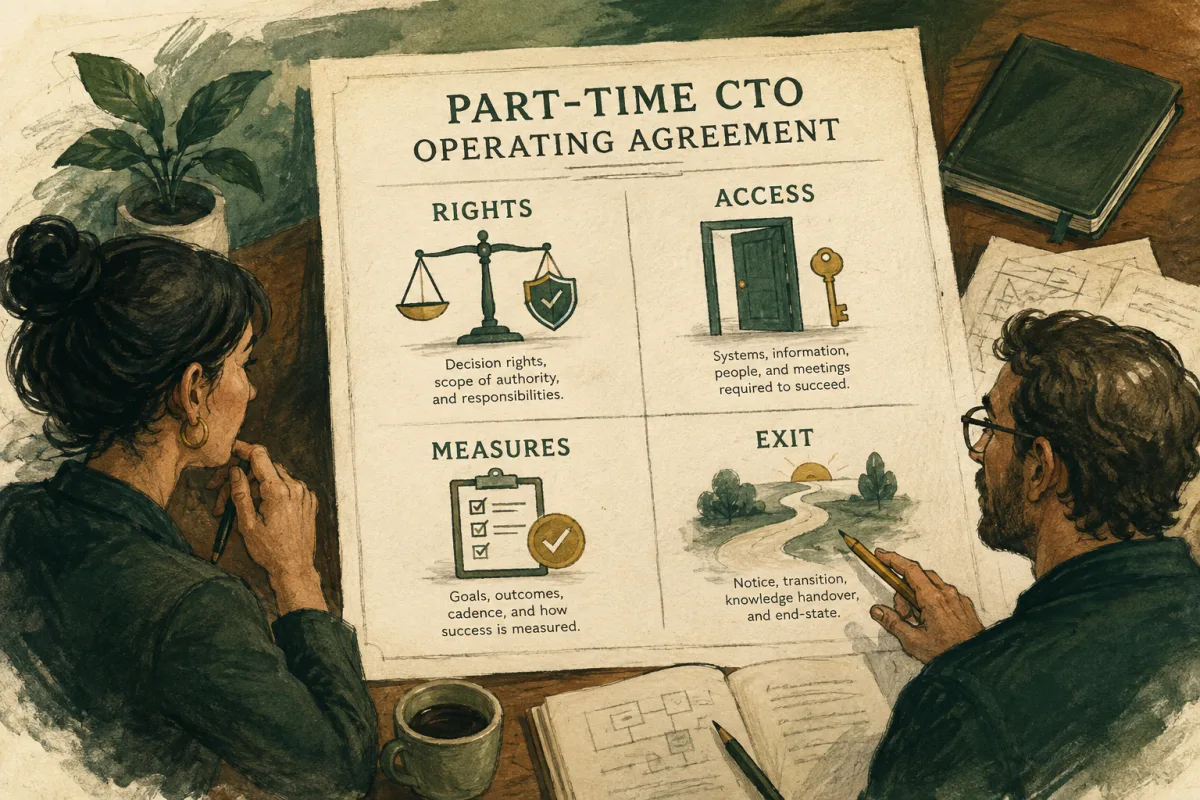
If the person is a contractor, the real relationship still matters for legal and tax classification. Obtain qualified local advice. A “part-time” label does not solve employment status.
Compare economics correctly
Hourly cost may appear high relative to salary. Compare the actual products:
- permanent cash compensation, benefits, equity, recruitment, ramp, and exit;
- part-time retainer, specialist support, internal execution, and transition;
- cost of vacant or unowned decisions;
- opportunity cost of insufficient capacity.
The part-time model is economical only when the workload can be bounded. If the company needs full-time executive presence, a discounted schedule transfers cost into delay and unmanaged risk.
Select for leverage and boundaries
Ask candidates:
- Which decisions did you own in a comparable part-time mandate?
- How did the internal team operate on your non-working days?
- Which expectation did you refuse or re-scope?
- How did you handle an incident outside the normal cadence?
- When did you recommend a full-time hire?
- How did you avoid creating dependency?
- How many other mandates will you hold?
- What would references say about availability?
Look for concise communication, delegation, preparation, and honest capacity. A prestigious résumé does not prove someone can create leverage in limited time.
Make the role work for executives
Executives should:
- sell less capacity than the calendar contains;
- separate client systems and confidential information;
- publish realistic availability;
- identify conflicts early;
- price non-billable preparation and portfolio risk;
- maintain a decision log and outcome baseline;
- avoid combining a CTO retainer with hidden delivery-team sales;
- recommend a different model when the work expands.
One poorly bounded engagement can degrade service to every client.
Know when to change the model
Review if:
- executive decisions arise daily;
- the CTO has many direct reports;
- board and customer demands become continuous;
- incidents require guaranteed response;
- the company is building a long-term executive organization;
- the time horizon is indefinite;
- internal leaders cannot operate between sessions;
- purchased capacity is repeatedly exceeded.
Options include increasing fractional capacity, converting to interim cover, hiring a VP Engineering, appointing a permanent CTO, or narrowing the mandate.
Part-time can be a strong design. It becomes weak when schedule is used to avoid acknowledging the real seat. Name the outcome and operating load first; let the title follow.

A worked capacity example: two days is not sixteen meeting hours
Consider a hypothetical engagement with sixteen working hours allocated each week. This is a planning example, not a service promise, market norm, or recommendation that every CTO work the same schedule. The company needs to fit the entire leadership workload inside that allocation.
Suppose six hours go to leadership meetings and one-to-ones, four to preparation and evidence review, two to asynchronous follow-up, and four to focused decisions and written work. The total is sixteen hours. Adding a three-hour board preparation request does not create three free hours. Something must move, the capacity must increase, or the request must receive another owner.
| Weekly activity | Illustrative hours | What the allocation includes |
|---|---|---|
| Meetings and one-to-ones | 6 | Sponsor review, engineering leadership, selected stakeholders |
| Preparation and evidence | 4 | Reading briefs, examining options, reviewing relevant signals |
| Asynchronous follow-up | 2 | Bounded questions, decisions, and clarification |
| Focused executive work | 4 | Architecture tradeoffs, investment notes, or hiring decisions |
| Total | 16 | The complete assumed weekly allocation |
The point is not to turn executive work into minute-by-minute surveillance. It is to expose assumptions that otherwise remain invisible. A company may prefer fewer meetings and more decision work. Another may need intensive coaching during a transition. The agreement should reflect that choice.
Review a representative period rather than a single unusually quiet or difficult week. Note recurring overload separately from exceptional events. If every week contains an “exception,” the mandate or capacity model is probably inaccurate. Discuss the evidence before either party normalizes unpaid work or delayed decisions.
Build a decision queue that does not stop the team
The company should know which questions need the CTO and which can proceed without them. A shared decision queue is a simple way to make that boundary visible. Each item should state the decision required, owner, deadline, available evidence, options, and consequence of delay.
Sort by consequence and urgency, not by the seniority of the person sending a message. A reversible implementation choice may remain with the engineering lead. A customer commitment that changes the platform's operating model may require executive review. A deadline should reflect the business need, not an arbitrary request for an immediate answer.
Provide evidence before the scheduled review. If the CTO receives an architecture choice for the first time during a short meeting, the company may be buying an impression rather than considered judgment. A concise brief can make the discussion shorter and more useful. It should also identify what remains unknown so that missing information is not mistaken for certainty.
Record the outcome and the delegated next step. Internal owners need to know what they may do after the meeting and which change would require another review. A decision log reduces repeated debate and gives the company context when the executive is absent. It should not require CTO approval for every routine adjustment.
Design response expectations around business consequences
“Available on Slack” is not a complete response arrangement. Distinguish ordinary questions, time-sensitive decisions, and incidents. For each, identify the channel, recipient, expected handling, and fallback. The exact response commitment must be something the executive can actually support.
A routine question can wait for the agreed review window. A commercial decision with an approaching deadline may need the sponsor to prioritize it against other work. An active service incident needs an operational response process that does not depend on discovering whether the CTO happens to be online.
Clarify what a response means. Acknowledging a message, giving an initial assessment, joining a call, and resolving the underlying issue are different commitments. A promise to reply within a period should not be interpreted as a guarantee that an incident will be fixed within the same period.
Rehearse a plausible conflict before signing. For example, the CTO is in another client meeting when your team needs a consequential decision. Who can act temporarily? Which choices are already delegated? When does the sponsor become involved? A clear answer may reveal that the company needs more internal authority or a more concentrated leadership model.
Choose the right internal counterpart
Part-time leadership works through people who are present when the CTO is not. The counterpart might be an engineering manager, head of engineering, technical lead, or another accountable operator. Choose the role based on the work rather than assigning the responsibility informally to the most senior developer.
An excellent developer may lack the time, authority, or interest to coordinate delivery and manage stakeholders. If the company expects them to run the team between CTO sessions, define that responsibility and provide support. Otherwise, the fractional arrangement can conceal a management vacancy while overloading someone who was hired for a different role.
Agree a regular exchange of evidence. The internal counterpart should surface decisions, risks, and changing assumptions. The CTO should provide context, coaching, and clear decisions within scope. Both should know when an issue belongs with product, finance, security, or the sponsor instead.
Review whether the relationship increases internal capability. If the counterpart becomes more confident in appropriate decisions, the model may be working. If they wait for permission more often than before, inspect the delegation boundary and the CTO's behavior. Senior leadership should make the operating system clearer rather than make every problem more hierarchical.
Write an honest part-time CTO job brief
A job brief should help a candidate assess the actual workload. Lead with the business event and decisions, then state the capacity, internal team, authority, location requirements, and review horizon. Avoid listing every possible technology responsibility merely because the role is senior.
An illustrative brief might say: “We need part-time technology leadership to evaluate enterprise customer commitments and sequence the resulting platform work. An engineering manager runs daily delivery. The CTO will own the technology recommendation, coach the manager, and join selected customer and board discussions. Capacity, overlap, incident involvement, and investment authority will be agreed explicitly.” This is a drafting example, not an advertised vacancy.
Add the facts that a serious candidate needs: expected days or hours, compensation basis, direct reports, travel, start timing, and any material constraints. If the company has not decided an element, label it as open. A precise-looking job post with unrealistic availability can attract unsuitable applications and damage trust during the first conversation.
Use the interview question guide to test comparable operating experience. Ask specifically how the candidate handled non-working days, conflicting commitments, and the transition to another leadership model.

Review the transition before the arrangement becomes permanent by default
A part-time role can remain appropriate for a long period, but renewal should still follow the evidence. Ask whether the decision load, team structure, and stakeholder demands have changed. Distinguish more work of the same kind from a different executive seat.
If the company now needs daily people management, adding a small amount of advisory time may not solve the problem. An engineering leadership hire could be more appropriate. If company-wide technology decisions and board demands have become continuous, a permanent CTO may fit. If the need is intense but temporary, consider an interim arrangement.
Plan knowledge transfer early. The next leader needs decision context, current risks, relationships, and a functioning operating cadence. A part-time executive who helps define the permanent role and supports a clean handover can provide value through the transition even when they are not the eventual hire.
Frequently asked questions about part-time CTO work
How many hours should a part-time CTO work?
Start with the decisions, preparation, people responsibility, and response expectations. There is no universal number that fits every company. Estimate the complete workload, agree a realistic allocation, and review actual demand. A small retainer cannot responsibly carry an unbounded full-time job description.
Is a virtual CTO always part-time?
No. Virtual describes remote delivery more directly than capacity. A remote CTO could work full-time, part-time, temporarily, or in an advisory arrangement. Ask about authority, schedule, and operating responsibility rather than interpreting the term as a complete service definition.
Can the CTO also be our main developer?
Possibly, but implementation and executive work compete for the same hours. Define which role has priority and who reviews consequential technical work. If the product needs sustained building capacity, a separate delivery owner may be necessary. Do not assume executive seniority makes the person able to perform several simultaneous jobs.
Should we pay hourly or use a retainer?
The appropriate model depends on whether the company needs occasional advice, reserved recurring capacity, or a defined project. Compare scope, access, preparation, exceptions, and transition terms. The pricing guide explains why proposals with the same label can include different responsibilities.
What if our part-time CTO is repeatedly unavailable?
Compare actual behavior with the agreed arrangement and the business need. The issue may be an unmet commitment, unclear expectations, or a mandate that has outgrown the purchased capacity. Establish the evidence, protect urgent operational coverage, and agree a correction or transition. Avoid resolving the problem through an informal promise of unlimited access.
Can a founder keep the CTO title while using part-time help?
A founder can retain technology leadership while obtaining advice or delegated executive support, but the authority boundary should be clear to the team. Two people informally occupying the same decision space can create confusion. State who owns each consequential decision and how disagreements are resolved.
Run a capacity audit before renewal
For four representative weeks, record the real operating surface: scheduled sessions, preparation, written decisions, async requests, direct-report work, incidents, customer calls, travel, and time displaced from internal leaders. Compare it with the agreement.
Then classify work:
- executive decisions that require the CTO;
- decisions that should transfer to an internal leader;
- specialist or delivery work that needs another owner;
- meetings that can stop;
- genuinely new scope.
Use that evidence to renew. The company may need more CTO capacity, a VP Engineering, a permanent hire, or a narrower mandate. The executive may need to reduce other clients or decline work. This review prevents both parties from normalizing invisible overage.
For job posts, state the actual days, core hours, direct reports, incident expectations, travel, and compensation. Experienced candidates will self-select more accurately, producing a smaller but stronger applicant pool.
Frequently asked questions
Is a part-time CTO the same as a fractional CTO?
They often overlap. Part time describes schedule; fractional usually implies an external executive with a bounded recurring mandate, potentially serving multiple clients. The agreement matters more than the label.
How many days per week does a part-time CTO work?
There is no standard. Capacity may range from a few days monthly to several days weekly. Price and schedule should follow outcomes, authority, stakeholder load, risk, and response expectations.
Can a part-time CTO manage a full-time engineering team?
Yes, when daily management is delegated appropriately and the CTO has enough access for people decisions. Large or unstable teams may require more continuous leadership.
When should a part-time CTO become full time?
Review when executive decision load, direct reports, incidents, customer and board demands, travel, or long-term organization building can no longer be bounded safely.
Sources and further reading
Turn research into a mandate
See the cost and hiring model before you shortlist.
Use the free calculator, then save a candidate search or post a transparent role when the mandate is ready.