SaaS executive leadership
Fractional CTO for SaaS: Platform, Team and Stage Fit
Plan SaaS technology leadership with tenancy comparisons, isolation tests, migration checks, platform economics, and enterprise customer decision examples.
- By
- Fractional CTO Experts
- Published
- 2026-07-30
- Reviewed
- 2026-09-08
- Reading time
- 12 minutes

A SaaS CTO connects the business model to the technology system. That means more than choosing architecture. Product retention, enterprise promises, delivery speed, reliability, security, support load, gross margin, and engineering capability interact.
A fractional CTO can fit when those connected decisions need executive ownership but the organization still has a capable internal leader for daily delivery.
- Start with the SaaS operating model
- Make multi-tenancy an explicit product decision
- Build a platform roadmap from evidence
- Design the engineering organization around ownership
- Connect delivery metrics to business questions
- Common fractional CTO mandates
- Decide between CTO and VP Engineering
- Select for stage and business model
- Measure changed capability
- Compare shared, separate, and hybrid tenancy deliberately
- A worked example: an enterprise customer requests a separate environment
- Test isolation across the whole request and job lifecycle
- Plan tenant migrations as a product operation
- Contain noisy neighbors and operational blast radius
- Define the tenant lifecycle before automating it
- Questions about SaaS CTOs and multi-tenancy
- Put customer promises under change control
Start with the SaaS operating model
Clarify:
- customer segments and critical jobs;
- sales motion and contractual promises;
- retention and expansion drivers;
- implementation and support burden;
- data sensitivity and customer assurance;
- pricing units and cost drivers;
- roadmap hypotheses;
- current engineering ownership;
- the business event behind the mandate.
Architecture should serve this model. A self-serve product for small teams and a regulated enterprise platform may use similar tools while requiring different isolation, support, control, and change systems.
Make multi-tenancy an explicit product decision
Multi-tenancy is not a binary checkbox. Decisions span:
- data placement and isolation;
- compute and workload isolation;
- identity and authorization;
- configuration and customization;
- noisy-neighbor limits;
- backup, recovery, export, and deletion;
- release and migration behavior;
- observability and support access;
- cost allocation;
- regional and contractual constraints.
The strongest design is not always maximum isolation. It is the design that meets customer and risk needs with an operating burden the team can carry. Overengineered tenancy can slow learning; weak boundaries can block enterprise trust and create expensive future migration.
Build a platform roadmap from evidence
Platform roadmaps become dumping grounds when every engineering concern is labelled strategic. Use four questions:
- Which customer or operating pain is observable?
- What business risk or option does it create?
- Which approaches are plausible?
- What milestone would provide new evidence?

Separate reliability work, security obligations, developer productivity, cost improvements, product enablers, and architectural options. They have different evidence and time horizons.
Avoid an indefinite rewrite. State the specific constraint, migration path, intermediate value, compatibility strategy, and conditions that would stop the program. The CTO should make incremental improvement possible even if the target vision changes.
Design the engineering organization around ownership
Team topology should follow product domains, platform needs, coordination load, and available leadership—not fashionable ratios.
Make ownership visible for:
- customer-facing domains;
- shared platform and developer experience;
- reliability and incident response;
- security and privacy;
- data pipelines, analytics, and AI;
- technical product management;
- architecture decisions;
- support and operational feedback.
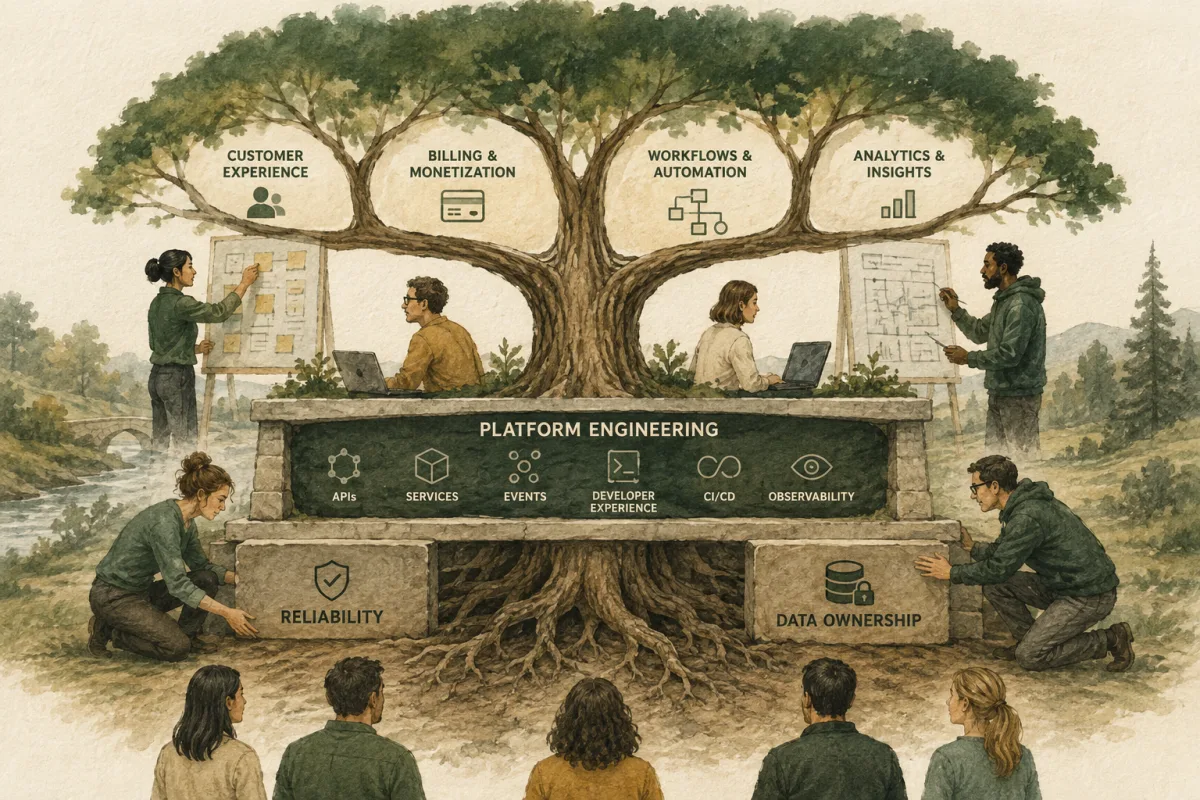
A platform team should provide a product that reduces cognitive load, not become a gatekeeper. A security function should create usable guardrails, not own every risk decision. The CTO clarifies interfaces and investment; managers make the daily system work.
Connect delivery metrics to business questions
DORA research gives useful language for software delivery performance, but metrics should prompt inquiry rather than create a league table.
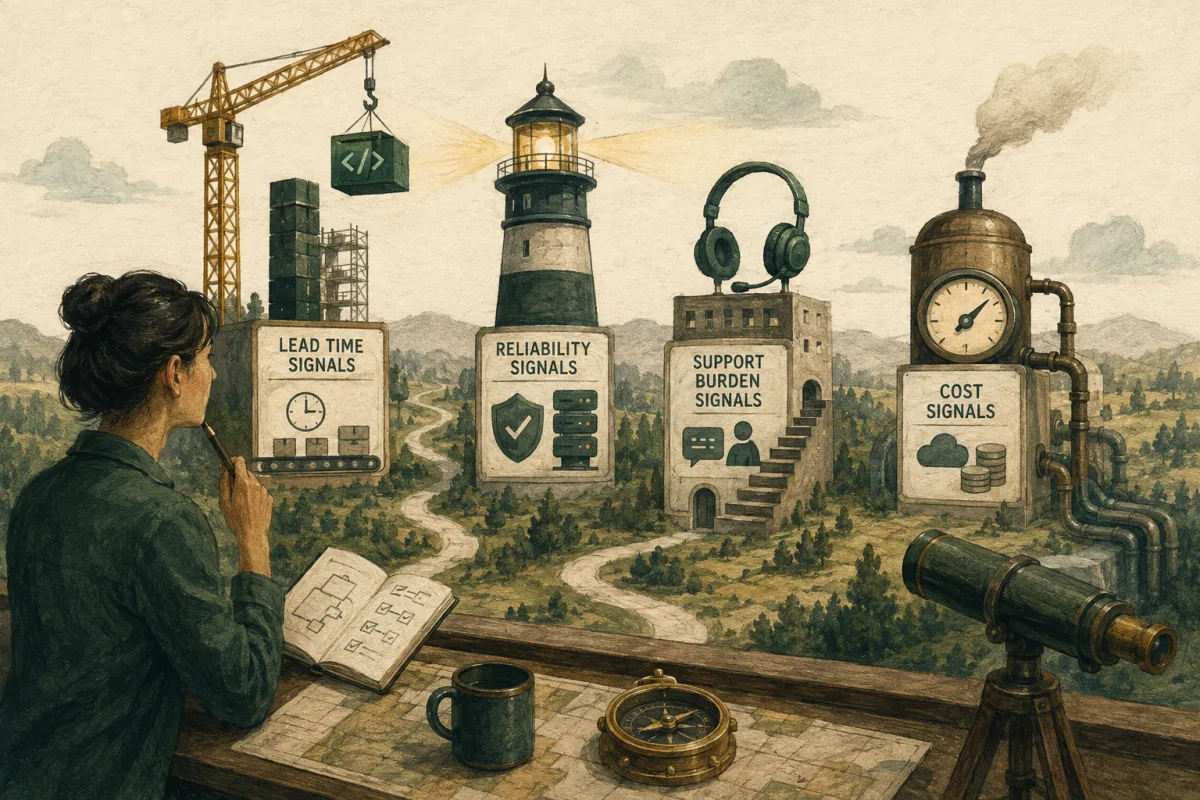
Balance:
- lead time and deployment flow;
- change failure and recovery;
- customer-impact availability and performance;
- incident recurrence;
- security and dependency exposure;
- support themes and implementation effort;
- cloud and vendor cost by useful unit;
- roadmap outcome evidence;
- team health and critical-role coverage.
If delivery speeds up while support burden and churn rise, the system is not high performing. If reliability improves through a release freeze, the result may not be sustainable. Interpret the set.
Common fractional CTO mandates
Useful mandates include:
- prepare for enterprise customers;
- scale after funding;
- recover unreliable delivery;
- assess or sequence a platform modernization;
- design the engineering organization and leadership hires;
- create security and customer-assurance capability;
- improve cloud and software economics;
- govern an AI product strategy;
- prepare for diligence or acquisition;
- bridge the gap before a permanent CTO.
Each should have a 90-day outcome, decision rights, internal owner, capacity, and transition.
Decide between CTO and VP Engineering
The boundary varies. A practical distinction:
- the CTO owns company-level technology strategy, architecture investment, risk, executive communication, and future capability;
- the VP Engineering owns the engineering organization, management system, staffing, delivery, and operational performance.
In a small company, one person may do both. As complexity grows, combining them can overload the leader. A fractional CTO supporting an internal VP or head of engineering can be a coherent bridge.

Select for stage and business model
Ask candidates to reconstruct:
- a tenancy or isolation decision;
- a platform investment they declined;
- a reliability event that changed priorities;
- an enterprise promise they narrowed;
- a team design that did not work;
- a cloud-cost decision tied to unit economics;
- a transition from founder-led technology;
- a roadmap conflict with product or sales.
Verify personal ownership, evidence, trade-offs, and references. Experience at a famous SaaS company does not prove the candidate can work within your capital, team, and sales motion.
Measure changed capability
After 90 days, expect clearer priorities, decision ownership, platform risk, customer commitments, engineering signals, security work, organization design, and investment choices. Expect internal leaders to have more—not less—authority within explicit boundaries.
The right fractional CTO helps a SaaS company avoid two expensive extremes: scaling an improvised system past its limits and building an imagined future before customers require it.
Compare shared, separate, and hybrid tenancy deliberately
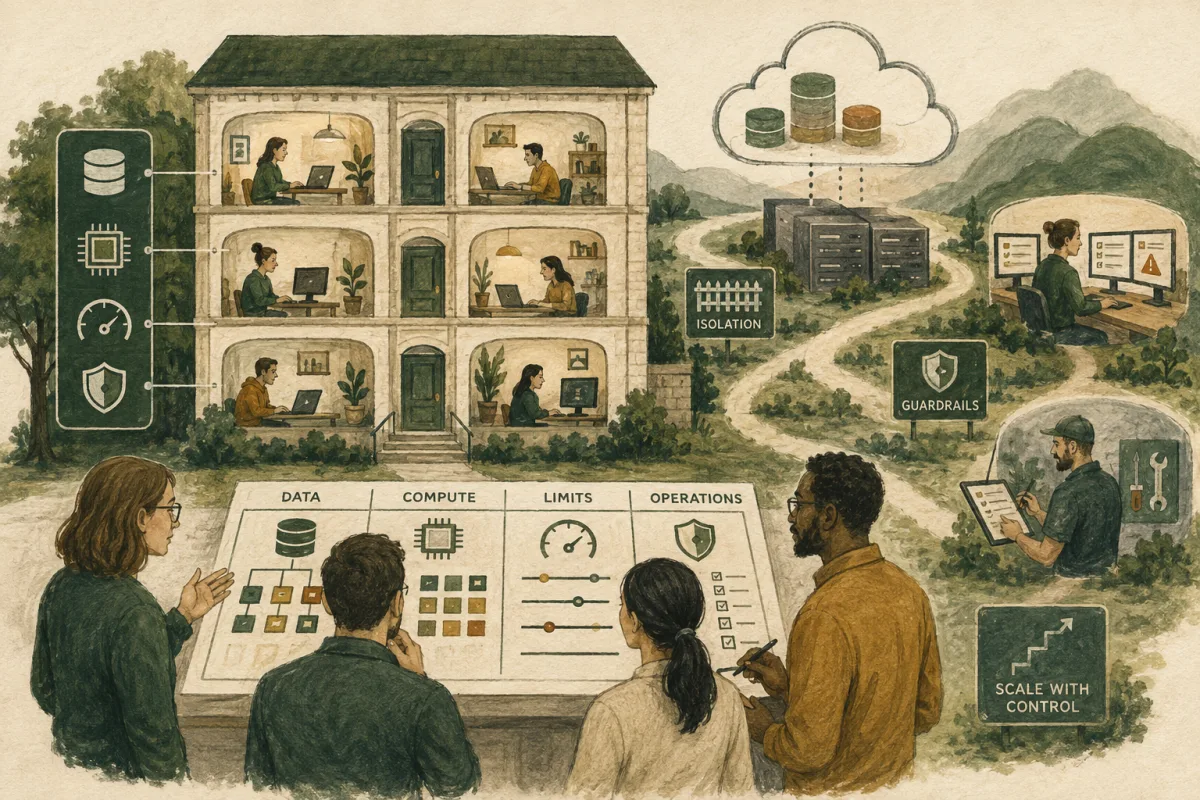
A tenancy decision should explain where customer data and workloads live, how boundaries are enforced, and how the team operates the design. “Enterprise-grade” is not a tenancy model. Start with actual customer requirements, the consequence of failure, the expected workload, and the available operational capability.
| Model | Potential advantage | Tradeoff to examine |
|---|---|---|
| Shared tables with tenant-scoped records | Efficient shared operation and a common schema | Every relevant access path needs reliable tenant enforcement |
| Separate schemas | More explicit data organization within a database system | Schema migrations, connection handling, and operational limits require care |
| Separate databases | Greater separation of data administration and recovery choices | Provisioning, upgrades, monitoring, and fleet management become more demanding |
| Separate deployment units | More control over workload and release boundaries | Repeated infrastructure and operating work can increase cost |
| Hybrid model | Different customer needs can use different placement | Routing, lifecycle operations, and support must handle more than one model |
This comparison is an architectural starting point, not a security guarantee. A separate database can still be accessed incorrectly through a faulty application or support tool. A shared database can support strong controls when the complete design is appropriate and tested. The CTO should make the assumptions and evidence visible rather than declare one model universally best.
AWS distinguishes tenant isolation from merely authenticating a user: the system must prevent access to another tenant's resources. Its guidance describes enforcement that varies with the infrastructure and resource model. This is a useful boundary to carry into an architecture review. See AWS on tenant isolation.
A worked example: an enterprise customer requests a separate environment
Suppose a SaaS company serves smaller customers on shared infrastructure and a prospect asks for a dedicated environment. This is a hypothetical decision exercise. Do not assume that the request necessarily requires a second product or that agreeing to it will win the contract.
Ask what problem the customer is trying to solve. They may need a particular data location, workload predictability, an administrative boundary, a recovery capability, or evidence for an internal review. The phrase “dedicated environment” can hide several distinct requirements. Involve the customer-facing owner and the people qualified to evaluate any contractual or regulatory interpretation.
Compare the requested design with alternatives. A separate database may address one need while leaving shared compute contention unchanged. A dedicated deployment may reduce some coupling while creating a new upgrade and support burden. A regional deployment unit may serve several customers with compatible requirements. Present the alternatives in terms the customer and commercial team can evaluate.
Estimate both initial and recurring work. Provisioning is only the beginning: include monitoring, backups, upgrades, incident support, data operations, and eventual exit. A one-time implementation fee may not cover a permanent operational obligation. Avoid hiding these costs in the general platform budget simply because the prospect is strategically important.
Finally record a decision with conditions. The company might accept the requirement with a defined service boundary, propose an alternative, defer until a reusable capability exists, or decline the exception. The CTO supplies technical consequences and ownership; the business makes the commercial decision through the agreed authority.
Test isolation across the whole request and job lifecycle
A useful isolation review follows data through ordinary and exceptional paths. The following is an original test-planning checklist, not a substitute for a security assessment. Use controlled test tenants and authorized environments; do not experiment on customer data.
Create two test tenants with deliberately distinct records and roles. Verify that a user in one tenant cannot read, modify, export, search, or delete the other tenant's records by changing an identifier or submitting a different tenant reference. Check both direct endpoints and indirect access through related records. A correctly scoped list view does not prove that a detail or update endpoint is protected.
Include background work. A queued export, scheduled report, webhook, or retry may execute without the original interactive request. The job needs a trustworthy tenant context and the correct authorization and data boundaries for its purpose. Test missing, stale, and mismatched context rather than only the successful path.
Inspect caches, object storage, analytics, logs, search indexes, and support tooling. A database query can be correct while a cache key or downloaded file exposes another tenant's information. Administrative access needs its own controls and auditability. An operator selecting the wrong customer should not silently create broad access that ordinary application checks would prevent.
Test lifecycle changes too: an invitation accepted into the wrong organization, a user removed from a tenant, an account transfer, and a tenant scheduled for deletion. Record expected behavior and verify it. These scenarios make the architecture decision concrete and help the team identify where enforcement belongs.
Plan tenant migrations as a product operation
Moving an existing customer between tenancy models affects more than rows in a database. Inventory identity, configuration, files, event history, integrations, billing relationships, and any customer-facing identifiers. Decide which identifiers remain stable and which downstream systems must be updated.
Choose a migration rehearsal with representative non-production data. Define reconciliation checks before moving anything: record counts alone may miss incorrect relationships or transformed values. Check the business invariants that matter, such as ownership, entitlement, totals, and the ability to complete the core workflow. Keep a record of expected exceptions.
Define cutover and rollback responsibilities. Some migrations can tolerate a maintenance window; others need a staged approach. Explain how writes are handled during the transition, how the team detects a mismatch, and when it must stop. Do not promise zero downtime simply because the target platform supports a particular replication feature.
Prepare customer communication and support. If an integration endpoint, access process, or availability window changes, the affected customer needs an actionable explanation. After cutover, inspect the customer workflow and operational signals before closing the migration. Keep the old environment only for an agreed, controlled period consistent with the relevant obligations and recovery plan.
Contain noisy neighbors and operational blast radius
A noisy neighbor is a workload whose use of shared resources harms other workloads. The relevant resource may be compute, database capacity, connections, queues, storage throughput, or an external service limit. Measure the constrained resource and the affected customer experience before choosing a remedy.
Tenant-aware observation helps distinguish one unusually expensive job from a system-wide capacity problem. Consider request limits, concurrency controls, workload scheduling, and placement alongside infrastructure changes. A larger server may temporarily conceal a fairness problem without resolving it. Conversely, adding isolation everywhere may impose operating cost that the product cannot support.
Microsoft's deployment-stamp pattern uses independently deployed instances to serve groups of customers, with customer placement as part of the architecture. It can help structure scale and isolation, but requires planning for routing, deployment, and operations. See the Azure deployment-stamp guidance.
For a CTO decision, connect the option to the service promise and operating budget. Which customers share a failure boundary? How is a tenant moved? Can the team patch and observe every deployment? What happens when one unit reaches capacity? An architecture diagram should have credible answers to these operating questions.
Define the tenant lifecycle before automating it
A tenant needs a reliable route into, through, and out of the product. Define provisioning, initial configuration, user administration, plan changes, suspension, export, and closure. Name the system of record for tenant identity and the owner of each transition. Otherwise, a customer can appear active in billing while another subsystem treats the account as suspended or deleted.
Use explicit states and review failure behavior. If provisioning stops halfway through, can the operation be retried safely, or will it create duplicate resources? If an export fails, who can see the failure and retry it? If an account changes its plan, when do the relevant entitlements change? These are product and operating decisions as well as implementation details.
Distinguish a temporary suspension from irreversible data removal. Define retention and deletion behavior with the people responsible for the applicable commitments, then ensure the technical workflow follows that decision. A customer-facing promise should not depend on someone remembering a manual cleanup step months later.
Test the lifecycle with representative scenarios before increasing automation. The CTO should require evidence that transitions are observable, recoverable where intended, and owned by the team that will support them.
Questions about SaaS CTOs and multi-tenancy
Is multi-tenancy required for every SaaS product?
No single infrastructure arrangement defines every SaaS business. A product can use shared, separate, or hybrid resources. The important questions are the customer experience, common operating model, economics, isolation, and lifecycle management. Choose the architecture from requirements rather than treating maximum sharing as an objective by itself.
Does database-per-tenant automatically satisfy compliance requirements?
No. Data placement is one part of a broader set of technical, organizational, and contractual obligations. Access, monitoring, recovery, support, retention, and other controls still matter. Obtain relevant specialist assessment for the actual requirements; do not present a tenancy choice as a certification or legal conclusion.
Can we add multi-tenancy without a complete rewrite?
Sometimes, but the answer depends on the existing data model, authorization boundaries, integrations, and operational assumptions. A staged migration may be possible after mapping dependencies and testing a representative path. First establish which customer requirement must be met and which part of the current design blocks it.
How much does multi-tenancy cost to implement?
A responsible estimate needs a defined model, current-state evidence, migration scope, customer commitments, and operating requirements. Separate design, implementation, migration, validation, and recurring support. Avoid a fixed universal price or delivery window based only on the number of tenants.
Should the fractional CTO implement the architecture personally?
Clarify the role. The CTO may own model selection, risk decisions, investment sequencing, and acceptance evidence while engineers implement the system. Some engagements include hands-on work; others do not. The company needs a named implementation owner and sufficient capacity regardless of the executive's title.
Which evidence should the board see?
Show the business requirement, plausible options, cost assumptions, major risks, migration dependencies, and decision gates. Include what has been tested and what remains uncertain. The board usually needs a clear investment and risk decision, with enough technical evidence to support it, rather than a list of cloud services.
Put customer promises under change control
Enterprise SaaS companies often accumulate technical commitments through sales calls, security questionnaires, statements of work, support escalations, and roadmap conversations. No single promise looks decisive, but together they can create a second product and operating model.
Build a visible route for commitments that affect architecture, data, security, availability, integration, or support. Record the customer value, revenue context, implementation and recurring cost, precedent created, owner, expiry, and product alternative. The CTO should not veto sales by default; they should make the full decision legible.
This also improves platform prioritization. If the same exception appears across prospects, it may justify a product capability. If one low-margin contract requires permanent bespoke operations, the commercial model deserves review.
During candidate interviews, use a scenario where a strategic prospect requests tenant-specific infrastructure and a contractual uptime promise. Ask how the candidate would gather evidence, involve sales and finance, price the obligation, design alternatives, and preserve the relationship. Their answer reveals whether they can operate across the company rather than only inside engineering.
Frequently asked questions
When should a SaaS company hire a fractional CTO?
When platform, team, security, customer, and investment decisions need recurring executive ownership but the workload can still be bounded and daily delivery has an internal owner.
Can a fractional CTO help with multi-tenant architecture?
Yes, by framing isolation, scale, cost, reliability, security, and migration decisions against the product and customer model. The executive should involve engineers who own implementation.
Should a SaaS startup hire a CTO or VP Engineering?
Hire around the work. A CTO usually owns long-horizon technology and business choices; a VP Engineering owns the engineering organization and delivery system. Some companies need one, both, or a fractional CTO supporting an internal engineering leader.
How should a SaaS CTO be measured?
Use a balanced set of product and operating signals: customer outcomes, delivery flow, reliability, security, support burden, platform cost, team capability, and the quality of major decisions.
Sources and further reading
Turn research into a mandate
See the cost and hiring model before you shortlist.
Use the free calculator, then save a candidate search or post a transparent role when the mandate is ready.