
Fractional CTO evidence
Fractional CTO Case Studies: How to Judge the Evidence
Evaluate fractional CTO case studies with worked examples, evidence checks, reference questions, and a practical hiring scorecard.
- By
- Fractional CTO Experts
- Published
- 2026-07-30
- Reviewed
- 2026-09-07
- Reading time
- 13 minutes

The best fractional CTO case study is not the one with the largest percentage improvement. It is the one that helps a buyer predict how an executive will reason inside a comparable situation.
That requires more than a triumphant ending. A useful case study reconstructs the starting evidence, the mandate, the leader’s personal decisions, alternatives rejected, constraints, operating friction, measurable change, and handover. Without those elements, a result may be true but still be useless for selection.
This guide uses composite scenarios, not invented customer stories. Each scenario combines common decision patterns to show what credible evidence should contain. It does not claim that Fractional CTO Experts delivered the outcomes.
- The six parts of decision-useful proof
- Composite scenario 1: delivery recovery
- Composite scenario 2: platform scale before growth
- Composite scenario 3: continuity after a CTO departure
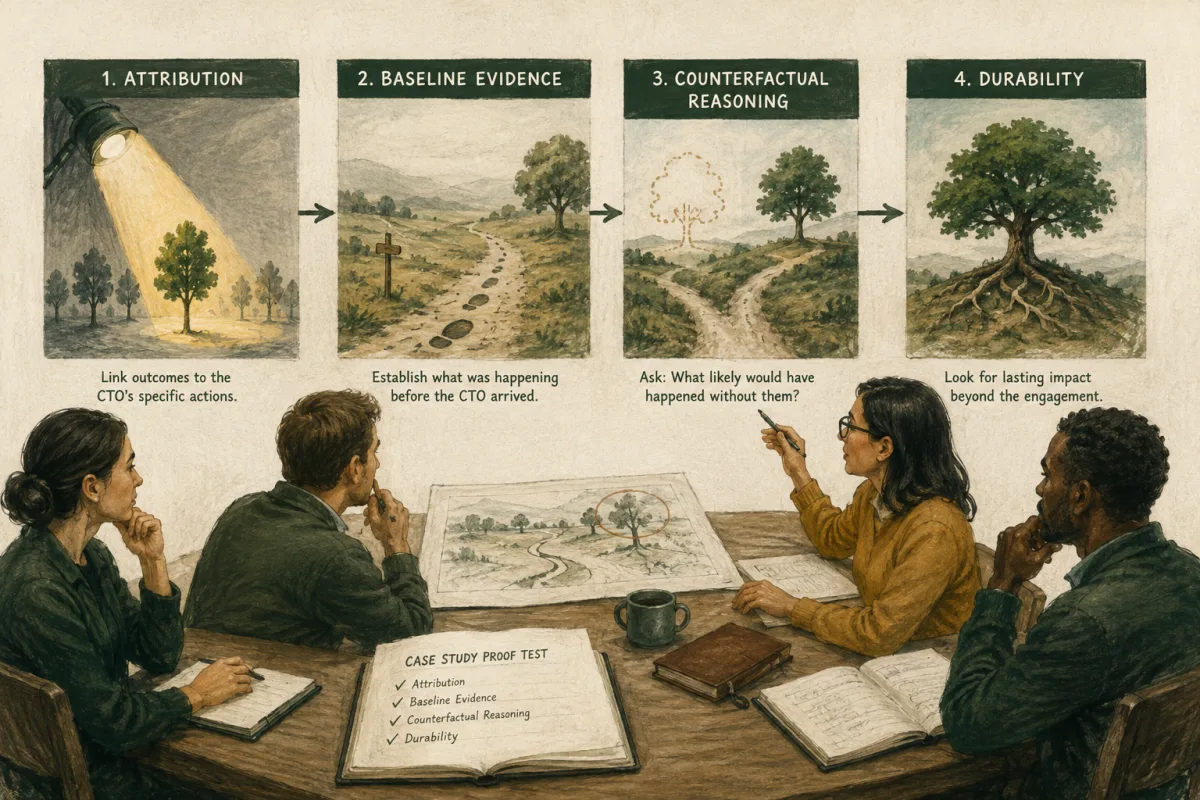
- How to verify attribution
- Red flags in fractional CTO success stories
- Turn case studies into a selection scorecard
- A worked example: turn an impressive claim into a testable result
- Build an evidence packet without demanding confidential documents
- Run a reference call around one decision
- A practical case-study comparison worksheet
- Frequently asked questions about fractional CTO case studies
- The standard to keep
The six parts of decision-useful proof
Start with a consistent anatomy.
- Baseline: What was happening before the executive arrived, and how was it measured?
- Mandate: What result and decisions did the company ask the executive to own?
- Attribution: What did this person decide or change personally?
- Tradeoffs: Which reasonable alternatives were rejected, and why?
- Evidence: What changed, over what period, and what else may have caused it?
- Transition: What remained after the executive reduced capacity or left?
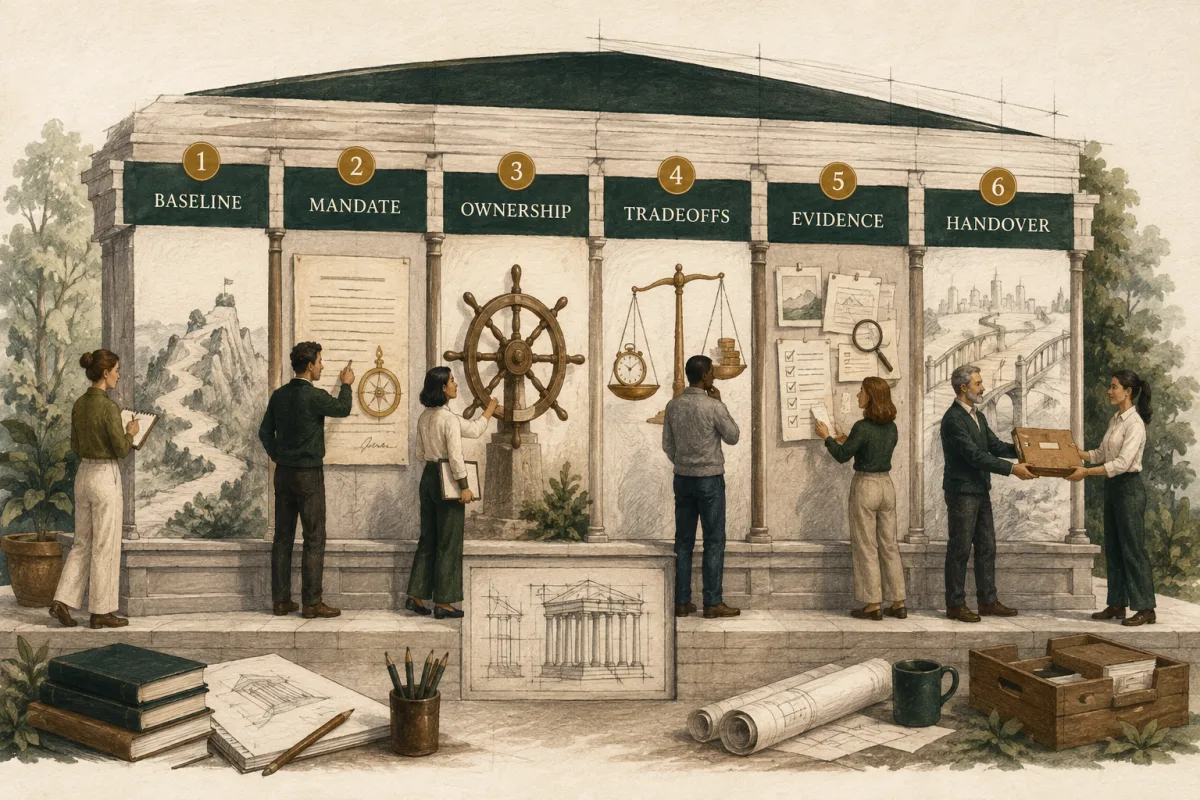
A case study that skips the baseline cannot show change. One that says “we transformed engineering” cannot show personal ownership. One that ends on launch day cannot show whether the system endured.
The transition matters especially in fractional work. The company is not only buying an executive’s judgment; it is buying a stronger internal ability to make and execute decisions after the engagement changes.
Composite scenario 1: delivery recovery
Imagine a software company that has missed several important release commitments. The CEO sees late work but cannot tell whether the constraint is architecture, product churn, team capability, management, or unrealistic commercial promises.
A weak case study says: “The fractional CTO introduced agile practices and increased velocity by 40%.”
A useful version would explain the investigation:
- release dates were being agreed before engineering discovery;
- work entered development without testable acceptance boundaries;
- one senior engineer held most production knowledge;
- incidents repeatedly interrupted planned work;
- no shared measure separated queue time from build time.
The executive’s contribution might be to stop date commitments for unshaped work, establish one decision owner for priority, reduce work in progress, make production interruption visible, and place knowledge-transfer work inside the roadmap.

The proof should not be “more tickets completed.” It could include a more reliable forecast window, fewer emergency interruptions, shorter time from decision to production, clearer ownership, or a reference from the product leader explaining how planning behavior changed.
The case should also name the cost. Perhaps two lower-value features were delayed. Perhaps an influential stakeholder lost a private escalation path. Mature leadership includes the price of the choice.
Questions to use in an interview
- What evidence showed the problem was flow rather than developer effort?
- Which intervention did you deliberately not make?
- Who disagreed, and how was the disagreement resolved?
- What was still weak after 90 days?
- Which part of the system continued without you?
Composite scenario 2: platform scale before growth
Now consider a company expecting a large increase in demand. The easy marketing story is a rewrite: old platform, heroic CTO, new architecture, enormous scale.
The real executive decision is usually less cinematic. The leader must decide what demand is credible, where failure would matter, which system limits are evidenced, how much capital to commit, and which organizational controls must change with the technology.
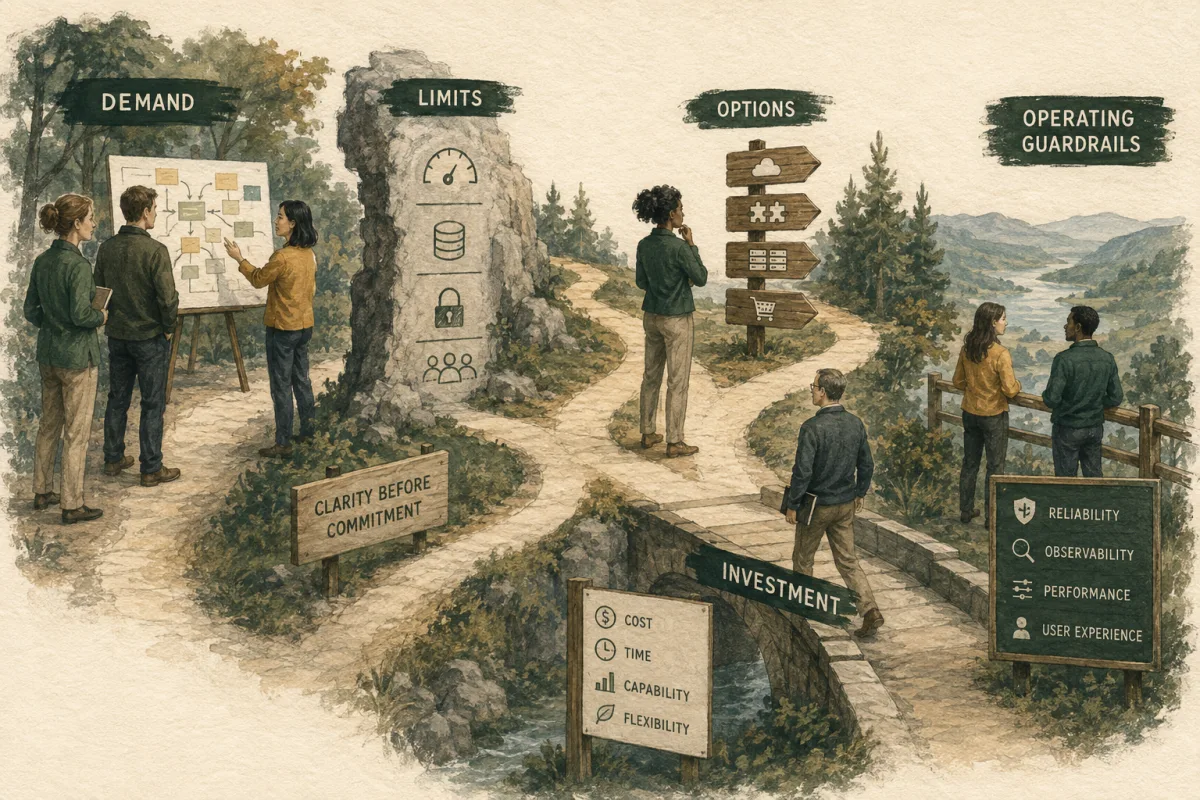
A credible platform-scale case study should disclose:
- the demand scenario and confidence level;
- observed bottlenecks rather than fashionable assumptions;
- reliability and recovery targets;
- options considered, including doing less;
- the relationship between architecture and team capability;
- sequencing that protected current customers;
- cost and operational consequences;
- load, incident, and customer evidence after the change.
If the case simply says “migrated to microservices,” it tells you almost nothing about judgment. Microservices can increase independent delivery in the right organization and multiply operational load in the wrong one.
Look for evidence that the executive connected engineering decisions to customer risk and capital allocation. That connection is the executive product.
Composite scenario 3: continuity after a CTO departure
A sudden CTO departure creates two problems: operational exposure today and uncertainty about the permanent role tomorrow.
The board may ask an interim or high-capacity fractional leader to stabilize releases, retain key people, communicate technology risk, protect a transaction, and help define the permanent search.

A credible continuity case study distinguishes containment from transformation.
In the first weeks, the leader may map decision owners, critical systems, incident readiness, customer commitments, key-person dependencies, security exposure, and team-retention risk. They should avoid launching a grand reorganization before the evidence is clear.
In the next phase, they can restore an operating cadence, resolve high-consequence decisions, clarify what the permanent executive must own, and support a structured search. The engagement succeeds when the company can transfer authority without losing context.
The proof is not merely “nothing broke.” Ask whether risks became visible, decisions stopped waiting for informal permission, the team understood the transition, and the permanent search used a sharper scorecard.
How to verify attribution
Executive work is collaborative. That makes attribution difficult, but not impossible.
Use three layers:
Documents: board material, decision records, roadmaps, operating reviews, risk registers, or architecture options can show how the work was framed. Confidential material may not be shareable, but the candidate should be able to describe its structure and purpose.
Observers: references should include someone who received the executive’s recommendations and someone who worked through the operational consequences. Ask each person to reconstruct the same period independently.
Counterfactual reasoning: ask what likely would have happened without the intervention. The answer should be cautious. If every positive change is credited to the executive and no external factor is acknowledged, the story is probably overfitted.
Red flags in fractional CTO success stories
Be cautious when:
- the company, stage, team, and time period are all hidden;
- every sentence uses “we” and none states personal decisions;
- a percentage has no baseline, denominator, or measurement window;
- a technology change is presented as a business result;
- the story contains no resistance, mistake, or rejected alternative;
- the executive claims fundraising, revenue, or valuation that depended on many actors;
- the case ends before the operating system was transferred;
- a provider presents composite examples as real customers.
An anonymous story can still be a useful teaching device. It should be labelled as a composite, as the examples in this guide are.
Turn case studies into a selection scorecard
Do not rank candidates by the drama of their best story. Score relevance.
| Dimension | Selection question |
|---|---|
| Starting condition | Was the baseline similar to ours? |
| Decision horizon | Did they operate under comparable time pressure? |
| Authority | Did they own decisions or only advise? |
| Constraints | Were capital, talent, regulation, and customer risk comparable? |
| Evidence | Can the outcome be independently reconstructed? |
| Transition | Did capability remain inside the company? |
Ask every candidate the same core questions. Record scores before the interview panel discusses them. This reduces the chance that confidence, pedigree, or shared background outranks evidence.
A worked example: turn an impressive claim into a testable result
Suppose a candidate says they cut delivery time in half. The following numbers are a hypothetical evaluation exercise, not a customer result or a claim about this platform. Before the engagement, ten comparable changes took a median of 20 days from an agreed start point to production. Afterwards, ten took a median of ten days. That is a 50% reduction in the measured median, but it is only the beginning of the evidence.
First establish the boundaries. Did the clock begin when a customer asked for something, when product accepted the request, or when a developer started work? If the team moved discovery outside the measured window, the apparent improvement might conceal an unchanged customer wait. Ask for the old and new definitions in the same sentence. A fair comparison uses the same start event, end event, exclusions, and time unit.
Next examine the sample. Ten small configuration changes should not be compared with ten complex integrations. Request a breakdown by work category and note exceptional items separately. Do not silently remove a release that failed because it makes the improvement look less tidy. In a small team, one unusually difficult project can shift the aggregate enough to change the story.
Then look for displaced costs. Did faster delivery depend on more overtime, delayed maintenance, reduced testing, or work pushed onto customer support? Ask the reference what became harder during the intervention. A result can still be valuable if it has costs, but those costs belong in the decision.
Finally establish whether the change persisted. A temporary release push may be exactly what a business needed, yet it demonstrates a different capability from building a sustainable delivery system. Ask for a later checkpoint and identify who owned the process after the executive stepped back. If there is no follow-up evidence, record durability as unknown rather than assuming success or failure.
Build an evidence packet without demanding confidential documents
A buyer does not need unrestricted access to another company's board papers. In many cases that would be inappropriate. Request a small, permissioned evidence packet that lets the candidate explain how they worked while protecting the former client's information.
A practical packet contains a one-page situation summary, a redacted decision record, a measurement definition, a description of the handover, and an authorized reference route. The situation summary can use ranges for company size and describe the industry broadly. The decision record should still show the problem, constraints, alternatives, selected option, owner, and review trigger. Removing customer names should not remove the reasoning.
Distinguish three evidence types explicitly. An authentic redacted artifact is a document created during the engagement with confidential details removed. A reconstruction is created afterwards from memory or permitted notes. A sample is an illustrative template that has never been used for that client. All three can support an interview, but they answer different questions. A polished sample demonstrates communication ability; it does not prove that the candidate used that process under pressure.
Offer an alternative when sharing is restricted: the candidate can describe the artifact in an interview, and a consenting reference can confirm its purpose and use. Do not ask someone to breach confidentiality to win your business. Equally, a confidentiality explanation does not automatically verify every claim. Mark the evidence boundary, then decide whether other references or a paid assessment can reduce the uncertainty.
Keep your own access proportionate. Assign a named reviewer, avoid forwarding the packet widely, and agree when sensitive material will be deleted. A hiring process that handles another company's information carelessly provides a poor foundation for asking an executive to protect yours.
Run a reference call around one decision
Broad questions such as “Would you recommend them?” often produce polite, difficult-to-compare answers. A more useful reference conversation reconstructs a specific decision. Obtain permission to contact the reference and explain the mandate you are considering so that the discussion has a clear purpose.
Start by confirming the relationship: when they worked together, their respective responsibilities, and what the reference observed directly. A board member may understand capital allocation but have little visibility into daily engineering management. An engineering lead may understand execution but not the commercial constraints behind a decision. Neither perspective is complete by itself.
Ask the reference to describe the starting problem before sharing the candidate's claimed outcome. This reduces the chance that your framing supplies the answer. Then ask which decision the executive personally owned, what alternatives were considered, and what the reference had to do differently as a result. Specific operational consequences are more informative than adjectives such as strategic or hands-on.
Use the last part of the call to test limits. Ask what support the executive needed, where their availability created friction, and what type of engagement would be a poor fit. A nuanced answer is not necessarily a negative reference. Someone can be excellent at transaction diligence and unsuitable for daily delivery management, or effective with an experienced team but a poor fit for a founder who needs constant implementation support.
Write down observed facts separately from interpretations. “They chaired our weekly release review for four months” is an observation. “They would suit our team” is your inference. Preserve that distinction when the hiring panel compares candidates.
A practical case-study comparison worksheet
Use a common worksheet for each shortlisted executive. The following anchors are an internal comparison aid, not a validated prediction model. They help a panel expose disagreements and missing evidence before making a judgment.
| Criterion | Weak evidence | Useful evidence | Stronger evidence |
|---|---|---|---|
| Relevant starting point | Similar job title only | Similar problem and stage | Comparable constraints and decision authority |
| Personal contribution | Unqualified team claim | Specific decisions described | Decisions independently corroborated |
| Measurement | Outcome without definition | Defined baseline and period | Comparable measures with limitations disclosed |
| Tradeoffs | No costs acknowledged | Rejected options explained | Consequences verified by an affected stakeholder |
| Continuity | Story ends at launch | Handover described | Internal owner confirms continued operation |
Give each reviewer space for an evidence link, a confidence note, and an unresolved question. Avoid producing a precise total that hides a fatal mismatch. A candidate with excellent references but no capacity for your required operating cadence may still be unsuitable. Another may have fewer public stories because of confidentiality but strong private evidence relevant to your situation.
Agree the non-negotiable requirements before reading portfolios. For example, your mandate might require direct ownership of a technology budget, experience stabilizing an inherited team, and a handover to a permanent leader. These should come from your business problem. They should not be reverse-engineered from the most charismatic candidate's biography.
Frequently asked questions about fractional CTO case studies
Can an anonymous case study be credible?
Yes, if anonymity is clearly explained and the evidence can be examined through an appropriate private process. An anonymous real engagement, a reconstructed example, and a composite teaching scenario are different things. Ask which one you are reading. A composite can explain good reasoning, but it should not count as proof of a provider's delivered results.
Does a case study prove return on investment?
It can support an investment discussion, but a single story rarely establishes a clean causal return. Separate engagement fees and implementation costs from estimated benefits, explain the measurement window, and account for other changes. Revenue growth during an engagement is not automatically revenue created by the executive. For budgeting mechanics, use the fractional CTO pricing guide.
How many case studies should a candidate provide?
Choose enough evidence to cover the consequential decisions in your mandate rather than imposing an arbitrary volume. One directly relevant, independently supported case may be more useful than a long portfolio of superficial examples. If all the evidence comes from one setting, use the interview to test how the candidate would adapt when your constraints differ.
What if the candidate has no published case studies?
Public publishing is not the only evidence route. Ask for permissioned references, a structured walkthrough of prior decisions, and an appropriate work sample. A paid, bounded discovery engagement can also test how they investigate your actual situation. Agree its outputs and limits first; it should not become an open-ended request for unpaid strategy or unrestricted production access.
Should we reject a case study that includes failure?
An acknowledged failure can reveal judgment, learning, and accountability. Establish what was known at the time, how the executive detected the problem, what they changed, and who bore the consequences. A candid account with a credible correction is different from repeatedly making avoidable mistakes or treating every failure as someone else's responsibility.
How do we turn the evidence into an engagement brief?
Translate the relevant decisions into your own scope: the starting condition, authority, expected outputs, available capacity, acceptance evidence, and handover owner. Keep desired outcomes separate from guarantees. Then use a structured hiring process to compare the proposed mandate with the executive's availability and demonstrated experience.
The standard to keep
A fractional CTO case study should help you answer four questions:
- Has this person owned a similar decision?
- Did they reason well with incomplete evidence and real constraints?
- Can another person verify both the value and the friction?
- Did they leave the organization more capable?
If the answer is yes, the story has moved from marketing material to hiring evidence. If not, use it only as the beginning of the interview.
For a concrete product-building narrative, read the Circuit Diagram Maker case study. Assess the documented work and its stated limitations separately from any claim about what a future executive engagement might achieve.
Frequently asked questions
What makes a fractional CTO case study credible?
It states the starting condition, mandate, executive’s personal decisions, constraints, evidence, result, and transition. The claims should be attributable through named context or a reference who observed the work.
Are anonymous fractional CTO case studies useful?
They can illustrate a decision pattern, but they are weak proof unless the provider can privately verify the context and attribution. Treat anonymous marketing outcomes as hypotheses for a reference call.
What outcomes should a fractional CTO case study measure?
Measures should follow the mandate: delivery predictability, risk retired, decisions made, reliability, team capability, investment sequence, hiring progress, or transition readiness. Vanity activity counts are rarely enough.
How do I compare a case study with my company?
Compare stage, team, capital, customer risk, regulatory context, decision horizon, and the executive’s authority. A famous company with different constraints can be less relevant than a smaller but truly comparable mandate.
Sources and further reading
Turn research into a mandate
See the cost and hiring model before you shortlist.
Use the free calculator, then save a candidate search or post a transparent role when the mandate is ready.