
Fractional CTO hiring
How to Hire a Fractional CTO: Evidence-Led Guide
Define the mandate, score evidence, interview candidates, check references and plan the first 90 days with this fractional CTO hiring guide.
- By
- Fractional CTO Experts
- Published
- 2026-07-30
- Reviewed
- 2026-09-07
- Reading time
- 15 minutes

The most reliable way to hire a fractional CTO is to define the decisions before searching for the person.
That sounds obvious, yet many searches start with a title and a list of technologies: “We need a fractional CTO with AI, AWS, cybersecurity, fundraising, product, hiring, and hands-on coding experience.” The result is a broad résumé contest. Candidates can sound relevant without agreeing on what they will own.
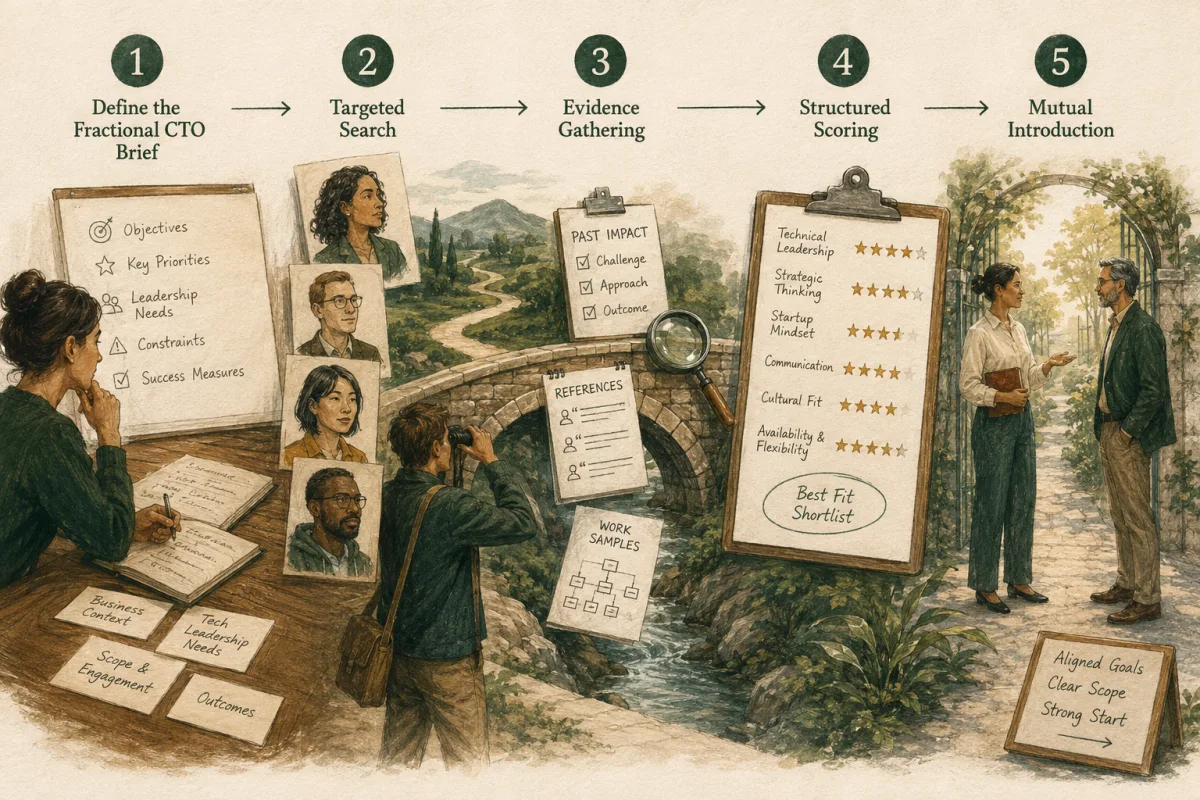
A better process moves in this order:
- define the business outcome;
- name the decisions and constraints;
- specify evidence that would predict success;
- choose the engagement model;
- search and score consistently;
- verify through references;
- contract around a 90-day plan and a transition.
In this guide
- Step 1: diagnose the leadership gap
- Step 2: write a one-page mandate
- Step 3: decide which CTO product you need
- Step 4: search where evidence is visible
- Step 5: screen for comparable decisions
- Step 6: run a structured interview
- Step 7: use a working session carefully
- Step 8: check references for the decision, not the personality
- Step 9: align the working model before signing
- Step 10: make the first 90 days visible
- Red flags to investigate
- Turn a vague hiring request into a one-page mandate
- Choose the search channel for the kind of evidence you need
- Run a structured interview that exposes decision quality
- Check references without relying on ceremonial praise
- Define authority before the first day
- Make the first 30 days a test of the operating relationship
- Recognise a poor fit early
- The final decision
Step 1: diagnose the leadership gap
Do not assume the answer is a CTO. Separate the problem into four layers.
Business consequence: What is the company losing or risking? Examples include missed revenue, slow product delivery, customer security concerns, fundraising friction, or unsustainable engineering cost.
Capability gap: Is the missing capability strategy, architecture, people leadership, delivery, security, data, product, or executive communication?
Authority gap: Is nobody qualified to decide, or is a qualified leader present but not empowered?
Capacity gap: Is senior judgment required a few hours a month, two days a week, or continuously?
A fractional CTO cannot repair a governance problem if the founder retains every decision. They cannot replace a full engineering team. They should not be used to avoid hiring a permanent leader when continuous executive capacity is already required.
Step 2: write a one-page mandate
A useful mandate fits on one page before it becomes a longer statement of work.
Include:
- the company stage and current operating context;
- one primary business outcome;
- three to five executive decisions;
- the teams and leaders involved;
- constraints that cannot be wished away;
- evidence expected by day 30, 60, and 90;
- the intended duration and capacity;
- likely transition at the end.

Compare these two descriptions:
Help with technology strategy and improve engineering.
By day 90, establish a board-approved platform investment sequence, restore a reliable delivery forecast, and define the leadership structure required for the next 18 months.
The second statement is not perfect, but it creates testable decisions.
Step 3: decide which CTO product you need
“Fractional CTO” covers several operating models:
| Model | Best when | Common mistake |
|---|---|---|
| Advisor | The internal team needs periodic senior challenge | Expecting the advisor to operate the function |
| Fractional CTO | A defined mandate needs recurring executive ownership | Buying too little access for the meeting load |
| Interim CTO | The seat must be held during a gap or transition | Pricing it like a light retainer |
| Hands-on technical lead | Architecture and implementation dominate | Giving an IC an executive mandate without support |
| Full-time CTO | The function needs continuous, enduring ownership | Hiring permanently before the role is understood |
The U.S. Bureau of Labor Statistics describes top executives as leaders who plan strategy and policy to ensure goals are met. That broad definition helps distinguish executive accountability from a collection of technical tasks. Your company may need both, but one person and one engagement do not always cover both well.
Step 4: search where evidence is visible
There are four main routes:
Referrals create trust quickly but are limited by the referrer's context. Ask what work the referrer directly observed.
Curated networks can reduce search time and add verification. Inspect how candidates are ranked, how the network is paid, and whether public claims are checked.
Open marketplaces and job posts widen reach. They transfer more filtering and verification work to the company.
Specialist search is useful when the mandate is unusual, confidential, regulated, or time-critical.
No channel removes the need for a scorecard. A platform's “vetted” badge should mean more than identity and résumé review. Ask what evidence was checked and whether the matching business model can distort rankings.
Step 5: screen for comparable decisions
Years of experience, company logos, and prior titles are weak signals without context. Build a screening table around decisions.
| What to test | Strong evidence | Weak signal |
|---|---|---|
| Stage fit | Led through a comparable transition | Worked at a famous company |
| Decision ownership | Can name the call, tradeoff, and consequence | “We transformed the platform” |
| Constraint fit | Faced similar capital, team, or regulatory limits | Uses a preferred methodology |
| Operating range | Can work through people and systems | Personally fixes every problem |
| Transition skill | Has handed capability to internal leaders | Creates ongoing dependence |
Ask candidates to choose one case that resembles your mandate. Depth is more predictive than a tour of every achievement.
Step 6: run a structured interview
Use the same core questions for every candidate:
- What made the comparable situation genuinely difficult?
- Which decision was yours?
- What alternatives did you reject and why?
- What evidence did you have at the time?
- Who disagreed, and how was the decision made?
- What changed after 30, 60, and 90 days?
- What failed or remained unresolved?
- What would be different in our constraints?
- What access and authority would you need?
- What would make you recommend that we do not hire a fractional CTO?
Score answers independently before discussing them. Otherwise, confidence, shared background, and conversational chemistry can overwhelm evidence.
Step 7: use a working session carefully
A paid working session can reveal how the candidate frames ambiguity, asks questions, and communicates tradeoffs. Keep it ethical:
- use a bounded fictionalized or non-sensitive problem;
- do not extract free consulting from several candidates;
- tell the candidate how the work will be used;
- pay for material analysis;
- avoid exposing customer or employee data;
- score the process, not whether they guessed your preferred answer.
The goal is not a polished slide deck. It is visible judgment.
Step 8: check references for the decision, not the personality
“Would you hire them again?” is easy to answer politely. A useful reference reconstructs the work.
Ask:
- What was at stake when the executive arrived?
- What decisions did you personally observe them own?
- Which tradeoff created disagreement?
- How did they behave when evidence changed?
- What did the team learn or retain after they left?
- Where did they need more support?
- In what situation would you not choose them?
Confirm the reference relationship independently where possible. One enthusiastic reference is not enough for a high-consequence mandate.
Step 9: align the working model before signing
Many fractional engagements fail through logistics, not competence.
Agree:
- named decision rights;
- meeting and communication cadence;
- expected hours or days;
- response expectations during incidents;
- access to systems and people;
- internal counterpart;
- travel and time-zone requirements;
- conflicts and other active engagements;
- documentation and handover;
- data protection, security, IP, and confidentiality;
- review and termination points.
If the CTO needs five days of meetings to deliver two days of work, the model is broken. Protect focus.
Step 10: make the first 90 days visible
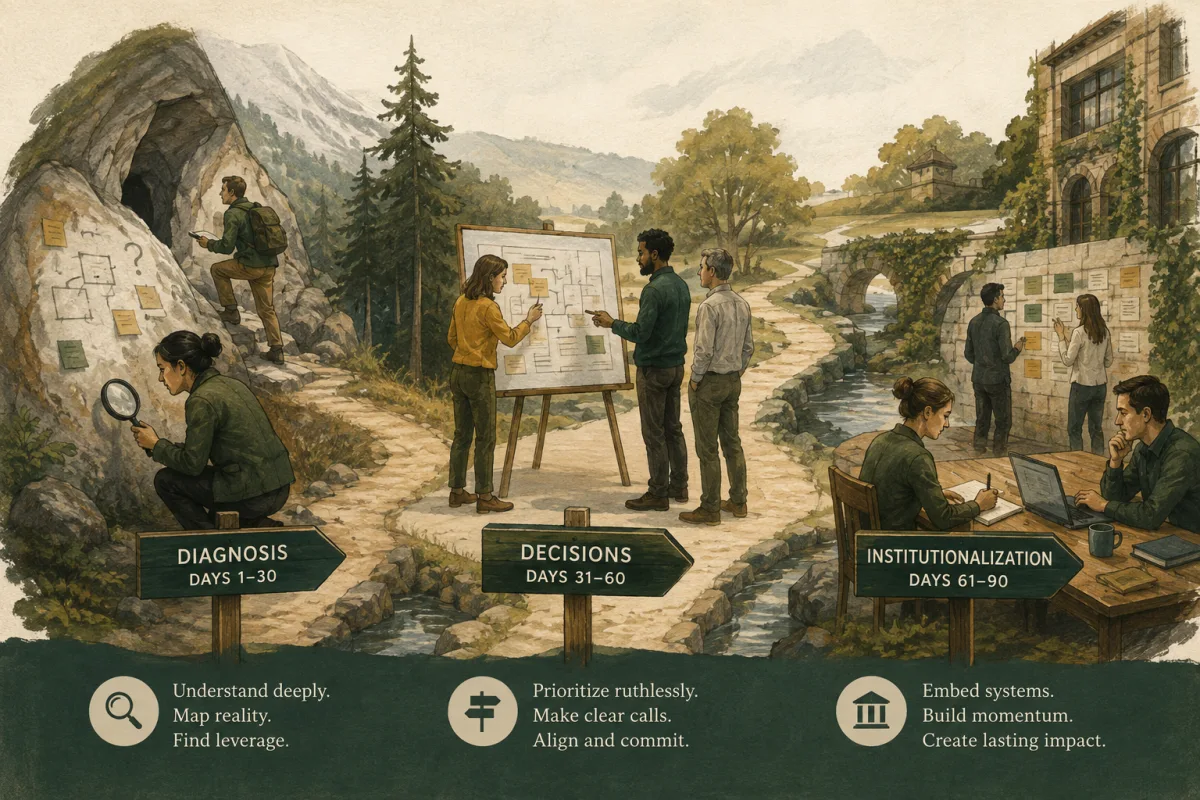
The exact plan depends on the mandate, but the sequence often looks like this:
Days 1–30: diagnose. Establish trust, inspect data and systems, listen to the team, baseline delivery, and confirm the decision backlog.
Days 31–60: decide. Make the few consequential calls, align owners, stop low-value work, and create a credible operating cadence.
Days 61–90: institutionalize. Move decisions into repeatable systems, strengthen internal leaders, report evidence, and confirm the next operating model.
Avoid plans that promise a strategy, reorganization, new architecture, complete hiring plan, security transformation, and AI launch in 90 days. A focused executive says what will not be done.
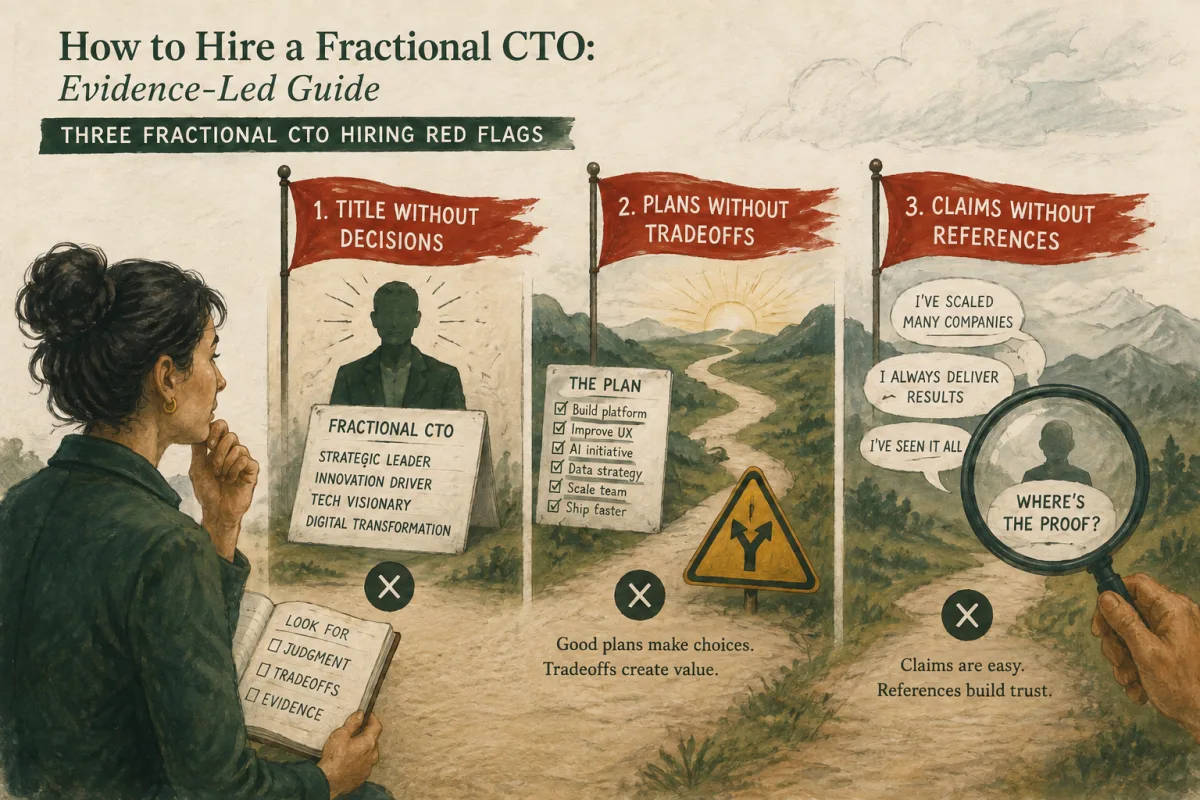
Red flags to investigate
- The candidate uses “we” but cannot identify their decision.
- Every past initiative was successful.
- The answer to every problem is a new tool, team, or rewrite.
- They want executive authority but avoid people decisions.
- They promise hands-on delivery and unlimited availability across several clients.
- References are prestigious but did not observe the relevant work.
- The proposal lists activities without an outcome.
- The engagement has no transition or end condition.
Red flags are prompts for evidence, not automatic rejection. The recurring test is specificity.
Turn a vague hiring request into a one-page mandate
Before searching for candidates, write down the event that made the hire necessary. A missed release, a departing technical founder, an acquisition, or a difficult enterprise sale creates a different assignment from general discomfort with the technology. Describe what is happening in business terms, then identify the decisions that are not being made well enough today.
A useful mandate includes the starting situation, the desired outcome, the decisions the executive can own, the people available to deliver the work, and the constraints that cannot be ignored. Keep the first version short enough for the founder and engineering lead to review together. If they disagree about the problem, resolve that disagreement before candidates are asked to solve it.
For example, a hypothetical eight-person engineering team might need to make release commitments more dependable while preparing for one enterprise integration. The mandate could ask the CTO to assess delivery constraints, agree a three-month roadmap with product leadership, establish architecture decision ownership, and support the integration design. It should also say that the internal engineering lead retains day-to-day supervision and that the engagement does not include supplying a development team.
The difference is practical. A candidate can explain whether that assignment fits two days a week, what evidence they need, and what they would change. “Help us scale” gives them too much freedom to sell their preferred service and too little information to price the actual work.
Choose the search channel for the kind of evidence you need
A referral from a founder who has worked with the executive can provide unusually useful context, but it is still one experience. Ask what stage the company was at, which decisions the executive owned, and whether the same person would be suitable for your present constraints. A successful turnaround in a large organisation does not automatically demonstrate skill in a small product team.
A curated network can make it easier to compare candidates and coordinate introductions. Examine how the network assesses people, who pays, whether commercial relationships affect visibility, and what support continues after the introduction. The word “vetted” should lead to a description of the actual checks, not end the conversation.
A broad freelance marketplace offers a wider range of skills and engagement sizes. That can help when you need a bounded assessment or specialist implementation. Read profiles carefully: a senior developer, architect, advisor, and accountable executive may all use similar keywords. Evaluate the work described rather than assuming that a platform category guarantees the intended level of leadership.
Direct outreach is useful when you already know the experience you need. Send a specific mandate and ask about fit and availability. A vague request for a quick chat pushes the work of diagnosis onto the candidate and makes responses harder to compare. Whether the route is a referral, a network, or direct contact, use the same assessment criteria for the final shortlist.
Run a structured interview that exposes decision quality
Begin with a comparable decision, not a tour of the candidate's entire career. Ask them to describe the business situation, available options, constraints, evidence, decision, and result. Then ask what they would do differently. A strong answer distinguishes their own contribution from work performed by a team and can explain why a reasonable alternative was rejected.
Use a realistic scenario from your mandate, with confidential details removed. For example: the sales team has promised an integration in six weeks, engineering estimates twelve, and the current platform has a reliability issue. Ask the candidate what they would learn first, who should participate in the decision, and how they would communicate a revised commitment. There is no single correct architecture to name; you are examining how they handle uncertainty and competing obligations.
Invite an internal technical leader to probe the reasoning. Invite the founder or commercial sponsor to assess whether the explanation is understandable and connected to the business. Collect written observations independently before discussing the candidate as a group. This reduces the risk that the most enthusiastic interviewer supplies everyone else's opinion.
Do not use an unpaid interview to obtain a complete technology strategy. A small hypothetical exercise can reveal judgment without extracting commercially useful work. If the company needs a real assessment before agreeing a longer mandate, offer a paid discovery phase with a clear deliverable and a separate decision about continuation.
Questions that deserve specific answers
Ask how the candidate distinguishes an architectural preference from a material business risk. Ask for an example of stopping a rewrite, reducing a roadmap, or deciding not to hire. These cases can reveal judgment that is hidden by a portfolio consisting only of successful launches and growing teams.
Ask how they would work with your existing engineering lead. Would they set priorities, coach privately, approve technical decisions, manage performance, or take over line management? The answer should match the agreed mandate. An unclear answer can create two competing bosses for the engineering team.
Ask how they document decisions between working days. A fractional arrangement depends on the team knowing what it can decide without waiting. If every question returns to the external CTO, the business may have purchased a new bottleneck. Use the interview question guide for a fuller question set and evidence prompts.
Check references without relying on ceremonial praise
Obtain the candidate's permission and use references appropriate to the assignment. A former founder or executive sponsor can explain commercial judgment and trust. A technical peer or direct report can describe how the person affected engineering decisions and team capability. Where practical, ask about the same engagement from both perspectives.

Give the reference a short description of your intended mandate. Ask whether the candidate has handled something comparable, where they were strongest, and what support made the relationship work. A question such as “Would you hire them again?” is useful, but incomplete. Follow it with “For which situation, and for which situation would you choose someone else?”
Probe the ordinary working relationship. Were difficult decisions communicated early? Did written recommendations lead to action? What happened when priorities changed? Did the internal team become more capable, or more dependent? A reference who can explain the executive's limitations may provide more useful evidence than one who offers only superlatives.
Record evidence without copying confidential details into a shared hiring document. Verification should improve the hiring decision without creating a new privacy or information-security problem. A candidate's refusal to disclose another client's private architecture is not itself a weakness; look for ways to discuss comparable reasoning with appropriate boundaries.
Define authority before the first day
The engagement should identify which decisions belong to the founder, product leader, engineering manager, and fractional CTO. Budget approval, hiring approval, technical standards, incident escalation, vendor selection, and roadmap tradeoffs are common areas of overlap. A lightweight decision table is often enough to expose ambiguity.
| Decision | Example accountable owner | Consultation required |
|---|---|---|
| Product priority | Founder or product lead | CTO and engineering lead assess feasibility and consequences |
| Architecture direction | CTO within agreed mandate | Engineers and product review tradeoffs |
| Engineering hiring | Named budget owner | CTO and team assess role and candidate evidence |
| Daily task allocation | Engineering manager or team lead | CTO joins when a material decision is blocked |
| Major expenditure | Company-authorised approver | CTO supplies options, assumptions, and recommendation |
This table is an example to adapt, not a universal organisational model. The point is to make authority visible. A CTO who is accountable for outcomes but cannot access relevant information, consult the team, or influence decisions is being set up to fail. Equally, an external executive should not assume authority the company has not granted.
Make the first 30 days a test of the operating relationship
During the first week, establish access, stakeholders, communication channels, and the immediate risk picture. Start with the minimum permissions required for the agreed work and identify who approves changes. Review existing roadmaps, delivery evidence, contracts, and architecture information before commissioning a new set of documents.
During the next phase, choose a small number of decisions that the engagement must improve. Perhaps the team needs a defensible release plan, a hiring priority, or an answer to an enterprise buyer's technical question. Ask for the assumptions and alternatives behind each recommendation. Early work should create useful clarity rather than an impressive catalogue of everything that could someday be improved.
At the end of the month, review the relationship with both the executive sponsor and the engineering team. Were decisions made in time? Was the agreed capacity available? Did recommendations fit the company's constraints? What work should stop, continue, or change? Use that review to correct the mandate while the arrangement is still easy to adjust.
Avoid measuring success solely through immediate revenue or a jump in delivery speed. Technology leadership can affect those outcomes, but attribution is rarely clean after a few weeks. Evaluate whether the executive has established credible baselines, made important tradeoffs explicit, and helped the organisation act on the highest-priority constraints.
Recognise a poor fit early
Warning signs include repeated recommendations before the situation is understood, unexplained pressure to use a particular agency, avoidance of specific commitments, and an inability to communicate tradeoffs to nontechnical stakeholders. A candidate who promises certainty where evidence is unavailable deserves further questioning. So does a provider who refuses to explain how conflicts of interest are handled.
Some difficulties come from the company rather than the candidate. A founder who changes priorities daily, withholds access, or asks the executive to enforce unpopular decisions without visible sponsorship can undermine a capable hire. Review both sides of the operating agreement before concluding that the person lacks skill.
If the arrangement is unsuitable, use the agreed exit process. Preserve access ownership, decisions, open risks, and next steps. Tell the team who now owns each responsibility. A clean transition matters more than winning an argument about whether the engagement was successful. The company should be able to continue operating without losing the context it paid to develop.
The final decision
Choose the candidate whose evidence best matches the mandate, whose working model is viable, and whose limitations are understood. Do not choose the broadest résumé or the person who most closely mirrors the founder.
A strong fractional CTO hire should make the organization less dependent on external judgment over time. If the mandate succeeds, decisions become clearer, internal leaders become stronger, and the company knows whether it needs continued fractional support, an interim seat, or a permanent CTO.
Frequently asked questions
What should I look for when hiring a fractional CTO?
Look for evidence that the candidate has personally owned comparable decisions under similar constraints. Then test availability, decision rights, communication style, conflicts, references, and the ability to leave stronger systems behind.
How long does it take to hire a fractional CTO?
A focused search can move faster than a permanent executive search, but speed should not remove mandate calibration, structured interviews, references, or conflict checks. Urgent interim cover and a longer-term fractional mandate can also be separated.
What questions should I ask a fractional CTO candidate?
Ask for a comparable situation, the decision they personally owned, alternatives they rejected, evidence available at the time, what changed, what did not work, and what they would do differently in your constraints.
Does a fractional CTO write code?
Sometimes, but coding volume should not be the default test for an executive mandate. Decide whether you need executive judgment, hands-on architecture, delivery leadership, or an individual contributor; then hire and price the correct product.
Sources and further reading
Turn research into a mandate
See the cost and hiring model before you shortlist.
Use the free calculator, then save a candidate search or post a transparent role when the mandate is ready.