
Executive selection
Fractional CTO Interview Questions and Scorecard
Interview a fractional CTO using practical questions, worked scenarios, a shared scorecard, reference checks, and explicit capacity and conflict criteria.
- By
- Fractional CTO Experts
- Published
- 2026-07-30
- Reviewed
- 2026-09-07
- Reading time
- 13 minutes

The best fractional CTO interview questions do not test whether a candidate knows fashionable technology. They test whether the candidate can reconstruct a consequential decision, reason from incomplete evidence, lead through disagreement, and leave a stronger operating system.
Fractional selection adds two concerns to a normal executive interview: exact capacity and competing commitments. A brilliant candidate who cannot provide the required access is not a fit.
Use the same mandate and scoring method for every candidate.
- Build the interview around four layers
- The core evidence question
- Questions about technology strategy
- Questions about engineering leadership
- Questions about incidents, security, and risk
- Questions about product and commercial judgment
- Fractional working-model questions
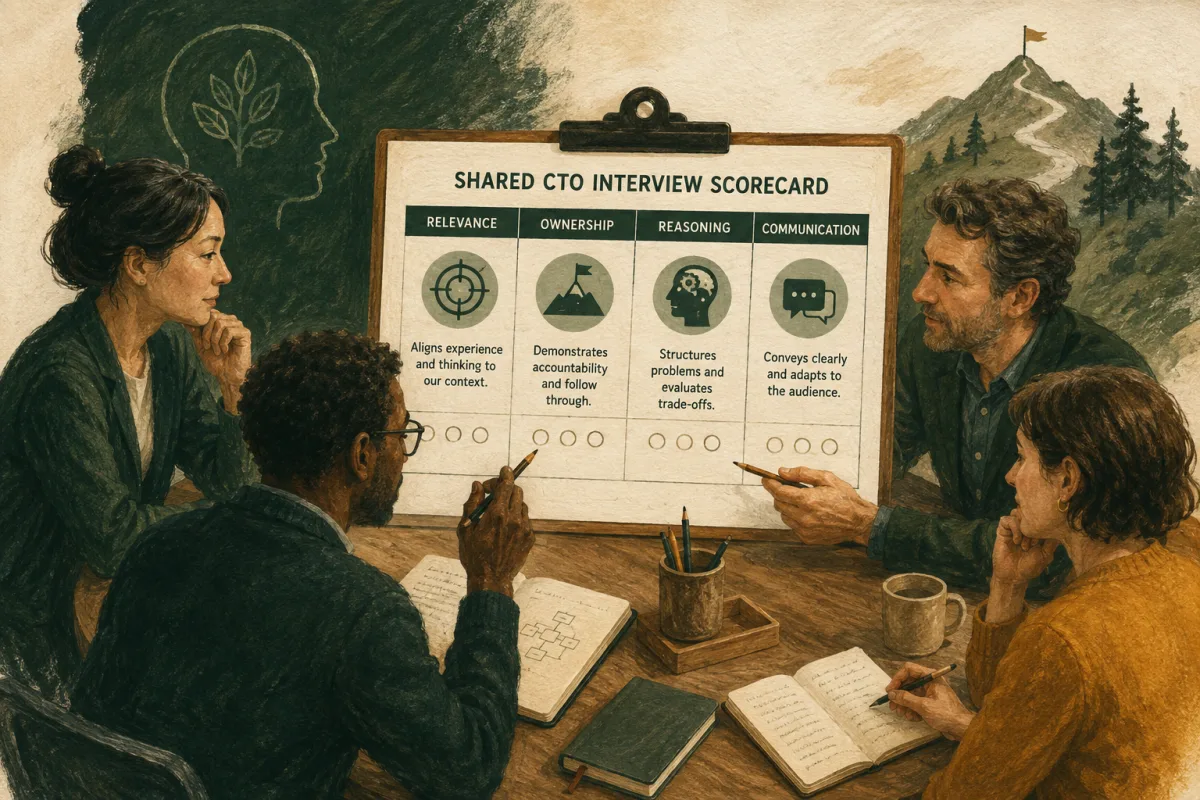
- Use a shared scorecard
- The 90-day-plan trap
- Reference questions that reconstruct the work
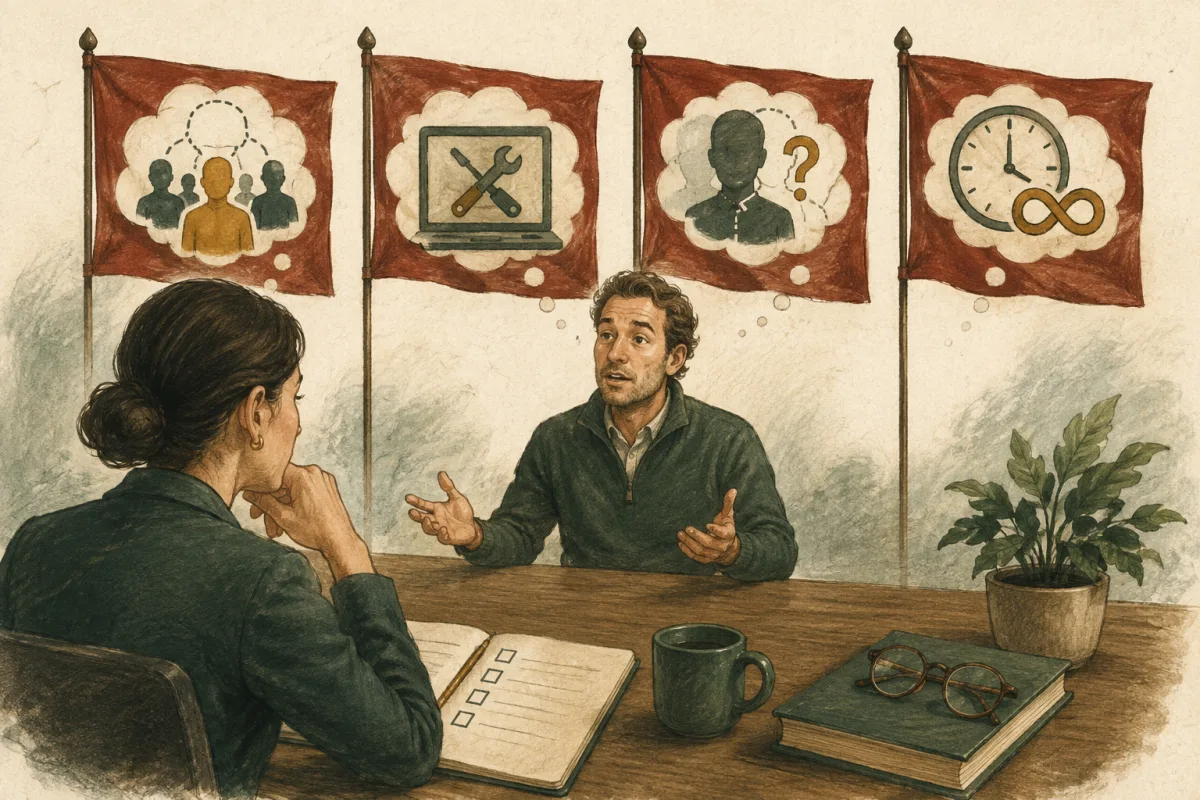
- Red flags
- A practical interview sequence
- A 60-minute interview agenda that leaves room for evidence
- Worked question: the founder wants a rewrite
- Worked question: an incident happens outside the retainer days
- Adapt the interview to company stage
- Resolve scoring disagreements before making an offer
- Frequently asked hiring questions
- Make the final choice explainable
Build the interview around four layers
Mandate relevance
Has the person owned a genuinely comparable situation? Compare company stage, team, capital, customers, regulation, technology risk, time horizon, and authority.
Executive judgment
Can the candidate distinguish evidence from assumption, create options, make tradeoffs, and communicate uncertainty?
Leadership
How do they shape teams, managers, founders, vendors, customers, and boards? What happens when people disagree or performance is weak?
Working model
Can the candidate provide the required cadence, response window, travel, and operating intensity while managing conflicts?

Do not spend the entire interview on biography. Use chronology to choose which decisions to investigate.
The core evidence question
Ask:
Tell us about a situation that is genuinely comparable to this mandate. What evidence did you have, which decision did you personally own, what reasonable options did you reject, and what happened?
Then stay with the example.
- What was true before you arrived?
- How did you know?
- Which part was your decision rather than the team’s?
- What did you not know?
- Who disagreed?
- What was the cost of your choice?
- What failed?
- Which evidence appeared later?
- What remained after you left?
- Who can verify the work?
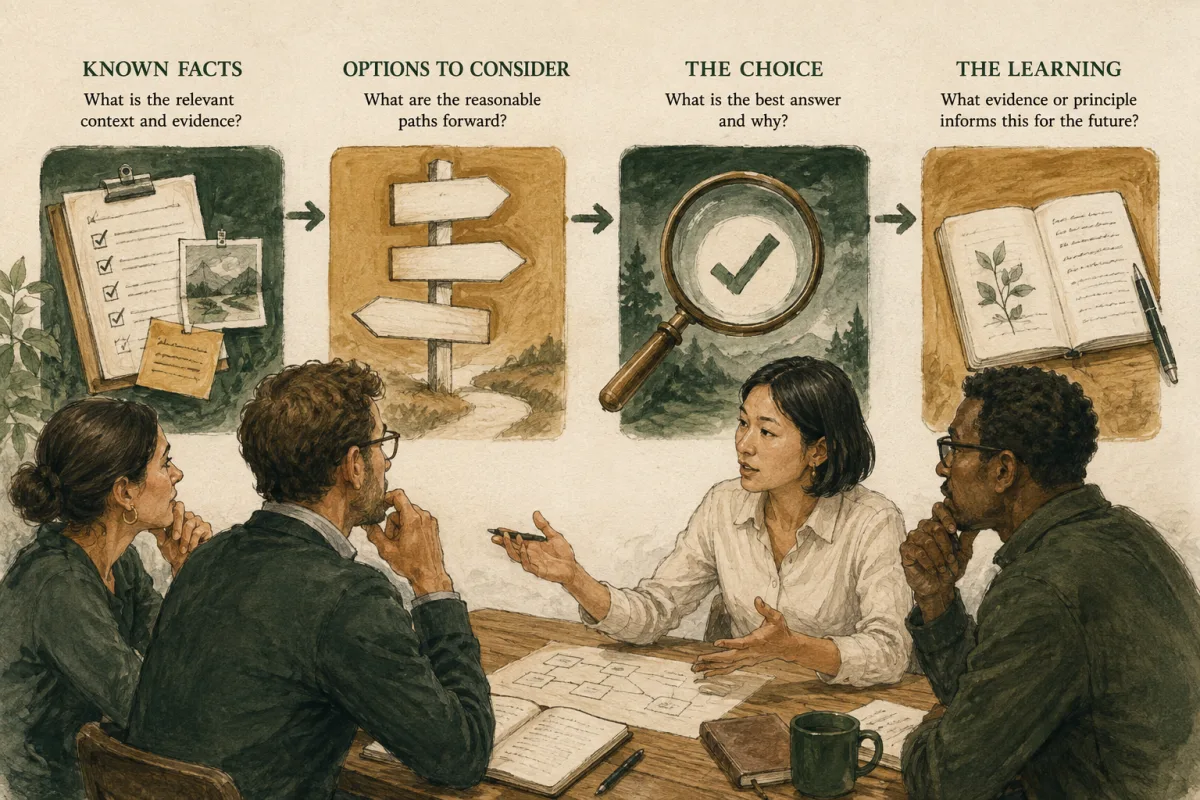
The follow-ups are more valuable than collecting 50 unrelated answers.
Questions about technology strategy
- Which technology investment did you decide not to make, and why?
- Tell us about a roadmap where business and engineering evidence conflicted.
- How did you separate reversible decisions from commitments?
- Describe a build-versus-buy decision that changed after new evidence.
- When have you accepted technical debt deliberately?
- How do you explain an architecture risk to a board without creating panic or false certainty?
Strong answers connect technology to customers, capital, risk, team capability, and time. Tool lists are weak unless the tool changed the decision.
Questions about engineering leadership
- Describe a team whose delivery was declining. How did you diagnose the system before judging individuals?
- When did you change the management structure?
- How do you decide whether to coach, replace, or add a leader?
- Tell us about a strong engineer who disagreed with you.
- Which measures do you use without turning them into performance theatre?
- How did the organization operate after your role changed?
Look for clarity about people authority. A fractional CTO with only advisory access cannot truthfully claim to have performance-managed a team.
Questions about incidents, security, and risk
- Reconstruct a serious incident. What did you personally decide?
- Which risk did you accept, and who approved it?
- How do you prioritize security when the roadmap is already overloaded?
- When should a CTO bring in a CISO or specialist?
- What would make you stop a launch?
- How do you communicate uncertainty during an incident?
Avoid rewarding candidates who claim they prevent every incident. Mature leaders prepare for failure, detect it, limit impact, learn, and change the system.
Questions about product and commercial judgment
- Tell us about a customer request you declined.
- When did you change a roadmap because of sales or support evidence?
- How do you protect learning speed without creating avoidable platform risk?
- Describe a technology decision that improved—or harmed—commercial flexibility.
- How do you work with a non-technical founder when the requested date is not credible?
The CTO is not the executive who says no to business. The CTO makes consequences and options visible enough for the company to decide.
Fractional working-model questions
Ask these directly:
- How many operating mandates do you currently hold?
- Which days and overlap windows are protected for us?
- What response time do you offer?
- Do you join incidents?
- Which meetings are necessary?
- What competing sectors or clients create conflicts?
- Can your capacity increase temporarily?
- What happens when the mandate needs a full-time executive?
- Who covers you during travel or illness?
- Which work will you not perform?
“I am always available” is not a strong answer. It is usually an untested promise.
Use a shared scorecard
Before interviews, define the dimensions and anchors.
| Dimension | Low evidence | Strong evidence |
|---|---|---|
| Relevance | Similar title only | Comparable stage, risk, and decision |
| Ownership | Vague “we” | Personal authority and contribution clear |
| Reasoning | Outcome-first story | Evidence, options, tradeoffs, uncertainty |
| Leadership | Generic values | Specific conflict and people decisions |
| Result | Activity or vanity metric | Baseline, change, window, limitations |
| Transition | Candidate remained essential | Internal ownership became stronger |
| Capacity | Flexible promise | Exact cadence and conflicts |
Collect each interviewer’s score before the discussion. Otherwise, the most senior voice or most charismatic candidate can reset the group’s memory.
Do not rely only on averages. A serious integrity, conflict, availability, or reference concern is not cancelled by high technical scores.
The 90-day-plan trap
A candidate with limited access cannot responsibly know the final plan.
Ask instead for:
- initial hypotheses;
- evidence they would request;
- urgent risks they would contain;
- people they would listen to;
- decisions they would defer;
- decision gates for the first 30, 60, and 90 days;
- measures that would reveal whether the mandate needs to change.
Reward calibrated uncertainty. A detailed reorganization and rewrite proposed after one interview may demonstrate presentation skill rather than judgment.
Reference questions that reconstruct the work
“Would you hire this person again?” is polite and easy.
Ask:
- What was happening before they joined?
- What authority did they really hold?
- Which decision was distinctly theirs?
- Where did you disagree?
- What did they underestimate?
- How did the team experience their leadership?
- What changed measurably?
- What remained difficult?
- What happened when they reduced capacity or left?
- For which mandate would you not hire them?

Use at least one reference who received the executive’s advice and one who lived with the operational consequences.
Red flags
Investigate when:
- every achievement uses “I” and every failure uses “we,” or the reverse hides ownership;
- answers begin with a preferred tool before the business decision;
- the candidate has never made a meaningful mistake;
- every prior company needed a rewrite;
- recognizable logos substitute for relevant examples;
- the candidate dismisses product, finance, security, or people constraints;
- they promise unlimited availability;
- they resist conflict disclosure;
- references can verify employment but not decisions;
- their plan makes the company dependent on them.
One weak answer is not a verdict. Patterns matter.
A practical interview sequence
Use four sessions:
- Mandate and evidence: comparable situations and executive reasoning.
- Working session: one real decision with sanitized evidence.
- Leadership and operating model: people, cadence, conflicts, and economics.
- References and mutual scope: verify claims and agree how the engagement works.
Do not ask candidates for unpaid consulting work or a complete company strategy. The working session should reveal how they frame a decision, not extract a deliverable.
A 60-minute interview agenda that leaves room for evidence
A question bank is useful only if the interviewer has enough time to investigate the answers. For an initial substantive interview, the following agenda is a practical starting point. It is an editorial suggestion, not a universally validated hiring procedure. Adjust it to the role and tell the candidate what the conversation will cover.
| Time allocation | Purpose | Evidence to capture |
|---|---|---|
| First 5 minutes | Confirm the mandate and interview structure | Shared understanding of the business decision |
| Next 15 minutes | Investigate one comparable engagement | Baseline, authority, options, and personal contribution |
| Next 15 minutes | Work through one bounded scenario | Clarifying questions, tradeoffs, and decision process |
| Next 10 minutes | Test leadership and fractional capacity | Internal ownership, cadence, escalation, and conflicts |
| Final 15 minutes | Candidate questions and next steps | Mutual fit, unresolved concerns, and verification plan |
Choose one primary interviewer to manage time and another to record evidence where possible. Avoid a panel in which everyone asks a favorite question and nobody follows up. If the candidate makes a material claim, stay with it long enough to understand the baseline and their contribution. You can defer a lower-priority topic to a later discussion.
Share enough context to make answers meaningful. A candidate cannot compare options sensibly if you conceal the business model, team structure, or intended authority. You do not need to disclose sensitive customer data. Provide a sanitized brief and state which details are deliberately omitted. Evaluate how the candidate handles those limitations.
Worked question: the founder wants a rewrite
Ask: “Our founder believes a rewrite will solve missed delivery dates. The engineering lead disagrees. What would you do before recommending an investment?” This is a hypothetical scenario. The purpose is to reveal reasoning rather than elicit a predetermined technology choice.
A weak answer immediately endorses or rejects the rewrite using a preferred architecture. Another weak answer promises a fixed delivery date without asking about scope or dependencies. Both skip the actual decision. A more useful answer distinguishes customer performance from engineering flow, asks what evidence supports the proposed cause, and identifies urgent risks that cannot wait for a broad review.
Probe the options: “What evidence would make a rewrite reasonable? What smaller intervention would you test first? How would you protect current customers while learning?” The candidate should be able to explain conditions under which their view would change. A cautious answer is not automatically a strong one; indefinite discovery can also avoid responsibility. Ask for a bounded process and a decision owner.
Then introduce disagreement: “The founder has already told investors that the rewrite will happen.” Look for an approach that makes consequences visible without humiliating the founder or quietly accepting an unsupported commitment. The candidate might propose an options review, revised communication, and staged investment. Assess the reasoning and authority required, not whether they use your preferred vocabulary.
Record what the candidate actually said. “Asked for the measured bottleneck and separated containment from investment” is stronger evidence than “seemed strategic.” If they miss a dimension, use one neutral follow-up before deciding whether the omission represents a meaningful gap.
Worked question: an incident happens outside the retainer days
Ask: “A customer-impacting incident begins on a day when you are working for another client. What happens?” This tests whether the fractional operating model is real. It is not a demand for a candidate to promise permanent on-call service.
A useful answer separates the incident command role, technical response, business communication, and executive decisions. The company needs to know who can act immediately, what escalation reaches the CTO, and which decisions require the sponsor. If the candidate proposes backup coverage, ask whether that coverage actually exists and how access and confidentiality would be handled.
Change one condition: “Our engineering manager is also unavailable.” The candidate may conclude that the company needs a stronger internal rota, a specialist support arrangement, more executive capacity, or an interim model. Treat an explicit mismatch as useful evidence. An unlimited availability promise may feel reassuring while leaving the company with no dependable response plan.
Close by asking how the arrangement would be documented and reviewed. The answer should connect the interview promise to the eventual scope, access setup, escalation path, and rehearsal. Compare candidates on the coverage they can support, including its cost and limitations.
Adapt the interview to company stage
Do not copy the same emphasis into every mandate. A pre-seed company may need disciplined product and technical choices with very little capital. A scaling business may need management systems, reliability, and delegation. A transaction may require an executive who can separate evidence from uncertainty under a fixed decision deadline.
| Situation | Useful emphasis | Follow-up question |
|---|---|---|
| Pre-seed product discovery | Learning scope, build-versus-buy, and cash constraints | What would you deliberately avoid building now? |
| Growing engineering team | Manager capability, ownership, and delivery dependencies | Which decisions should stop reaching the CTO? |
| Enterprise customer expansion | Reliability, integration commitments, and assurance work | How would you prevent one deal from distorting the platform? |
| Acquisition diligence | Evidence quality, material risk, and investment consequences | Which uncertainty could change the transaction decision? |
| Leadership departure | Immediate continuity and permanent role definition | What must work independently before you hand over? |
Use sector questions only when they matter to the mandate. If specialized regulation or assurance is central, involve someone qualified to evaluate that expertise. A general interview guide cannot validate a candidate's legal interpretation or certify their security competence. The CTO should know where specialist ownership is necessary and how to integrate it into the operating plan.
Resolve scoring disagreements before making an offer
Ask reviewers to record independent judgments promptly, including evidence and uncertainty. During the discussion, separate disagreement about facts from disagreement about priorities. One interviewer may have heard a clear operating cadence while another assumed full-time incident availability. That is a clarification issue, not a personality difference.
If a critical requirement remains unverified, ask a targeted follow-up or obtain a relevant, permissioned reference. Do not repeat an entire interview merely to generate more impressions. A short question about actual people-management authority may resolve a more important uncertainty than another broad conversation about leadership style.
Write the final decision in plain language: why this candidate fits, which risk remains, what capacity has been agreed in principle, and what the first engagement review will test. Include reasons to decline or defer when appropriate. This record helps the sponsor avoid changing the mandate after selection and blaming the candidate for expectations that were never agreed.
Frequently asked hiring questions
Should a fractional CTO complete a coding test?
Use an assessment relevant to the work the person will actually own. If the mandate includes hands-on implementation, a bounded technical exercise may be appropriate. If the role primarily owns strategy, management, and investment decisions, an architecture or operating scenario may provide more relevant evidence. Explain the purpose and time expectation, and avoid extracting unpaid production work.
Can a non-technical founder interview a CTO effectively?
Yes, a founder can investigate business judgment, authority, communication, references, and capacity. For technical depth, add an independent person with relevant expertise and clear conflicts disclosure. Give that reviewer the same mandate and scoring criteria. Do not outsource the entire hiring decision to a technical opinion disconnected from the company's commercial needs.
How should we evaluate an answer we disagree with?
Ask which assumptions support it and what evidence would change it. A different recommendation can reveal useful judgment when the reasoning is sound. Conversely, agreement with your preferred solution does not prove competence. Evaluate the candidate's handling of constraints, consequences, uncertainty, and ownership before judging the conclusion alone.
Are case studies more useful than interview answers?
They serve different purposes. A case study provides a prior claim to investigate; an interview shows how the candidate explains and adapts their reasoning. References and permissioned artifacts can strengthen the evidence. Use the case-study evaluation guide to distinguish authentic engagement evidence from a polished illustrative example.
What should happen after a strong interview?
Verify the consequential claims, resolve capacity and conflict questions, and convert the discussion into a bounded mandate. Define authority, internal dependencies, outputs, review points, and transition expectations. A positive conversation is the beginning of that agreement, not a substitute for it. The hiring guide connects selection to onboarding and engagement design.
Make the final choice explainable
The hiring team should be able to say:
- which evidence made this candidate relevant;
- which risks remain;
- why the capacity matches the mandate;
- how references changed confidence;
- what the first review point will test;
- what would cause the company to stop, expand, or transition the role.
That explanation is more valuable than “the chemistry was strong.” Chemistry matters, but a consequential executive selection needs evidence that survives the room.
Frequently asked questions
What questions should I ask a fractional CTO?
Ask the candidate to reconstruct comparable decisions: evidence known, alternatives, personal authority, tradeoffs, disagreement, result, failure, and transition. Also test capacity, conflicts, cadence, and first-90-day measures.
How can a non-technical founder interview a CTO?
Test reasoning and evidence rather than trivia. Use an independent technical reviewer for claims you cannot assess, but retain founder responsibility for business judgment, communication, ethics, and working fit.
Should a CTO candidate prepare a 90-day plan?
Ask for hypotheses, discovery priorities, urgent risks, and decision gates—not a confident transformation plan based on limited evidence. Over-specific plans before access can reward performance rather than judgment.
How should CTO interviews be scored?
Use a shared scorecard tied to the mandate, define scoring anchors, collect scores independently before discussion, and require evidence notes. Do not average away a serious integrity, availability, or reference concern.
Sources and further reading
Turn research into a mandate
See the cost and hiring model before you shortlist.
Use the free calculator, then save a candidate search or post a transparent role when the mandate is ready.