Executive hiring templates
CPO Job Description: Copyable Template and Scorecard
Copy an editable chief product officer job description with decision rights, 90-day outcomes and an interview scorecard. Compare CPO, VP Product and head of product.
- By
- Fractional CTO Experts
- Published
- 2026-10-22
- Reviewed
- 2026-10-22
- Reading time
- 15 minutes
- Chief product officer responsibilities, in plain terms
- CPO vs VP Product vs Head of Product
- Editable CPO job description template
- Write decision rights a candidate can test
- Worked example: a roadmap that promises more than the teams can build
- 90-day outcomes for a new CPO
- CPO interview scorecard
- Red flags in a CPO job description
- When a fractional CPO fits better
- Final review before you publish the role
A CPO job description should say which product decisions the chief product officer owns, which teams and budget come with the role, what stays with the CEO and CTO, and how the first 90 days will be judged. Everything else, from required experience to interview stages, should follow from those four points. The template below is written so you can copy it, delete what does not apply and fill the brackets with your company's facts.
A quick note on the acronym. CPO also stands for chief people officer and chief procurement officer. This page covers the chief product officer only. If you are hiring a people leader, the fractional CHRO guide is the closer match.
Along with the template, you get a comparison of CPO, VP Product and head of product titles, a decision-rights table, a worked example, 90-day outcomes and an interview scorecard. It is a hiring resource, not a live vacancy at Fractional CTO Experts.
Chief product officer responsibilities, in plain terms
Product leadership writing agrees on a small core. Marty Cagan's description of the VP Product role at Silicon Valley Product Group names four competencies: developing the team of product managers and designers, setting a product vision, execution, and product culture. The same article notes that the job appears under titles "ranging from Director of Product Management to Chief Product Officer", which is why the title alone tells a candidate very little.
A published employer example makes the core concrete. GitLab's public CPO job description reports to the CEO. It includes managing a team of product leaders "up to VP level", allocating engineering effort across product categories, pricing-tier decisions and a transparent roadmap. Your company will differ, but the pattern of naming concrete decisions, rather than traits, is worth copying.
Translated into responsibilities a candidate can test, a chief product officer typically:
- Sets product strategy that serves the company strategy, and says what the company will not build.
- Makes portfolio choices across products, segments or platforms, including when to stop investing in something.
- Builds the product organization: hiring, coaching and, when necessary, replacing product managers, designers and product leaders.
- Sets the discovery standard, meaning how the teams learn what customers need before committing engineering time.
- Owns the roadmap as a communication tool, so sales, customer success and the board understand what is committed and what is still a bet.
- Shares pricing and packaging decisions with commercial leaders where the company assigns product a role in them.
- Allocates product capacity with the CTO or engineering leader, because engineering effort is the scarcest input to most roadmaps.
- Reports product outcomes to the CEO and board with context, not only activity counts.
The US Bureau of Labor Statistics summarizes top executives as people who "plan strategies and policies to ensure that an organization meets its goals". That general framing is useful, but it is also why a CPO job description needs to be specific. The product part of the job is where candidates look for evidence that you know what you are asking for.
CPO vs VP Product vs Head of Product
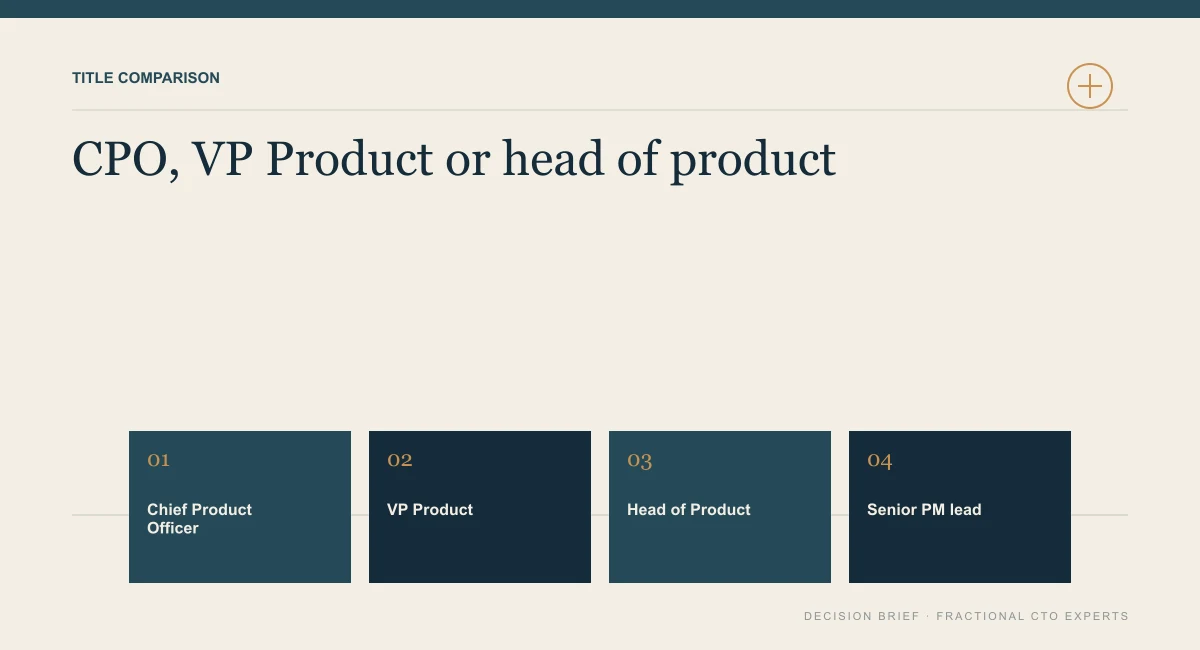
Titles vary so much between companies that you should choose one by the decisions attached to it, not by prestige. The UK government's digital, data and technology capability framework is a useful public reference. It defines five product levels up to "head of product", described as someone who leads on product strategy, supports all product managers in the organization and is "responsible for setting and raising standards for product management". That is close to what many private companies call a VP Product or CPO.
The table below describes common usage, not a legal or universal definition.
| Question | Chief Product Officer | VP Product | Head of Product |
|---|---|---|---|
| Typical reporting line | CEO | CEO or CPO | CEO, COO, CTO or VP Product |
| Scope of choices | Company-wide product strategy and portfolio | One product line or the whole product org in a smaller company | Product practice and strategy for a team or business unit |
| Leads other product leaders? | Usually yes | Sometimes | Rarely; usually leads PMs directly |
| Board exposure | Regular; presents product strategy | Occasional | Uncommon |
| Owns pricing or packaging input? | Often shares it with commercial leaders | Sometimes | Rarely |
| When the title fits | Several product teams or lines need one strategy and the CEO wants a product peer | One product needs senior leadership, or a CPO needs a delivery-focused deputy | First senior product hire in a single-product company |
Two practical rules follow. First, if the person will lead only product managers and never product leaders, "head of product" or "VP Product" is usually more honest than "CPO", and it avoids inflating the title before the company can support it. Second, if you intend the role to sit in the executive team and present to the board, say so. A VP title with CPO responsibilities tends to attract candidates who underestimate the job.
Editable CPO job description template
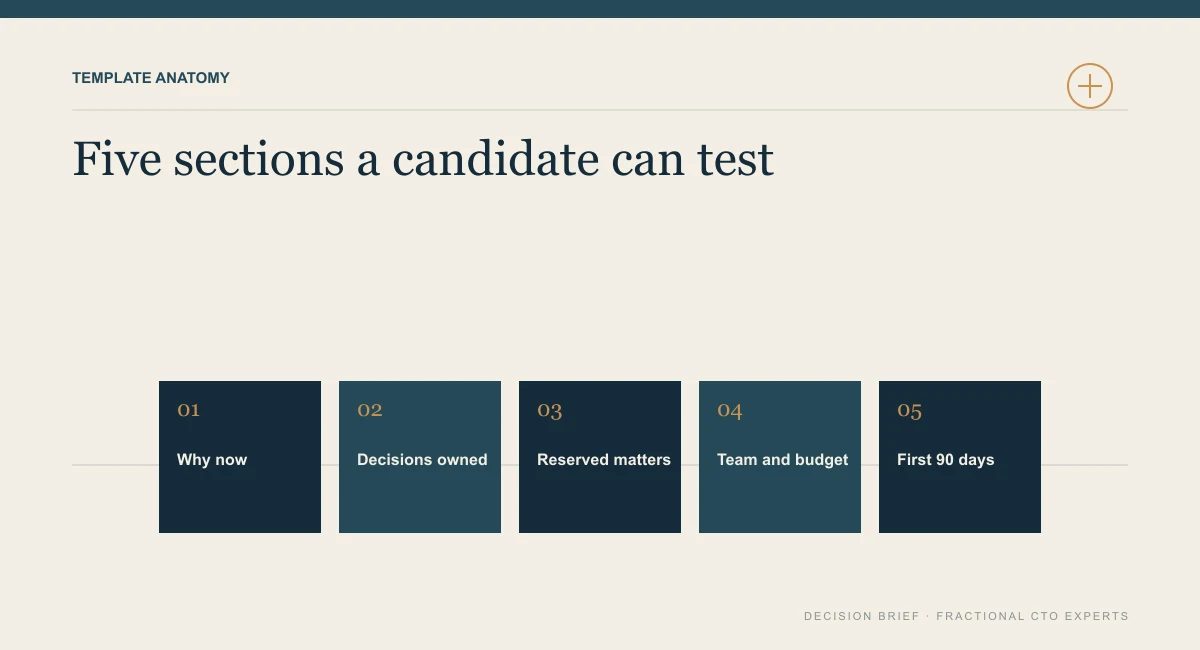
Copy the sections below into your applicant tracking system or document editor. Replace every bracketed field with verified company information, and delete any responsibility that is not part of the real mandate. The template deliberately separates what the CPO decides, what they recommend and what is reserved for someone else.
Role summary
Job title: Chief Product Officer.
Company: [Company name, what you sell, to whom, and the current stage, for example "B2B software for regional logistics firms, Series A"].
Reports to: [Chief Executive Officer, or another named role with an explanation].
Direct reports: [Product managers, product leaders, designers, product operations or analytics, named by role].
Engagement: [Full-time employment, interim appointment or fractional arrangement], with [working pattern or reserved capacity where relevant].
Location: [Office, hybrid or remote arrangement, required travel and time-zone expectations].
Why we are hiring now: [The specific product problem, for example "three product teams are working from separate roadmaps and our largest customers see inconsistent priorities"]. Keep this honest. Strong candidates use it to decide whether they can help.
Purpose of the role
The Chief Product Officer will own [company or product-line] product strategy and portfolio decisions, lead the product organization and make sure the teams build what customers and the business need. The CPO will work with the CEO, the [CTO or engineering leader] and commercial leaders to connect product choices to revenue, retention and cost goals. Success will be judged against the outcomes agreed for the first 90 days and the first year, from the baseline the company provides.
Responsibilities
- Define and communicate a product strategy that supports the company strategy, including explicit choices about what the company will not pursue.
- Decide how product investment is split across [products, segments or platforms] within the budget and headcount approved by [the CEO or board].
- Lead, hire and develop the product team, including [number] product managers and [number] designers, and set clear expectations for their work.
- Set the standard for product discovery, so teams test customer value and feasibility before large engineering commitments.
- Maintain a roadmap that separates committed work from exploration, and explain changes to sales, customer success and leadership.
- Agree product capacity with the [CTO or engineering leader], including how engineering effort is allocated across new work, maintenance and technical debt.
- Contribute to pricing and packaging decisions with [commercial leader], within the decision process described below.
- Report product performance to the CEO and board, with context on what changed, why, and what the team learned.
- Build working relationships with key customers and partners, and bring their evidence into product decisions without letting the loudest customer set the roadmap.
Decision rights
The CPO decides: [for example, roadmap priority within approved capacity, product team structure within approved headcount, discovery methods, feature retirement below an agreed revenue threshold].
The CPO recommends, and [CEO or executive team] decides: [for example, new product lines, market entry, pricing changes, headcount above plan].
The CPO is consulted on: [for example, technical architecture changes that affect product scope, commercial commitments that include product promises].
Reserved to others: [for example, customer contract terms, engineering hiring, security exceptions].
Experience and capabilities
- Evidence of leading product strategy for [comparable product type, customer type or market], including decisions that turned out wrong and what the candidate changed.
- Experience leading [product managers only, or product leaders who manage product managers], matching the actual team.
- A record of working with engineering leadership on capacity and technical tradeoffs.
- Comfort presenting product strategy and results to [executive team, board or investors].
- [Domain knowledge that is genuinely required, for example regulated payments or clinical workflows]. Separate essential knowledge from knowledge a strong candidate could learn.
Avoid adding a degree, a certification or a number of years because another template does. Ask for evidence tied to the work instead.
First 90 days
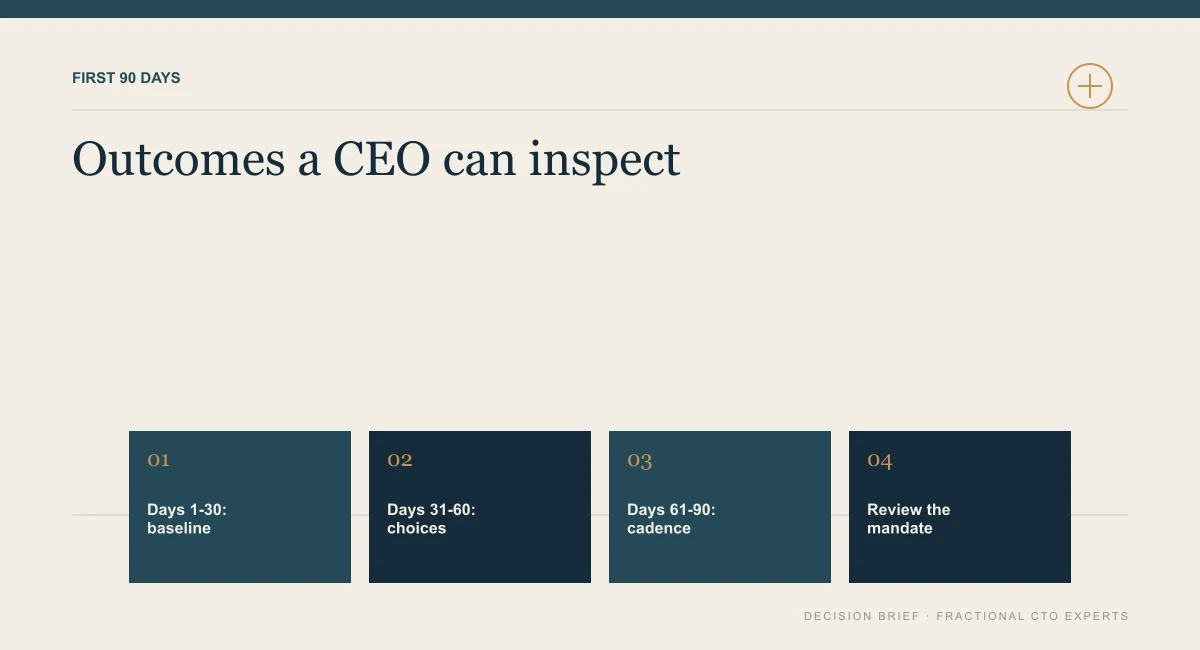
In the first 90 days the CPO will [establish a product baseline, agree portfolio choices with the CEO, and put a product review cadence in place]. Specific outcomes are listed in the section of this page on 90-day outcomes; copy the ones that fit.
Compensation and process
[Compensation information and engagement terms appropriate to the role and required where you hire], [application steps], [interview stages and approximate timing], [contact for questions or adjustments]. This template does not provide a market salary benchmark.
Write decision rights a candidate can test
The decision-rights section is where most CPO job descriptions are weakest, and it is what experienced candidates probe hardest. A CPO who cannot stop a feature promised by sales, or who cannot move one engineer between teams, has a title without a mandate. Use the table as a drafting aid; your answers will differ.
| Decision | CPO owns | CPO recommends | Someone else owns | Common conflict to settle in advance |
|---|---|---|---|---|
| Roadmap priority within approved capacity | Yes | Sales commitments made before the CPO joined | ||
| Allocation of engineering effort across products | Shared with CTO | Maintenance and technical debt versus new features | ||
| Launching a new product line | Yes | CEO or board | Investment size and timing | |
| Retiring a feature or product | Yes, below an agreed revenue or customer threshold | Above the threshold | CEO | Customers on legacy contracts |
| Pricing and packaging | Often | Commercial leader or CEO | Discounting that bypasses packaging | |
| Product team structure | Yes, within headcount | Existing managers' expectations | ||
| Customer-specific feature promises | Consulted | Commercial leader | Deal-driven roadmap changes |
If the answer to "who decides?" is "we discuss it", write down how the discussion ends. For example: "If the CPO and CTO disagree on capacity allocation, the CEO decides at the monthly product review." That sentence is short, but it prevents months of informal escalation.
Worked example: a roadmap that promises more than the teams can build
This example is invented to show how the template becomes an interview exercise. It is not a client case or a benchmark.
A software company has three product teams. Each team's engineering lead estimates capacity of about 10 sprint-weeks of feature work in the next quarter, so 30 in total. The current roadmap contains 42 sprint-weeks of committed items. Of those, 14 were promised to named customers during sales cycles, and 8 are platform work that the CTO considers necessary to keep release times stable.
Simple arithmetic shows a 12-week gap. A weak answer from a candidate is to ask for more engineers or to cut items from the bottom of the list. A strong answer usually starts with questions:
- Are the 14 customer-promised weeks contractual, or were they verbal intentions? Which revenue depends on them, and when?
- Is the 8-week platform work reducing a risk that would slow every team later? If so, deferring it may cost more than it saves.
- Are the estimates for comparable work, or do some items still need discovery before anyone can size them?
- Which of the remaining 20 weeks have evidence behind them, and which are there because nobody removed them?
The candidate should then propose options with consequences. They might fund the platform work, keep contractual promises, move verbal promises to a later quarter with a message for the account owner, and send two unvalidated items back to discovery. They should also name who approves each change. In this company, the template's decision-rights section says the CPO owns priority within capacity, while customer contract terms belong to the commercial leader. So the CPO decides the sequence, and the commercial leader decides what to tell customers about contractual items.
The responsibility this creates in the job description is: "Maintain a roadmap that separates committed work from exploration, and explain changes to sales, customer success and leadership." The matching interview exercise is this scenario. The scorecard rewards clear assumptions and correct escalation, not the most confident number.
90-day outcomes for a new CPO
A 90-day plan should produce decisions and working habits, not a strategy deck nobody uses. The phases below are a starting point. Adjust them to your company's calendar, such as a board meeting or annual planning cycle.
| Period | Outcome | Evidence the CEO can inspect | Reviewed with |
|---|---|---|---|
| Days 1–30 | Product baseline | One-page summary of products, teams, current commitments, customer evidence and known risks | CEO, CTO |
| Days 1–30 | Relationship map | Notes from conversations with each product manager, engineering lead, major customer owner and board member the CEO nominates | CEO |
| Days 31–60 | Portfolio choices | Written recommendation of where to invest, hold and stop, with the evidence and its limits | CEO, executive team |
| Days 31–60 | Roadmap reset | Roadmap split into committed and exploratory work, with customer-facing changes agreed with the commercial leader | CTO, commercial leader |
| Days 61–90 | Operating cadence | A recurring product review that makes decisions and records them | Executive team |
| Days 61–90 | Team plan | Assessment of product team strengths and gaps, with a hiring or development plan within approved budget | CEO, people leader |
| Day 90 | Mandate review | CEO and CPO confirm or change decision rights based on what the first quarter showed | CEO |
Resist attaching revenue or retention targets to the first 90 days unless the CPO controls the inputs in that period. Most product changes take longer to show up in those numbers. It is fair to expect the CPO to agree on the measures that will be used later and to establish the baseline for them.
CPO interview scorecard
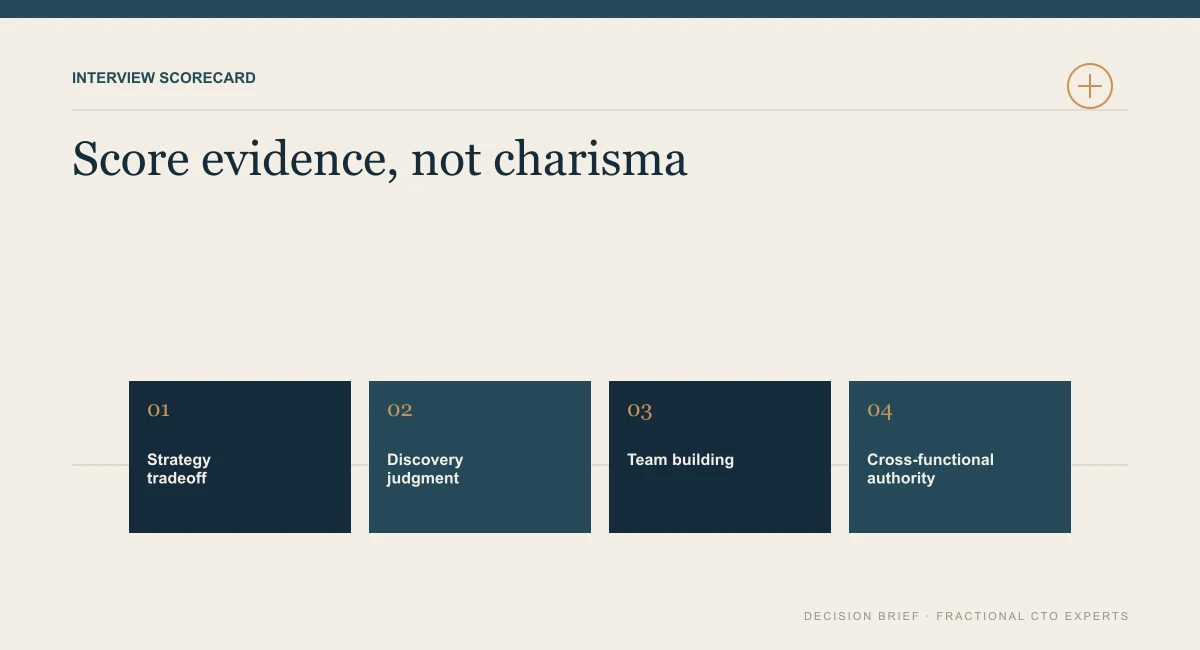
Agree the criteria before the first interview, and have each interviewer score independently before the debrief. Tie every criterion to a responsibility in the job description. The weights below are an illustrative starting point for a company whose main problem is fragmented roadmaps; change them for your situation.
| Criterion | Illustrative weight | Question or exercise | Strong evidence | Weak evidence |
|---|---|---|---|---|
| Strategy and tradeoffs | 25% | "Tell me about a product you decided to stop investing in." | Names the evidence, the people affected and what happened afterwards | Only describes launches; no example of stopping anything |
| Roadmap and capacity judgment | 20% | Worked example from this page | Tests assumptions, separates contractual and verbal promises, names decision owners | Jumps to headcount or a single number |
| Discovery standard | 15% | "How did your teams decide what was worth building last quarter?" | Describes methods, what evidence changed a plan, and limits of that evidence | Relies on stakeholder requests or opinion |
| Building the product team | 15% | "Describe a product manager you hired, and one you had to move out of the role." | Clear expectations, coaching steps, fair process | Vague about their own contribution |
| Cross-functional authority | 15% | "Describe a disagreement with an engineering or sales leader." | Knows who owned the decision; escalated appropriately; relationship survived | Won by persistence or went around the other leader |
| Board and CEO communication | 10% | Ask for a redacted product update they wrote | Explains outcomes with context and admits misses | Lists shipped features only |
Use a four-point rating: insufficient evidence, partial, sufficient, strong. Write a sentence explaining each rating. If interviewers disagree by more than one point on a criterion, discuss the evidence each heard rather than averaging.
Here is how the weights work in practice. Suppose one candidate scores strong (4) on strategy and roadmap judgment, and sufficient (3) elsewhere. Their weighted score is 0.25×4 + 0.20×4 + 0.55×3 = 3.45. Another candidate scores strong on communication and team building but partial (2) on roadmap judgment. The first candidate fits the stated problem better, even if the second interviewed more smoothly. The arithmetic is only a prompt for discussion; the written evidence is what the panel should defend.
When you check references, ask the referee to reconstruct one decision: what the situation was, what the candidate decided, who disagreed and what happened next. A reference who can only describe the candidate's personality has not given you evidence about product leadership.
Red flags in a CPO job description
Review your draft against this checklist before you post it. Each item is a common reason strong candidates decline to apply.
- No product problem is stated. "Drive product excellence" does not tell a candidate why the role exists now.
- Responsibilities without authority. The CPO "owns the roadmap", but sales can add commitments without review.
- The CPO and CTO both own product capacity, with no rule for resolving disagreement.
- The team is not described. Candidates cannot judge the job without knowing how many product managers and designers there are, and at what level.
- A CPO title on a head-of-product job. If the role leads three product managers and never presents to the board, the title may attract people who will be disappointed.
- Revenue targets in the first quarter that the CPO cannot influence in that time.
- Copied requirements such as a specific degree or a large number of years that the work does not need.
- No compensation or process information where the candidate would reasonably expect it, or where local rules require it.
When a fractional CPO fits better
A full-time CPO is not the only way to cover product leadership. A fractional CPO holds the same kind of mandate for a reserved share of their time. That can work well when the company needs executive product judgment but not a full-time executive. The fractional CPO guide covers how those engagements are scoped.
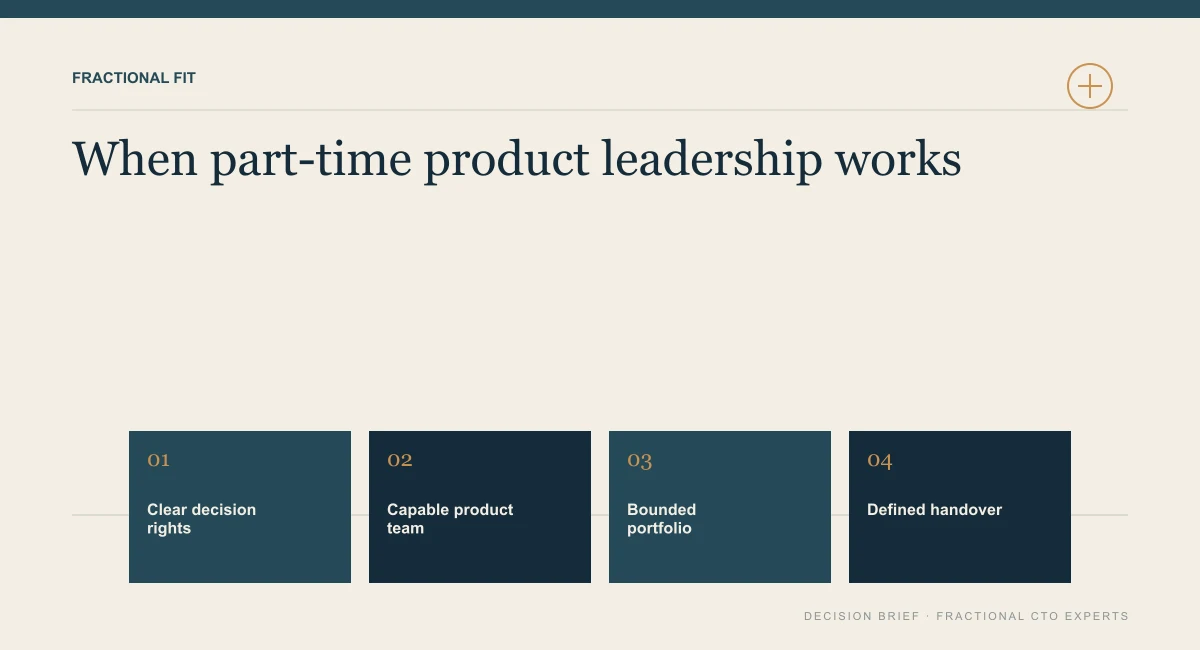
A fractional arrangement tends to fit when:
- Decision rights are clear, and the CEO will let an external leader make or recommend product calls.
- The company already has capable product managers who carry day-to-day work between the CPO's sessions.
- The portfolio is bounded, such as one or two products, and does not need constant executive presence.
- There is a defined end state: hiring a permanent CPO, promoting an internal head of product or completing a portfolio reset.
It tends to fit poorly when the company has no product managers, when the product changes daily and needs constant decisions, or when the CEO wants someone to manage every roadmap meeting. If the gap is hands-on product management for one product area rather than executive leadership, a fractional product manager is often the more precise hire.
The template above still applies to a fractional mandate. Add the reserved capacity, the availability between reviews and the internal person who carries decisions forward on days the CPO is not working. Leave the decision rights as specific as they would be for a full-time hire.
Final review before you publish the role
Read the completed description once more against three questions:
- Can an outsider explain why the role exists? Give the draft to someone outside the hiring group and ask them to describe the product problem in one sentence.
- Does every major responsibility have matching authority and resources? If the CPO owns roadmap priority, the decision-rights section should say what happens when sales disagrees.
- Could the interview panel score a candidate against this document? Every scorecard criterion should map to a responsibility, and every important responsibility should have a way to test it.
If the role also depends on technical leadership, the CTO job description template uses the same structure, which makes the boundary between the two roles easier to write. Fractional CTO Experts is an executive network and matching platform. If a fractional or interim product mandate fits, you can request a shortlist with the completed description and assess each candidate's evidence directly.
The worked example and scorecard weights on this page are illustrative. The diagrams are simple editorial graphics, not depictions of real candidates or client results. This template is an editorial hiring resource, not a claim of independent specialist review or a live job advertisement.
Frequently asked questions
How is a CPO different from a CTO?
The CPO usually owns what the company builds and why: product strategy, portfolio choices and the product management team. The CTO usually owns how it is built and run: architecture, engineering capacity and technical risk. Write down where the two share decisions, such as allocating engineering effort, rather than assuming the titles settle it.
Who should a chief product officer report to?
Most CPO mandates report to the CEO because product choices shape company strategy, and published examples such as GitLab's CPO description use that line. A CPO reporting to another executive can work, but the job description should then explain which product decisions still reach the CEO directly.
Should a startup hire a CPO before it has product-market fit?
Usually a founder or a senior product manager owns discovery at that stage, because there is not yet a portfolio or a product team to lead. A CPO title is easier to justify once several teams need a shared product strategy. A time-bound fractional product leader can bridge the gap.
Does a CPO job description need a salary range?
Some jurisdictions require pay information in job postings, and candidates at this level expect compensation to be discussed early. Confirm the rules that apply where you hire. This template leaves a field for compensation and does not supply a market benchmark.
Can this template be used for a chief people officer or chief procurement officer?
No. The acronym is shared, but those roles own the workforce and purchasing respectively. The responsibilities, decision rights and scorecard here are written for a chief product officer only.
Sources and further reading