AI leadership
Fractional Chief AI Officer: Mandate, Governance and Hiring
What a fractional chief AI officer owns, how the role differs from an AI consultant or fractional CTO, the governance anchors it answers to, and a hiring scorecard.
- By
- Fractional CTO Experts
- Published
- 2026-10-26
- Reviewed
- 2026-10-26
- Reading time
- 16 minutes
- Where the chief AI officer role is actually defined
- Fractional CAIO vs AI consultant vs fractional CTO
- Do you need a chief AI officer at all?
- Governance anchors the role should answer to
- Copyable fractional CAIO mandate
- Worked example: three AI proposals in one quarter
- First 90 days for a fractional CAIO
- Evidence to ask candidates for
- Hiring scorecard for a fractional CAIO
- Scope the engagement and plan the exit
A fractional chief AI officer is a part-time executive who owns an organization's AI decisions for a reserved share of their time. Those decisions cover which AI uses to pursue or stop, how their risks are governed, which vendor and data terms are acceptable, and who is accountable when something goes wrong. The role differs from an AI consultant, who delivers a defined analysis or project, and from a fractional CTO, who owns the technology platform and engineering team.
The title is new in private companies and has no settled definition. This guide uses the clearest formal description available, a US federal policy memo, as a reference point. It then sets out the governance frameworks the role usually answers to, a copyable mandate, a first-90-days plan, the evidence to request from candidates and a hiring scorecard. It does not cite adoption statistics, because we could not verify reliable figures for private-sector CAIO roles.
Where the chief AI officer role is actually defined
Most descriptions of the chief AI officer come from vendors, communities and job boards, and they vary widely. The most specific public definition we found is in US federal policy. OMB memorandum M-25-21, dated April 3, 2025, rescinds and replaces the earlier M-24-10. It requires the head of each federal agency to "retain or designate a Chief AI Officer (CAIO)" within 60 days.
The memo applies to Executive Branch agencies, not to companies. Still, it is a useful model because it spells out duties in operational terms. Under M-25-21, the CAIO, working with other agency officials, must:
- promote responsible AI innovation and adoption through a governance and oversight process;
- coordinate with other officials so that AI use complies with applicable law and guidance;
- serve as the senior adviser on AI to the agency head;
- maintain the agency's AI use case inventory;
- ensure processes exist for "high-impact AI", including determining which uses are high-impact, monitoring their performance and arranging independent review before risk is accepted;
- advise on building an AI-ready workforce;
- guide AI investment decisions with the agency head and CFO, and support tracking of AI spending.
Two more details in the memo carry over to private companies. First, agencies may designate an existing official, "such as a Chief Information Officer, Chief Data Officer, Chief Technology Officer", provided that person has significant AI expertise. The role is a mandate that can be added to another seat, not necessarily a new headcount. Second, the CAIO "must have the necessary authority to perform the responsibilities" and be senior enough to engage regularly with top leadership. A CAIO without authority is an adviser with a bigger title.
For a company, the practical translation is: someone must keep an inventory of AI uses, decide which ones carry significant risk, make sure those risks are reviewed before launch, and advise leadership on where AI investment should go. A fractional CAIO does this for part of their week. It works when those decisions are real, recurring and currently unowned.
Fractional CAIO vs AI consultant vs fractional CTO
Many searches for a fractional chief AI officer are really looking for AI strategy consulting with a new title. That is not a criticism; a project may be exactly what the company needs. The table helps you decide which arrangement matches the gap.
| Question | Fractional CAIO | AI consultant or strategy engagement | Fractional CTO | Governance adviser |
|---|---|---|---|---|
| What is bought? | Ongoing ownership of AI decisions | A defined analysis, roadmap or build | Ongoing ownership of technology and engineering | Policies, controls and review support |
| Holds decision rights? | Yes, as agreed in the mandate | No; recommends | Yes, for technology | No; advises the owner |
| Typical outputs | Use-case portfolio decisions, risk sign-offs, vendor approvals, operating cadence | Use-case assessment, pilot, model or report | Architecture, delivery plan, team structure | Inventory method, policy set, review process |
| Ends when | Capability is handed to a permanent owner | Deliverable is accepted | Mandate or transition is complete | Controls are adopted |
| Main risk if mis-chosen | Paying for a title while nobody inside owns the work | A good report with no owner to act on it | AI governance squeezed by platform work | Controls with no authority behind them |
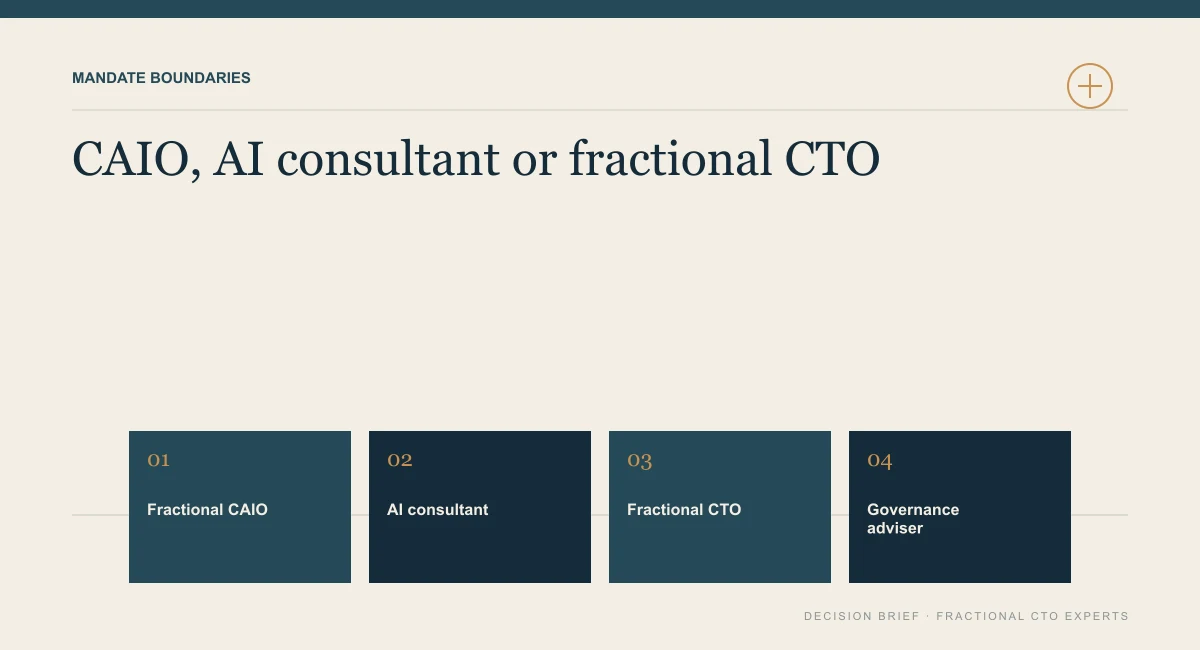
Use the AI and ML consultant guide when the need is a specific model or feature, and AI strategy consulting when you need a prioritized set of use cases once. Use a fractional CTO when the core gap is the technology platform and team, with AI as one part of it. The CAIO arrangement is the right one when AI decisions keep arriving across several functions and no executive owns them.
Do you need a chief AI officer at all?
Answer the questions below honestly before writing a mandate. They are a decision aid, not a scoring model.
| Signal | Points toward a CAIO mandate | Points toward something smaller |
|---|---|---|
| Number of AI uses | Several, across different functions | One or two, inside one team |
| Who proposes them | Many teams, plus vendors adding AI to tools you already use | One product team |
| Risk profile | Some affect hiring, credit, health, safety or customer rights | Internal drafting and summarization with human review |
| Regulatory exposure | You sell or deploy AI in the EU or to US federal agencies | No specific regime applies beyond general law |
| Existing owner | Nobody; or the CTO has no capacity | A CTO, CIO or head of data has capacity and relevant expertise |
| What leadership asks for | Ongoing decisions and accountability | A one-time plan or a readiness check |
If most answers sit in the right-hand column, start with an AI readiness assessment or a bounded strategy engagement. Add the CAIO duties to an existing executive, and revisit the question in six months. If most sit on the left, a fractional CAIO is worth scoping. The rest of this guide assumes you are in that position.
Governance anchors the role should answer to
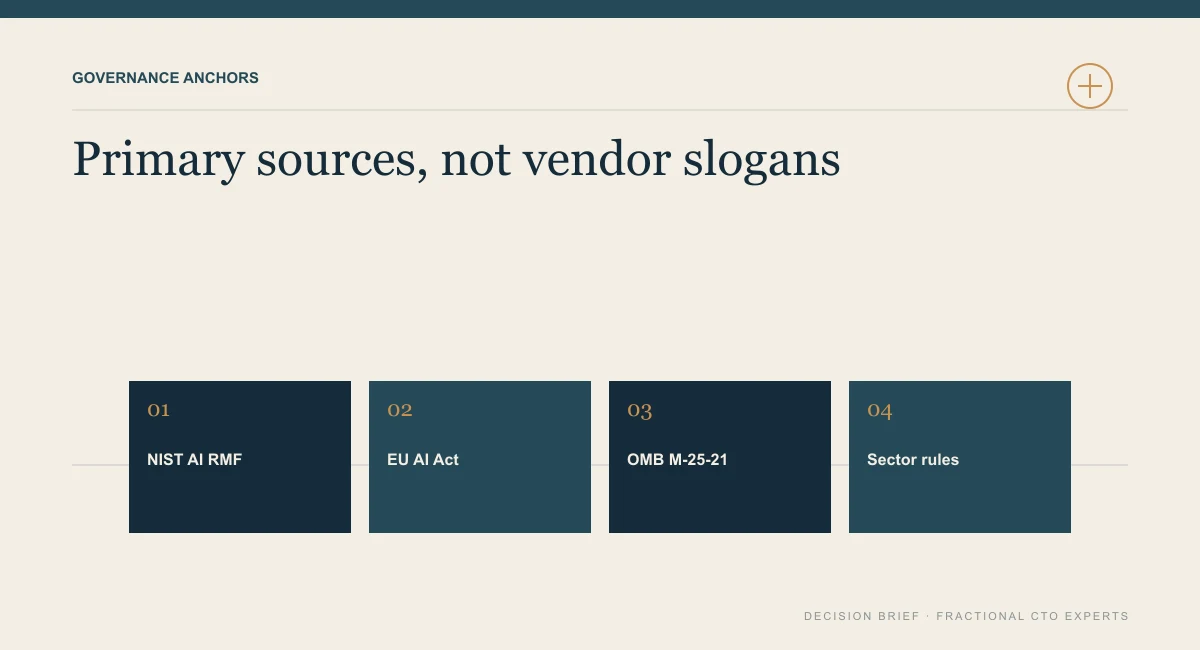
A CAIO is accountable for making the organization's AI use defensible. That means knowing which frameworks and laws apply and showing evidence of meeting them. Three public sources recur. The mandate should name the ones that apply to you.
NIST AI Risk Management Framework
NIST released the AI Risk Management Framework on January 26, 2023, "intended for voluntary use". It is organized around four functions: Govern, Map, Measure and Manage. NIST added a Generative AI Profile, NIST AI 600-1, on July 26, 2024.
Several subcategories in the framework document read almost like a CAIO job description:
- GOVERN 1.6: "Mechanisms are in place to inventory AI systems and are resourced according to organizational risk priorities."
- GOVERN 2.1: roles, responsibilities and lines of communication for mapping, measuring and managing AI risks are documented and clear.
- GOVERN 2.3: "Executive leadership of the organization takes responsibility for decisions about risks associated with AI system development and deployment."
- GOVERN 6.1: policies address AI risks from third-party entities, including infringement of a third party's intellectual property or other rights.
Because it is voluntary, the framework is often the easiest structure for a company to adopt without a legal trigger. A CAIO who cannot explain how their past work mapped to something like it is likely to struggle with the governance half of the role.
EU AI Act
If you place AI systems on the EU market or use them there, the EU AI Act assigns obligations based on your role. The Article 3 definitions distinguish a provider, which develops an AI system and places it on the market under its own name, from a deployer, which uses "an AI system under its authority". A software company can be both: a provider of the AI features in its product and a deployer of AI tools it buys.
The timeline has changed, so check it. According to the European Commission, the Act entered into force on August 1, 2024. Prohibited practices and AI literacy obligations applied from February 2, 2025, and rules for general-purpose AI models from August 2, 2025. The Act became generally applicable on August 2, 2026, with exceptions. The Commission's page also says an amending "AI Omnibus" entered into force on July 27, 2026. Under it, high-risk rules for use cases in sensitive areas (Annex III) apply from December 2, 2027, and rules for high-risk AI embedded in regulated products (Annex I) from August 2, 2028.
Two provisions matter directly to a CAIO:
- AI literacy. Article 4, as originally adopted, requires providers and deployers to take measures to ensure "a sufficient level of AI literacy" among staff dealing with AI systems. The Commission's service desk notes that the provision "has been amended by the Digital Omnibus on AI" and that its displayed text has not yet been updated. Confirm the current wording before you build a training obligation around it.
- Deployer duties for high-risk systems. Article 26 requires deployers to use high-risk systems according to the instructions for use. They must assign human oversight to people with "the necessary competence, training and authority", monitor operation and keep automatically generated logs for at least six months unless other law provides otherwise. Annex III lists high-risk areas, including AI "intended to be used for the recruitment or selection of natural persons".
None of this requires a title called chief AI officer. It requires someone who knows which of your systems fall into which category, and who can show the evidence. Classification decisions have legal consequences, so the CAIO should own the process and involve qualified counsel for the conclusions.
US federal buyers
M-25-21 sets minimum risk-management practices for high-impact AI used by agencies. They include pre-deployment testing, a documented AI impact assessment and ongoing monitoring. The impact assessment must cover intended purpose and benefits, data quality and fitness, potential impacts on privacy, civil rights and civil liberties, reassessment plans, costs, independent review and a signed risk acceptance. The memo also notes that when an agency lacks access to source code, models or data, it must use alternative testing methods such as querying the service. If you sell AI to federal agencies, expect buyers to ask for information that helps them complete these steps. A CAIO should know what you can provide.
The AI governance consulting guide goes deeper into building inventories, controls and evaluation evidence. The CAIO's job is to make sure that work has an owner and reaches decisions.
Copyable fractional CAIO mandate
Copy this into an engagement letter or internal appointment note. Replace the bracketed text and delete what does not apply. A mandate this specific protects both sides: the company knows what it is paying for, and the CAIO knows what they can decide.
Role: Fractional Chief AI Officer.
Reports to: [CEO, or another named executive], with a standing slot at [executive team or board risk committee meetings, and how often].
Capacity: [Reserved days or hours per period], plus [response expectations between sessions, for example for incident escalation].
Why now: [The specific situation, for example "Teams have adopted several AI tools independently, and we plan to launch an AI feature to EU customers next year."]
Decision rights. The CAIO decides:
- whether a proposed AI use enters the inventory as low, elevated or high risk, using the agreed classification method;
- whether an elevated or high-risk use may proceed to pilot, with conditions;
- approval of AI vendors against the agreed data, security and contractual criteria, up to [spend or risk threshold];
- the content of the AI use policy and the training requirements for staff.
The CAIO recommends, and [CEO or executive team] decides:
- the AI investment portfolio and budget;
- launch of any high-risk use or any AI feature sold to customers;
- acceptance of residual risk for high-risk uses, signed by [named role].
Reserved to others: legal conclusions ([counsel]), security exceptions ([security owner]), engineering staffing and architecture ([CTO]), and employment decisions ([people leader]).
Deliverables in the first 90 days:
- An inventory of AI in use, in pilot and proposed, including AI features inside purchased software.
- A classification of each use against the agreed method, noting which laws or frameworks apply.
- A portfolio recommendation: continue, change, stop or start.
- An AI use policy, a vendor review checklist and a decision log.
- A recurring AI review meeting that makes and records decisions.
- A handover plan naming the internal owner or permanent hire who will take the mandate on.
Evidence of success: decisions recorded and followed, high-risk uses with documented oversight and monitoring, fewer unreviewed tools in use, and an internal owner able to run the cadence. Do not measure the CAIO on the number of AI projects launched.
Conflicts: the CAIO discloses any commercial relationship with AI vendors under consideration and steps out of those approvals.
Worked example: three AI proposals in one quarter
This example is invented to show how the mandate works. It is not a client case, and the classifications are illustrative, not legal advice.
A B2B software company with about 150 staff sells to customers in the US and the EU. In one quarter, three proposals reach leadership:
- Support reply drafting. The support team wants a third-party model to draft replies, which agents edit before sending.
- Document summaries in the product. Product wants to launch a feature that summarizes customers' uploaded contracts.
- Application screening. The people team wants a vendor tool that ranks job applicants for roles in the Dublin office.
Without a CAIO, each proposal goes through its own team's budget process, and nobody compares them. With one, the CAIO puts all three into the inventory and classifies them:
- The support drafting tool is a deployer use with a human in the loop and no decision about individuals' rights. The main questions are data handling and confidentiality in the vendor contract, which the CAIO checks against the vendor checklist. It proceeds with conditions.
- The summarization feature makes the company a provider of an AI capability. The CAIO requires an evaluation plan before launch: what counts as an unacceptable summary error, how it will be measured on representative documents, and what the customer sees. Launch goes to the executive team for approval under the mandate.
- The screening tool matches the Annex III description of AI "to analyse and filter job applications". Used in the EU, that points toward high-risk treatment, and the Commission's timeline says those rules apply from December 2, 2027. The CAIO does not simply block it. The recommendation lays out the deployer duties the company would need to meet, including competent human oversight, monitoring and log retention. It then asks counsel to confirm the classification and asks the vendor for its instructions for use and documentation. Leadership decides whether the benefit justifies that work now.
The value here is not that the CAIO knew the answers in advance. It is that one person saw all three proposals, applied one method, and routed each decision to the right owner with evidence attached.
First 90 days for a fractional CAIO
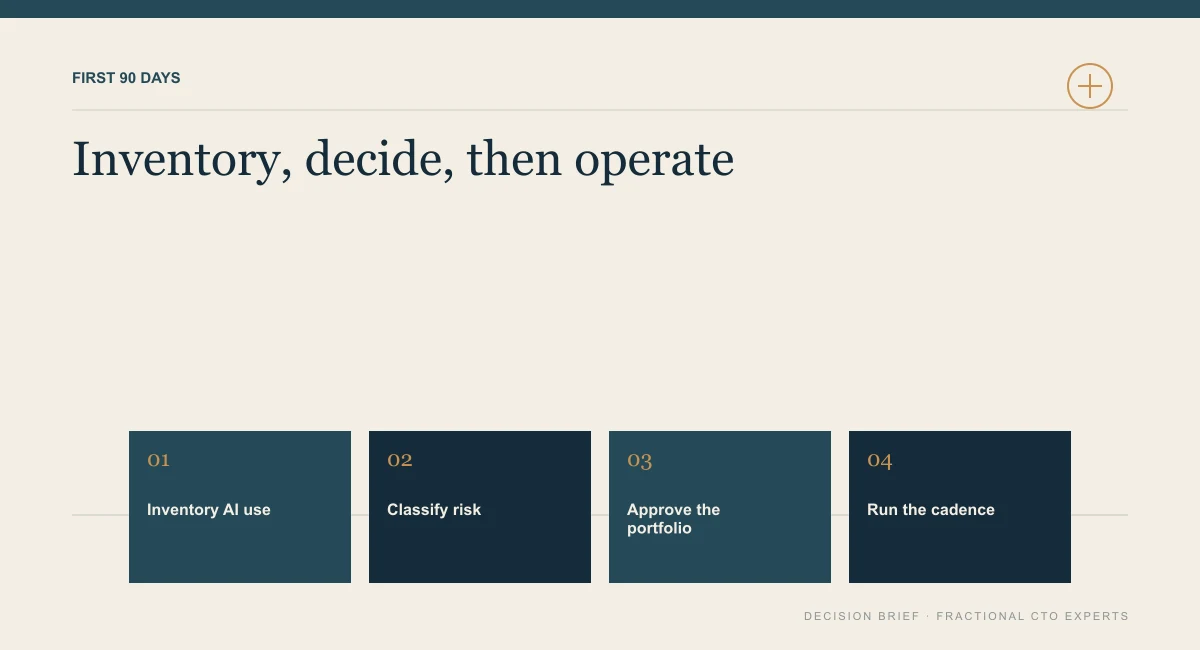
The first quarter should produce an inventory, decisions and a working cadence. A slide deck about AI transformation is not an outcome.
| Period | Outcome | Evidence to inspect | Reviewed with |
|---|---|---|---|
| Days 1–30 | Inventory of AI in use, in pilot and proposed | A list with owner, purpose, data used, vendor and users for each item | CEO, CTO, security owner |
| Days 1–30 | Applicable obligations | A short note on which frameworks and laws apply, reviewed by counsel | CEO, counsel |
| Days 31–60 | Classification and portfolio | Each use classified; continue, change, stop or start recommendations with reasons | Executive team |
| Days 31–60 | Policy and vendor checklist | AI use policy and vendor review criteria, adopted by the executive team | Executive team |
| Days 61–90 | Operating cadence | A recurring review with a decision log, and at least one real decision made through it | CEO |
| Days 61–90 | Oversight for elevated and high-risk uses | Named oversight owners, monitoring measures and escalation routes | Owners of each use |
| Day 90 | Mandate review | Confirm capacity, decision rights and the handover path | CEO |
The inventory usually takes longer than expected. That is mostly because AI features arrive inside software the company already pays for, and nobody logged them as AI. Budget for that. Where evidence is thin, the CAIO should record the gap rather than guess.
Evidence to ask candidates for
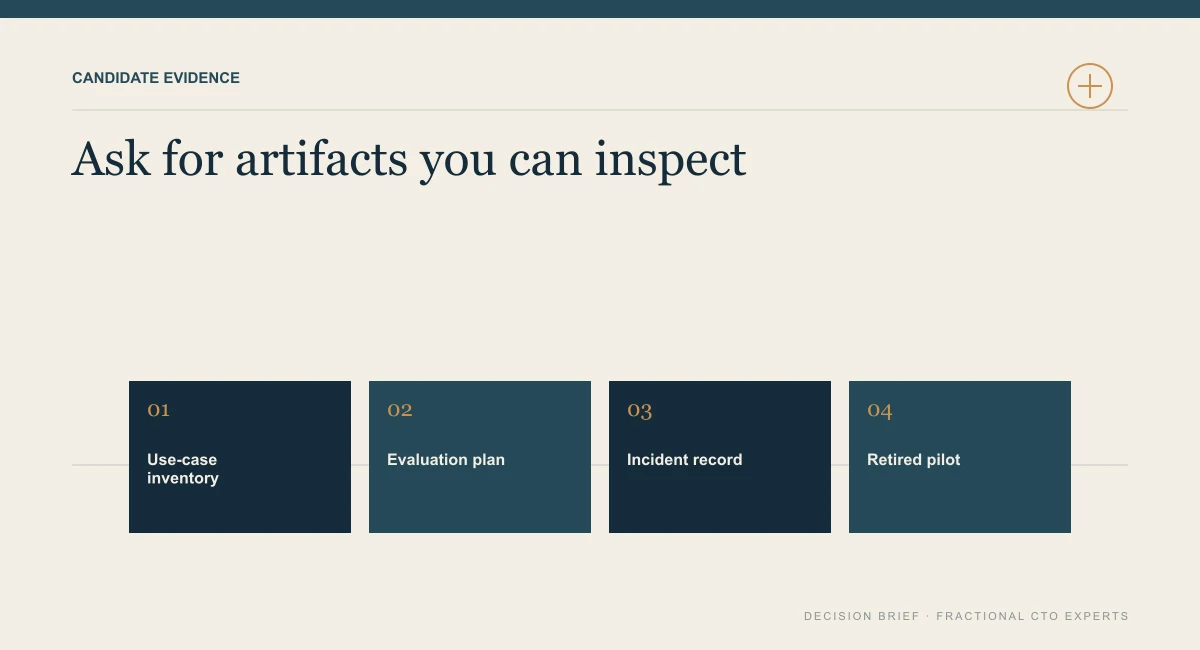
Because the title is new, few candidates have held it. Ask for evidence of the work instead. Request redacted artifacts where confidentiality allows, and ask the candidate to walk you through them.
| Artifact | What it shows | What good looks like | Warning sign |
|---|---|---|---|
| An AI use inventory they built or ran | Whether they can find and track AI use | Owners, purposes, data and risk level for each entry; a process for new entries | Only lists projects the candidate led |
| An evaluation plan for an AI feature | Whether they can define acceptable behavior before launch | Test data that represents real use, error thresholds, who reviews results | Accuracy on a demo set only |
| A risk decision they recorded | Whether they can make and document hard calls | States options, evidence, who accepted the risk and conditions | No record, or the decision was never revisited |
| An incident or near miss | Whether they can learn from failure | Timeline, cause, what changed afterwards | "Nothing ever went wrong" |
| A pilot they stopped | Whether they will say no | Clear reason, evidence and what happened to the team's effort | Every pilot continued |
| A vendor review | Whether they read contracts and data terms | Data use, retention, model changes, exit terms | Chose vendors by demo quality |
References are most useful when the referee can reconstruct one decision: the situation, the candidate's call, who disagreed and what happened. Ask permission first and follow your normal recruitment process.
Hiring scorecard for a fractional CAIO
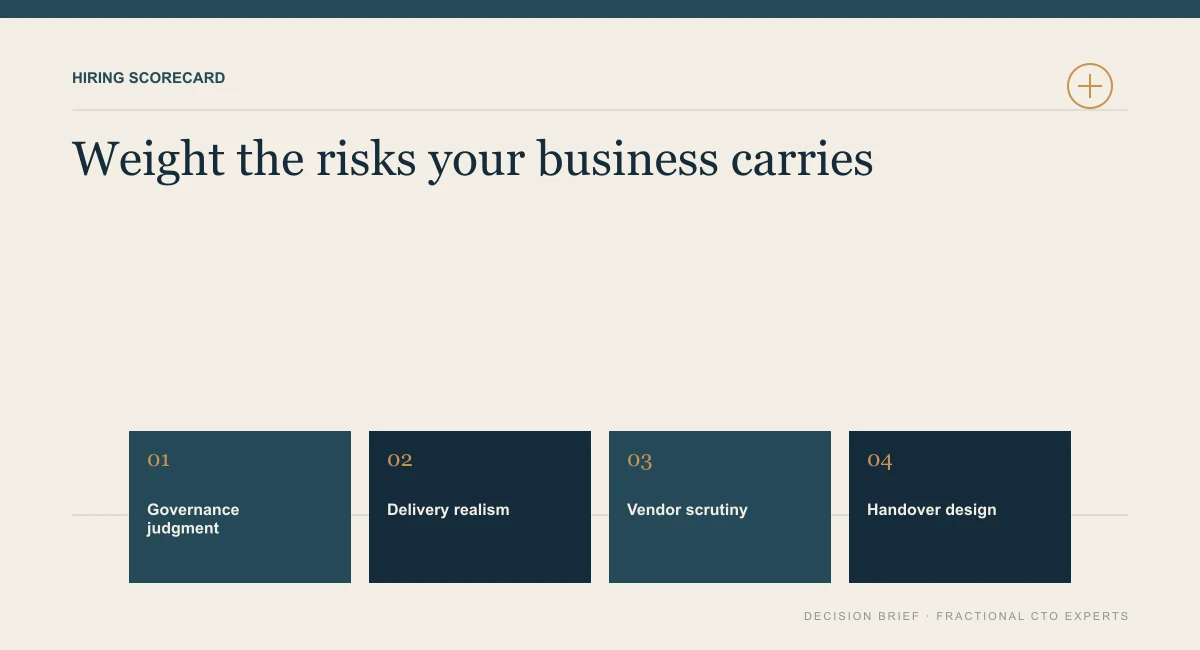
Set the criteria before interviews and score independently before the debrief. The weights are an illustrative starting point for a company with several AI proposals and EU exposure. Change them to match your risks.
| Criterion | Illustrative weight | Question or exercise | Strong evidence |
|---|---|---|---|
| Governance judgment | 25% | Classify the three proposals from the worked example and explain what you would need to confirm | Separates provider and deployer duties, names what counsel must confirm, proposes proportionate conditions |
| Delivery realism | 20% | "Walk me through an AI feature from proposal to monitored production." | Describes evaluation, rollout, monitoring and who did the work |
| Vendor scrutiny | 15% | Review a sample AI vendor's terms together | Finds data use, retention, model-change and exit issues |
| Portfolio and investment sense | 15% | "Which AI project would you stop first here, and why?" | Uses cost, evidence and risk rather than novelty |
| Executive communication | 10% | Ask for a redacted board or leadership AI update | Explains risk plainly, admits uncertainty |
| Handover design | 15% | "How would we run this without you in twelve months?" | Names an internal owner, documents, a cadence and a transition date |
Use a four-point rating: insufficient evidence, partial, sufficient, strong. Record a sentence of evidence for each score. To see how weighting changes the outcome, take a candidate rated strong (4) on governance and vendor scrutiny, partial (2) on delivery realism and sufficient (3) elsewhere. Their score is 0.25×4 + 0.15×4 + 0.20×2 + 0.40×3 = 3.2. If your main risk is shipping AI features rather than governing purchased tools, move weight toward delivery realism and the ranking may change. Treat the number as a prompt for discussion, not a verdict.
Scope the engagement and plan the exit
We do not publish a rate for fractional CAIOs. We have no verified benchmark for an emerging role, and prices depend heavily on capacity and scope. Compare proposals for the same mandate instead. Ask each candidate to state:
- the reserved capacity and what it assumes about the number of AI uses and decisions;
- whether they will do any hands-on delivery, such as building evaluations, or only govern;
- response times for incidents between sessions;
- conflicts of interest with AI vendors or model providers;
- the handover they propose, and when.
A fractional CAIO should make the company less dependent on them over time. By the end of the engagement, the inventory, policy, vendor checklist, decision log and review meeting should run under a named internal owner. That owner might be the CTO, a head of data or a permanent CAIO. If the proposal has no end state, ask why.
Fractional CTO Experts is an executive network and matching platform. If a fractional AI leadership mandate fits after working through this guide, you can request a shortlist with the completed mandate and assess each candidate's evidence directly.
The worked example and scorecard weights on this page are illustrative. Regulatory descriptions summarize the sources cited as they read when this guide was prepared; they are not legal advice. The diagrams are simple editorial graphics, not depictions of real candidates or client results.
Frequently asked questions
Is a chief AI officer the same as a head of AI or head of machine learning?
Not usually. A head of AI or machine learning typically leads the people who build models and AI features. A chief AI officer mandate is broader: which AI uses the organization pursues, how their risk is governed and who is accountable. In a small company one person can hold both, but the job description should list both sets of duties.
Can our CTO also act as the chief AI officer?
Often, yes. US federal guidance lets agencies designate an existing official such as a CIO, CDO or CTO, provided that person has significant AI expertise. A company can follow the same logic. Check two things: whether the CTO has the capacity, and whether they would be reviewing risks in systems their own team builds.
Does the EU AI Act require companies to appoint a chief AI officer?
The provisions reviewed for this guide place obligations on providers and deployers, such as assigning competent human oversight for high-risk systems. They do not require a specific executive title. A CAIO is one way to make sure someone owns those obligations; confirm your position with qualified counsel.
How much time does a fractional CAIO usually work?
There is no reliable benchmark for this emerging role. Size the capacity from the work: the number of AI uses to govern, how often decisions are needed, and whether the person also leads delivery. Ask each candidate to explain the time their proposal assumes.
What is the difference between chief AI officer as a service and a fractional CAIO?
The labels are used loosely. 'As a service' offerings are often packaged by a firm and may rotate people, while a fractional CAIO is usually one named executive with a reserved share of time. Compare proposals by who holds the decision rights and who is accountable, not by the label.
Sources and further reading
- OMB Memorandum M-25-21: Accelerating Federal Use of AI through Innovation, Governance, and Public Trust (April 3, 2025)
- NIST: AI Risk Management Framework
- NIST AI 100-1: Artificial Intelligence Risk Management Framework (AI RMF 1.0)
- European Commission: AI Act regulatory framework and application timeline
- European Commission AI Act Service Desk: Article 3, definitions
- European Commission AI Act Service Desk: Article 4, AI literacy
- European Commission AI Act Service Desk: Article 26, obligations of deployers of high-risk AI systems
- European Commission AI Act Service Desk: Annex III, high-risk AI systems