Executive hiring
Director of Engineering Job Description Template
Copy a director of engineering job description template with decision rights, 90-day outcomes and an interview scorecard, plus how the role differs from VP.
- By
- Fractional CTO Experts
- Published
- 2026-10-19
- Reviewed
- 2026-10-19
- Reading time
- 16 minutes
A director of engineering job description should define a manager of managers: someone accountable for delivery across several teams, the health of the engineering managers who lead them, and the hiring and budget decisions for that group. The template below is ready to copy. Replace the brackets with the teams, decisions and outcomes specific to your company, and add a pay range where the law requires one.
This page also explains how the role differs from engineering manager, head of engineering and VP of Engineering. It sets out outcomes to expect in the first 90 days and gives you an interview scorecard with anchored ratings. It's written for hiring managers, usually a CTO or VP of Engineering, and for founders who are hiring their first director.
What does a director of engineering do?
The shortest accurate answer is that a director runs an engineering organization made of teams, through the managers of those teams. LeadDev's 2025 overview of the role describes the director as "a manager of managers" who keeps "an entire engineering function humming." It notes that the director typically reports to a VP of Engineering or a CTO and is "very concerned with operational matters" such as budgeting, staffing and resource allocation.
In practice, the core engineering director responsibilities fall into five groups:
- Leading managers. Hiring, coaching and, when needed, replacing engineering managers. Running skip-level conversations. Making sure every engineer has a manager with time for them.
- Delivery across teams. Turning company priorities into a plan several teams can carry out, managing dependencies between them and resolving conflicts about sequencing or shared resources.
- Organization design. Deciding how teams are split, when a team should divide, and where new hires go.
- Technical judgment at the organization level. Working with senior engineers and architects on decisions that affect several teams, such as platform investments, reliability standards and technical debt that no single team can justify alone.
- Hiring plan and budget. Owning the headcount plan for their organization, the hiring process quality and, depending on the company, a share of the engineering budget.
What a director usually doesn't own is also worth stating. Company-wide technical strategy typically belongs to the CTO. Engineering-wide operating practices and the full engineering budget usually sit with the VP of Engineering. Day-to-day team execution belongs to the engineering managers. A director who takes over the managers' work leaves the managers without a job and the organization without a director.
Director versus engineering manager, head of engineering and VP Engineering
Titles vary widely between companies. At a 40-person startup, "director" may mean the most senior engineering leader. At a large company, it may mean a leader of one product area among many. Compare scope, not titles.
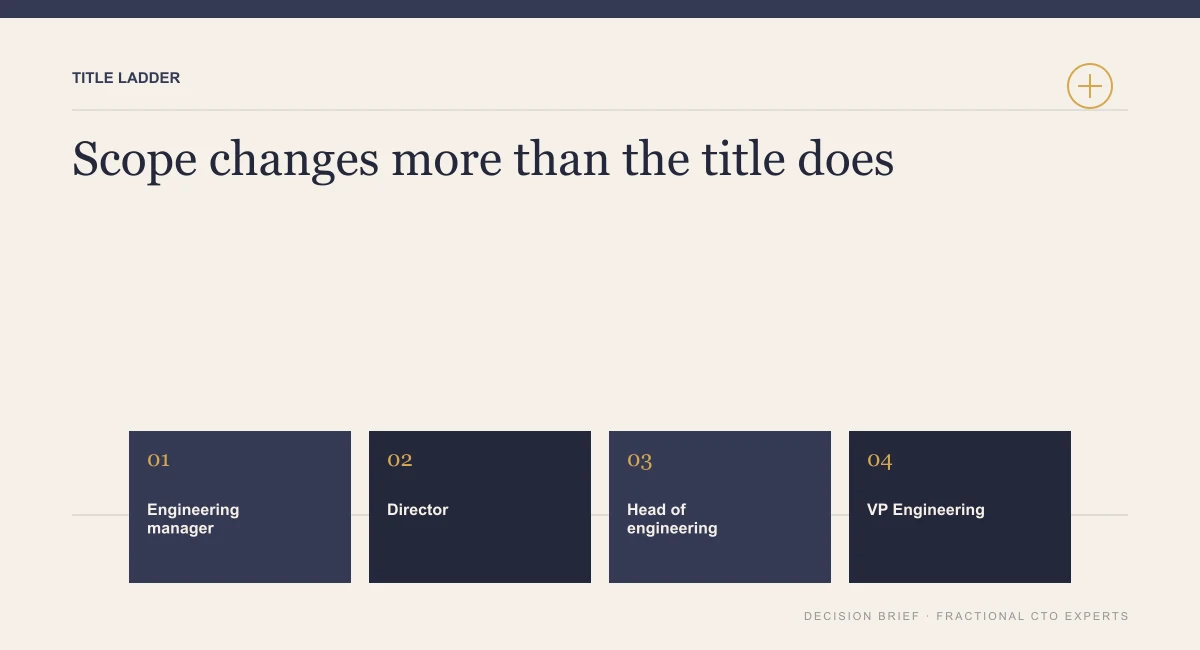
| Role | Typically leads | Typically owns | Common reporting line |
|---|---|---|---|
| Engineering manager | One team of individual engineers | Team execution, people management of engineers, team process | Director or head of engineering |
| Director of engineering | Several teams, through their managers | Cross-team delivery, manager development, org design and hiring plan for their area | VP of Engineering or CTO |
| Head of engineering | The whole engineering function in a smaller company | Engineering operations, often with hands-on management | CTO or CEO |
| VP of Engineering | The whole engineering organization, often including directors | Engineering-wide operating model, budget, leadership bench and executive partnership | CTO or CEO |
| CTO | Technology direction for the company | Technical strategy, architecture direction, technology risk | CEO |
If you're hiring the level below the director, see the engineering manager job description template. If your company doesn't yet have managers to manage, you may need a head of engineering instead. The fractional head of engineering guide covers when part-time leadership can fill that gap. For the level above, the VP of Engineering guide covers the full engineering organization, and the CTO versus VP of Engineering comparison explains how technical strategy and engineering operations are divided.
LeadDev's article makes a practical point about growth. In smaller companies, the director often also acts as the strategic planner and may later take the VP title. As companies grow, that dual role tends to separate, with a VP above and directors in the middle layer. If you're hiring a director who will temporarily cover VP responsibilities, say so in the posting and state what happens when a VP is hired.
Five decisions to make before you write the posting
Most weak job descriptions come from skipping these decisions. The posting then fills with generic responsibilities that every candidate will say they meet.
- Which teams, exactly? Name the product areas or platforms, the number of teams, the number of managers and the approximate number of engineers. "Lead several teams" tells a candidate nothing.
- What can the director decide alone? Hiring within an approved plan? Moving an engineer between teams? Changing an on-call rotation? Pausing a feature for reliability work? List them.
- What budget authority, if any? Some directors approve spend within a limit; some only recommend. Both are legitimate, but candidates need to know which.
- How technical should the director be? Decide whether the role reviews designs, leads architecture discussions or is expected to write code. Be honest; the answer determines who applies.
- What must be true in 90 days and in a year? If you can't describe the outcomes, the role isn't ready to post.
Write the answers down before you open the template. They become the "decision rights" and "outcomes" sections, which are the parts most postings leave out.
The director of engineering job description template
Copy the text below into your applicant tracking system or document. Everything in brackets must be replaced. Delete any sentence you can't make specific; a vague line tells a strong candidate the role hasn't been thought through.
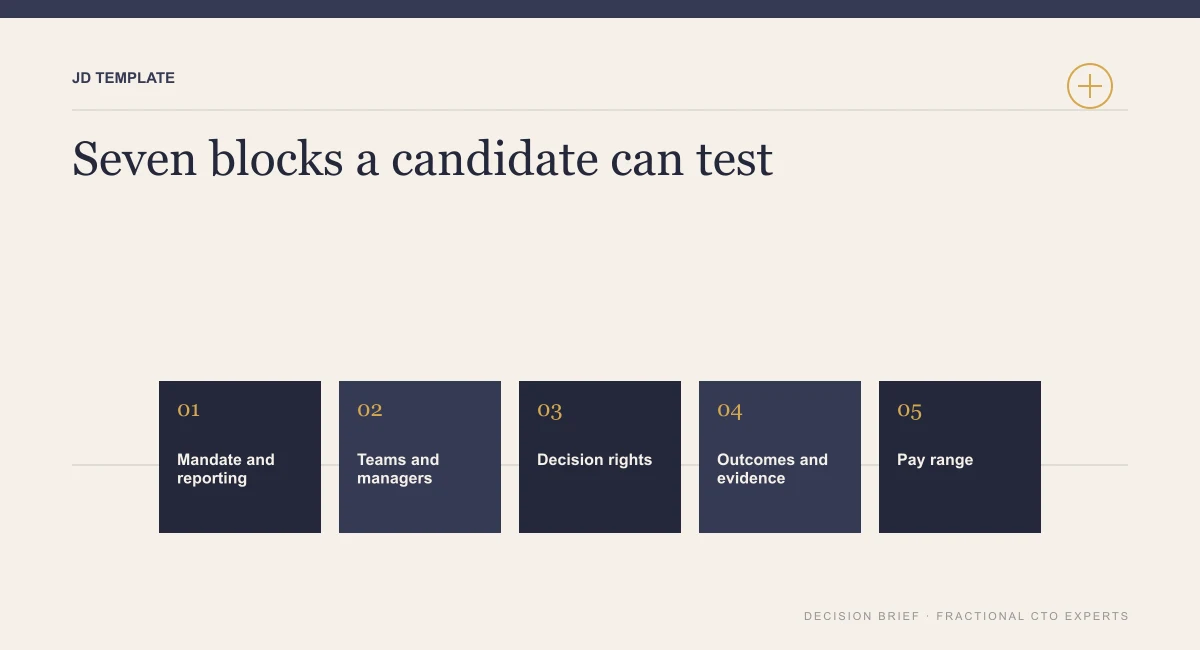
Job title
Director of Engineering, [area, for example: Payments, Platform or Growth]
About the role
We're hiring a director of engineering to lead [number] teams working on [area], through [number] engineering managers. Together the teams have about [number] engineers. You'll report to [VP of Engineering / CTO], and your job is to make sure these teams deliver [the business outcome, for example: a reliable payments platform that finance and product can build on] while growing the managers who lead them.
This role exists because [the honest reason, for example: the organization has grown past what one head of engineering can manage directly, and delivery across our three payments teams needs a single owner].
What you'll own
- The delivery plan for [area]: turning company priorities into a sequenced plan across the teams, managing cross-team dependencies and reporting progress and risk to [role].
- The engineering managers in your organization: hiring, coaching, performance and development. You'll hold regular one-on-ones with each manager and skip-levels with engineers.
- Organization design for [area], including when to split or merge teams and where new hires join.
- The hiring plan for [area] within the approved headcount, including interview process quality.
- Technical decisions that span more than one of your teams, made together with [staff engineers / architects / the CTO].
- Operational health for [area]: incident follow-through, on-call sustainability and reliability standards agreed with [role].
Decisions you can make
- Hire within the approved plan, with final sign-off from [role / no additional sign-off].
- Move engineers between your teams after consulting their managers.
- Set team boundaries and working agreements within [area].
- Approve spend up to [amount / "no direct spend; you recommend and [role] approves"].
- Pause planned feature work for reliability or security work, informing [role] within [timeframe].
Decisions you'll share or recommend
- Headcount changes beyond the approved plan (approved by [role]).
- Architecture decisions affecting other engineering areas (agreed with [role or forum]).
- Vendor and tooling choices above [amount or scope].
What success looks like
- By day 90: [see the 90-day outcomes section of this guide for examples, and pick three or four].
- By month 12: [two or three measurable outcomes, for example: every team in the area has a manager it rates as supportive; the area's delivery plan is met or deliberately revised each quarter; unplanned incident work has fallen in line with an agreed reliability target].
What we're looking for
- Experience leading engineering managers, not only engineers, in an organization with [number] or more teams.
- A record of delivering work that required coordination across several teams.
- Enough technical depth in [relevant technologies or domain] to review designs and challenge estimates.
- Experience building a hiring process and closing candidates.
- [One or two genuinely required specifics, for example: experience with regulated payment systems.]
What we don't require
[List things candidates might assume you require but you don't, for example: a specific degree, experience at a company of a particular size, or a specific framework. This widens the pool of qualified applicants.]
Working arrangement
[Location, remote or hybrid expectations, time zone overlap, travel, and on-call expectations for the director, if any.]
Compensation
[Pay range, as required by law where the role is posted, plus equity and benefits summary.]
How we'll interview
[List the stages, for example: a conversation with the hiring manager, an organization design case, a manager coaching exercise, a delivery review with peers and reference checks. Candidates prepare better, and you learn more, when they know what's coming.]
Pay transparency and posting rules
Posting rules differ by jurisdiction, and this guide is not legal advice. Several US jurisdictions require pay ranges in job postings. Two examples show how the requirements are worded.
- California. Labor Code section 432.3 says an employer with 15 or more employees "shall include the pay scale for a position in any job posting." It defines the pay scale as a good faith estimate of the salary or hourly wage range the employer reasonably expects to pay on hire. The statute was amended by SB 642, effective January 1, 2026.
- New York City. The NYC Commission on Human Rights states that since November 1, 2022, the city's Human Rights Law requires employers to include a good faith pay range in job advertisements for work performed in the city.
Other states and cities have their own rules, and remote roles can bring several jurisdictions into play. Check with someone who knows employment law in the places where you'll post and hire.
Federal law also shapes the wording. The US EEOC says it's illegal to publish a job advertisement that shows a preference for, or discourages applicants on the basis of, protected characteristics including age (40 or older). Its example is an ad seeking "recent college graduates." Phrases in engineering postings such as "young, energetic team" or "digital native" carry the same risk and add nothing about the job.
A note on pay data. The BLS Occupational Outlook Handbook covers the closest category, computer and information systems managers. It lists CIO, CTO and MIS director as example titles, and the category spans many kinds of IT and technology management roles. That makes it too broad to set a director of engineering range on its own. Use current compensation data for your location, company stage and the specific scope you've written.
Variants of the template
The same structure adapts to the most common kinds of director role. Change the "about the role" and "what you'll own" sections; keep the decisions and outcomes sections.
Product engineering director. Owns delivery for a product area. Emphasize the partnership with product management, how roadmap tradeoffs are negotiated and which product outcomes the teams are measured against.
Platform or infrastructure director. Owns shared systems other teams build on. Emphasize internal customers, reliability standards, on-call load and how platform priorities are balanced against product team requests.
First director at a growing startup. Often the first manager of managers in the company. Emphasize building the management layer: promoting or hiring the first managers, setting up one-on-ones and career conversations, and establishing a planning process. State clearly whether the director will keep a team of individual engineers reporting directly while the managers are hired.
Director covering VP responsibilities. Used when a company needs a VP-level scope but isn't ready to hire one. The VP template overlaps heavily with this one, so start here. Add the engineering-wide operating model, the full engineering budget and executive team participation to "what you'll own," and state what changes if a VP is later hired above the role. Be honest about the title. Candidates who have held VP roles will notice a VP scope attached to a director title, and some will ask for the higher title.
90-day outcomes
A director's first 90 days should produce evidence that they understand the organization and have made a small number of well-chosen changes. Will Larson's guide to the first 90 days as a CTO or VP Engineering is written for a more senior role, but several of its recommendations apply directly. They include asking your manager to write down explicit expectations, running a listening tour, setting up recurring one-on-ones and skip-levels, and implementing "at most one or two changes" rather than a sweeping overhaul.
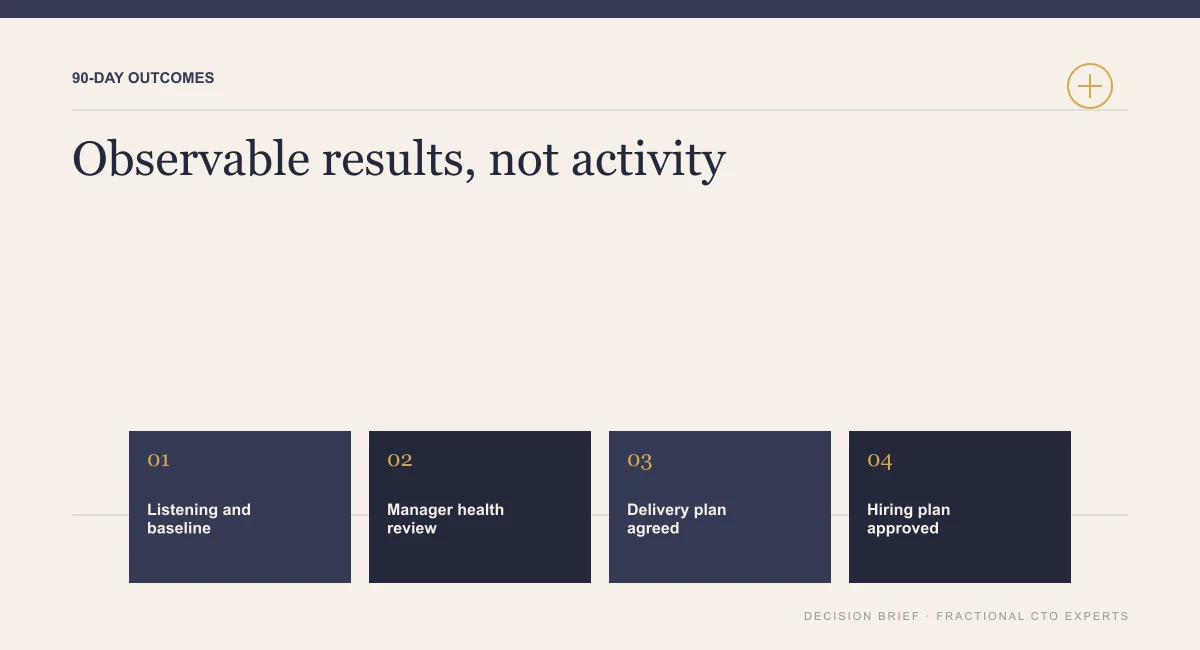
Pick three or four of these for the posting and for the new director's first review. Each has an observable output.
| Outcome | Observable evidence at day 90 |
|---|---|
| Written expectations agreed with the hiring manager | A short document both sides signed off in the first two weeks |
| Listening tour complete | Notes from conversations with every manager and a sample of engineers, product partners and stakeholders, summarized into themes the director shares back |
| Manager health review | For each manager: strengths, gaps, and a development or support plan agreed with that manager |
| Delivery baseline | A current view of what each team is working on, cross-team dependencies and the main risks, reviewed with product partners |
| One or two targeted changes | The changes, why they were chosen, and early signs of whether they're working |
| Hiring plan | Open roles ranked with reasons, the interview process reviewed and any gaps fixed |
| Operational picture | Recent incidents reviewed, on-call load understood, and reliability risks raised with the right owner |
What to avoid in the first 90 days: a reorganization announced in week three, a new process imposed on every team at once, or a director who spends the period coding because it feels productive. None of these is always wrong, but each needs a strong reason, and the hiring manager should hear the reason first.
Measuring the director after the first quarter
Once the director is established, measure the organization they lead, not their personal output. Delivery metrics are useful here, with care. DORA's guide to software delivery performance metrics lists five measures: change lead time, deployment frequency, failed deployment recovery time, change fail rate and deployment rework rate. The same guide warns against making the metrics targets, citing Goodhart's law. It says comparing metrics between very different applications "can be misleading," and that the goal is improvement over time, "not to compete against other teams or organizations."
That caution suits a director's scorecard. Use delivery metrics to start conversations with managers about what's slowing a team down, not to rank teams. Pair them with measures the metrics can't see: whether managers feel supported, whether engineers are leaving, whether product partners trust the plan and whether incidents lead to real follow-up. If delivery is declining and nobody can say why, the engineering velocity diagnostic is a useful place to start.
The interview loop
Design the interview around the work the director will actually do. A general conversation about leadership philosophy tells you how well someone talks about leadership, which is a different skill.
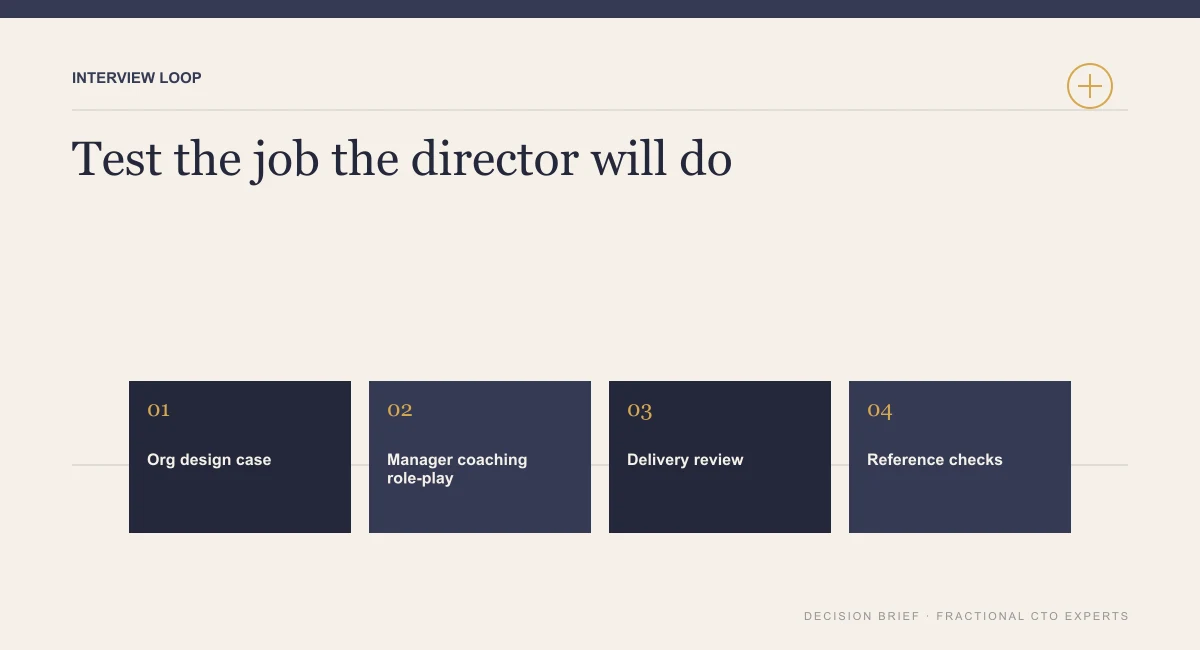
Hiring manager conversation. Walk through the posting together and ask the candidate which parts they would push back on. Strong candidates question the decisions section and ask about the managers they'd inherit.
Organization design case. Give the candidate a short written description of a real or realistic organization: teams, managers, a planned growth in headcount and a cross-team problem. Ask how they'd structure it and what they'd want to learn first. You're testing whether they ask about people and constraints before drawing boxes.
Manager coaching role-play. An interviewer plays an engineering manager with a specific difficulty, such as a team member who is technically strong but disrupts others, or a team that keeps missing commitments. Watch whether the candidate coaches the manager to solve it or takes the problem over.
Delivery review with peers. A product leader and a senior engineer ask the candidate to walk through a past multi-team project: the plan, what went wrong and what they changed. Ask about a project that failed, too.
Technical discussion. A staff engineer or architect discusses a cross-team technical decision with the candidate. The question is whether the director can hold a useful technical conversation and make a tradeoff, not whether they can pass a coding test.
References. Ask for at least one reference from a manager who reported to the candidate. Ask that reference what the candidate did when they struggled.
Interview scorecard
Agree on the weights and anchors before the first interview. Each interviewer scores only the criteria their stage tests and writes the evidence next to the score. Compare the evidence in the debrief, not just the numbers.
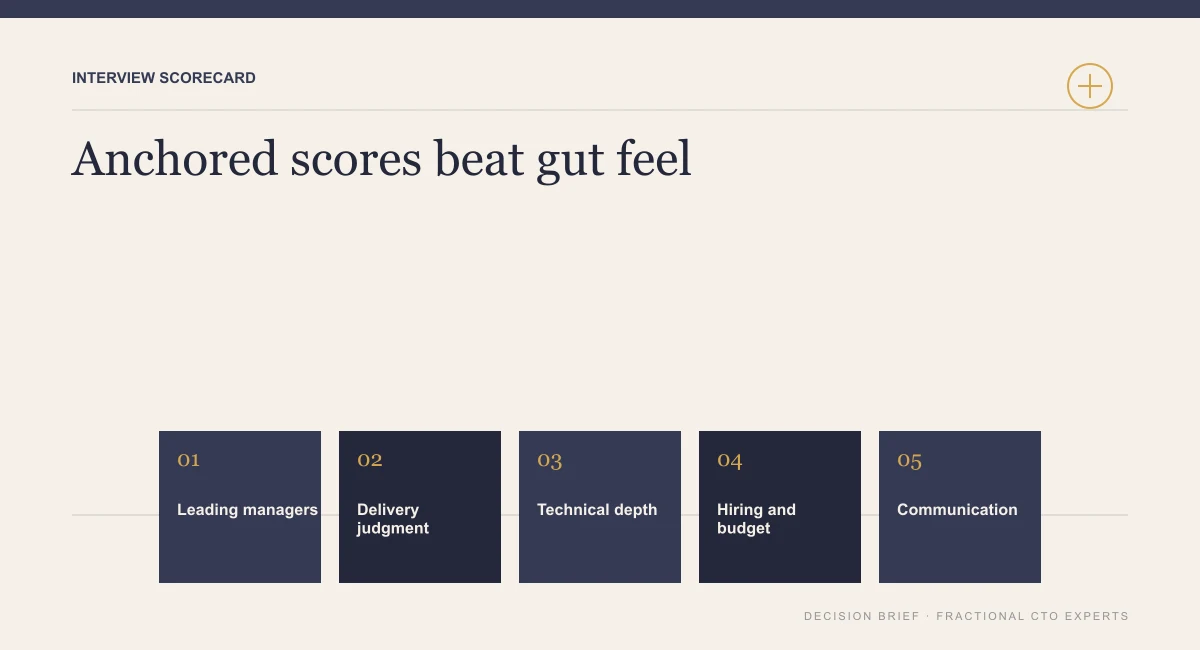
| Criterion | Weight | 1: weak evidence | 3: adequate evidence | 5: strong evidence | Tested in |
|---|---|---|---|---|---|
| Leading managers | 25% | Talks mostly about managing engineers directly | Has managed managers; describes one-on-ones and feedback | Can describe developing a struggling manager, and a case where they had to replace one, with specifics | Coaching role-play, references |
| Delivery judgment | 25% | Describes delivery in terms of effort and hours | Has run multi-team plans and managed dependencies | Explains a plan that failed, why, and what they changed in the organization, not just the plan | Delivery review |
| Organization design | 15% | Draws a structure without asking about people or constraints | Considers team size and ownership boundaries | Asks about managers, dependencies and growth before proposing, and explains the tradeoffs | Org design case |
| Technical depth | 15% | Avoids technical detail or wants to rewrite everything | Follows the discussion and asks relevant questions | Makes a clear tradeoff across teams and explains what they'd leave alone | Technical discussion |
| Hiring and budget | 10% | Has interviewed but never owned a hiring plan | Has owned hiring for a team | Has built or fixed a hiring process for several teams and can explain what changed | Hiring manager conversation |
| Communication with partners | 10% | Explains things only in engineering terms | Communicates clearly with product partners | Adjusts the message for executives, peers and teams, with examples of delivering bad news | Delivery review, references |
Multiply each score by its weight and total them, but treat any score of 1 on leading managers or delivery judgment as a likely no-hire, whatever the total. Those two criteria are the job.
Common mistakes in director job descriptions
- A list of 25 responsibilities. It reads as a job with no focus. Keep the owned responsibilities to about six and put the rest in the decisions sections.
- No reporting line or team size. Candidates can't judge the scope, and the best ones won't apply to find out.
- "Hands-on" without definition. Say what percentage of time, if any, goes to technical work, and what kind.
- Requirements you wouldn't enforce. If you'd hire a strong candidate without a particular degree or years of experience, remove the requirement. Unnecessary requirements can discourage qualified people from applying.
- Outcomes missing. Without outcomes, the posting describes activities, and interviewers have nothing to test against.
- VP scope with a director title. If the role owns the whole engineering organization, consider whether it's really a head of engineering or VP role, and read the CTO job description template if the scope includes technology strategy.
Before you publish
Check the posting against this list. Every bracket is replaced. The teams, managers and headcount are named. The decisions section says what the director can do without asking. There are three or four 90-day outcomes and two or three 12-month outcomes. A pay range is included where required, and the wording has been reviewed for your jurisdictions. The interview stages are listed. The scorecard weights are agreed with everyone who will interview.
If you can't fill in the decision rights or the outcomes, pause the posting and settle those questions with the leadership team first. That time is well spent, because a clear description of the job attracts candidates who want that specific job, and makes the interview loop far easier to run.
Frequently asked questions
Who does a director of engineering report to?
Usually a VP of Engineering or a CTO. In smaller companies without a VP, the director may report to the CTO or even the CEO and carry some VP-level strategic work. State the reporting line in the job description, because it changes the scope a great deal.
How many engineering managers should report to a director?
There is no fixed number. It depends on how experienced the managers are, how independent their teams are and how much hands-on work the director keeps. Write the actual number and the team sizes into the posting so candidates can judge the load.
Should a director of engineering still write code?
Rarely as a main responsibility. Directors need enough technical depth to review designs, challenge estimates and make tradeoffs across teams. If you need significant hands-on coding, you may be hiring a senior engineering manager or tech lead instead.
Can I post this template as-is?
Treat it as a draft. Replace every bracket with specifics, add a pay range where the law requires one, and have someone familiar with employment law in your locations review the final posting. Remove any requirement you would not actually use to reject a candidate.
Can a fractional leader fill the director role?
Sometimes, for a defined period. A part-time leader can cover an organization while you search or while an internal manager grows into the role. The day-to-day people management a director does needs regular presence, so check that the time allocation is realistic.
Sources and further reading
- LeadDev: What is a director of engineering? The glue keeping engineering together (2025)
- Will Larson: Your first 90 days as CTO or VP Engineering
- DORA: Software delivery performance metrics
- California Labor Code section 432.3
- NYC Commission on Human Rights: Salary transparency in job advertisements
- US EEOC: Prohibited employment policies and practices
- US BLS Occupational Outlook Handbook: Computer and information systems managers