Fractional legal leadership
Fractional General Counsel: Buyer's Guide, Vetting Checks and Scorecard
A neutral guide to hiring a fractional general counsel: what the role covers, how it compares with outside counsel, license checks, a scoping brief and a scorecard.
- By
- Fractional CTO Experts
- Published
- 2026-11-26
- Reviewed
- 2026-11-26
- Reading time
- 18 minutes
A fractional general counsel is an experienced lawyer who acts as your company's senior legal officer part time, typically for a set number of hours or days each month. They handle the recurring legal work a business generates (contracts, employment questions, corporate housekeeping, regulatory questions) and decide when a specialist law firm is needed. Hire one when legal questions arrive every week and nobody inside the company owns them. When you have a single transaction or dispute, outside counsel is the better buy.
Most pages that rank for this term are written by law firms and legal service providers describing their own offer. This guide is written for the buyer. It covers what the role does and does not include, how it compares with outside counsel, a full-time general counsel and legal operations, the checks to run before you hire, and a first-90-days plan. It also includes a scoping brief and an interview scorecard you can copy.
This guide is general information, not legal advice. The rules that govern lawyers differ between US states and between countries, so confirm anything that matters with a lawyer licensed where you operate. It quotes no market rates, because we have not verified a reliable public benchmark. The examples are hypothetical and are labeled that way.
What a fractional general counsel does
The useful way to describe the role is by the decisions it takes off the chief executive's desk. A general counsel, full time or fractional, is the person who decides how much legal risk the company accepts in ordinary business and who makes sure the paperwork matches that decision. A typical remit covers six areas.
- Commercial contracts. Reviewing and negotiating customer, supplier, partner and reseller agreements. Building standard templates and a written list of fallback positions so the sales team can close routine deals without a lawyer on every call.
- Corporate housekeeping. Board and shareholder approvals, the cap table records, option grants, entity filings and the data room that an investor or acquirer will ask for.
- Employment and contractor questions. Offer letters, contractor agreements, policies, and the first response when a termination or complaint turns difficult. Specialist employment counsel usually handles claims.
- Regulatory and privacy questions. Working out which rules apply to a product or market, turning them into requirements for product and engineering teams, and answering customer due diligence questionnaires.
- Managing outside counsel. Choosing specialist firms, writing the instructions, agreeing budgets, reviewing invoices and challenging advice that does not fit the business.
- Risk reporting. A short, regular summary for the executive team or board: open matters, exposure, decisions needed and deadlines.
The fifth item is easy to overlook. A founder who instructs a law firm directly rarely knows whether a memo needed ten hours or two. A lawyer who has sat on both sides of that relationship does.
What a fractional GC does not do
Being clear about exclusions prevents most disappointments. A part-time general counsel is a generalist with limited hours. Expect the following to sit outside the engagement unless you agree otherwise in writing.
- Litigation and regulatory enforcement. Court work needs specialist counsel, often admitted in a particular court. The fractional GC manages that counsel; they do not usually replace it.
- Deep specialist work. Patent prosecution, tax structuring, immigration filings, securities offerings and merger filings are specialist fields. A good generalist recognizes the issue and brings in the right expert.
- Law outside their license. A lawyer admitted in one US state is not automatically able to advise on another state's law or another country's. The vetting section below covers this.
- Advice to founders, directors or employees personally. The company is the client. More on that under conflicts.
- Running your compliance program. Legal interpretation is their job. Evidence collection, control testing and audit preparation are a different kind of work. If you are preparing for SOC 2 or ISO 27001, see the guide to hiring a compliance consultant, who can work from the fractional GC's reading of the requirements.
- Business decisions. Counsel advises on legal risk. Whether to accept a customer's liability cap is a commercial decision that an executive must own.
ABA Model Rule 1.1 states the baseline you are entitled to expect: "A lawyer shall provide competent representation to a client," which the rule defines as "the legal knowledge, skill, thoroughness and preparation reasonably necessary for the representation." A candidate who claims to cover every specialist field alone should make you more cautious, not less.
Fractional general counsel, fractional chief legal officer, outsourced GC: the titles
These terms overlap heavily in practice. "Fractional general counsel," "fractional GC" and "part-time general counsel" generally describe the same thing: one named senior lawyer working a fixed share of the week for your company. "Fractional chief legal officer" is usually the same role with a more senior title, sometimes implying a seat on the executive team and oversight of compliance. "Outsourced general counsel" is more often used by firms and alternative legal service providers that supply a team or a rotating pool under a subscription.
The difference that matters to you is whether you get a named individual or a service. With a named individual you get continuity and context, and you carry the risk of a single person's availability. With a service you get cover and a wider skill range, and you carry the risk that the person who learned your business last quarter is not the one answering this quarter. Ask every provider which model they are offering, who exactly will do the work, and who covers absences. If the general idea of a part-time executive is new to you, the explainer on what a fractional executive is covers the basics across roles.
Fractional GC vs outside counsel vs full-time GC vs legal ops
These four options solve different problems. Many companies end up combining two of them, most often a fractional GC plus specialist outside counsel.
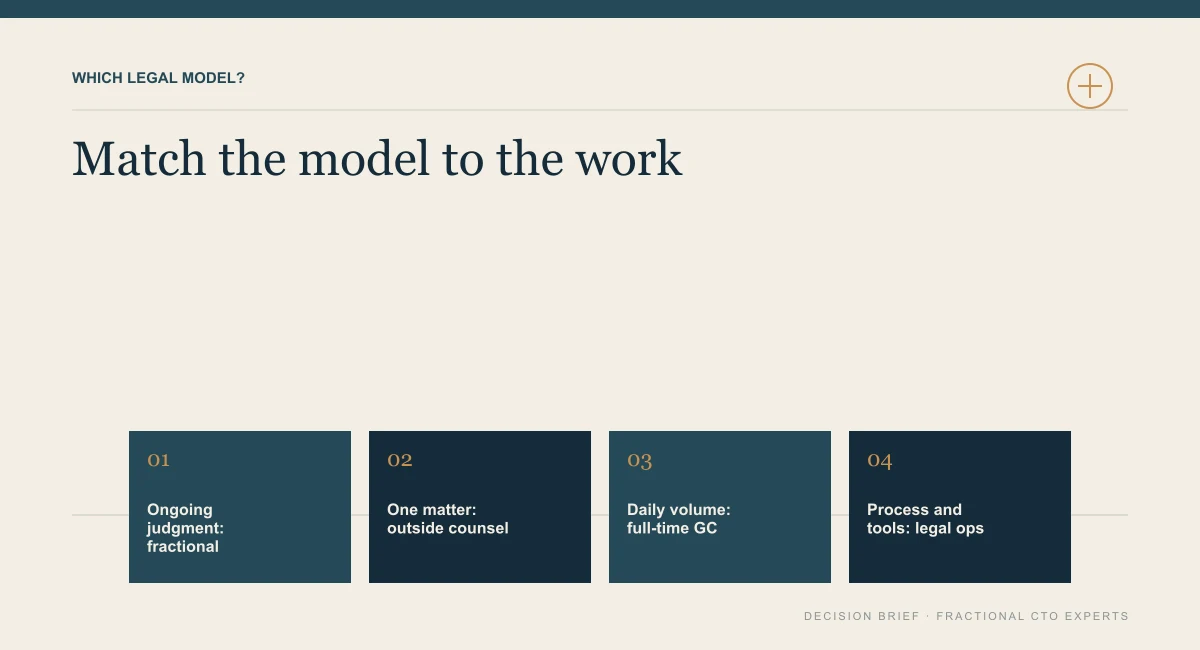
| Question | Fractional general counsel | Outside counsel (law firm) | Full-time general counsel | Legal operations |
|---|---|---|---|---|
| What you are buying | Ongoing legal judgment from someone who knows the business | Expertise on a defined matter | Daily legal leadership and capacity | Process, tooling and workflow for legal work |
| Best fit | Steady flow of varied legal questions, not enough for a full-time hire | A transaction, dispute, filing or specialist opinion | High volume, regulated business, or daily executive involvement | An existing legal function that is slow or disorganized |
| Knows your business context | Yes, builds over time | Limited to the matter | Yes, deeply | Knows the workflow, not the legal merits |
| Gives legal advice | Yes, within license and competence | Yes, within the matter | Yes | Not necessarily; legal ops staff may not be lawyers |
| Availability | Fixed allocation with an agreed response window | When instructed | Daily | Depends on the arrangement |
| Depth in specialist fields | Generalist; refers out | Deep in the chosen field | Generalist; refers out | Not applicable |
| Main risk | Allocation too small for the queue; key-person dependence | Cost drift and advice detached from the business | Under-used if volume is low; a costly mis-hire | Faster process around unchanged legal decisions |
| What to check first | License, conflicts, insurance, scope | Matter budget and staffing | Whether the volume justifies the role | Whether a lawyer still owns the decisions |
Three quick tests help with borderline cases.
- Count the questions. Keep a simple log for a month: every time someone asks "can we sign this?" or "are we allowed to do this?", write it down. A handful of unrelated one-off questions points to outside counsel. A steady weekly stream points to a general counsel, fractional or full time.
- Look at who is answering today. If the chief executive or the finance lead is reviewing contracts at night, you already have a part-time general counsel. They are just unqualified and expensive.
- Separate legal judgment from process. If contracts are slow because nobody knows where a request stands, the fix may be an intake form and a tracker. If they are slow because nobody can decide what to accept, you need a lawyer.
When a company needs one
Stage and headcount are weak predictors. Legal workload is driven by what the business sells, to whom and under which rules. These are the triggers worth watching, with something you can observe for each.
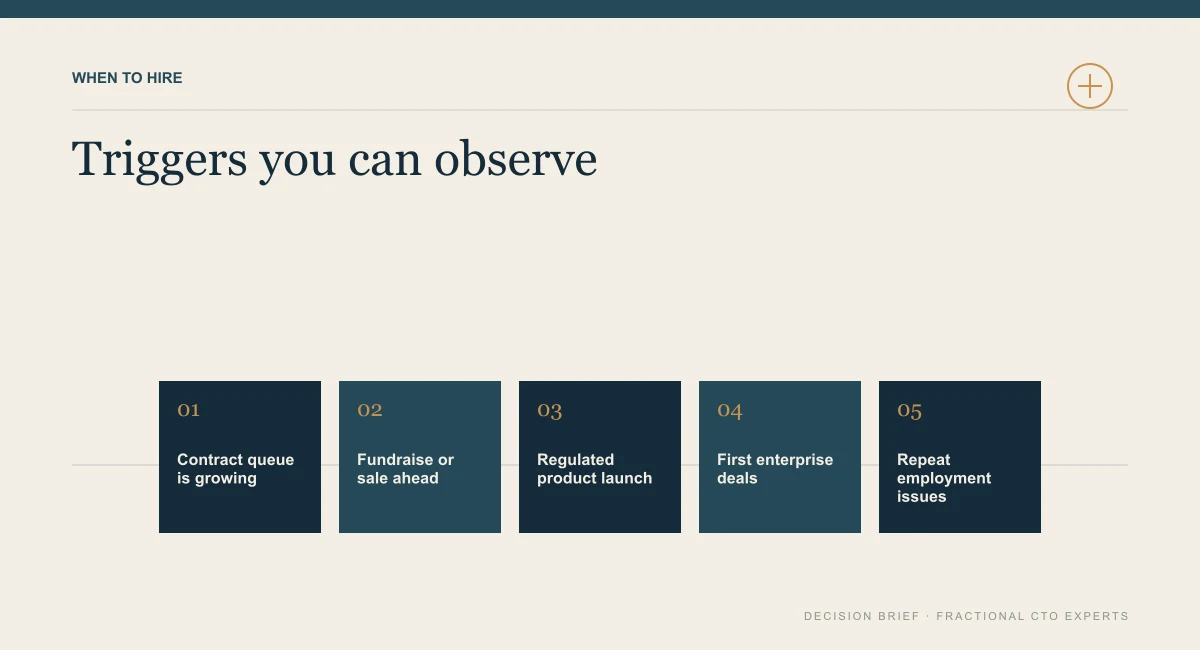
| Trigger | What you can observe | What the fractional GC does first |
|---|---|---|
| Contract volume | Deals wait on legal review; the same clauses are renegotiated from scratch each time | Standard templates, a fallback-position list and a rule for which deals need a lawyer |
| First enterprise customers | Customers send their own paper, security schedules and long procurement questionnaires | A negotiation playbook and a clear line on liability, indemnity and data terms |
| Fundraising or a sale process | Investors ask for a data room; diligence questions expose missing records | Clean up corporate records, contracts and IP assignments; manage transaction counsel |
| Regulated product or new market | Product teams ask whether a feature is allowed and nobody can answer | Map the applicable rules, write requirements, engage a specialist where needed |
| Employment issues | Repeated difficult exits, contractor classification questions, hiring in new states or countries | Consistent documents and a first-response process; specialist counsel for claims |
| Rising outside counsel spend | Law firm invoices grow and nobody can say whether the work was necessary | Triage, budgets and instructions; routine work moves in-house |
| Board or investor request | Directors ask for a legal risk report | A short recurring report with open matters and exposure |
If none of these apply and your legal needs amount to a few documents a year, you probably do not need a general counsel of any kind yet. A relationship with a law firm you trust is enough.
Functions next to legal often reach the same point at the same time. A company preparing for a fundraise may need finance leadership as much as legal leadership; the fractional CFO guide covers that role. A company whose contracts are slow because of handoffs between sales, finance and delivery may have an operations problem, which the fractional COO guide addresses.
Scope and engagement models
Fractional legal work is sold in three basic shapes. Decide which shape fits before you compare prices, because a quote for the wrong shape is not comparable to anything.
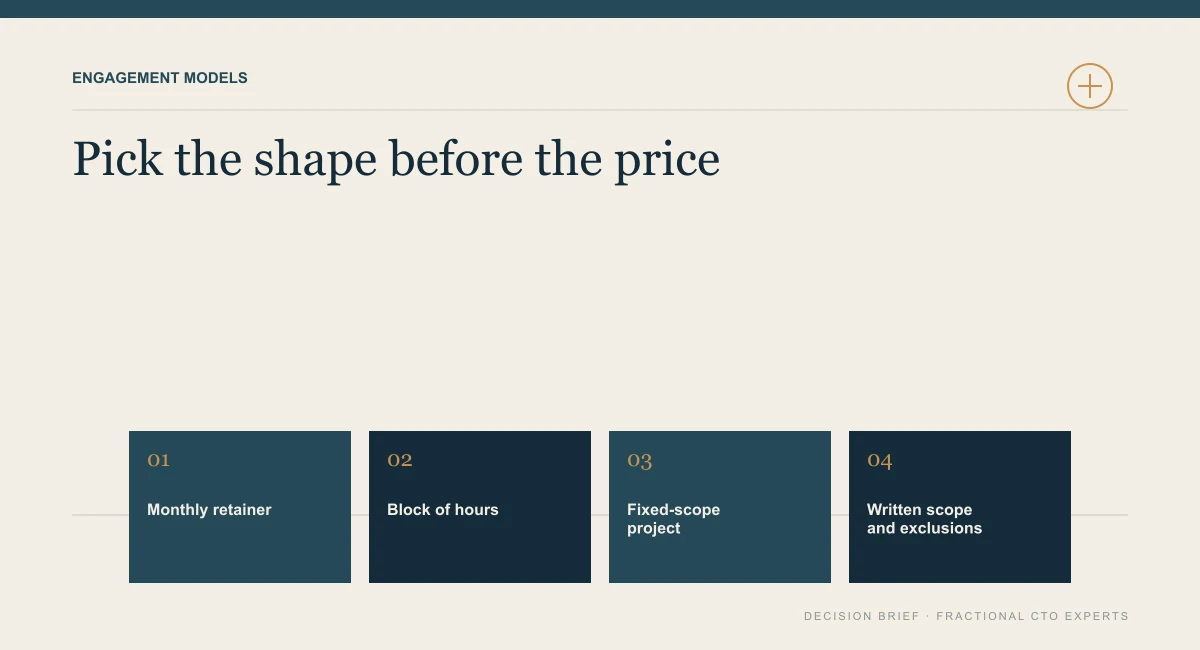
| Model | How it works | Fits when | Watch for |
|---|---|---|---|
| Monthly retainer | A fixed fee for an agreed allocation or an agreed scope of work each month | Work is steady and you want the lawyer in regular meetings | What happens to unused time, and what happens when the queue exceeds the allocation |
| Block of hours | You buy hours in advance and draw them down | Work is irregular, or you are testing the relationship | Expiry dates, minimum increments, and slow response when you are not a regular commitment |
| Fixed-scope project | A defined deliverable for a set fee | A contract template suite, a diligence clean-up, a policy set | Scope written tightly enough that both sides agree when it is finished |
Whatever the shape, get the scope and the fee basis in writing. ABA Model Rule 1.5(b) says the scope of the representation and "the basis or rate of the fee and expenses" shall be communicated to the client, "preferably in writing," before or within a reasonable time after the representation starts. Model Rule 1.2(c) allows a lawyer to limit the scope of a representation "if the limitation is reasonable under the circumstances and the client gives informed consent." In plain terms, a limited-scope engagement is normal, and you should understand the limits before you agree to them. The Model Rules are a template that each state adapts, so the rule in your lawyer's state may be worded differently.
Two commercial points deserve attention.
Equity as part of the fee. Early-stage companies sometimes offer options or shares. Model Rule 1.8(a) restricts a lawyer from entering a business transaction with a client or acquiring an ownership interest adverse to a client unless the terms are fair and disclosed in writing, the client is advised in writing to consider independent legal advice, and the client gives signed, informed consent. Expect a careful lawyer to raise this with you, and treat one who waves it away as a warning sign.
Liability caps in the engagement letter. Model Rule 1.8(h)(1) says a lawyer shall not make an agreement prospectively limiting the lawyer's liability to a client for malpractice unless the client is independently represented in making the agreement. If the letter you are given limits the lawyer's liability, ask how that fits the rule in their state.
Comparing quotes without a rate benchmark. Ask every candidate to price the same brief (the template is below), and convert each quote to a monthly figure on the same basis:
Monthly cost = fixed fee, or (expected hours × quoted hourly rate) + expected overflow hours × overflow rate + outside counsel spend the plan assumes + internal staff time spent supporting the work.
Fill that in with the quotes you receive and your own payroll figures. A lower fee for a narrower scope, or one that pushes more work to a law firm, is not cheaper.
How to vet a fractional general counsel
Most vetting advice for fractional executives is about references and track record. Lawyers add a layer that other executives do not have: they are licensed, the license is tied to a place, and public records exist. Run these checks before the first interview. They take little time, and a failed check ends the process early.
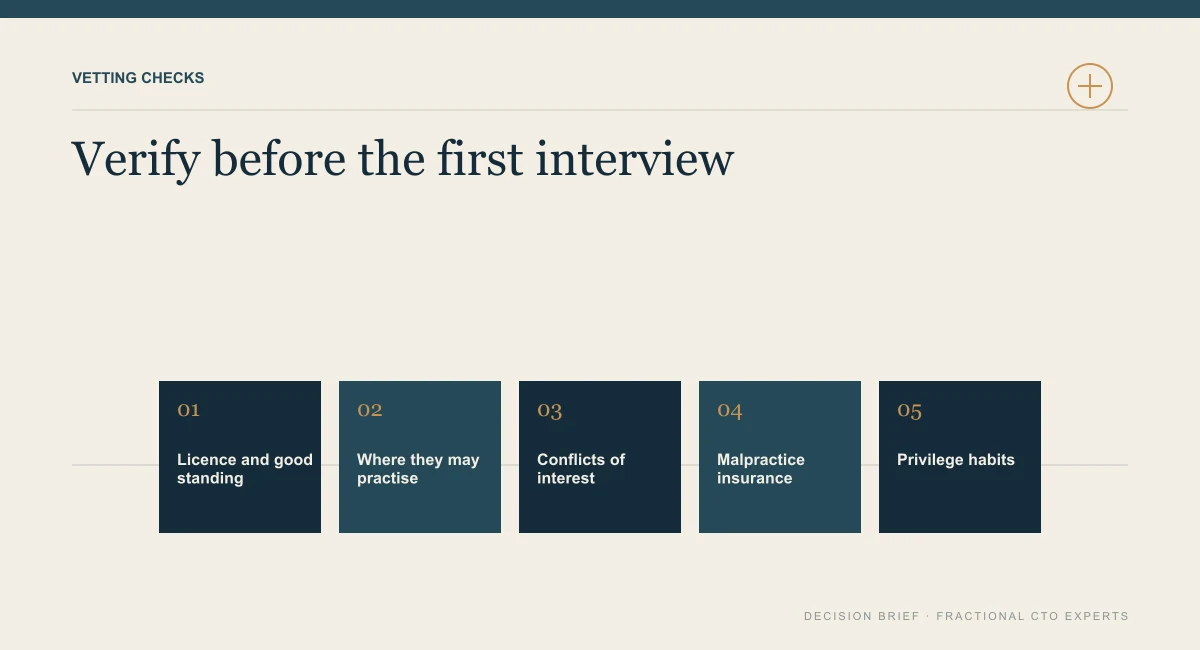
1. License and good standing
In the United States, lawyers are admitted jurisdiction by jurisdiction, which is why the Model Rules speak of a lawyer "admitted to practice in this jurisdiction." Ask the candidate for every jurisdiction where they are admitted and their bar number in each, then look them up yourself. California's attorney search, for example, lets you search by name or bar number, and the State Bar publishes disciplinary and administrative status changes. Look for the equivalent lookup from the bar or court system in each jurisdiction the candidate names.
Check three things in each record: that the name matches the person you are speaking to, that the license is currently active, and whether any discipline is recorded. You can also ask the candidate for a recent certificate of good standing from their licensing authority. An "inactive" or "retired" status is not a scandal, but it may mean the person cannot currently practice law, so ask.
2. Where they are allowed to practice
This is the check buyers most often skip. ABA Model Rule 5.5(b) says a lawyer who is not admitted in a jurisdiction shall not, except as authorized, "establish an office or other systematic and continuous presence in this jurisdiction for the practice of law," or represent that they are admitted there. The rule then lists exceptions. Paragraph (c) allows certain legal services "on a temporary basis," including work that arises out of or is reasonably related to the lawyer's practice where they are admitted. Paragraph (d)(1) allows a lawyer admitted in another US jurisdiction to provide services "to the lawyer's employer or its organizational affiliates," which is the exception that addresses in-house work.
Notice the word "employer." A fractional GC may be a part-time employee of your company, or an independent lawyer serving several clients, or a member of a firm. Which exception applies, if any, depends on that structure and on how each state has adopted and interpreted its own version of the rule. This guide cannot tell you how the rule applies to your situation. What you can do is ask the candidate three direct questions:
- Where are you admitted, and where will you physically be working?
- Where is our company based, and which states' or countries' laws will most of the work involve?
- On what basis are you permitted to do this work for us, and what will you refer to locally admitted counsel?
A competent candidate will have a clear, specific answer. A vague one is a result in itself.
3. Conflicts of interest
A full-time general counsel has one client. A fractional one has several, and may have advised your competitors, customers, investors or suppliers. Model Rule 1.7 says a concurrent conflict exists when representing one client will be "directly adverse to another client," or when there is "a significant risk" that the representation will be "materially limited" by the lawyer's responsibilities to another client, a former client, a third person or the lawyer's own interests. Some conflicts can be waived with informed consent confirmed in writing; some cannot.
Ask how the candidate checks for conflicts before taking a client, and give them the names they need to run the check: your major customers, competitors, investors and any counterparty in a dispute. Ask what happens if a conflict emerges mid-engagement.
Settle who the client is, too. Model Rule 1.13(a) says a lawyer employed or retained by an organization "represents the organization acting through its duly authorized constituents." Paragraph (f) requires the lawyer to explain the identity of the client when the organization's interests are adverse to those of the directors, officers or employees they are dealing with. That matters in founder disputes, executive exits and financing rounds, where a founder may assume the company's lawyer is also theirs.
4. Malpractice insurance
Do not assume a lawyer carries professional liability insurance. Requirements differ by jurisdiction. As one example, California's Rule 1.4.2 requires a lawyer who knows or reasonably should know that they do not have professional liability insurance to tell the client in writing at the time of engagement. The rule has exceptions, including one for a lawyer employed as in-house counsel who is advising the client in that capacity. That is a disclosure rule, and it shows why you should ask instead of assuming.
Ask for a certificate of insurance. Check that the policy covers the kind of work in your brief and the entity you are contracting with (the individual, their firm or a provider). If the person will be your employee, ask your own broker how employed lawyers are treated under your company's policies.
5. Privilege and confidentiality habits
Attorney-client privilege can protect a company's communications with its lawyers, including in-house lawyers. In Upjohn Co. v. United States, the US Supreme Court held that employees' communications to the company's counsel in that case were covered by the privilege, and rejected a test that limited it to a senior "control group." The Court also stated the limit: the privilege "only protects disclosure of communications; it does not protect disclosure of the underlying facts."
A general counsel who sits in commercial meetings gives legal advice and business advice in the same hour. Cornell's Wex legal encyclopedia notes that "communications relating solely to non-legal business matters are not privileged," and that sharing a communication with third parties can waive protection. Privilege rules differ between courts and between countries, so do not rely on a general description, including this one.
Ask the candidate how they keep legal advice identifiable in practice: how they label requests for advice, who gets copied, where legal files are kept and whether they will use a company email account. Ask what they tell non-lawyer colleagues about forwarding legal emails. You are testing whether they have working habits, not whether they can recite doctrine.
6. Evidence of generalist judgment
After the regulatory checks, vet them as you would any senior hire. Ask for a redacted example of a negotiation playbook or risk report they wrote. Ask about a time they told an executive "yes, and here is how" when the easy answer was no. Ask about a matter they referred out and how they chose the firm. Ask for a reference from a chief executive or finance lead they served part time, and ask that reference how fast answers came back and whether the advice was usable.
Scoping brief you can copy
Send the same brief to every candidate so the proposals are comparable. Replace the bracketed text. This is a planning document, not an engagement letter; the lawyer will supply that, and you should read it against this brief.
Role: Fractional general counsel for [company], a [short description: sector, headcount, where incorporated, where customers and staff are].
Reports to: [CEO / CFO]. Day-to-day contact: [name, role], who triages requests.
Why now: [the trigger: contract queue, enterprise deals, fundraise, regulated product, employment issues, outside counsel spend].
Work in scope:
- Commercial contracts: [types and approximate monthly volume from your own count].
- Templates and playbook: [which agreements need a standard form].
- Corporate: [board support, option grants, records, data room].
- Employment: [documents, first response; states or countries involved].
- Regulatory and privacy: [the rules you believe apply, or "to be assessed"].
- Outside counsel management: [current firms and matters].
- Reporting: [a monthly legal risk summary to the executive team / quarterly to the board].
Out of scope: litigation and enforcement; [tax, patents, immigration, securities offerings]; advice to individual founders, directors or staff; operating the compliance program.
Jurisdictions: Company is based in [state/country]. Most work involves the law of [states/countries]. Candidate to state where they are admitted and how they will handle other jurisdictions.
Allocation and availability: [hours or days per month]; [fixed weekly session]; response window of [for example, one business day] for routine requests and [same day] for agreed urgent categories. Cover during absence: [expectation].
Preferred model: [retainer / hours block / project]. Candidate to state the fee basis, what is included, the overflow rate and how unused time is treated.
Information requested with the proposal: jurisdictions of admission and bar numbers; confirmation of good standing; professional liability insurance certificate; conflict check against [list of customers, competitors, investors, counterparties]; two references from part-time or in-house clients.
Records: matter list, templates, playbook and executed contracts are kept in [company system] and belong to the company.
Review and exit: scope review at day 90; [notice period]; handover of the matter list and open items to [successor or deputy].
Interview scorecard
Agree on the weights before the first interview, and write the evidence next to each score. The weights are a starting point; adjust them to your brief. The first row is a gate, not a score.
| Criterion | Weight | 1: weak evidence | 3: adequate evidence | 5: strong evidence |
|---|---|---|---|---|
| License, standing and insurance | Gate: pass or stop | Cannot be verified, or answers are vague | Verified, with gaps explained | Verified on public records; certificate supplied without being asked twice |
| Jurisdiction answer | 15% | Has not considered it | States where admitted; unsure about your other states | Explains the basis for the work and what goes to local counsel |
| Commercial contract judgment | 25% | Talks about "protecting the company" in general | Describes negotiations they ran | Shows a playbook with fallback positions and explains what they concede and why |
| Business fluency | 20% | Answers in legal terms only | Understands your revenue model after explanation | Asks about deal cycle, margins and risk appetite before giving a view |
| Managing outside counsel | 15% | Has only been outside counsel | Has instructed firms | Describes budgets set, invoices challenged and work brought in-house |
| Conflicts and client identity | 10% | Treats it as a formality | Describes a conflict check process | Raises who the client is and how founder or investor conflicts are handled, unprompted |
| Availability and working method | 10% | "Whenever you need me" | States an allocation | States allocation, response windows, current client load and absence cover |
| Handover design | 5% | Has not thought about exit | Mentions documentation | Proposes a matter list, templates and a named internal owner from the start |
Multiply each score by its weight and add the results. Discuss any criterion scored 1 whatever the total. A candidate who is strong on contracts and scores 1 on the jurisdiction answer has not done the work of understanding how they would lawfully serve you.
The first 90 days
A good start moves from inventory to standard documents to a working rhythm. Each phase below ends in an output you can inspect.
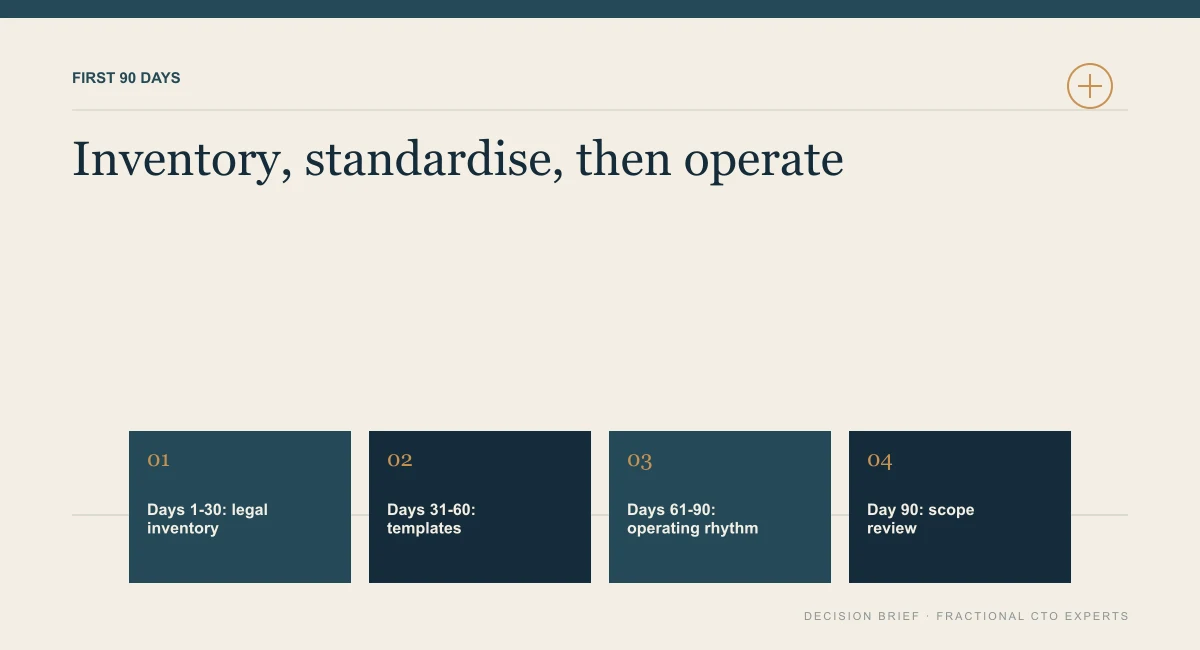
Days 1–30: legal inventory
- Sign the engagement letter, complete the conflict check and agree how requests for legal advice will be sent and stored.
- Interview the executives and the people who generate legal work: sales, people operations, finance, product.
- List every open matter, every law firm relationship and the current spend with each.
- Collect the contracts that carry the most revenue or risk, and note renewal dates, unusual liability terms and change-of-control clauses.
- Check the corporate records: board approvals, cap table, option grants, IP assignments from founders, staff and contractors.
- Output at day 30: a matter list, a contract register for the key agreements, and a short risk memo that ranks issues by exposure and urgency.
Days 31–60: templates and decisions
- Draft or repair the standard agreements the business uses most.
- Write the negotiation playbook: preferred position, acceptable fallbacks and the points that need executive sign-off.
- Agree an approval matrix with the chief executive: who can sign what, at what value and with which non-standard terms.
- Reset outside counsel: confirm which firms handle what, with budgets and a single point of instruction.
- Fix the highest-ranked items from the risk memo, or assign them with dates.
- Output at day 60: approved templates, a playbook the sales team has been trained on, an approval matrix and an outside counsel roster.
Days 61–90: operating rhythm
- Run a simple intake process so requests arrive in one place with the information needed to answer them.
- Start the recurring legal risk report.
- Train managers on the few things that create the most avoidable risk in your business, such as side letters, informal contract amendments by email, or contractor engagement.
- Measure what you can: how long routine contracts take, and how many deals close on standard terms.
- Output at day 90: a scope review with the reporting executive covering what was fixed, what remains open, whether the allocation matches the queue and what should move to specialists.
Judge the review on evidence. Can a salesperson find the current template and the fallback list without asking anyone? Does the chief executive know which legal issues are open and what each could cost? Has routine work stopped going to a law firm at specialist rates? If so, the engagement is working.
Worked example: the enterprise contract queue (hypothetical)
This is an illustrative scenario, not a client story. A software company with about 60 employees starts selling to large customers. Each customer sends its own master agreement and a security schedule. The chief executive forwards them to a law firm, which returns careful mark-ups. The customers push back, the same arguments recur on every deal, and the legal bill grows with each sale.
The company considers hiring a full-time general counsel. A month-long log shows the real workload: a few enterprise contracts in negotiation at any time, a steady trickle of supplier agreements and non-disclosure agreements, and an occasional employment question. That is real work, but it does not fill a full-time senior role.
The company engages a fractional general counsel on a monthly retainer with the scope in the brief above. In the first month, the lawyer reads the last ten negotiated contracts and finds that the same handful of clauses caused nearly every delay: liability caps, indemnities, data-processing terms and audit rights. In the second month, they write a playbook with a preferred position and two fallbacks for each, and agree with the chief executive which fallbacks sales may offer without asking. The law firm is kept for a pending financing and for anything contentious.
The result to look for is fewer surprises, and legal headcount is not the measure. Routine deals now close on known terms, and exceptions reach an executive with a clear statement of the risk. The firm's time goes to work that needs a specialist.
Red flags
- No clear answer on licensing. The candidate cannot say where they are admitted or how they are permitted to serve a company in your location.
- No conflict check. They are ready to start without asking who your customers, competitors and investors are.
- Reluctance to show insurance. A certificate is a routine request.
- "I cover everything." No generalist covers litigation, tax, patents and securities work alone.
- No written scope. The engagement letter does not match the brief, or leaves fees and overflow undefined.
- Too many clients for the allocation promised. Ask directly how many companies they serve and how urgent requests are prioritized.
- Advice with no recommendation. Long memos that list risks without saying what they would do are a law firm habit a general counsel should have left behind.
- Records kept outside your systems. Templates and executed contracts that live only in the lawyer's files make the exit painful.
Ending or converting the engagement
Engagements usually end in one of three ways. The workload grows and the company hires a full-time general counsel, often with the fractional GC helping to define the role and hand over. The work shrinks to occasional questions and the arrangement steps down to a small hours block. Or the company is acquired or changes direction and the engagement stops.
Each ending needs the same records in company systems: the matter list, the contract register, templates and playbook, the approval matrix and the outside counsel roster. If a new lawyer could pick those up and run next month's risk report, the handover is sound.
To find candidates, employers can post a fractional general counsel role with the scoping brief attached. Lawyers looking for part-time leadership work can browse open fractional and interim executive roles. Whoever you speak to, run the public license check first, send every candidate the same brief and score the answers against evidence.
Frequently asked questions
Is a fractional GC an employee or an outside lawyer?
It can be either. Some work as part-time employees and others as independent lawyers or through a firm or legal services provider. The structure affects licensing, insurance and conflicts questions, so ask the candidate which one they propose and why, and have the engagement terms reviewed before you sign.
Does a fractional general counsel need to be licensed in our state?
Rules vary by jurisdiction. ABA Model Rule 5.5 bars a lawyer from setting up a systematic and continuous presence for the practice of law in a jurisdiction where they are not admitted, with listed exceptions, and each state adopts its own version. Ask the candidate where they are admitted and how their arrangement with you complies with the rules of the states involved.
Are emails with a fractional GC protected by attorney-client privilege?
Not automatically. Cornell's Wex legal encyclopedia notes that communications relating solely to non-legal business matters are not privileged, and a lawyer who sits in commercial meetings gives both kinds of advice. Agree on working habits with the lawyer in the first week, and take specific advice before relying on privilege for a sensitive matter.
Can a fractional GC go to court for us?
Most engagements exclude litigation. The usual pattern is that the fractional GC selects and manages specialist litigation counsel, sets the budget and reports to the executive team. If you expect court work, say so in the brief, because it changes the licensing, insurance and capacity questions.
Can the same lawyer advise the company and its founders personally?
Treat that as a conflict question. ABA Model Rule 1.13 says a lawyer retained by an organization represents the organization, and allows representation of its officers or shareholders only subject to the conflict rule, Rule 1.7. Founders negotiating their own terms with the company should expect to need separate counsel.
When should we replace a fractional GC with a full-time general counsel?
Consider it when legal questions need a same-day answer most days, when the queue no longer fits the allocation even after templates and delegation, or when regulators, investors or a planned listing call for a named full-time legal officer. Plan the handover with the matter list, templates and outside counsel roster.
Sources and further reading
- ABA Model Rules of Professional Conduct, Rule 5.5: Unauthorized Practice of Law; Multijurisdictional Practice of Law
- ABA Model Rules of Professional Conduct, Rule 1.1: Competence
- ABA Model Rules of Professional Conduct, Rule 1.2: Scope of Representation
- ABA Model Rules of Professional Conduct, Rule 1.5: Fees
- ABA Model Rules of Professional Conduct, Rule 1.7: Conflict of Interest: Current Clients
- ABA Model Rules of Professional Conduct, Rule 1.8: Current Clients: Specific Rules
- ABA Model Rules of Professional Conduct, Rule 1.13: Organization as Client
- State Bar of California: Attorney Search
- State Bar of California: Rules of Professional Conduct (Rule 1.4.2, Disclosure of Professional Liability Insurance)
- Upjohn Co. v. United States, 449 U.S. 383 (1981), Cornell Legal Information Institute
- Cornell Legal Information Institute, Wex: Attorney-client privilege