Executive hiring templates
Engineering Manager Job Description: Editable Template
Copy an editable engineering manager job description, see how the role differs from tech lead and director, and set team size, hands-on work, 90-day outcomes and a scorecard.
- By
- Fractional CTO Experts
- Published
- 2026-10-12
- Reviewed
- 2026-10-12
- Reading time
- 16 minutes
- Start with the team, not the title
- Editable engineering manager job description template
- Engineering manager vs tech lead, director and head of engineering
- The choices most templates leave implicit
- IC and manager expectations are different jobs
- Two versions of the same job
- Measuring delivery without turning measures into targets
- Worked example: splitting a team that outgrew its CTO
- 90-day outcomes with acceptance evidence
- Engineering manager interview scorecard
- When a fractional engineering manager fits
- Review checklist before you publish
An engineering manager job description should state which team the manager leads, how many people report to them, how much hands-on technical work is expected, what they can decide about hiring and performance, and what the team should deliver in the first 90 days. Engineering manager responsibilities fall into four groups: people, delivery, technical health and hiring. The template below lets you set each of those explicitly instead of leaving candidates to guess.
This page gives you a copyable software engineering manager job description, a table that separates the role from tech lead, director and head of engineering, the choices that most templates leave implicit, first-quarter outcomes and an interview scorecard. It is a reusable resource for your own hiring, not a live vacancy.
Start with the team, not the title
"Engineering manager" covers very different jobs. At one company it means the first person who manages engineers other than the CTO. At another it means one of twenty managers in a structured organization with a career ladder, a calibration process and a recruiting team. The duties list looks similar in both places; the actual work does not.
Before writing, answer four questions. Which team or teams will this person lead, and what do they own in the product or platform? How many engineers will report to them on day one, and how many in a year? Who has been managing these people until now, and what is changing for that person? And what is going wrong or about to go wrong that makes the hire necessary now?
The last question matters most. Companies usually hire an engineering manager because a CTO or founder is managing too many people to do either job well, because a team is growing faster than its informal habits can handle, or because delivery has become unpredictable and nobody owns fixing it. Each reason puts a different responsibility at the top of the list.
The US Bureau of Labor Statistics profile of software developers notes that developers may advance to become computer and information systems managers who oversee the software development process. That is the common route into this job, and it is why a clear description matters: many strong candidates will be experienced engineers deciding whether management is the job they want.
Editable engineering manager job description template
Copy the text into your own document and replace every bracketed field. Remove responsibilities that are not part of the real job. The sections after the template explain the choices you will need to make to fill in the brackets honestly.
Role summary
Job title: Engineering Manager, [team or product area].
Company: [Company name], [one sentence on what the company builds and for whom].
Reports to: [CTO / VP of Engineering / Director of Engineering / Head of Engineering].
Team: [Number] direct reports: [roles and levels, for example "four backend engineers, two frontend engineers and one QA engineer"]. Planned growth to [number] in [period].
What the team owns: [Product area, services or platform components, and the customers or internal users who depend on them].
Location and working pattern: [Remote, hybrid or on-site; time zone overlap required with the team].
Engagement: [Full-time employment / fractional arrangement of stated days per week].
Why we are hiring now: [For example: "Our CTO has been managing twelve engineers directly while also leading architecture and hiring. We are creating this role so the team gets consistent support and the CTO can focus on technical direction."]
Purpose of the role
The engineering manager is accountable for the people on [team] and for the team's ability to deliver [product area] reliably. They will support each engineer's growth, make sure work is planned, visible and sustainable, keep technical quality at a level the team is proud of, and help hire the people the team needs next. Success means the team delivers what it commits to, knows why the work matters, and people want to stay.
The manager is expected to spend [stated share or description, for example "most of their time on people and delivery, with code review and occasional small fixes"] on hands-on technical work. [Named role, for example the tech lead or staff engineer] owns technical design decisions for the team; the manager ensures those decisions are made, recorded and followed through.
Principal responsibilities
People:
- Hold regular one-to-ones with every direct report and act on what they hear.
- Set clear expectations for each engineer using [the company's career framework, or "a framework you will help create"], and give specific, timely feedback.
- Write and deliver performance reviews and make promotion recommendations through [the company process].
- Address performance problems early, document them fairly and involve [HR partner or manager] when needed.
- Protect the team from avoidable interruption and burnout, including a sustainable on-call arrangement.
Delivery:
- Work with [product manager and design lead] to turn priorities into a realistic plan, and say no or not yet when the plan does not fit the capacity.
- Make the team's work and risks visible to stakeholders without creating reporting overhead.
- Run or delegate team rituals such as planning, reviews and retrospectives, keeping only the ones that help.
- Track a small set of delivery measures at team level and use them to find problems, not to rank people.
Technical health:
- Make sure the team has time and a plan for maintenance, reliability work and technical debt.
- Participate in [code review / design review / incident review] at the level agreed with the tech lead.
- Own the team's part of incident response and follow-up actions.
Hiring and team building:
- Define the roles the team needs, run interviews and make hiring recommendations or decisions within [stated authority].
- Onboard new engineers so they contribute confidently within [period].
- Build a team culture where people ask questions, disagree openly and share knowledge.
Cross-functional:
- Represent the team with product, design, support, sales and other engineering teams, and resolve dependencies before they block work.
- Escalate risks, staffing needs and cross-team conflicts to [manager] with options, not just problems.
Decision rights
The engineering manager decides [for example: team rituals and working agreements; allocation of engineers to work within the agreed priorities; approval of time off; whether a candidate passes the team's interview stage]. They recommend, and [manager or HR] decides, on [for example: offers and compensation; promotions; performance improvement plans and terminations; headcount changes]. The tech lead or staff engineer decides [technical design within the team's systems], with the manager able to escalate concerns about delivery risk.
Experience and capabilities
- Has [managed engineers / led a team as a tech lead with coaching responsibilities] and can describe specific people decisions they made and what happened.
- Has delivered software in [relevant environment: languages, cloud platform, product type] and can hold a credible technical conversation with the team.
- Can plan work with product partners, explain trade-offs to non-engineers and push back on unrealistic commitments.
- Has run or contributed to hiring for engineering roles.
- Handles difficult conversations directly and fairly.
Preferred, not required: [experience at a particular stage, domain knowledge, specific tooling]. Avoid a fixed number of years unless you can say what those years provide that a strong candidate with fewer years would lack.
First 90 days
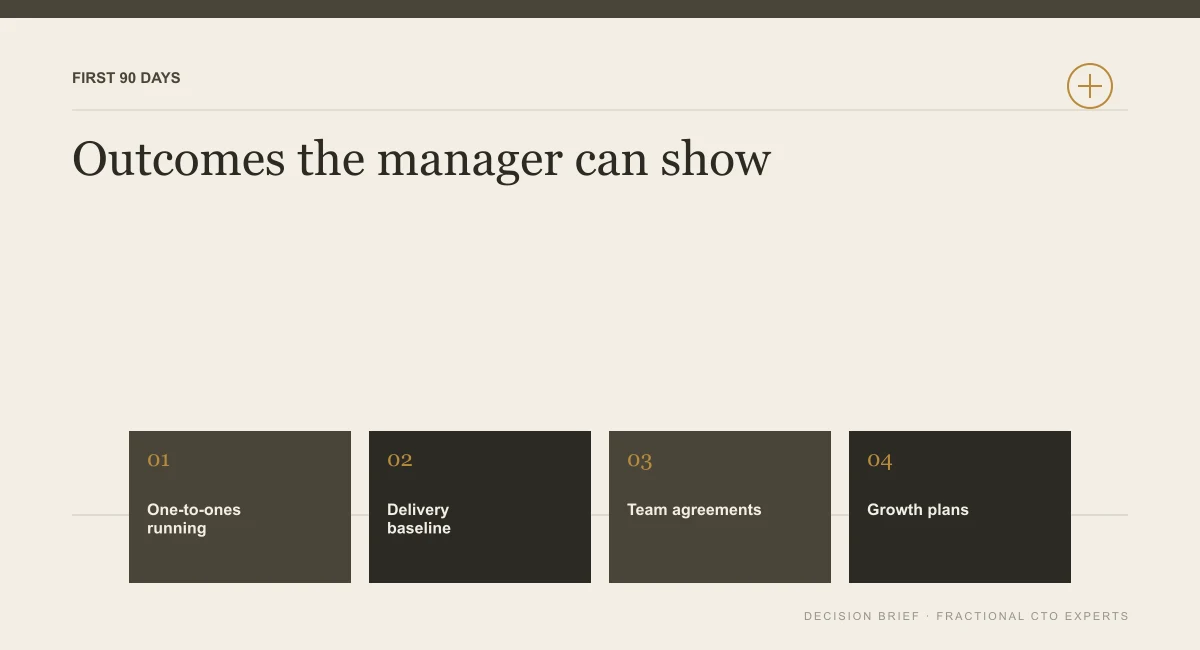
Within 90 days, the engineering manager will have regular one-to-ones running with every direct report, a written baseline of how the team currently plans and delivers, agreed team working agreements, and an individual growth conversation with each engineer. A later section lists acceptance evidence for each outcome.
Practical information
[Compensation information required or appropriate for the jurisdiction], [benefits], [interview stages and timeline], [contact for adjustments]. Ask candidates for [the evidence you need at this stage]. Keep it proportionate.
Engineering manager vs tech lead, director and head of engineering
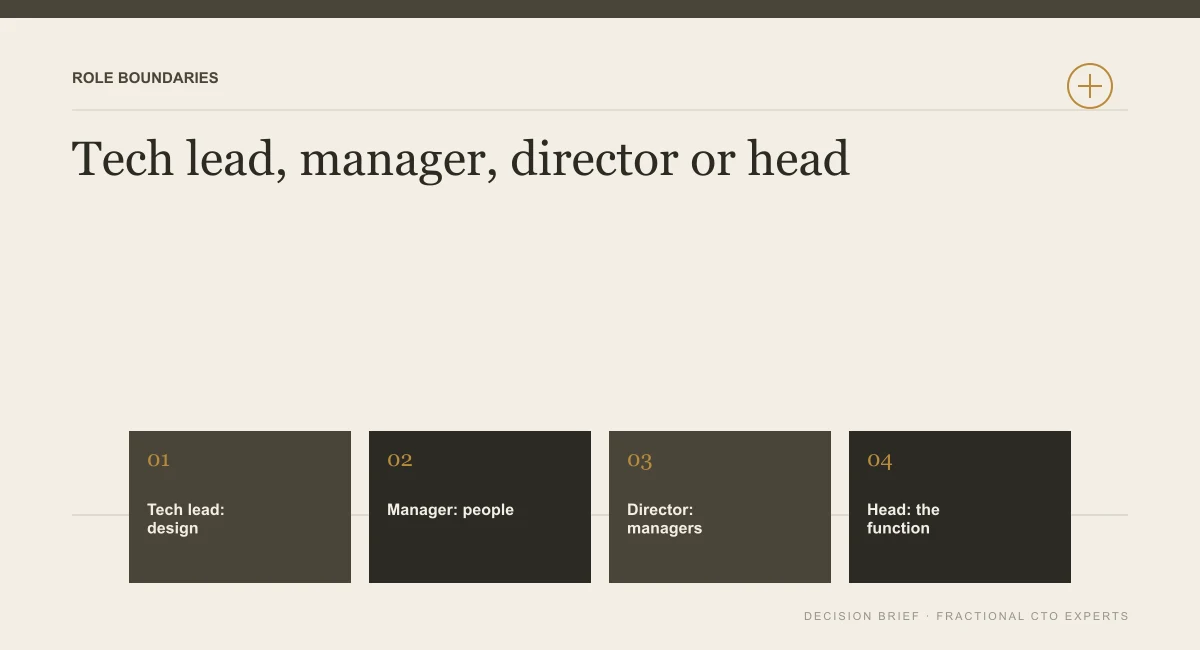
These titles overlap, and companies use them differently. What matters is who is accountable for what. The table shows a common division; your company may reasonably draw the lines elsewhere, but the job description should say where you drew them.
| Role | Primarily accountable for | Typically manages | Hands-on technical work | Where it goes wrong |
|---|---|---|---|---|
| Tech lead | Technical direction, design quality and technical decisions for one team | Usually no formal reports; guides engineers technically | High; often a significant contributor | Asked to handle people problems without the authority or time |
| Engineering manager | The people on a team, their growth and the team's delivery | Individual engineers | Lower, and varies by team size and company choice | Treated as a senior engineer with extra meetings |
| Director of engineering | A group of teams, their managers and cross-team delivery | Engineering managers, sometimes senior ICs | Low; involved in architecture and review at a higher level | Promoted manager keeps managing individuals instead of managers |
| Head of engineering | The engineering function as a whole: structure, hiring plan, practices, budget | Managers and directors, or the whole team in a smaller company | Varies widely with company size | Title used for an EM-sized job, or given without budget authority |
In a small company, one person may hold several of these roles at once. A founding engineer may be tech lead and manager; a head of engineering may still manage individual engineers directly. That is fine if the job description says so and the workload is realistic.
The biggest source of confusion is usually between the manager and the tech lead. If one person holds both roles, say which responsibility takes priority when time is short. If they are separate people, write down who decides technical design, who decides who works on what, and how disagreements get resolved.
For the layer above the engineering manager, the fractional head of engineering guide explains what the head of engineering owns and when part-time leadership can cover it. If you are also deciding how technical leadership is split at the top, the CTO vs VP of Engineering comparison covers that boundary, and the CTO job description template helps keep the documents consistent.
The choices most templates leave implicit
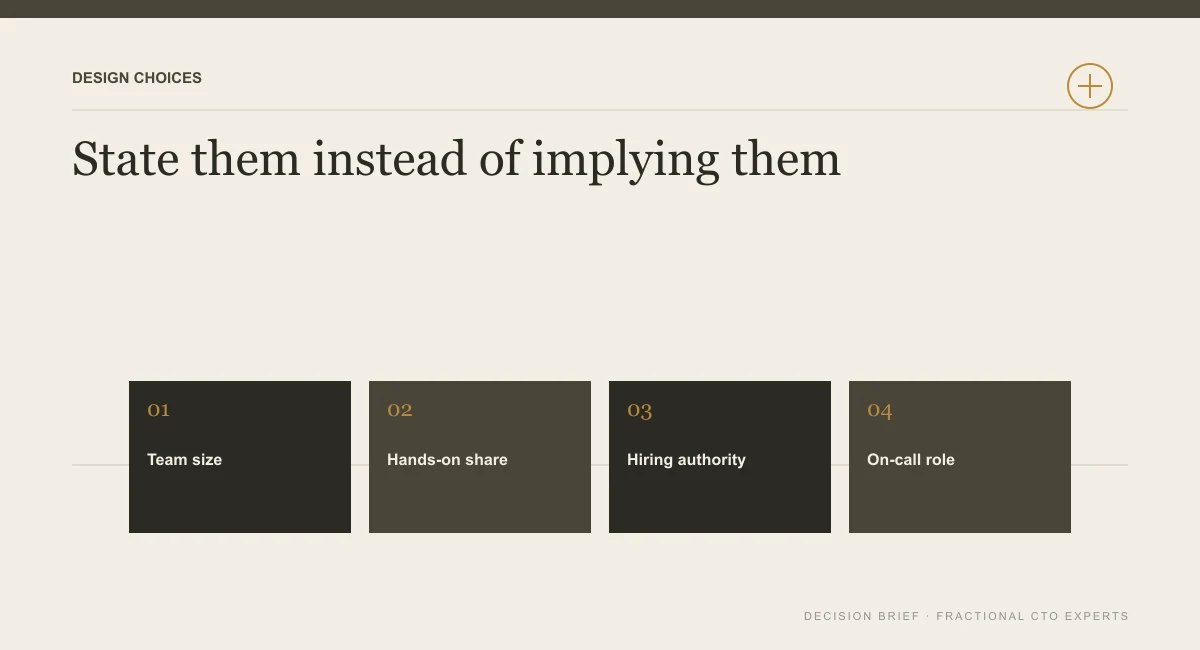
Generic job descriptions often hide four decisions that shape the job more than any responsibility list. Make each one explicitly, record the reasoning, and tell candidates. There is no universal right answer for any of them; the tables describe trade-offs, not industry benchmarks.
Span of control: how many direct reports
State the actual number of direct reports and the expected growth. Then check it against the other expectations in the description.
| Choice | What it allows | What it costs | Fits when |
|---|---|---|---|
| Smaller team | Time for deeper coaching and some technical contribution | Management overhead per engineer is higher; may feel like a tech lead role | Team is new, junior-heavy, or the manager is expected to stay hands-on |
| Mid-size team | Room for regular one-to-ones, planning and hiring, with limited coding | Little time for feature work; manager must delegate technical leadership | Team is stable and has a strong tech lead or senior engineers |
| Larger team | Fewer managers to coordinate | One-to-ones get shorter or less frequent; hiring and performance issues can overwhelm | Team is senior and self-directed, and the manager does little or no coding |
A useful test: add up the time needed for one-to-ones, planning, hiring, stakeholder work and any expected coding. If the total exceeds a working week before incidents and surprises, something has to come off the list.
Hands-on share: how much the manager codes
Choose and state one of these, or describe your own:
- Off the critical path. The manager reviews code and joins design discussions but does not own features with deadlines. This protects the team from a manager who becomes a bottleneck when meetings run long.
- Reviews and small fixes. The manager contributes code review, small improvements and investigation, but not large features.
- Significant feature work. The manager carries real engineering load. This usually only works with a small team and should be stated plainly, because it changes who will apply.
Hiring authority
Say whether the manager makes hiring decisions, recommends them or only interviews. Say whether they own job descriptions and interview loops for their team. If a recruiting team or a head of engineering controls headcount, say that too.
On-call and incident role
State whether the manager is on the on-call rotation, acts as incident commander, or only handles escalations and follow-up. Managers who sit on a rotation keep context but lose time; managers who do not need another way to stay close to production reality.
IC and manager expectations are different jobs
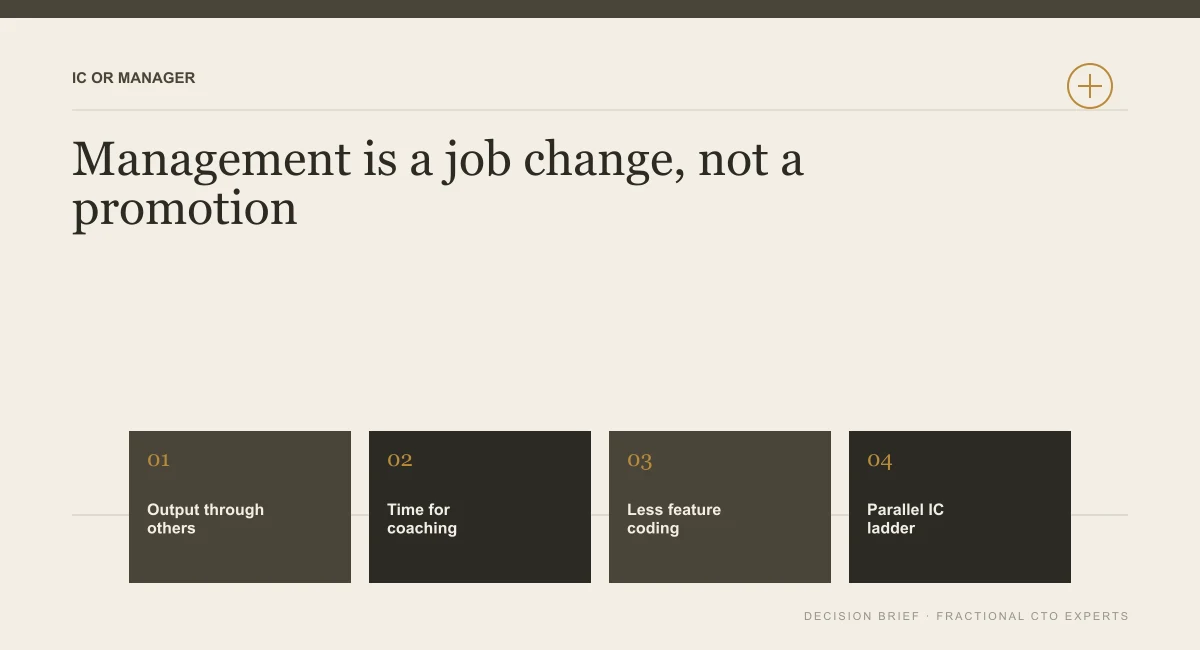
Many engineering managers are promoted from within, and many external candidates are strong engineers deciding whether to switch tracks. The job description should make clear that this is a change of job, not a reward for being the best engineer.
| Area | Senior individual contributor | Engineering manager |
|---|---|---|
| How impact is judged | Quality and significance of their own technical work | The team's delivery, health and growth |
| Main tools | Code, design documents, reviews | Conversations, plans, feedback, hiring |
| Feedback loop | Fast: code ships, tests pass | Slow: people grow over months |
| Typical frustration | Unclear requirements, interruptions | Problems that cannot be solved alone |
| Where time goes | Mostly focused technical work | Mostly meetings, writing and one-to-ones |
If your company has a parallel IC ladder with staff or principal engineer roles, mention it in the description. It tells candidates that management is one route to seniority, not the only one, and it makes it easier for someone to try management and return to IC work without it being seen as failure. If there is no parallel ladder yet, be honest about that as well.
Two versions of the same job
Adjust the template to the context. These replacement paragraphs cover the two most common situations.
The first engineering manager at a startup. The CTO or a founder has been managing everyone. The manager will take over most people management, set up the first real planning and one-to-one habits, and probably help design the first career framework. Expect a small, mixed-experience team, a close working relationship with the CTO and more hands-on work than in a larger company. Replacement purpose text:
You will be the first engineering manager at [Company]. Today our CTO manages all [number] engineers. You will take over line management of [team], set up regular one-to-ones, planning and review habits that fit a team our size, and work with the CTO to hire the next [number] engineers. You will stay close to the code through reviews and small contributions.
An engineering manager in a multi-team organization. The company already has managers, a career ladder, a recruiting process and a platform or product structure. The manager inherits a team with history and joins a peer group of managers. Replacement purpose text:
You will lead the [team] team of [number] engineers, one of [number] teams in [group]. You will report to [Director of Engineering] and work with peer managers on shared planning, calibration and cross-team dependencies. The team has an established tech lead; your focus is people, delivery and hiring.
Measuring delivery without turning measures into targets
Engineering managers are usually accountable for team delivery, so the description should say what evidence will be used. Choose a small set of team-level measures and state that they will be used to find problems, not to rank individual engineers.
DORA's research program offers one widely used set. DORA's software delivery performance metrics now comprise five measures: change lead time, deployment frequency and failed deployment recovery time for throughput, and change fail rate and deployment rework rate for instability. They describe how changes move to production and what happens when a change fails, which is a property of the team's delivery process. That makes them better suited to team-level conversations than to individual performance reviews.
Add qualitative evidence alongside any numbers: whether the team understands its priorities, whether stakeholders find the team predictable, what engineers say in one-to-ones and retrospectives, and whether new joiners become productive. Write in the description that the manager will agree the baseline before any target, because improvement claims without a starting point cannot be checked.
Worked example: splitting a team that outgrew its CTO
This is an invented scenario to illustrate the method, not a client story or a benchmark.
A software company has a CTO who directly manages eleven engineers while also making architecture decisions, interviewing and meeting customers. One-to-ones have become irregular. Two engineers have said in their occasional one-to-ones that they do not know how they are being evaluated. Planning happens, but estimates are routinely missed and nobody owns asking why.
The first draft of the job description asked for an engineering manager who would "own all engineering delivery, mentor the team, set technical direction and ship features." That combined the CTO's job, a tech lead's job and a manager's job in one listing. Working through the questions above changed it. The team was split into two groups by product area. The new manager would lead one group of six, including a senior engineer who became tech lead. The CTO kept the other group temporarily and technical direction across both.
The final job description stated six direct reports with planned growth to eight, reviews and small fixes as the hands-on share, hiring recommendations rather than final decisions, and escalations-only on-call. The first-quarter outcomes focused on regular one-to-ones, a written delivery baseline and a first draft of role expectations. The company also decided to reassess in six months whether the CTO's remaining group needed a second manager.
90-day outcomes with acceptance evidence
Write outcomes the hiring manager can check. The list below suits a manager inheriting an existing team; for a first manager at a startup, add setting up the basic rituals from scratch.
| Window | Outcome | Acceptance evidence |
|---|---|---|
| Days 1–30 | One-to-ones running | Every direct report has had at least two one-to-ones; the manager can summarize each person's goals and concerns |
| Days 1–30 | Handover from previous manager | Notes on each engineer's history, current commitments and open issues, confirmed with the previous owner |
| Days 1–30 | Stakeholder map | List of the people and teams that depend on the team, with how and how often they communicate |
| Days 31–60 | Delivery baseline | Written description of how work is planned and tracked, the chosen delivery measures, and their current values |
| Days 31–60 | Team working agreements | Agreed norms for reviews, meetings, on-call and communication, written with the team |
| Days 31–60 | Hiring plan | Agreed next roles, interview loop and the manager's part in it |
| Days 61–90 | Growth conversations | A documented expectations and growth conversation with each engineer |
| Days 61–90 | First improvement | One process or technical-health change chosen with the team, with a before-and-after check |
| Days 61–90 | Report to manager | A short written review of the team's strengths, risks and priorities for the next quarter |
Also agree on what is not expected in the first quarter. A new manager asked to reorganize the team, rebuild the release process and hire several engineers at the same time is unlikely to do any of those well.
Engineering manager interview scorecard
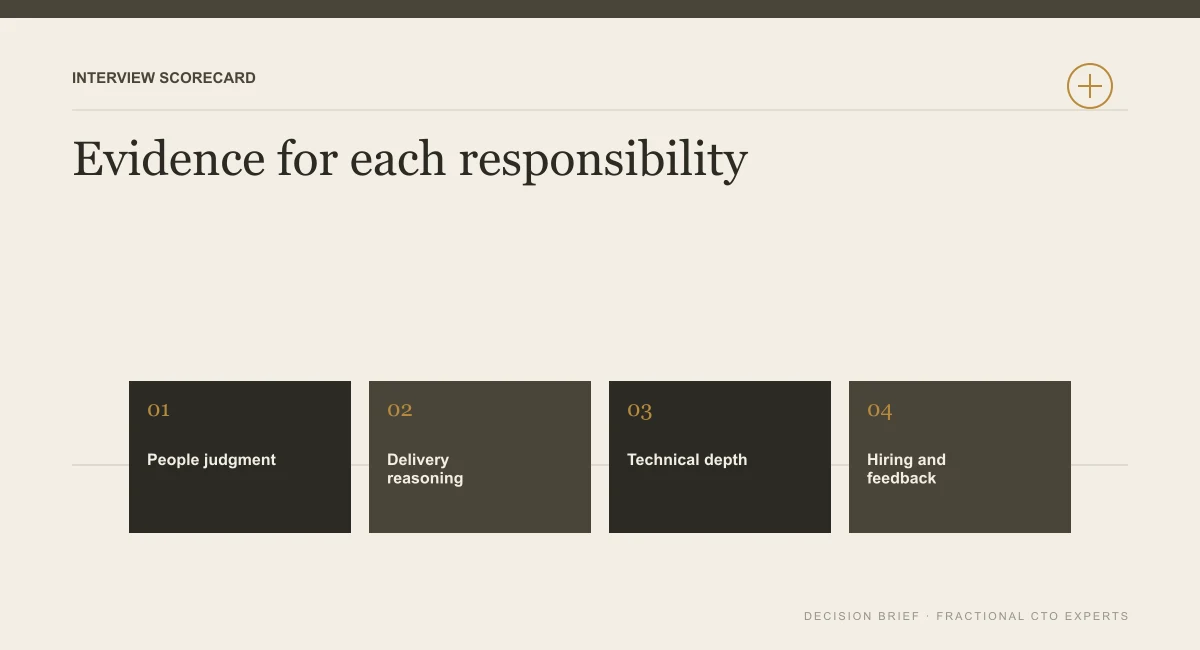
Define the scorecard before interviews start and give each interviewer different criteria. Tie every row to a responsibility in the description.
| Criterion | Question or exercise | Strong evidence | Warning signs |
|---|---|---|---|
| People judgment | "Tell me about an engineer who was struggling. What did you notice, what did you do and what happened?" | Specific observations, early and direct conversation, fair documentation, clear outcome | Waited months; blamed the person without describing support |
| Feedback | Role play: give feedback to an engineer whose code reviews are harsh | Specific, kind and direct; asks questions; agrees next steps | Vague, avoids the issue, or turns it into a lecture |
| Delivery reasoning | Give a one-page scenario of a team missing commitments. "What would you look at first?" | Asks about scope, interruptions, dependencies and estimates; proposes a way to find out | Jumps to more process or longer hours |
| Technical depth | Walk through a system the candidate knows, including a trade-off they would revisit | Explains decisions and limits clearly; knows where their knowledge ends | Cannot explain trade-offs, or dominates the design discussion |
| Hiring | "Design an interview loop for a mid-level engineer on this team" | Criteria tied to the role, structured questions, attention to fairness and candidate experience | Relies on gut feeling or brain-teasers |
| Stakeholder management | "Product wants a feature in two weeks; the team says six. What do you do?" | Clarifies scope and options, negotiates in the open, protects the team without stonewalling | Commits to two weeks, or refuses without alternatives |
| Motivation for management | "Why do you want to manage rather than stay on the IC track?" | Draws energy from others' growth; realistic about the loss of coding time | Sees management as the only way to be promoted |
Use a four-point scale with written reasons: no evidence, partial, sufficient and strong. Score independently before the debrief. In reference calls, ask how the candidate handled one specific difficult people situation, and what the referee would have wanted them to do differently.
When a fractional engineering manager fits
Some companies need management capacity before they can justify or find a permanent hire. A fractional engineering manager can set up one-to-ones, planning, hiring processes and role expectations for a few days a week, then hand over to an internal or permanent manager. It suits a team that has outgrown its founder's attention but is not yet large enough, or stable enough, for a permanent manager to be the obvious answer.
The same template works for a fractional role with two additions: the reserved time per week, and the name of the person who will take over day-to-day relationships at the end. Our fractional engineering manager guide covers when the model fits, the first 90 days and how to plan the handover.
Review checklist before you publish
- The team, its ownership area and the number of direct reports are stated.
- The hands-on technical share is stated and is realistic for the team size.
- Hiring, performance and on-call authority are explicit.
- The tech lead or technical decision owner is named, with a way to resolve disagreements.
- The "why we are hiring now" field describes a real problem.
- Delivery measures are team-level and will start from an agreed baseline.
- The 90-day outcomes have evidence that the hiring manager can check.
- The interview scorecard has a criterion for every major responsibility.
- Requirements separate essentials from preferences; years of experience are justified or removed.
- Location, compensation information and application steps match the real role and applicable law.
Compensation depends heavily on location, company stage and level, so this template does not supply a range. The BLS publishes wage data for the broad computer and information systems managers occupation, but that category spans CIOs, IT directors and many other roles, so it is not a benchmark for a single engineering manager position. Use current data for the specific level and market, and follow any pay-transparency rules that apply.
If a part-time arrangement fits your situation, Fractional CTO Experts is an executive network and matching platform; you can request a shortlist with the completed description and assess each candidate's relevant experience and availability.
The worked example on this page is hypothetical, and the diagrams are schematic illustrations rather than depictions of a real organization. This is an editorial hiring resource, not a live job advertisement.
Frequently asked questions
Should an engineering manager still write code?
That is a design choice for your company, not a universal rule. Decide whether the manager will stay off the critical path, contribute reviews and small fixes, or carry real feature work, and write it into the job description. The more people they manage, the less feature work is realistic.
How many engineers should report to one engineering manager?
There is no reliable universal number. The right team size depends on how experienced the engineers are, how much the manager is expected to code, how much hiring is underway and how stable the work is. State the actual number of direct reports and the planned growth so candidates can judge the load.
What is the difference between an engineering manager and a tech lead?
A tech lead is usually accountable for technical direction and design quality on a team, while an engineering manager is accountable for the people, their growth and the team's delivery. In small teams one person may do both, but the job description should say which responsibility wins when time runs short.
Who should an engineering manager report to?
In a small company, usually the CTO or a founder; in a larger one, a director of engineering, VP of engineering or head of engineering. Whoever it is should own the manager's own coaching and performance review, not just their delivery dates.
Can a startup hire an engineering manager part time?
Yes. A fractional engineering manager can set up one-to-ones, planning and hiring processes while the company grows into a permanent role. It works best when a named internal person will take over the day-to-day relationships at the end.
Sources and further reading