
Technology leadership models
CTO as a Service in 2026: Models, Cost, Scope and Fit
Understand CTO as a service: engagement models, scope, pricing assumptions, a first-month plan, provider questions, and when another leadership model fits.
- By
- Fractional CTO Experts
- Published
- 2026-07-30
- Reviewed
- 2026-09-07
- Reading time
- 13 minutes

“CTO as a service” sounds like a packaged product. In practice, it is an umbrella term for several very different ways of buying technology leadership.
One provider may offer two advisory hours a month. Another may place a fractional CTO into the leadership team. Another may supply a near-full-time interim executive. An agency may combine an external CTO with architects and developers. Those are all defensible products, but they carry different authority, capacity, risk, and prices.
The buying task is to turn the label into an operating agreement.
- The short definition
- Four models behind the label
- Start with the business result
- What does the service usually include?
- How CTO as a service is priced
- When the model fits
- CTO as a service versus adjacent choices
- What to put in the agreement
- How to select the provider
- Match the service to your company's starting point
- Build a service scope around decision packages
- A sample first-month service plan
- Understand the economics without accepting a generic ROI claim
- Questions to ask a CTO-as-a-service provider
- When CTO as a service is the wrong purchase
- Make the service leave behind a stronger organisation
- The durable buying rule
The short definition
CTO as a service is a commercial model through which a company accesses CTO-level judgment without immediately employing a permanent chief technology officer.
It can cover:
- technology and product strategy;
- engineering organization and leadership;
- architecture and platform investment;
- AI and data decisions;
- security, resilience, and compliance;
- technical diligence and board communication;
- vendor and delivery governance;
- an executive transition.
The service is credible only when it states which outcomes and decisions are included.
Four models behind the label
Advisor: reacts to high-consequence questions and challenges the existing team. The company keeps operating authority.
Fractional CTO: owns a bounded set of recurring executive decisions on a part-time cadence. They may participate in leadership meetings, manage leaders, and remain accountable for defined outcomes.
Interim CTO: temporarily holds most of a permanent seat, usually with greater capacity and people responsibility.
Agency CTO: leads a provider-owned or mixed team that may advise and deliver. The buyer contracts for a combined service rather than only an individual executive.
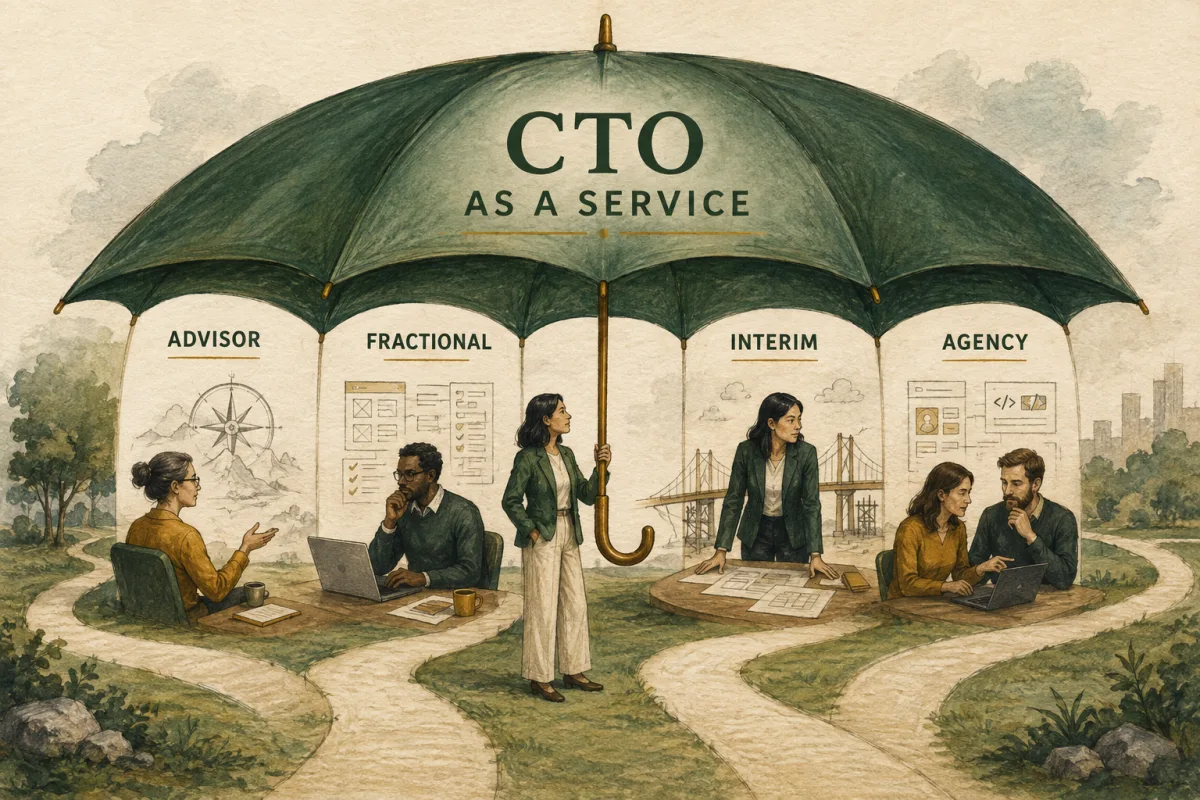
The useful question is not “Do you provide CTO as a service?” It is “Which of these operating models are you proposing, and why is it sufficient for our risk?”
Start with the business result
Weak scopes begin with activities:
- attend meetings;
- review architecture;
- advise developers;
- create a roadmap.
Stronger scopes begin with a consequence:
- restore reliable delivery before a customer commitment;
- decide how the platform must change for the next growth stage;
- establish security ownership before enterprise procurement;
- stabilize the technology function while a permanent search runs;
- connect diligence findings to a 100-day value-creation plan.
From the result, name the decisions. Then define access and execution.
A roadmap has little value if the CTO cannot resolve priorities or the team cannot execute. Strategy without an ownership boundary becomes a recurring presentation.
What does the service usually include?
A recurring fractional service may include:
- a weekly CEO or leadership session;
- product and engineering operating review;
- coaching for engineering managers;
- architecture and investment decisions;
- hiring plans and senior interviews;
- board or investor material;
- risk and security review;
- vendor governance;
- written decision records;
- a monthly scorecard.
Not every engagement needs all of these. Meeting count should follow decision load, not signal seniority.
An advisory service may provide a smaller number of prepared decision sessions. An interim service may include daily operating access, performance management, incident leadership, and external representation.
How CTO as a service is priced
Providers may charge hourly, daily, monthly, by project, or through a blended team fee.
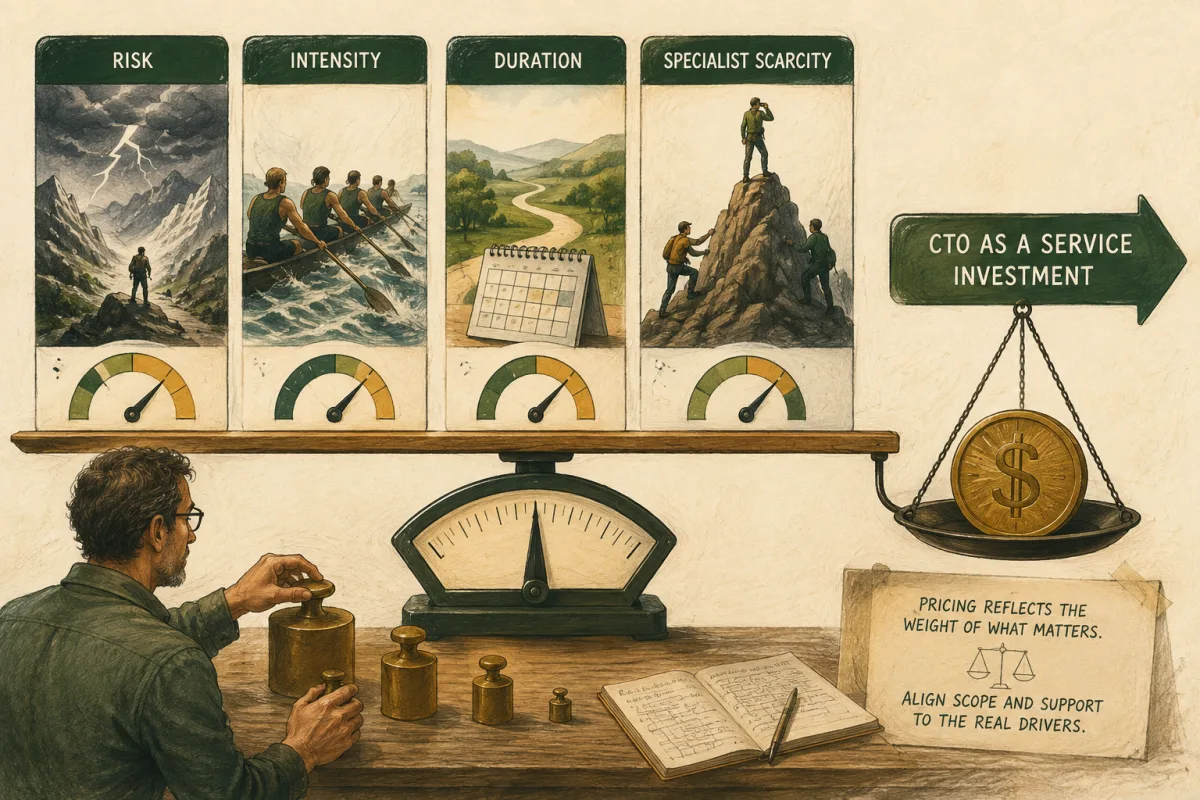
Price follows four forces:
- Risk: the business, security, regulatory, customer, and capital consequences of a wrong decision.
- Intensity: real meeting, preparation, management, incident, and asynchronous access.
- Duration: the time needed to reach and transfer the result.
- Scarcity: evidence in the exact stage, sector, transaction, or technical constraint.
Use hourly access for bounded advice. Use a retainer for recurring decision ownership. Use a fixed project for a defined assessment or diligence result. Use an interim capacity model when someone must carry most of the seat.
For illustration, a hypothetical $3,000 advisory package and a $25,000 interim proposal would not be comparable merely by their fees; these figures are examples, not market benchmarks. They are different amounts of executive capacity.
For a fuller budgeting method, use the fractional CTO pricing guide.
When the model fits
CTO as a service is plausible when:
- important technology decisions are unowned;
- the company does not need a permanent seat yet, or a search is in progress;
- the mandate can be bounded;
- an internal sponsor can provide access and resolve business dependencies;
- the team can execute between executive sessions;
- the company is willing to grant the required authority;
- success and transition can be measured.

It is a weak fit when the title is being used to avoid hiring the engineering capacity the company actually lacks, when the founders will not share evidence or authority, or when the role quietly requires permanent full-time people leadership.
Startup fit
An early startup may need a technical co-founder or senior builder more than a CTO. A fractional CTO becomes useful when technology decisions begin to cross product, team, capital, customer risk, and company strategy.
Growth-company fit
A growth company may use the model for a platform transition, engineering leadership gap, enterprise readiness, AI investment, or board-level technology governance.
Private-equity fit
A portfolio company may need diligence, interim cover, a 100-day technology plan, integration leadership, cyber remediation, or a cost and operating-model reset.
CTO as a service versus adjacent choices
| Option | Best when | Primary risk |
|---|---|---|
| Technical advisor | Existing team owns operations | Advice has no execution path |
| Fractional CTO | Bounded recurring executive decisions | Capacity is underspecified |
| Interim CTO | Temporary seat ownership is required | Expensive if the need is narrow |
| Development agency | Delivery capacity is the constraint | Provider incentives shape strategy |
| Full-time CTO | Enduring function needs continuous leadership | Premature permanent role design |
The right answer may combine models. A fractional CTO can govern a specialist agency. An interim CTO can run a permanent search. An advisor can support an existing CTO.
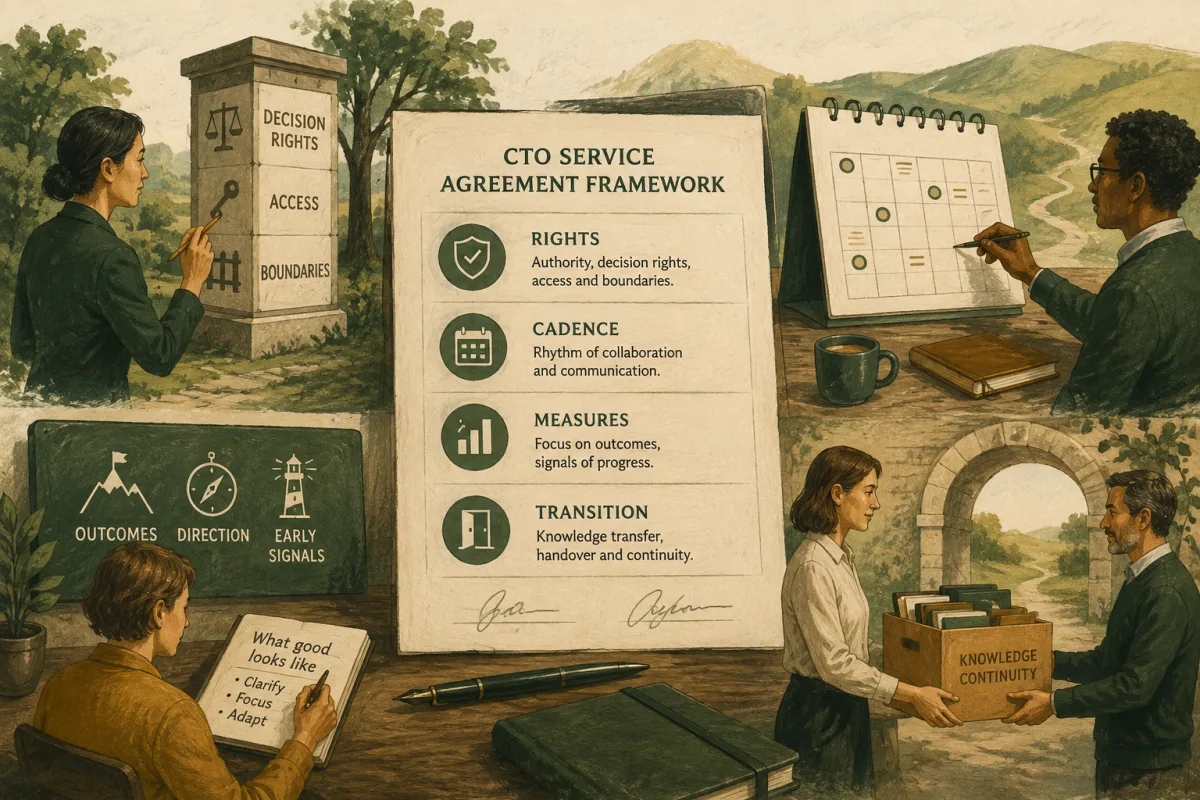
What to put in the agreement
The statement of work should let a board member understand the operating system.
Include:
- business outcome and review date;
- decisions the CTO may recommend, make, veto, or escalate;
- expected days, hours, meetings, and response windows;
- access to leaders, systems, financial information, and customers;
- work products only where artifacts matter;
- internal owners and dependencies;
- security, confidentiality, intellectual-property, and conflict terms;
- travel and incident expectations;
- measures and evidence;
- renewal, reduction, termination, and handover.
Avoid “all CTO duties as needed.” It is impossible to staff, price, or evaluate.
How to select the provider
Ask each candidate or firm to reconstruct a comparable mandate:
- What was true at the start?
- What did you personally decide?
- Which alternatives did you reject?
- What evidence changed your view?
- Who disagreed?
- What improved, and what did not?
- Who can verify it?
- What remained after your role changed?
Then test the actual service: named individual, availability, simultaneous mandates, substitution rights, commercial incentives, references, and transition.
Match the service to your company's starting point
For a nontechnical founder with an early product idea, the immediate need may be a sequence of product and technology decisions rather than an executive operating cadence. A bounded assessment can clarify the smallest useful product, implementation options, risks, and the capabilities needed to build it. Buying a large recurring leadership package before those questions are understood may create work without reducing uncertainty.
For a startup with developers but no experienced technology leader, the service may need to connect daily engineering choices with a coherent product plan. The executive can help establish architecture ownership, hiring priorities, delivery expectations, and a manageable risk process. The company still needs someone who can coordinate the team between the CTO's working sessions.
For a growing company with internal engineering managers, the gap may be more specific: cross-team architecture, board communication, an enterprise integration, or preparation for a major transaction. Here, the service should strengthen existing leaders rather than quietly replace their authority. Agree which decisions remain with them and where the external executive adds experience or capacity.
For an organisation whose CTO has departed, examine whether a part-time service can cover the actual seat. If important decisions, people management, and incident escalation require continuous attention, an interim executive may be more appropriate. The interim CTO guide explains that distinction in more detail.
Build a service scope around decision packages
A decision package is a practical way to describe a piece of leadership work. It contains the question, context, evidence, options, recommendation, owner, and next action. The label is less important than the discipline: a recommendation should be understandable and usable by the people who have to act on it.

For a build-versus-buy decision, the package might compare the business requirement, integration effort, operating cost, supplier dependency, data access, and exit options. It should identify assumptions that need testing before commitment. A feature checklist alone is insufficient when the more important risk is how the company will operate or replace the system later.
For an architecture decision, ask for the expected constraints, alternatives, consequences, and conditions under which the decision should be revisited. The executive does not need to turn every design choice into a board paper. Focus this treatment on choices that are expensive to reverse or affect several teams, customers, or operational processes.
For a hiring decision, define the work the new role must own before choosing a title. A company that needs daily delivery management may not need another architect. A company with capable delivery managers may need a senior technical specialist. The service should improve the definition of the problem before recommending a more expensive person to solve it.
A sample first-month service plan
The following is an illustrative sequence for a company with an operating product and an internal development team. It is not a promise that every organisation can complete discovery and change in four weeks. Adjust the order to the urgency, access, and complexity of the mandate.
Week one: establish context and urgent decisions
Meet the executive sponsor, product owner, engineering lead, and people responsible for operating the product. Review existing plans and identify immediate commitments that cannot wait for a full assessment. Establish how access is granted, where decisions are recorded, and who can approve changes. Produce a short list of open questions rather than a premature transformation roadmap.
Week two: test the most consequential assumptions
Select the evidence that will change the immediate decisions. This might include a deployment walkthrough, customer integration requirements, a supplier contract, or a sample of recent work. Distinguish observed failures from concerns that have not been verified. Discuss findings with the people who operate the system before presenting them as settled conclusions.
Week three: agree priorities and ownership
Turn the findings into a small number of choices. For each choice, explain the options, expected effort, dependencies, and consequence of waiting. Identify the accountable owner and what evidence will show that the action worked. Make deferred work visible so the team does not mistake a short priority list for a claim that every other issue has disappeared.
Week four: review how the service works
Evaluate both the outputs and the operating relationship. Has the executive made important decisions clearer? Are internal leaders able to act between sessions? Does the reserved capacity match the workload? Use these answers to adjust the scope, not simply to schedule another month of the same meetings.
Understand the economics without accepting a generic ROI claim
The service fee is only one part of the cost. Internal staff contribute time, implementation consumes engineering capacity, and some recommendations require specialist support or additional infrastructure. A price comparison should therefore separate executive time, discovery, delivery work, third-party services, and the minimum contractual commitment.
Consider a hypothetical engagement that costs $9,000 per month and requires six hours of founder participation plus twelve hours of engineering preparation. The fee is visible, while the internal effort may be hidden. Those assumed hours are not an industry benchmark; they illustrate why the company should agree participation expectations before buying the service.
Benefits should be described with similar care. Avoid claiming that every avoided rewrite, faster release, or reduced infrastructure bill was caused by the executive. Identify the specific decision, its alternatives, and the evidence available at the time. Where the business estimates a benefit, preserve the assumptions and distinguish a forecast from a measured outcome.
Use a review period that matches the decision. A supplier selection can be assessed when the recommendation is accepted and implementation begins. The operational effect of a platform migration may take longer to observe. A leadership coaching objective requires feedback from the people whose capability is supposed to improve. One generic monthly ROI number cannot represent all three well.
Questions to ask a CTO-as-a-service provider
Ask who the named executive will be and how much of the work they will personally perform. If the provider uses a team, ask which specialists may participate, whether substitution requires approval, and how context is transferred. A proposal built around a senior person's reputation should not quietly deliver a different operating arrangement.
Ask how the provider handles recommendations that reduce its own revenue. Can the assessment conclude that your existing team is sufficient, that a rewrite should be cancelled, or that a different supplier is more suitable? Request disclosure of material partnerships and referral relationships. The answer helps you understand the incentives around a recommendation without assuming that every commercial relationship is problematic.
Ask what happens when a deadline, incident, or departure changes the workload. Which changes fit the existing agreement, which require a new scope, and who decides? A service that appears flexible during procurement can become difficult to operate if every ordinary question is treated as extra work or every emergency is assumed to be included.
Ask what you will retain at the end. The company should be able to locate its decisions, operating procedures, architecture information, and open risks without relying on the provider's private workspace. Examine the practical handover alongside the contractual ownership terms.
When CTO as a service is the wrong purchase
It may be the wrong model when the company needs continuous line management, a full-time executive voice in daily decisions, or a permanent leadership succession plan. A part-time external service can support those needs, but it should not be presented as a substitute for capacity it does not provide.
It can also be the wrong purchase when the actual bottleneck is execution. If the roadmap is clear and the team lacks a particular implementation skill, a specialist engineer or delivery partner may be more useful. If the team lacks day-to-day coaching and coordination, consider fractional engineering management. Choose the role that can act on the constraint.
Finally, external leadership struggles when the sponsor will not make tradeoffs. If every feature remains urgent, budget constraints cannot be discussed, and the executive has no access to the people doing the work, a better service package is unlikely to solve the problem. The company must provide the decision authority and participation that the mandate requires.
Make the service leave behind a stronger organisation
The enduring value of an engagement is not the number of recommendations produced. It is whether the company can make better technical decisions, operate with clearer responsibilities, and recognise when its leadership model should change. Ask the provider how those capabilities will be transferred to internal people.
Build the transition into the regular work. Invite internal leaders to develop recommendations, review alternatives, and explain decisions. Keep the operating record in company-controlled systems. Revisit whether recurring meetings are still necessary as the team becomes more capable. A service that succeeds may eventually need less of the executive's time.
When you are ready to compare providers, use the fractional CTO pricing guide to examine capacity and exclusions, then the hiring guide to evaluate evidence. A clear mandate makes both conversations more useful and reduces the chance of buying a familiar title for an unfamiliar problem.
The durable buying rule
Buy the smallest operating model that can responsibly carry the decisions.
If occasional challenge is enough, do not buy an interim seat. If the company needs daily people leadership and board representation, do not disguise it as an advisory package. If delivery is the real constraint, fund delivery and define who governs it.
CTO as a service becomes useful when the service stops being a label and becomes a visible system of outcome, authority, capacity, evidence, and exit.
Frequently asked questions
What is CTO as a service?
CTO as a service is access to external CTO-level leadership through an advisory, fractional, interim, or agency model. The label is not a standard scope, so the buyer must define the outcome, authority, capacity, and transition.
How much does CTO as a service cost?
Cost depends on whether the company is buying occasional advice, recurring executive ownership, concentrated interim capacity, or a delivery team. Compare a priced mandate rather than headline hourly rates.
Is CTO as a service suitable for a startup?
It fits when a startup has consequential recurring technology decisions and enough internal capacity to execute. A pre-product team may instead need validation, a technical co-founder, or a hands-on lead engineer.
What should a CTO as a service contract include?
Include outcomes, decision rights, capacity, access, cadence, incident expectations, deliverables, dependencies, conflicts, security, intellectual property, success measures, termination, and the handover.
Sources and further reading
Turn research into a mandate
See the cost and hiring model before you shortlist.
Use the free calculator, then save a candidate search or post a transparent role when the mandate is ready.