
Fractional executive careers
How Fractional CTOs Find Clients: A Practical Guide
Find fractional CTO clients through clear positioning, checkable proof, referrals and qualified discovery. Build a pipeline that fits your delivery capacity.
- By
- Fractional CTO Experts
- Published
- 2026-07-30
- Reviewed
- 2026-09-09
- Reading time
- 14 minutes

Fractional CTOs find durable clients by making three things clear before a sales call: which business event they understand, which decisions they can credibly own, and who can verify their evidence. Channels then move that trust.
The mistake is treating pipeline as a burst of activity when availability becomes urgent. Executive work has a long trust cycle. Build a small, repeatable relationship and evidence system while delivery is healthy.
- Choose a market before choosing a channel
- Start with the trust network
- Publish content that helps a buyer decide
- Use platforms deliberately
- Run restrained, relevant outreach
- Build partnerships around adjacent work
- Create a weekly pipeline cadence
- Qualify the client as carefully as they qualify you
- Turn a broad background into a specific first offer
- Build proof when client names are confidential
- Use discovery to identify the buying decision
- Measure a pipeline without fooling yourself
- Protect delivery capacity while building demand
- Handle follow-up and contact data deliberately
- Run a focused first-month experiment
- Let delivery create the next relationship
Choose a market before choosing a channel
A market is not “startups.” Define:
- the buyer: founder, CEO, board, investor, portfolio operator, or technology leader;
- the company context: stage, sector, model, team, and geography;
- the trigger: funding, departure, enterprise pressure, transaction, delivery failure, or platform limit;
- cost of delay;
- connected decisions you can own;
- evidence and references;
- reasons you are not a fit.

This focus makes referrals possible. “Talk to Maya when a healthtech company needs to prepare platform, security, and interoperability for health-system customers” is memorable. “Maya does fractional CTO work” depends on the referrer inventing the fit.
Start with the trust network
Map people who have observed your decisions and people who encounter your buyer before you do:
- former CEOs, founders, peers, direct reports, and customers;
- investors and portfolio operators;
- executive recruiters and search partners;
- corporate, employment, privacy, and transaction lawyers;
- finance, security, compliance, product, and go-to-market advisors;
- development and cloud partners who do not sell executive independence;
- community leaders and specialist platforms.

Do not open with “send me leads.” Explain the trigger, show a useful framework, and ask what those partners see. Learn how they qualify trust and where your work complements theirs. Refer appropriate work back.
Respect duties to current and former employers, confidentiality, non-solicitation, conflicts, and data-protection law. Obtain qualified advice where needed.
Publish content that helps a buyer decide
Useful content answers a consequential question:
- Should we hire fractional, interim, or permanent?
- What does a serious 90-day mandate include?
- How should a board assess platform risk?
- Which cloud migration assumption is usually missing?
- How should a healthtech company interview a CTO?
- What makes a technology diligence finding material?
Use a structure:
- direct answer;
- decision framework;
- real or clearly labelled composite example;
- failure modes;
- a small next action.
Write from attributable operating experience. Do not manufacture statistics, customers, or urgency. Content compounds when another advisor can send it to a client without embarrassment.
One strong guide repurposed into a board checklist, short post, workshop, and partner conversation is more useful than daily generic thought leadership.
Use platforms deliberately
Evaluate marketplaces and networks:
- Who pays?
- Can executives buy rank?
- What is verified?
- How are profiles matched?
- Are direct contact details exposed?
- Does the platform have active buyers?
- What fee, margin, or exclusivity applies?
- Who owns the client relationship?
- What happens after an unsuccessful introduction?
Keep your profile specific and availability current. Respond quickly to genuinely relevant briefs. Decline mismatches with a short reason; trustworthy platforms learn from accurate boundaries.
Do not build a practice that depends on one algorithm, community, or intermediary.
Run restrained, relevant outreach
Direct outreach should begin with an observable signal, not a scraped title.
A useful note contains:
- the relevant signal;
- a tentative hypothesis, clearly labelled;
- one useful question or resource;
- a low-friction next step;
- an easy way to decline further contact.
Example structure:
I saw the company is moving into enterprise healthcare partnerships. That often creates connected questions around integration ownership, security evidence, and platform commitments. I wrote a short decision checklist from similar operating contexts. If that work is current, I would be interested in how you are framing the mandate.
Do not pretend to have assessed a company from public signals. Avoid bulk personalization, misleading subject lines, purchased private data, and excessive follow-up. Laws differ by jurisdiction and audience; understand consent, identification, opt-out, and recordkeeping obligations.
Build partnerships around adjacent work
The best partner has trusted access to the same buyer but sells a different product.
Examples:
- a technical diligence leader and transaction lawyer;
- a fractional CTO and permanent executive search firm;
- a healthtech CTO and privacy or quality specialist;
- a cloud transformation leader and finance transformation advisor;
- a portfolio operator and interim executive network.
Define referrals honestly. Disclose material fees where required. Never recommend a provider only because the economics are hidden from the client.
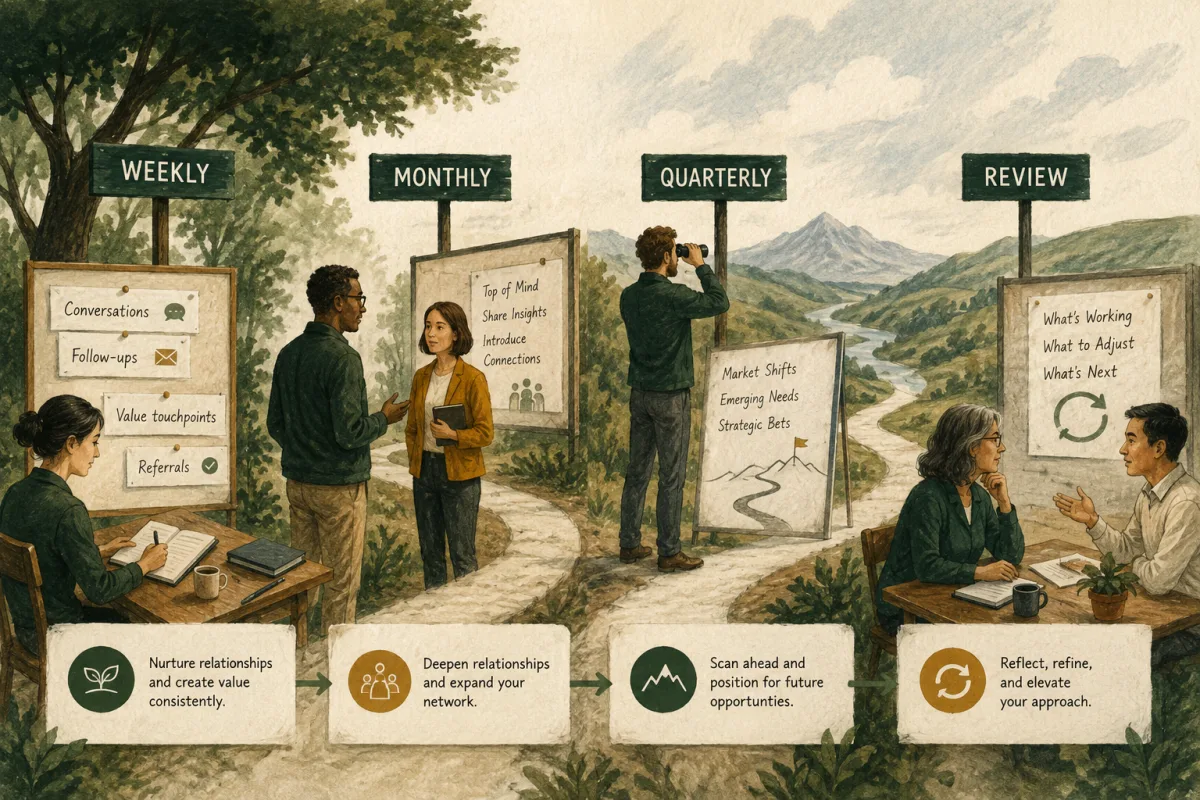
Create a weekly pipeline cadence
A small system might include:
Weekly
- two relationship conversations;
- one useful follow-up;
- one evidence asset improved;
- current opportunities advanced or disqualified;
- availability and capacity reviewed.
Monthly
- publish one substantial buyer resource;
- host or join one focused discussion;
- review referral sources and conversion;
- contact former clients or peers with genuine context;
- update profile evidence.
Quarterly
- review positioning;
- ask which mandates were profitable and referenceable;
- assess client concentration and channel risk;
- refresh target accounts and partners;
- decide which offer to stop.
Track qualified conversations, proposals, wins, loss reasons, time to close, source, effective rate, renewal, and reference permission. Do not optimize for raw lead volume.
Qualify the client as carefully as they qualify you
Look for:
- a real sponsor;
- a costly and current outcome;
- authority appropriate to the work;
- evidence access;
- internal execution capacity;
- realistic expectations;
- ethical alignment;
- clear economics and payment process.
Walk away when the company wants a borrowed title, asks you to mislead investors or customers, refuses to pay for discovery while demanding certainty, or expects continuous access within token capacity.
Turn a broad background into a specific first offer
A fractional CTO can have twenty years of experience and still leave a prospective client unsure what to buy. Your biography describes the supply side of the relationship. An offer describes a decision the buyer needs to make now. Start with one situation in which your experience changes the quality of that decision, then explain the work, evidence required, boundaries and handover.
Consider the difference between “technology leadership for growing businesses” and “a four-week review of the architecture, team ownership and delivery commitments behind your first enterprise contracts.” The second description lets a founder recognize a trigger and judge whether a conversation would be useful. It does not promise that every enterprise deal will close or that an audit will fix the platform. It gives the buyer a concrete piece of work to evaluate.
A first engagement should also have a sensible ending. A diagnostic might conclude with a prioritized decision memo, a costed set of options and a recommendation about the leadership model required for execution. The answer may be a permanent hire, a specialist engineer or no external engagement. An honest route to those outcomes makes your recommendation more credible than a review that always discovers a need for your largest retainer.
| Offer element | Example wording | What it prevents |
|---|---|---|
| Trigger | Enterprise commitments are exposing unclear platform ownership | A conversation based only on a job title |
| Decision | Choose which reliability and integration work must precede the next launch | A vague promise to improve technology |
| Inputs | Sponsor interview, roadmap, incident history and engineering walkthrough | Certainty without access to evidence |
| Deliverable | Decision memo with options, owners, assumptions and sequencing | An impressive presentation with no next action |
| Boundary | No implementation or continuous incident cover in the review fee | An advisory project becoming unlimited support |
| Exit | Sponsor decides whether to proceed, hire or stop | An implied obligation to renew |
Use the fractional CTO proposal guide to turn the offer into a reviewable scope. Before publishing that scope, check that the effort and availability are realistic. An offer that sounds precise but cannot fit your calendar creates the next delivery problem.
Build proof when client names are confidential

Confidentiality limits what you can disclose; it does not require a profile full of adjectives. Separate proof into public, privately verifiable and illustrative material. A public case study can identify the company and result only when you have permission. A private reference can confirm a defined part of your work to an appropriate buyer. An illustrative decision memo can demonstrate your reasoning without pretending that a fictional company hired you.
For each experience claim, record your role, the situation, the decision you owned, the evidence available at the time, the tradeoff and the outcome you can substantiate. Distinguish a result achieved by a team from a result attributable to your individual work. “I led the evaluation and recommended a staged migration” is more precise than “I transformed the business.” If the result is still developing, describe the current evidence and what remains unknown.
A useful anonymous case can explain that a subscription software company had two teams changing a shared release pipeline, that you introduced an ownership decision and a rollback review, and that the sponsor can discuss your contribution privately. It should not include identifying customer details disguised by removing only the logo. Ask the client which details are safe; do not decide unilaterally that a case is anonymous enough.
An illustrative sample should carry its label near the example, not in a distant disclaimer. Include the uncertainty as well as the polished recommendation. A buyer learns more from seeing how you revise a decision when the evidence changes than from a flawless sample that contains no constraints.
Use discovery to identify the buying decision
A first conversation is a joint qualification exercise. The buyer is deciding whether you understand the problem; you are deciding whether the problem needs your particular contribution. Avoid spending the whole call recounting your career. Ask what changed, why the work matters now, who will use the recommendation and what happens if the company delays.
Move from the business consequence into the operating detail. If a founder says delivery is too slow, ask which commitment is at risk, how the team currently measures progress, what has already been tried and who has authority to change priorities. Slow delivery could reflect architecture, overloaded people, contradictory goals, procurement or an unrealistic promise. A fractional CTO should not sell an architecture review before establishing which explanation deserves investigation.
End the conversation with a short statement of the decision, the missing evidence and the next agreed step. If the next step is a paid diagnostic, explain its output and why that output is needed before committing to a larger engagement. If the buyer already has enough evidence, do not add a diagnostic merely to create a sale. If there is no sponsor or current decision, mark the opportunity as unqualified rather than leaving it indefinitely in a hopeful pipeline.
A worked discovery example
The following is an illustrative scenario, not a client case. A founder asks for a fractional CTO because an enterprise prospect wants a delivery date for a new integration. The founder expects two days per month to be sufficient. During discovery, you learn that no engineer owns the external API, the product team has not agreed the acceptance criteria, and the prospect's requested security evidence has not been reviewed.
The initial buying question is therefore not simply “which CTO should we hire?” It is “what can we credibly commit to, and who must make the connected product, engineering and security decisions?” You propose a bounded assessment with the product owner and engineering lead, plus specialist security input if the evidence requires it. The output is a commitment decision and ownership plan. You explain that ongoing execution may require a different capacity allocation from the founder's initial assumption.
The opportunity becomes qualified only when the sponsor accepts the decision, provides access and confirms the process for approving the work. A friendly conversation and a request for your rates are not substitutes for those steps.
Measure a pipeline without fooling yourself
Keep a small set of stages with observable entry conditions. “Interested” is too subjective to support planning. “The sponsor agreed to a discovery meeting about a named decision” is observable. Likewise, a proposal should mean a scoped document requested by a qualified buyer, not a rate card sent after any conversation.
| Stage | Evidence needed to enter | Next decision |
|---|---|---|
| Relevant relationship | Person has observed your work or encounters your buyer | Is there a useful reason to talk? |
| Qualified conversation | Named problem, plausible fit and an engaged sponsor | Is more evidence needed? |
| Agreed next step | Buyer accepts a defined action and date | Should a scope be prepared? |
| Proposal under review | Scope, buyer, approval process and timing are known | Proceed, revise or decline? |
| Signed engagement | Terms and start conditions are agreed | Is onboarding ready? |
| Delivery and renewal | Outcomes and remaining work are reviewed | What should happen after this phase? |
Here is an illustrative planning calculation. Suppose twelve qualified conversations in a quarter produce six agreed next steps, three requested proposals and one signed engagement. The stage ratios are 50%, 50% and roughly 33%. Those figures describe that small sample; they are not industry benchmarks or reliable forecasts. They also say nothing about profitability until you include the time spent on research, conversations, proposals and delivery.
Record the source and loss reason for each opportunity. A lost proposal caused by a hiring freeze calls for a different response from one lost because the buyer needed an implementation team. If warm referrals produce suitable mandates while broad platform applications mostly produce mismatches, adjust effort according to that evidence. Do not infer channel quality from one win, and do not count the same buyer as several opportunities because they appeared through multiple channels.
Protect delivery capacity while building demand
Pipeline activity becomes counterproductive when it promises more availability than you can supply. Maintain separate views of contracted capacity, likely extensions and uncommitted opportunities. Only the first is a firm obligation. Reserve space for preparation, administration and the variability of executive work before deciding that an apparently free day is sellable.
Tell a prospective buyer when you could start and what would need to be true. If a current client may extend, make the uncertainty explicit. Do not accept two overlapping mandates on the assumption that one will be quiet. If the buyer requires emergency response or regular board attendance, model those requirements directly rather than hiding them inside an average number of days.
A pipeline review should include whether you want the next engagement at all. A mandate that expands your evidence in a coherent market may be worth pursuing. One that forces you into an unfamiliar sector, continuous availability and unclear authority may weaken the practice even if its headline fee looks attractive. Fractional CTO career planning and pricing belong in the same discussion as acquisition.
Handle follow-up and contact data deliberately

A thoughtful message still has to meet the rules that apply to its channel, recipient and jurisdiction. In the United States, the FTC explains that CAN-SPAM covers commercial business-to-business email as well as bulk campaigns. Accurate identification, a valid postal address, a clear opt-out and timely handling of opt-outs are among its requirements. See the FTC's business guide before building an email process.
For UK audiences, use the ICO's direct marketing guidance to assess the relevant data-protection and electronic-marketing rules. Do not assume that a publicly visible address grants unrestricted permission to contact someone. These links are starting points for jurisdiction-specific review, not a universal permission model.
Operationally, keep the information needed to explain the relationship, the source of the contact, the agreed next step and any objection to further contact. Avoid speculative notes about personal circumstances. A clear decline should end prospecting follow-up. A buyer who asks you to return after a financing decision should receive a relevant check-in at that time, not an automated sequence that ignores the conversation.
Run a focused first-month experiment
Choose one buyer situation, one evidence asset and one relationship channel for the first month. In week one, write the offer and ask two trusted peers whether they can recognize its trigger. In week two, prepare an illustrative decision memo or a permissioned case and correct any claims that cannot be verified. In week three, hold relevant conversations with people who know the buyer context. In week four, review what those conversations taught you about urgency, objections, decision ownership and the language buyers use.
The objective is not an arbitrary number of booked calls. It is to learn whether a recognizable market has a current problem you can responsibly help solve. If people understand the situation but do not see urgency, revise the trigger or timing. If urgency exists but you lack the required evidence, build experience before escalating promotion. If qualified buyers respond, preserve the narrowness that made the offer useful and expand only when delivery supports it.
Let delivery create the next relationship
At the end of a successful phase, ask for specific proof:
- May this stakeholder serve as a reference?
- Which parts of the mandate may be described?
- Who else faces the same trigger?
- Is the next phase a different, explicit outcome?
Do not demand referrals before earning the right. Do not trap the client into renewal.
A healthy pipeline is not a list of strangers. It is a network that understands your fit, a body of useful evidence, a disciplined follow-up system, and a reputation for declining work you cannot responsibly own.
Frequently asked questions
Where do fractional CTOs find clients?
Common sources are trusted referrals, former colleagues and customers, investors, legal and finance partners, specialist platforms, professional communities, useful content, events, and selective outreach around a visible trigger.
Should a fractional CTO use cold email?
It can work when outreach is lawful, relevant, restrained, and based on a genuine business signal. Avoid scraped bulk campaigns, invented personalization, hidden tracking, and repeated contact after no interest.
How long does it take to build a fractional CTO pipeline?
There is no reliable universal timetable. Build relationships and test demand before relying on a full client portfolio. Where permitted, begin preparation before leaving employment, respect contractual duties and maintain business-development capacity while serving clients.
Do fractional CTO marketplaces work?
They can improve discovery and trust if buyers are active, verification is meaningful, incentives are visible, ranking is fair, and introductions protect consent. Do not rely on one platform as the entire pipeline.
Sources and further reading
Next useful move
Build your free evidence-led executive profile.
Executives never pay to appear or rank. Keep your availability current, create job alerts, and track applications in one workspace.