
Fractional executive careers
Fractional CTO Proposal: Template and Worked Example
Write a fractional CTO proposal with a worked example, outcome schedule, capacity budget, fee comparison, acceptance checks, and buyer questions.
- By
- Fractional CTO Experts
- Published
- 2026-07-30
- Reviewed
- 2026-09-08
- Reading time
- 13 minutes

A fractional CTO proposal should let the sponsor explain one thing clearly: what executive result the company is buying, under which conditions, at what capacity and cost.
It is not a résumé, a strategy presentation, or a list of everything you could do. Discovery created a shared understanding; the proposal converts that understanding into a decision-ready product. Legal obligations belong in the final agreement, drafted or reviewed for the relevant jurisdiction.
- Open with the business condition
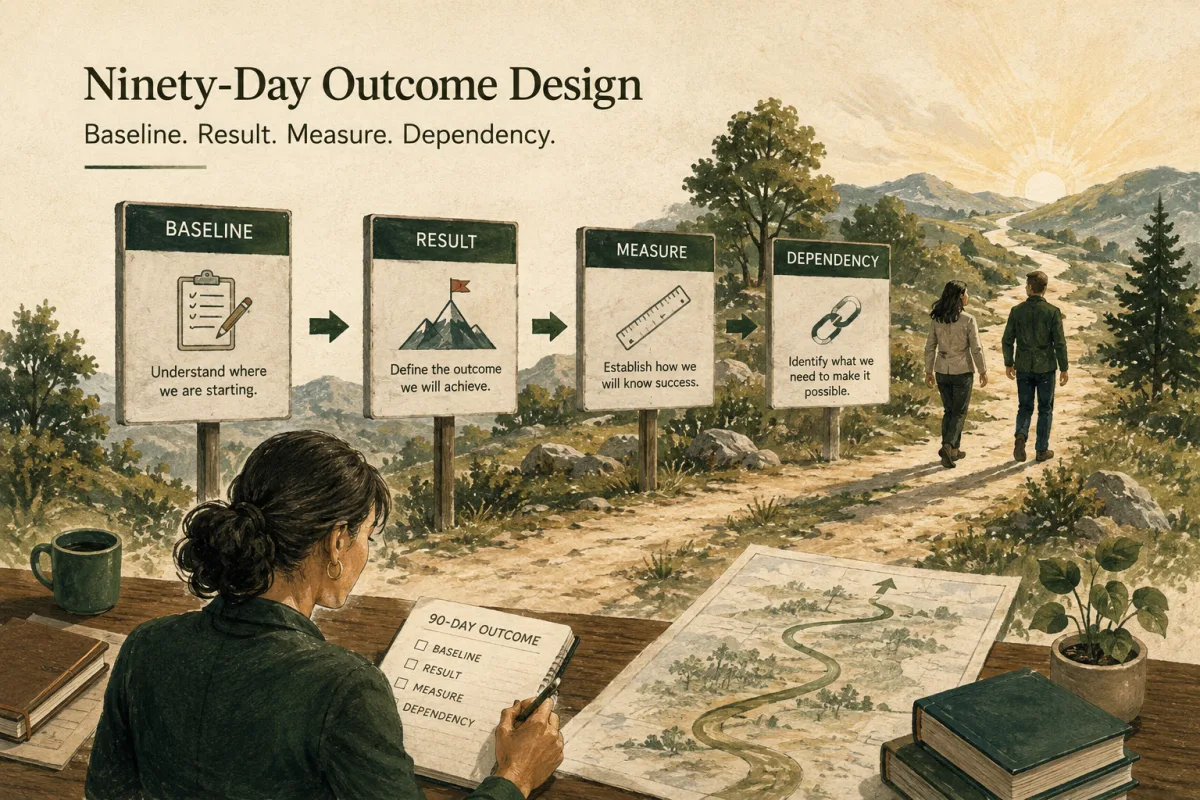
- Define observable 90-day outcomes
- State decisions and exclusions
- Connect capacity to operating load
- Name the client dependencies
- Present commercial options only when useful
- Define measurement and reporting
- Include transition from the beginning
- Make approval easy
- A compact proposal outline
- Worked proposal: a platform investment decision
- Build a capacity budget before quoting the fee
- Compare the total commitment, not just the monthly retainer
- Give the buyer an acceptance checklist
- Handle a new request without hiding its consequences
- Questions buyers ask about fractional CTO proposals
- Quality-check before you send
Open with the business condition
Describe why the mandate exists:
- the company is entering enterprise sales without supportable security and platform commitments;
- delivery has become unpredictable after team growth;
- a CTO departure left connected decisions unowned;
- the board needs transaction-ready technology evidence;
- a platform decision blocks the next stage;
- the CEO is carrying technology risk without an executive counterpart.
State evidence, interpretation, unknowns, and assumptions separately.

In this hypothetical example:
- Evidence: three roadmap commitments moved in the last quarter; ownership differs across product and engineering views.
- Interpretation: priority and dependency decisions may lack one operating route.
- Unknown: reliability and support impact have not yet been reviewed.
- Assumption: the VP Engineering can own daily delivery if executive priorities and decision rights are clarified.
This is more credible than diagnosing the entire company after two calls.
Define observable 90-day outcomes
Use three to five results. Each should include:
- current baseline or uncertainty;
- target condition;
- evidence or measure;
- client dependency;
- review date.
Weak: “Develop a technology strategy.”
Stronger: “By week eight, the executive team has approved a twelve-month technology investment sequence linking the enterprise roadmap, platform constraints, security work, and leadership hires; assumptions, owners, and decision gates are documented.”
Do not guarantee revenue, valuation, fundraising, compliance, or absence of incidents. You control decision and operating quality, not every business cause.
State decisions and exclusions
Define what you can recommend, decide, approve, manage, or represent. Examples:
- roadmap and technology investment;
- architecture principles and exceptions;
- engineering organization and senior hiring;
- vendor evaluation;
- risk acceptance or escalation;
- board and customer communication;
- incident leadership;
- budget authority.
Then state exclusions: hands-on development, legal advice, formal audits, security testing, regulatory opinions, 24/7 incident response, or direct people management unless explicitly purchased.
Exclusions are not defensive fine print. They show the buyer which capability must come from internal teams or specialists.
Connect capacity to operating load
Describe:
- expected days or hours;
- recurring meetings;
- preparation and written analysis;
- async channel and response expectations;
- time-zone overlap;
- on-site work and travel;
- incidents and exceptional work;
- holidays and unavailable periods;
- capacity review when scope changes.
Avoid “up to 40 hours” if the client actually needs executive continuity. Avoid unlimited Slack. Explain what work happens between meetings and who owns execution on non-CTO days.
Name the client dependencies
Your result may require:
- one executive sponsor;
- access to systems, metrics, contracts, and people;
- an empowered engineering or product owner;
- timely leadership decisions;
- budget for specialists or implementation;
- legal, privacy, security, finance, or regulatory input;
- stakeholder attendance;
- truthful disclosure of incidents and constraints.
State what happens if a dependency is absent: the outcome changes, timeline moves, or mandate pauses. This protects attribution and gives the sponsor a real role.
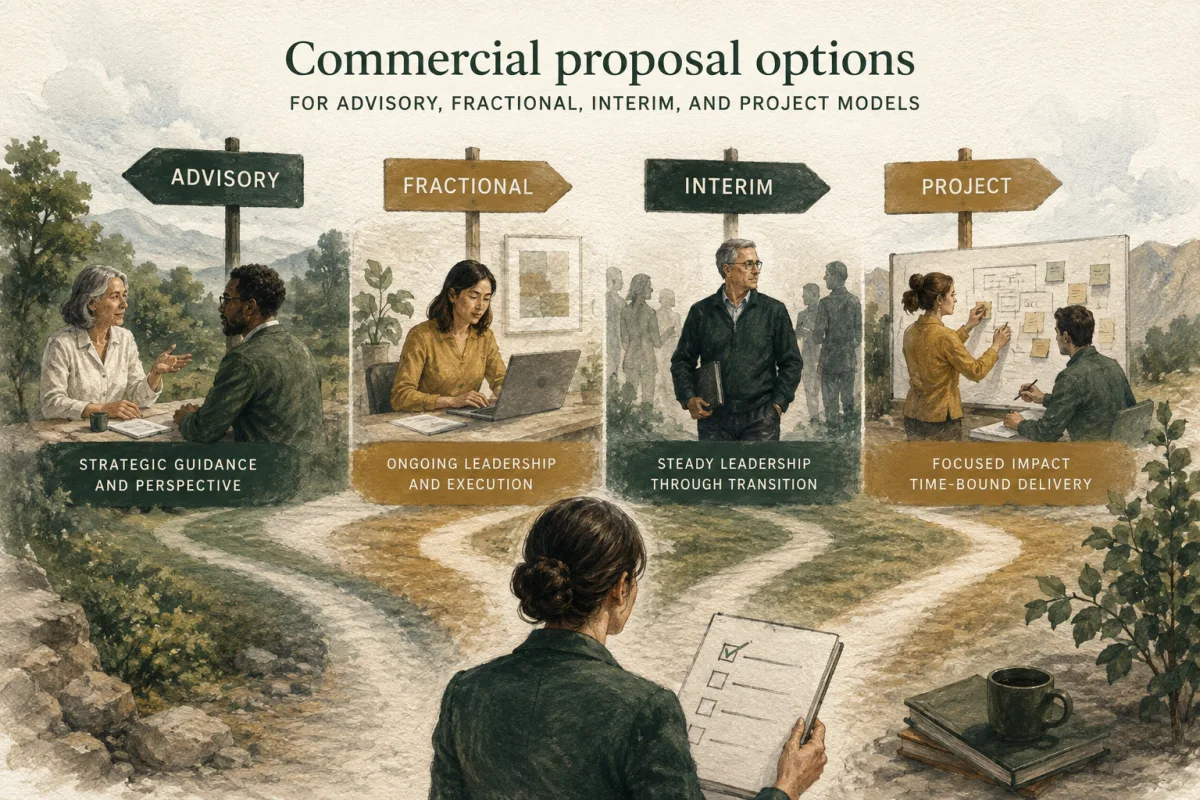
Present commercial options only when useful
Offer alternatives that change scope or intensity:
| Model | Product | Example |
|---|---|---|
| Advisory | Expert challenge; client owns action | Monthly board and architecture review |
| Fractional | Recurring executive ownership | Two days weekly with a 90-day scorecard |
| Interim | Temporary seat ownership | Four or five days weekly through a search |
| Project | Bounded assessment or decision | Technical diligence or cloud business case |
Do not remove essential security or governance from a cheaper tier. Change the outcome, capacity, or time horizon.
State fees, tax, payment timing, deposit where applicable, expenses, travel, overage, late payment, and price-review conditions. Treat equity separately from cash and obtain qualified tax and legal advice.
Define measurement and reporting
Use a short cadence:
- weekly decision and risk update;
- monthly outcome and capacity review;
- 30-, 60-, and 90-day scorecard;
- immediate escalation for predefined events.
Measures should connect to the mandate: decision lead time, roadmap stability, delivery visibility, service performance, risk evidence, customer assurance, hiring progress, or transition readiness. Avoid a generic executive dashboard.
Include transition from the beginning
State:
- initial term and notice;
- what will be handed over;
- ownership of artifacts and accounts;
- successor onboarding;
- final risk and decision review;
- conditions for extension, reduction, interim conversion, or permanent hiring.
The company should not need you forever to understand its own decisions.
Make approval easy
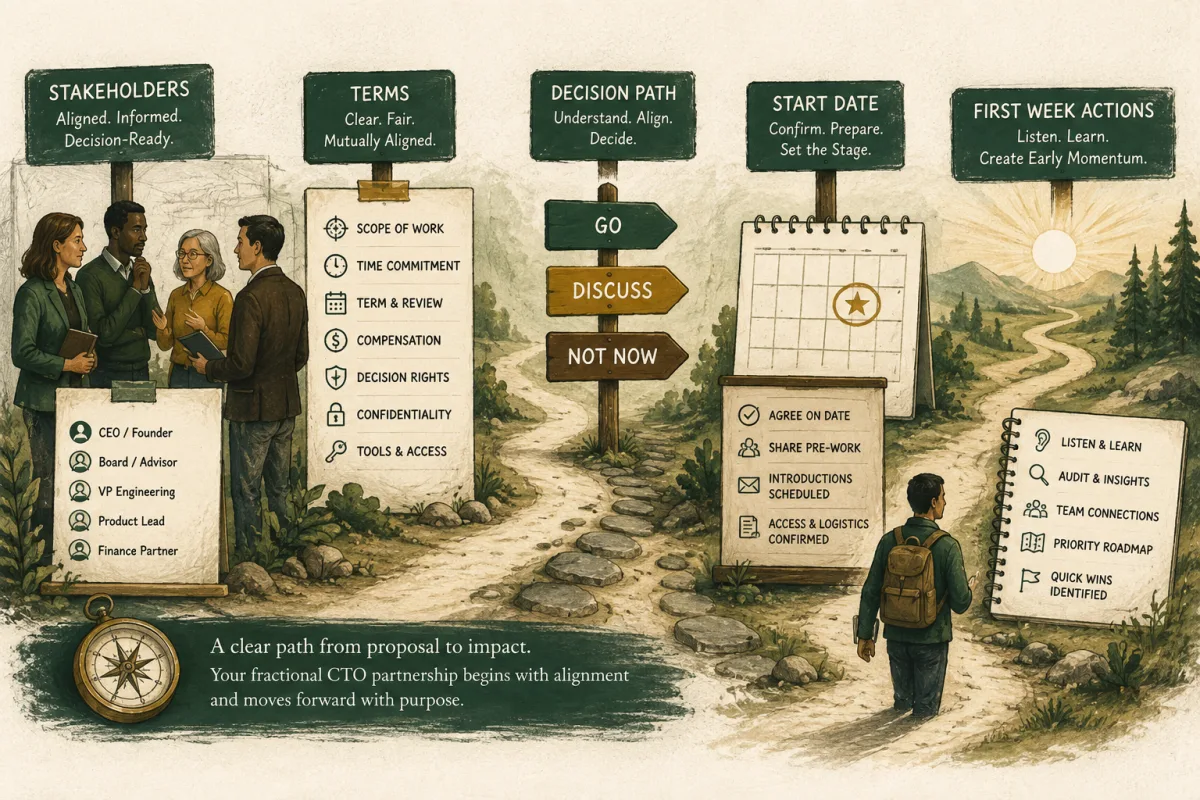
End with:
- decision makers;
- open assumptions;
- proposal validity period;
- contract and data steps;
- proposed start date;
- first-week access and meetings;
- explicit next action.
After sending, walk the sponsor through the proposal. Ask them to explain the purchase back to you. If their description differs, revise before contracting.
A compact proposal outline
Use:
- Executive summary
- Business condition and evidence
- 90-day outcomes
- Scope and decisions
- Working model and capacity
- Dependencies and exclusions
- Measures and reporting
- Team and specialist support
- Fees and commercial assumptions
- Review, exit, and handover
- Decision and kickoff
Attach relevant evidence and biography, but keep the mandate central.
A good proposal makes “yes” safer and “no” easier. It should prevent a buyer from purchasing vague prestige and prevent an executive from accepting an unbounded job at part-time capacity.
Worked proposal: a platform investment decision
The following is a hypothetical example you can adapt. It is not a client case study, a quoted service package, or a forecast of results. The company, timetable, capacity, and fees exist to show how the pieces of a proposal fit together.
A software company has six engineers, a product lead, and a founder who approves every major technical decision. Two prospective enterprise customers need integrations that could require substantial platform changes. The company cannot yet explain which changes are reusable, how much they will cost, or what work must stop to fund them. The buyer needs an investment decision and an operating owner, rather than another general architecture presentation.
Proposed mandate: provide recurring technology leadership for a twelve-week decision and implementation-planning period. Establish a documented route for evaluating enterprise commitments, select an investment sequence with the executive sponsor, and transfer the continuing process to the engineering and product leads.
Business question: should the company build a shared integration capability, deliver one bounded customer integration, or defer both opportunities while addressing reliability constraints? The proposal should keep all three answers possible. Selling a predetermined rebuild before examining the evidence would undermine the assignment.
Copyable outcome schedule
| Outcome | Evidence delivered | Client contribution | Review decision |
|---|---|---|---|
| Establish the starting position | Dependency map, available service evidence, interview findings, and unresolved questions | System access and participation from engineering, product, sales, and support | Sponsor confirms which assumptions remain material |
| Compare investment options | Options memo with cost assumptions, sequencing, constraints, and consequences of deferral | Finance validates affordability; sales validates customer commitments | Sponsor selects, defers, or rejects an option |
| Make delivery ownership explicit | Named owners, decision thresholds, escalation route, and first implementation checkpoints | Engineering lead accepts delivery responsibility | Executive team approves the operating arrangement |
| Prepare continuity | Decision register, outstanding risks, and a walkthrough led by the internal owner | Internal owner rehearses the next review | Sponsor decides whether further external leadership is necessary |
This table describes reviewable outputs without pretending that a customer will sign or that engineering delivery will become predictable immediately. Add actual dates after checking access and stakeholder availability. If the evidence is incomplete, the appropriate output may be a recommendation to investigate a specific uncertainty before committing capital.
What the executive will actually do
The proposed executive interviews the relevant owners, reads existing evidence, challenges the architecture options, prepares the investment memo, and chairs the decision review. They maintain the escalation route during the agreed period and coach the internal leaders who will own it afterwards. Engineers estimate and implement technical changes; the product lead validates customer priorities; finance owns affordability; the sponsor approves commercial commitments.
Write these relationships into the proposal even when the people know one another. A founder may hear “own the platform decision” as permission to delegate every customer assurance call. An engineering lead may hear the same words as a threat to their architecture authority. Naming the decisions and interfaces resolves both interpretations before work begins.
Build a capacity budget before quoting the fee

For the hypothetical engagement, assume eight reserved working days in a month. Allocate two days to interviews and preparation, two to technical and commercial analysis, one to the investment memo, one to leadership and decision meetings, one to follow-up and coaching, and one to bounded contingency. These are planning assumptions, not a prescription for every mandate.
Include preparation time in meeting estimates. A board discussion may last an hour but require evidence collection, a written memo, and revisions. Similarly, reading a vendor agreement or reconstructing an incident timeline can occupy time that is invisible on a shared calendar. A proposal that prices only the visible meeting becomes an argument about effort later.
The contingency is finite. Explain which interruptions can use it and who decides what moves when it is exhausted. An urgent incident, an acquisition request, or a new enterprise procurement deadline may displace planned analysis. The sponsor should receive a choice between changing scope, changing the date, and purchasing additional agreed capacity. Avoid representing a small monthly reserve as continuous emergency coverage.
Record the working calendar and overlap window without promising that every message receives an immediate answer. Define a route for urgent issues that does not depend on the fractional executive being online. The internal incident owner remains responsible unless the engagement explicitly includes a different arrangement.
Compare the total commitment, not just the monthly retainer
The SBA business-finance guidance recommends considering recurring and nonrecurring costs when evaluating a business decision. Apply that distinction to the engagement comparison; a retainer alone does not represent the full investment. The figures below are an original worked example.
Here is an illustrative comparison in US dollars. These numbers are invented for arithmetic and are not market averages or prices offered by this site.
| Cost assumption | Advisory option | Fractional ownership option |
|---|---|---|
| Monthly fee | $3,000 | $10,000 |
| Three-month fees | $9,000 | $30,000 |
| Separately approved specialist assessment | $4,000 | $4,000 |
| Assumed travel | $0 | $1,500 |
| Illustrative total before tax | $13,000 | $35,500 |
The advisory option leaves preparation, stakeholder coordination, and implementation ownership with the buyer. The fractional option includes the recurring leadership described in its scope. A lower headline price is useful only if the company can supply the missing ownership. Conversely, paying for recurring leadership makes little sense when the company only needs an independent review of one already well-defined decision.
List excluded implementation costs beside the comparison. Engineering time, cloud consumption, software licenses, legal review, and security testing do not disappear because the CTO fee is fixed. Separate committed fees from optional expenses and estimates. If the term can end early, show the notice and payment assumptions that determine the actual minimum commitment rather than multiplying a monthly fee mechanically.
For cross-border work, identify the invoicing currency, exchange-rate exposure, applicable tax treatment to be confirmed, and any travel assumptions. Use qualified advisers for the tax and legal position. The proposal can identify the questions without asserting that one jurisdiction's treatment applies to another.
Give the buyer an acceptance checklist
A useful acceptance process tests whether an output supports the agreed decision. For the investment memo, the sponsor could check that all agreed options appear, assumptions have owners, major dependencies are visible, costs distinguish estimates from approved spending, and the recommendation explains its tradeoffs. The engineering lead checks that the proposal reflects the system accurately. Finance checks the economic assumptions.
Name a review window, the person who consolidates feedback, and the route for resolving disagreement in the services agreement. Do not treat silence as acceptance unless the final terms deliberately establish that arrangement and it is appropriate to the engagement. In the proposal, make the intended review process understandable enough that the buyer can identify an unavailable reviewer before kickoff.
Acceptance of a memo is different from approval of its recommendation. The work may be complete even if the sponsor decides to defer investment. Equally, a sponsor's enthusiasm does not prove that the memo meets its agreed evidence requirements. Keeping these decisions separate prevents the executive from being rewarded for telling the buyer what they wanted to hear.
Handle a new request without hiding its consequences
Suppose the buyer adds a due-diligence request in week four. The executive estimates that interviews, evidence review, and a transaction memo will require three days. The original capacity budget does not contain three unused days. A short change note should describe the new decision, the deadline, the evidence required, the estimated effort, and the effect on the existing investment review.
Offer concrete choices: move the platform review, remove a defined part of the original scope, or add separately approved capacity if it is available. State who can authorize the change. A message from a stakeholder who does not control the budget should not silently become a new mandate.
Keep the approved change with the proposal and outcome schedule. At the next review, assess progress against the revised commitment. Otherwise, both parties may remember different versions of what the executive promised, and a reasonable adjustment will look like a missed deadline.
Questions buyers ask about fractional CTO proposals
Should the proposal be free or paid?
A proposal can summarize discovery without becoming a free technical assessment. If producing a responsible recommendation requires substantial system access, interviews, or analysis, define a paid diagnostic with its own output and decision. Make the boundary clear before starting. The buyer should understand what they will receive even if they do not purchase the subsequent leadership engagement.
Can I request the same proposal from several executives?
Yes. Give each candidate the same factual brief, constraints, questions, and access arrangements. Compare their diagnosis, assumptions, decision ownership, capacity, evidence, and commercial commitment. Avoid ranking documents by length or polish alone. A candidate who identifies a missing internal owner may be giving you more useful information than one who agrees to every requested outcome.
Should the proposal include a guarantee?
It can make specific commitments about work, communication, reviewable outputs, and the agreed process. Business outcomes depend on factors outside one executive's control. Treat guarantees about funding, sales, compliance, or uninterrupted service cautiously and examine their conditions with appropriate advisers. A transparent uncertainty register is more useful than an unsupported promise.
How do we move from proposal to kickoff?
Resolve material scope and commercial questions, complete the appropriate agreement and data-access steps, and confirm the sponsor and internal owners. Schedule the first evidence review and explain the mandate to the team. Keep the proposal's assumptions available during onboarding so that new information can trigger an explicit revision rather than an informal expansion.
What if the buyer asks for a discount?
Revisit the commitment together. A shorter assessment, fewer recurring responsibilities, or a later start may change the economics legitimately. Explain what the buyer must own under the revised option. Do not keep the same promises while removing the time needed to deliver them. Record the final version so the discounted proposal cannot be confused with the original scope.
For the next step, use the fractional CTO contract checklist to translate the agreed commercial understanding into questions for the services agreement. Review the fractional CTO pricing guide when comparing engagement models and cost assumptions.
Quality-check before you send
Read the document from three perspectives.
As the CEO, can you explain what changes, why this executive model fits, what the company must provide, and what the first decision is?
As the engineering leader, can you see whether the fractional CTO will support, manage, override, or replace parts of your authority? Ambiguity here creates resistance after kickoff.
As the board or finance lead, can you identify the cash commitment, risk boundaries, review point, alternatives, and transition?
Remove ornamental deliverables that do not change a decision. Replace broad verbs such as “support,” “drive,” and “optimize” with accountable language. Check that the outcome is achievable within the stated capacity and that every dependency has an owner.
Finally, compare the proposal with your public profile and discovery notes. If the product suddenly expands to match the buyer’s wish list, pause. A tailored mandate should reflect the client context without abandoning the evidence and boundaries that made you qualified.
Frequently asked questions
What should a fractional CTO proposal include?
Include the business condition, evidence and assumptions, 90-day outcomes, decisions and exclusions, authority, capacity, cadence, dependencies, measures, fees, expenses, change control, review points, and transition.
How long should a fractional CTO proposal be?
Long enough to describe the product clearly and short enough for the sponsor to explain. A concise main proposal with detailed legal terms in the contract is often more usable than a long consulting deck.
Should a proposal include multiple pricing options?
Only when the options are genuinely different products, such as advisory, fractional ownership, or interim cover. Do not create artificial tiers with essential risk controls removed.
Is a proposal legally binding?
That depends on its language and jurisdiction. Mark status clearly and use a qualified professional for the services agreement. Avoid making legal assumptions from a generic template.
Sources and further reading
Next useful move
Build your free evidence-led executive profile.
Executives never pay to appear or rank. Keep your availability current, create job alerts, and track applications in one workspace.