
Fractional executive careers
Fractional CTO Contract: Scope, Terms and Handover Checklist
Review fractional CTO contract scope, authority, capacity, IP, confidentiality, change requests, and handover with a practical commercial checklist.
- By
- Fractional CTO Experts
- Published
- 2026-07-30
- Reviewed
- 2026-09-08
- Reading time
- 12 minutes

A fractional CTO contract converts an executive mandate into enforceable responsibilities and boundaries. The agreement should be tailored by qualified counsel for the parties, facts, and jurisdictions. This guide is a commercial checklist, not legal advice.
Do not rely on a generic consultancy template where the executive will manage people, access production, represent the company, handle sensitive data, or make material decisions. Those facts create specific risk.
- Define the parties and relationship
- Attach a mandate schedule
- Write decision rights precisely
- Define capacity and access
- Protect confidentiality, data, and security
- Separate intellectual-property categories
- Handle conflicts and independence
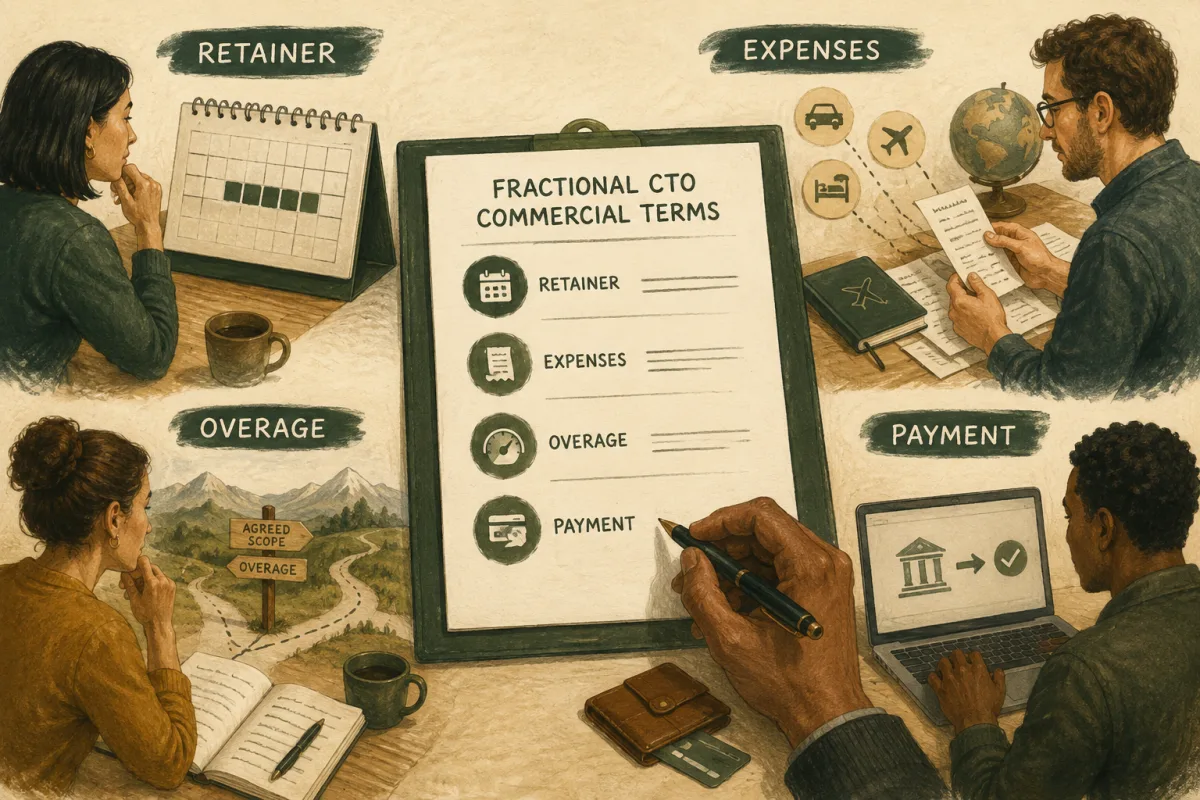
- Make commercial terms explicit
- Allocate warranties, indemnities, insurance, and liability
- Define term, termination, and handover
- Add practical operating schedules
- Use a mandate schedule the team can operate
- A worked change-request example
- Distinguish an output from acceptance of a business outcome
- Review employment status using the actual facts
- Inventory intellectual property before the engagement starts
- Prepare an exit package throughout the engagement
- Common fractional CTO contract questions
- Review the real relationship
Define the parties and relationship
State:
- legal names and addresses;
- whether the executive contracts personally or through a company;
- independent contractor or other intended status;
- no authority to bind the company except where explicitly granted;
- tax and statutory responsibilities;
- no employment benefits unless legally required;
- non-exclusivity and conflict limits;
- governing law and dispute route.
The written label cannot override the real working relationship. Control, integration, substitution, economic dependence, exclusivity, and local rules may affect classification.
Attach a mandate schedule
Keep the business product readable:
- starting condition;
- outcomes and measures;
- decisions and services included;
- exclusions;
- capacity and cadence;
- client dependencies;
- named sponsor and internal owner;
- initial term and review dates;
- transition.
Update the schedule through written change control rather than allowing scope to expand through meeting invitations.
Write decision rights precisely
For each area, state whether the CTO can recommend, decide, approve, manage, veto, or escalate:
- technology budget and purchases;
- roadmap and investment;
- architecture standards and exceptions;
- hiring, performance, compensation, and termination;
- vendor commitments;
- security risk acceptance;
- incident command and external communication;
- customer, board, investor, or regulator representation;
- use of company name and title.

Align these rights with corporate approvals and the authority of directors and officers. A fractional title should not imply legal office or authority that has not been granted.
Define capacity and access
Include:
- normal working days or hours;
- location and time-zone overlap;
- recurring meetings;
- async channels and response expectations;
- preparation and written work;
- travel and expenses;
- holidays and unavailability;
- incident or out-of-hours expectations;
- overage approval;
- what the client does between scheduled days.

If the company needs guaranteed daily availability, the product may be interim rather than fractional. State service expectations the executive can actually meet across their portfolio.
Protect confidentiality, data, and security
The agreement should address:
- definition and exclusions for confidential information;
- permitted use and disclosure;
- legal disclosure process;
- duration;
- client and personal data roles;
- approved systems, devices, storage, and communication;
- identity, access, secrets, and privileged accounts;
- subcontractors and tools;
- security incidents and notification;
- return or deletion;
- survival after termination.
Do not send production data, private employee information, or confidential documents into unapproved AI and software tools. Agree the tool boundary and evidence requirements.
Separate intellectual-property categories
Distinguish:
- client-specific deliverables;
- pre-existing executive materials and frameworks;
- reusable skills, knowledge, and non-confidential patterns;
- third-party and open-source materials;
- jointly created work;
- licensed components and usage rights.
State assignment timing, moral rights where relevant, assistance with filings, warranties the parties can reasonably make, and how pre-existing materials embedded in deliverables may be used.
An executive should not attempt to own the client’s roadmap. A client should not claim ownership of the executive’s entire pre-existing method.
Handle conflicts and independence
Define:
- direct competitors or restricted categories;
- client, investor, vendor, and board conflicts;
- disclosure and consent;
- information barriers;
- recusal;
- referral and reseller economics;
- gifts and benefits;
- what happens when a conflict emerges.
Avoid an industry-wide non-compete that makes a portfolio practice impossible and may be unenforceable. Protect legitimate confidentiality and decision integrity with proportionate terms.
If the CTO recommends a vendor in which they have an interest, disclose it before the decision.
Make commercial terms explicit
Cover:
- retainer or project fee;
- currency and tax;
- invoice and payment timing;
- deposit or advance;
- reimbursable expenses and approval;
- included capacity;
- overage or additional work;
- price review;
- late payment and suspension;
- equity or incentives in a separate, carefully reviewed instrument;
- referral fees;
- renewal and no automatic renewal where intended.
Do not let “reasonable additional support” become unlimited free work. Do not let every five-minute exchange become hostile timekeeping. The operating product and change route should be clear enough to preserve trust.
Allocate warranties, indemnities, insurance, and liability
These provisions require legal advice. Consider:
- standard of performance;
- compliance with law and client policy;
- professional and cyber insurance;
- third-party claims;
- IP infringement;
- data and confidentiality breaches;
- exclusions of indirect loss;
- liability caps and exceptions;
- interaction with company directors-and-officers coverage;
- client responsibility for final business decisions.
Do not accept unlimited liability by accident. Do not assume a low fee justifies no accountability. Align exposure with the work, insurance, control, and commercial value.
Define term, termination, and handover
State:
- start and initial term;
- review and renewal;
- notice for convenience;
- termination for breach, nonpayment, conflict, misconduct, security, or insolvency;
- cure period where appropriate;
- fees owed;
- immediate protection actions;
- transition support and rate;
- return of property;
- access removal;
- survival.
The handover should include current decisions, roadmap, risks, owners, vendor commitments, access, relevant artifacts, and successor context. Agree what is maintained during the engagement so transition is not reconstructed under pressure.
Add practical operating schedules
Depending on scope, attach:
- mandate and scorecard;
- data processing terms;
- security requirements;
- approved systems;
- rates and expenses;
- decision-rights matrix;
- conflict disclosures;
- subcontractors;
- transition plan.
Keep schedules current. A contract nobody can operate is not clear merely because it is long.
Use a mandate schedule the team can operate
The agreement needs legal review, but the commercial schedule should also be understandable to the people doing the work. A sponsor, engineering manager, and executive should be able to identify the same responsibilities without interpreting dense legal language during a delivery problem.
The following is an original schedule outline for discussion with counsel. It is not a ready-to-sign contract or a statement that particular wording is enforceable in every jurisdiction.
| Schedule field | Commercial question | Evidence that the parties agree |
|---|---|---|
| Starting condition | Why does the company need the role now? | A short, shared problem statement |
| Included decisions | Which decisions does the CTO own? | Named areas and approval boundaries |
| Capacity | What time and access are reserved? | Preparation, meetings, and follow-up included |
| Dependencies | What must the company supply? | Sponsor, internal operator, evidence, and implementation budget |
| Outputs | What work will be delivered or maintained? | Format, purpose, owner, and review process |
| Review | How will scope and progress be evaluated? | Review dates and evidence requirements |
| Exit | What must continue after the engagement? | Handover owner and agreed transition work |
Keep the schedule aligned with actual practice. If the CTO begins managing a team, handling new categories of data, or representing the company in a transaction, review the agreement before treating the additional responsibility as routine. A changed meeting pattern can be an early sign that the mandate has expanded.
Reconcile authority with the company’s approval systems
Before kickoff, compare the signed decision schedule with the actual purchase, hiring, and access workflows. If the agreement permits a vendor recommendation but the procurement system gives the CTO unrestricted purchasing authority, correct that mismatch. Conversely, a documented spending limit is ineffective if every purchase still waits for an unavailable founder. Name the approver, delegate, evidence required, and escalation route for each material decision.
Keep approvals in company-controlled records that remain available after the engagement. A personal inbox or private chat should not be the only record of a major architecture exception or additional fee. When authority changes, update the operational permissions and the written schedule together, recording the effective date and who approved the change.
A worked change-request example
Imagine an executive retained to assess platform risks and coach an engineering manager. The company then asks them to lead an acquisition's technical diligence. This is a hypothetical commercial scenario, not a client engagement or proposed legal clause.
The new request changes the evidence, stakeholders, deadline, confidentiality requirements, and potentially the executive's exposure. Do not resolve it with an informal promise to “help where needed.” Write down the new decision the company needs, the work required to support it, and the limits of the assessment.
Compare the request with the original capacity. The parties might defer existing roadmap work, buy additional days, engage a specialist, or create a separate project. State who approves the change and when the revised work can begin. If the executive cannot support the deadline, that fact should be visible before the company relies on them.
Record the commercial and operational consequences together. A higher fee without access to relevant evidence may still leave the project impossible. More days without clear decision authority may create activity without a usable recommendation. The change request should update scope, dependencies, capacity, outputs, review, and any terms counsel identifies as affected.
At the next review, compare what actually happened with the revised scope. The purpose is not to charge for every minor conversation. It is to prevent a materially different executive role from being created through a sequence of unexamined requests.
Distinguish an output from acceptance of a business outcome
A contract may specify reports, workshops, decision records, operating reviews, or hiring support. Explain how the company will review each output and identify material gaps. A document can be delivered on time while failing to answer the agreed question; conversely, a sound recommendation may be commercially unwelcome.
For an architecture options paper, the commercial acceptance discussion might cover whether the agreed options, assumptions, risks, dependencies, and recommendation are present. It should not imply that acceptance guarantees the future performance of an implementation the executive does not control. Counsel should translate the parties' intended review process into appropriate terms.
For recurring leadership, a simple project-delivery model may not capture the work. The parties may need a maintained decision log, an operating cadence, and periodic scope reviews rather than a long list of documents. State the evidence of service clearly without pretending every executive contribution can be measured by page count.
Keep client decisions visible. If the sponsor chooses a different option or delays implementation, record that through the agreed process. This helps distinguish the executive's work from business choices and dependencies that affect later outcomes.
Review employment status using the actual facts
A fractional title is not a classification test. The parties should obtain advice for the jurisdictions and facts that apply, particularly where the executive has substantial management authority or the relationship changes over time.
For U.S. federal tax purposes, the IRS emphasizes the facts of the relationship and the right to control how services are performed. Calling someone a contractor does not settle the question. See the IRS definition of an independent contractor.
UK guidance distinguishes employment-law status from tax status and notes that these may differ. The relevant rights and responsibilities therefore need more than a label in a consultancy agreement. See the UK government's employment-status overview.
These references illustrate jurisdiction-specific questions; they do not create a universal test for a global engagement. Give advisers the real operating facts: who directs the work, what authority exists, how availability is managed, and how the relationship functions in practice. Do not alter a description merely to make an intended classification appear more convenient.
Inventory intellectual property before the engagement starts

List the materials each party brings and the work expected to be created. A practical inventory can distinguish a client-specific roadmap, the executive's existing workshop framework, third-party software, open-source components, and implementation work produced by another supplier. Ask counsel to address ownership and permitted use for the actual categories.
Do not assume that payment alone answers every ownership question. In the United States, the Copyright Office explains that work-made-for-hire treatment applies in defined circumstances, including employee work within regular duties and certain commissioned work under an express written agreement. See Copyright Office Circular 30. Other jurisdictions and other intellectual-property rights require their own analysis.
The commercial goal is practical continuity. The client needs appropriate rights to use and maintain the work it buys. The executive needs to protect pre-existing materials and confidential information from other clients. Third-party licenses and supplier agreements should be identified rather than hidden inside a broad statement that everything is owned outright.
Ask what happens on termination or nonpayment and have counsel reflect the agreed position. The team should know which materials may be used, transferred, or retained without improvising an answer during a dispute.
Prepare an exit package throughout the engagement

An orderly exit starts before notice is given. Maintain the decision history, current priorities, risk register, important contacts, outstanding commitments, and location of relevant artifacts as ordinary work products. Assign an internal owner who can understand and use them.
At exit, review the package with the successor or sponsor. Separate completed work, open decisions, unresolved risks, and tasks requiring specialist support. Identify anything whose context exists only in conversation and capture the permitted information while the executive is available.
Coordinate access removal with continuity. The company needs to retain control of its accounts and evidence while removing access that is no longer authorized. The agreement and operating process should address the timing, responsibilities, and any continuing support. Do not leave production access active indefinitely because a handover meeting has not been scheduled.
Confirm the scope and commercial treatment of transition assistance in advance. A limited handover and an extended successor onboarding programme are different amounts of work. A clear arrangement reduces the chance that either party discovers an unpriced obligation at the end.
Common fractional CTO contract questions
Can we use a standard consulting agreement?
It may be a starting point for counsel, but review whether it addresses the actual authority, management work, data access, intellectual property, incident expectations, and transition. A template designed for a short report may not fit an executive who participates in consequential operating decisions.
Should the contract guarantee a 90-day result?
Distinguish work and decisions the executive can undertake from outcomes dependent on the client, implementation team, market, or other parties. Define scope, evidence, dependencies, and review points clearly. Have counsel assess any proposed warranty or guarantee rather than copying a sales promise into the agreement.
What notice period should we use?
There is no universal period appropriate to every engagement. Consider continuity, reserved capacity, current commitments, the nature of termination, and applicable law. Agree how urgent protective actions and ordinary transition differ. The commercial discussion should identify what each party needs before counsel drafts the terms.
Does the CTO need unrestricted system access?
Access should match authorized responsibilities. Some assessments can begin with limited or read-only evidence; operating work may require additional privileges. Use the company's access controls, approvals, and audit processes. A senior title alone is not a reason to bypass them.
Can we prohibit all other client work?
Discuss the actual conflict and capacity concern. Broad exclusivity may change the economics and nature of a portfolio engagement, and enforceability depends on applicable law and facts. Counsel can help design appropriate restrictions and disclosure arrangements. Confidentiality, recusal, and specific competitor concerns should be examined separately.
What should we settle before kickoff?
At minimum, align the mandate, authority, capacity, commercial terms, data and access requirements, relevant legal documentation, and first review. The proposal guide helps organize the commercial decision; it does not replace the final agreement or professional review.
Review the real relationship
At 30 or 90 days, compare practice with the agreement:
- Has capacity expanded?
- Is the CTO managing employees differently than stated?
- Are new systems or data in scope?
- Has a conflict appeared?
- Are decision rights working?
- Is the next outcome different?
Amend before assumptions harden. The purpose of the contract is not to eliminate uncertainty. It is to make authority, risk, economics, and exit understandable enough that both sides can do serious work.
Frequently asked questions
What should be in a fractional CTO contract?
Cover parties and status, scope, decision rights, capacity, deliverables and dependencies, confidentiality, data and security, intellectual property, conflicts, fees, expenses, insurance, liability, term, termination, and handover.
Is a fractional CTO an employee or contractor?
The label does not decide status. Classification depends on jurisdiction and the real relationship, including control, integration, exclusivity, financial risk, and working practices. Obtain qualified local advice.
Who owns work created by a fractional CTO?
The agreement should distinguish client-specific work, pre-existing materials, reusable know-how, third-party materials, and licenses. Do not assume payment automatically resolves ownership.
Can a fractional CTO work for competitors?
The agreement should define conflicts narrowly and practically. Address direct competitors, sectors, geography, confidential information, disclosure, consent, recusal, and what happens when a new conflict appears.
Sources and further reading
Turn research into a mandate
See the cost and hiring model before you shortlist.
Use the free calculator, then save a candidate search or post a transparent role when the mandate is ready.