
Fractional executive careers
CTO Portfolio Career: Capacity, Clients and Sustainable Work
Build a CTO portfolio career with capacity examples, engagement models, client qualification, pricing assumptions and renewal plans. Protect time for delivery.
- By
- Fractional CTO Experts
- Published
- 2026-07-30
- Reviewed
- 2026-09-07
- Reading time
- 13 minutes

A CTO portfolio career combines several forms of executive work instead of one permanent role. It can create variety, independence, and high-leverage impact. It also transfers commercial risk, context management, benefits, pipeline, boundaries, and professional infrastructure from an employer to the executive.
The aim is not to fill a calendar with logos. It is to build a coherent practice in which every mandate receives credible attention and the portfolio remains financially and personally sustainable.
- Choose the portfolio thesis
- Design the engagement mix
- Build a real capacity budget
- Protect context quality
- Manage concentration and volatility
- Price for the unsold work too
- Build continuity without a hidden team
- Maintain pipeline while busy
- Review renewal as a new decision
- Test whether a portfolio career fits the work you enjoy
- Build a capacity model from actual responsibilities
- Compare three engagement mixes
- Price a mandate before turning it into a day rate
- Qualify a client for fit and operating conditions
- Keep client context separate and recoverable
- Use a renewal conversation to reduce unhealthy dependence
- Questions about a fractional CTO portfolio career
- Measure portfolio health
Choose the portfolio thesis
Define:
- the company contexts and events you serve;
- connected decisions you can own;
- types of engagement accepted;
- evidence and references;
- geography and time zones;
- conflicts you will avoid;
- annual income and time goals;
- professional work you want to stop.
This thesis should be specific enough for referrals and broad enough to support a pipeline. It can include one primary market and one adjacent product.
Design the engagement mix
Portfolio components behave differently:
Anchor fractional retainers provide recurring revenue and deeper impact, but consume context and predictable calendar capacity.
Advisory roles are lighter, but can expand through async questions and preparation unless bounded.
Interim roles may dominate the portfolio for several months. Treat them as a deliberate temporary mode, not an addition to already full retainers.
Assessments and projects create bounded revenue and new relationships, but increase sales and transition frequency.
Board work has a distinct legal, fiduciary, preparation, and reputation profile.

Create a target mix by capacity and risk, not only revenue. One complex client can outweigh three quiet retainers.
Build a real capacity budget
Start with the year:
- leave, holidays, training, and recovery;
- business development and relationships;
- administration, finance, legal, insurance, and tools;
- content and professional contribution;
- unsold transition time;
- incident and travel buffer.
Then allocate client capacity. A sold day also creates preparation, context switching, follow-up, and occasional escalation. Do not assume five billable days each week.
For each client, track:
- recurring meetings;
- expected decision load;
- direct reports and stakeholders;
- async response;
- incidents;
- travel;
- work products;
- emotional and political intensity.
Review actual load monthly. When a mandate expands, change scope, capacity, price, or portfolio—not personal sleep.
Protect context quality
Executive value depends on remembering the business, people, decisions, and evidence. Use a secure, client-separated system:
- pre-meeting decision brief;
- current outcomes and scorecard;
- decision and assumption log;
- risk and dependency view;
- stakeholder map;
- next actions and owners;
- approved storage and communication.
Never mix client data in notes, AI tools, chat accounts, or shared drives. Use separate identities and access where possible. Follow client policies and contractual obligations.
Theme days can reduce switching, but the schedule must align with client operating cadence. Avoid back-to-back executive contexts without preparation.
Manage concentration and volatility
Portfolio risk includes:
- one client producing most revenue;
- several clients in one exposed sector;
- all contracts renewing in the same month;
- long payment terms;
- one referral partner controlling pipeline;
- equity substituting for cash;
- open-ended cancellation;
- reputation exposure through misaligned clients;
- currency and tax complexity;
- health or leave with no cover.
Use cash reserves, deposits or advance billing where appropriate, clear notice, a diversified trust network, insurance, and realistic personal contingency. Obtain qualified financial, tax, insurance, and legal advice.
Do not accept conflicting clients to smooth revenue. One breach can damage the whole practice.
Price for the unsold work too
Your effective economics must cover:
- non-billable time;
- benefits and leave;
- professional services and tools;
- insurance;
- payment and cancellation risk;
- pipeline;
- continued learning;
- taxes;
- retirement and long-term security.
Compare expected annual net income under plausible utilization, not a perfect month multiplied by twelve. A high day rate with inconsistent work and heavy sales may be weaker than a well-bounded anchor portfolio.
Keep equity separate from fee adequacy. Treat it as risky investment exposure and understand dilution, vesting, tax, information, liquidity, and conflict.
Build continuity without a hidden team
Clients hire you personally, but they also need continuity. State:
- emergency contact and escalation;
- planned leave;
- what happens during illness;
- whether approved subcontractors or associates may help;
- how context is recorded;
- which decisions always remain with the client;
- handover expectations.
Do not introduce a substitute executive without consent, confidentiality, security review, and contract coverage.
Maintain pipeline while busy
Reserve weekly time for relationships and evidence even at full capacity. Pipeline work can be light:
- one useful partner or peer conversation;
- one relevant follow-up;
- profile and availability updates;
- notes on recurring buyer questions;
- permission-based case evidence;
- review of future capacity.
Avoid announcing “fully booked” indefinitely. Instead, state the next plausible availability and accept introductions for future or bounded advisory work only when you can respond honestly.
Review renewal as a new decision
At each phase:
- compare outcomes with baseline;
- identify remaining risk and internal capability;
- define the next business result;
- estimate required capacity;
- choose extend, reduce, change model, hand over, or stop.
Do not renew because the calendar slot exists. A long retainer can be healthy if the outcomes evolve and the need remains fractional. It can also hide a permanent role priced and supported as part time.
Test whether a portfolio career fits the work you enjoy
A portfolio career changes the job as well as the employment arrangement. You become responsible for finding work, defining it, maintaining several relationships and deciding when to stop. An executive who enjoys deep immersion in one organisation may find the commercial and contextual demands less attractive than the apparent flexibility suggests.
Before leaving a permanent position, describe a realistic ordinary week. Include sales conversations that do not convert, preparation for different boards, invoicing, professional development and time away from work. Then identify which activities you can perform consistently without resenting them. Delegating administration can help, but you cannot outsource the judgment required to qualify a client or recognise a conflict.
Test demand through conversations with buyers and trusted referrers, subject to any existing obligations. Ask which decisions they would pay you to own, what evidence they would need and how often they would expect access. A compliment about your experience is not the same as a funded mandate. Record the difference between interest, a concrete problem, a decision-maker conversation and an agreed engagement.
Build a capacity model from actual responsibilities
Consider an illustrative executive who sets aside forty working weeks and four working days per week for the practice. That provides 160 days before allocation. If thirty days go to business development, twenty to administration and learning, and ten to contingency, the model leaves 100 days for client work. These are planning assumptions, not a recommended schedule or an industry utilisation benchmark.

Suppose an anchor client requires one day per week over those forty weeks. That consumes forty days, leaving sixty. A second client requesting another weekly day would leave twenty for assessments, unexpected demands or additional slack. The calculation becomes misleading if either weekly day also generates several uncounted evenings of preparation and urgent messages.
Track total engagement effort for a trial period, including the work between meetings. A two-hour board meeting may require several hours of evidence gathering, discussion with executives and follow-up. Those hours are part of the service. If you only count scheduled calls, the model will systematically overstate the number of clients you can support.
| Capacity item | Planning question | Evidence to review |
|---|---|---|
| Recurring meetings | Which meetings require your judgment? | Attendance and preparation time |
| Asynchronous decisions | What response window has been promised? | Actual questions and resolution effort |
| Incident availability | Are you an adviser or the response owner? | Escalation arrangements and recent demand |
| Travel | Does presence change the decision? | Door-to-door time and recovery needs |
| Sales and renewal | What work sustains next quarter's pipeline? | Qualified conversations and pending decisions |
Review the model when the work changes. A quiet advisory relationship can become a concentrated turnaround after a funding change or executive departure. Treat that as a new mandate rather than silently absorbing it into the original retainer.
Compare three engagement mixes
An anchor-led portfolio combines one substantial recurring client with smaller advisory or assessment work. It can simplify context management and provide a clearer operating rhythm. Its weakness is concentration: losing the anchor may create an immediate gap in both revenue and routine. Build the sales plan around the time at which that relationship may reduce or end.

A portfolio of several similarly sized retainers spreads dependence across clients but increases context switching and coordination. It can work when mandates are well bounded and ordinary meeting times fit together. It becomes fragile when every client believes they have first claim on the same urgent capacity. The apparent diversification does not help if all clients need support during the same market event.
A project-led practice emphasises assessments, architecture decisions, diligence or temporary transitions. It can offer clear deliverables and varied work, but requires more frequent qualification, contracting and onboarding. The executive must price and schedule those transitions honestly. A month with no assessment delivery may still contain substantial work preparing the next engagement.
Choose the mix that matches your strengths, availability and buyer demand. You do not need to offer all three models. An executive who is excellent at concentrated interim leadership may prefer alternating assignments with planned breaks instead of maintaining several simultaneous fractional seats.
Price a mandate before turning it into a day rate
The SBA business-management guide provides a broader reference for managing a small business; the capacity scenarios here are illustrative planning tools.
Start with the decisions, responsibilities, evidence and availability the buyer needs. Then estimate the capacity required to deliver that scope. A day rate can express the commercial arrangement, but it should not conceal a disagreement about what the client receives between those days.
Separate ordinary operating work from exceptional events. For example, the base engagement might include roadmap decisions, leadership coaching and a monthly board update, while a major acquisition assessment requires a separately agreed scope. State how additional work is approved and what happens to existing priorities when the client requests it.
Compare the proposed fee with the practice's actual cost and capacity assumptions. Include unsold time and professional overhead, and distinguish revenue from money available for personal spending. Build conservative and less conservative scenarios without presenting either as a prediction. Tax treatment, benefits, insurance and entity choices depend on circumstances and jurisdiction; use qualified advice for those decisions.
Avoid inventing return-on-investment figures to justify a fee. Explain the decision you will help the client make and the evidence that will show progress. If the engagement is intended to reduce rework, establish the baseline and method of observation. Do not assume that every avoided engineering hour becomes cash savings or additional revenue.
Qualify a client for fit and operating conditions
A suitable client has a meaningful problem, someone accountable for the buying decision and a realistic ability to implement the work. Ask who can approve priorities, who owns delivery and what has prevented progress so far. A company seeking executive accountability while withholding access or authority may need a different engagement design.
Request a concrete example of the problem. If the buyer says that engineering is slow, ask about a recent change that missed expectations. If they want an AI strategy, ask which business decision is blocked and what evidence already exists. The example helps distinguish a leadership mandate from a need for implementation capacity, training or a specialist review.
Discuss how disagreements will be resolved. An executive relationship requires room to challenge assumptions. If the buyer only wants confirmation of a predetermined decision, be clear about whether you can provide useful independent judgment. Agree who receives sensitive findings and how conflicts between stakeholders will be handled.
Also evaluate whether the work fits the rest of the portfolio. A promising client can still be unsuitable because of timing, competitive conflicts, travel or emotional load. Declining or referring the work can preserve the quality of existing commitments. Document the reason privately so future qualification becomes more consistent.
Keep client context separate and recoverable
Use a brief operating record for each engagement: the current business objective, key decisions, unresolved assumptions, principal risks and next actions. Review it before entering that client's context. The record should be concise enough to use and detailed enough to prevent repeated discovery.

Keep records within the storage and access arrangements approved for that client. Do not transfer confidential material into a general portfolio knowledge base merely because you created it. If you use reusable templates, separate the empty framework from client-specific examples. The same distinction applies to AI tools: approval to use a tool for one client does not establish approval for another.
Before a meeting, identify the decision that needs attention and the evidence required. Afterward, record the choice, owner, assumptions and review trigger. This reduces dependence on memory and makes handover easier. It also helps distinguish useful executive work from a calendar full of recurring discussion.
Build continuity into the engagement from the beginning. A client should be able to locate the important decisions if you are unavailable. That does not mean another person can automatically substitute for your judgment; it means the company is not locked out of its own operating context.
Use a renewal conversation to reduce unhealthy dependence
Prepare the renewal discussion before the contract's final week. Review the original mandate, the evidence of progress and the work still required. Ask whether the remaining need is smaller, different or now continuous enough to justify a permanent role. A useful conclusion may be a reduced retainer, a specialist project or a planned handover.
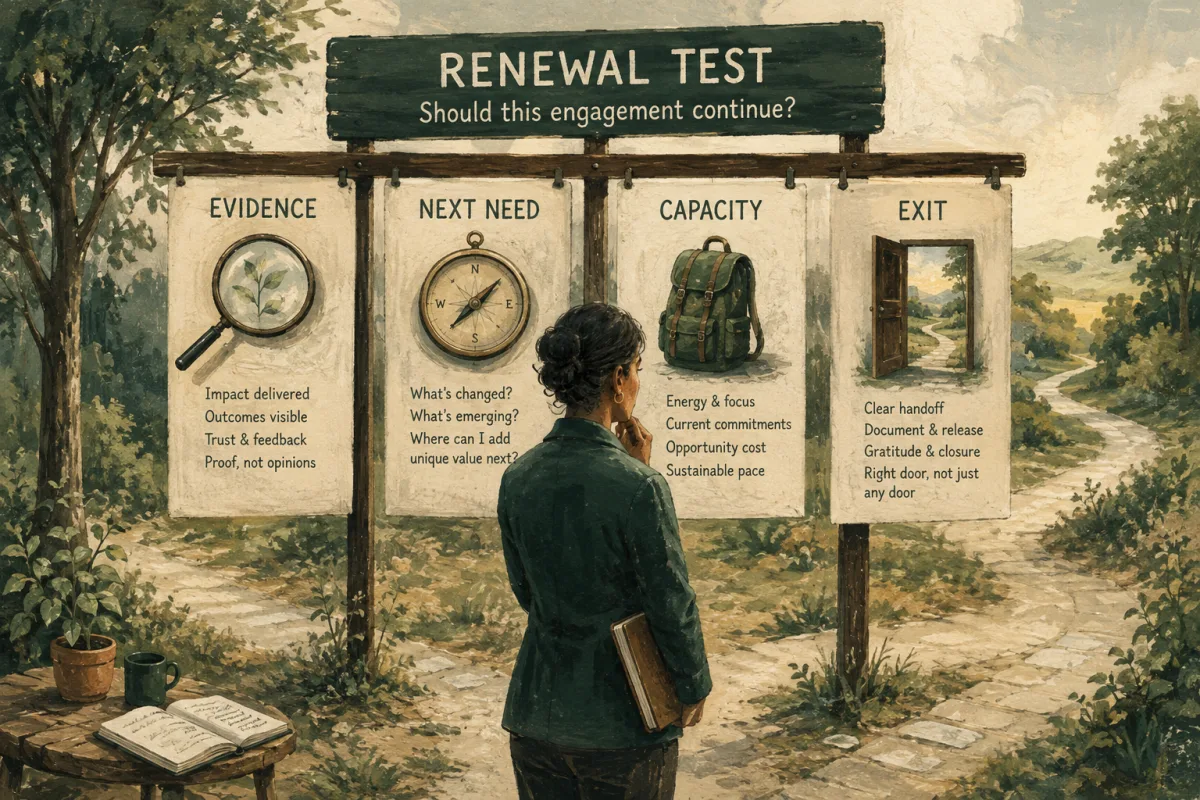
Distinguish appreciation from a business case for continuation. A client may enjoy working with you while no longer needing the same level of executive involvement. Conversely, the company may still need leadership but require more availability than your portfolio can supply. Both situations deserve an honest conversation.
Present options with explicit responsibilities and consequences. For example, a lower-capacity arrangement might preserve board support while transferring delivery decisions to an internal leader. Explain what preparation that leader needs and which questions can still be escalated. Reducing days without transferring authority can leave the client with the same dependency and less access.
Request permission before turning outcomes into public evidence. Confirm the facts, your contribution, the period and any confidentiality limits. A private reference can still be valuable when a public case study is inappropriate. Never imply that you alone caused a result produced by the client's team and other partners.
Questions about a fractional CTO portfolio career
How many clients can a fractional CTO support?
There is no useful universal number. Count decision load, preparation, incidents, stakeholder complexity and promised response times. Two demanding mandates may exceed the capacity required for several bounded advisory relationships. Use the capacity model and recent actual effort to decide whether another commitment fits.
Do I need a large audience to find clients?
A large audience can help discovery but does not replace relevant trust and evidence. A smaller network of founders, investors, operators and specialist partners may produce better-fit introductions. Make your positioning specific enough that someone can recognise a suitable situation. The client-acquisition guide develops that process further.
Should I accept equity instead of fees?
Treat equity as a separate, uncertain component of the arrangement rather than assuming it covers current living or business costs. The commercial, tax and legal implications require appropriate advice. First decide whether you can afford the engagement if the equity produces no liquid return and whether the terms create conflicts with your responsibilities.
Can I combine an interim role with other clients?
Only when the interim mandate's actual availability requirements and the other commitments are compatible. A full-time transition role may require pausing, transferring or ending existing work. Make the arrangement explicit before accepting it; do not rely on the hope that urgent demands will occur on different days.
What is the clearest sign that the portfolio is overloaded?
Repeatedly missing preparation, delaying important decisions, borrowing recovery time and depending on client patience are stronger signals than a busy calendar alone. Review which commitments changed and agree a correction. The sustainable response may be a narrower scope, additional approved support or fewer simultaneous engagements.
Measure portfolio health
Track:
- effective revenue and margin by mandate;
- capacity planned versus consumed;
- qualified pipeline and source;
- client concentration;
- payment time;
- extensions and their reasons;
- referenceable outcomes;
- conflicts declined;
- days unavailable for recovery;
- whether work remains aligned with positioning.
Include qualitative signals: Is your judgment improving? Are clients stronger after your work? Can you be present? Are you proud to be associated with the mandates?
A portfolio career is successful when choice, economics, evidence, and capacity reinforce each other. It fails when independence becomes permanent availability and every client receives the remainder of your attention.
Frequently asked questions
What is a CTO portfolio career?
It is a deliberate mix of fractional executive mandates, interim work, advisory roles, board work, and bounded projects rather than one full-time employer. The mix should have clear capacity and conflict controls.
How many fractional CTO clients can one person handle?
There is no universal number. Count operating load, context, meetings, incidents, travel, sales, and administration. A few high-accountability mandates can consume the whole safe portfolio.
How do portfolio CTOs manage conflicts?
Use explicit sector and client boundaries, early disclosure, consent, recusal, information separation, tool and access controls, and a clear process when new conflicts appear.
How much capacity should remain unsold?
Keep enough buffer for preparation, follow-through, incidents, pipeline, administration, leave, and recovery. Selling every calendar day usually creates hidden under-delivery.
Sources and further reading
Next useful move
Build your free evidence-led executive profile.
Executives never pay to appear or rank. Keep your availability current, create job alerts, and track applications in one workspace.