
Technology leadership diagnostics
MVP Taking Forever? Diagnose Scope, Flow and Decision Debt
Rescue a delayed MVP with a worked scope example, decision worksheet, technical spike guidance, vendor recovery steps, and a practical release gate.
- By
- Fractional CTO Experts
- Published
- 2026-07-30
- Reviewed
- 2026-09-09
- Reading time
- 12 minutes
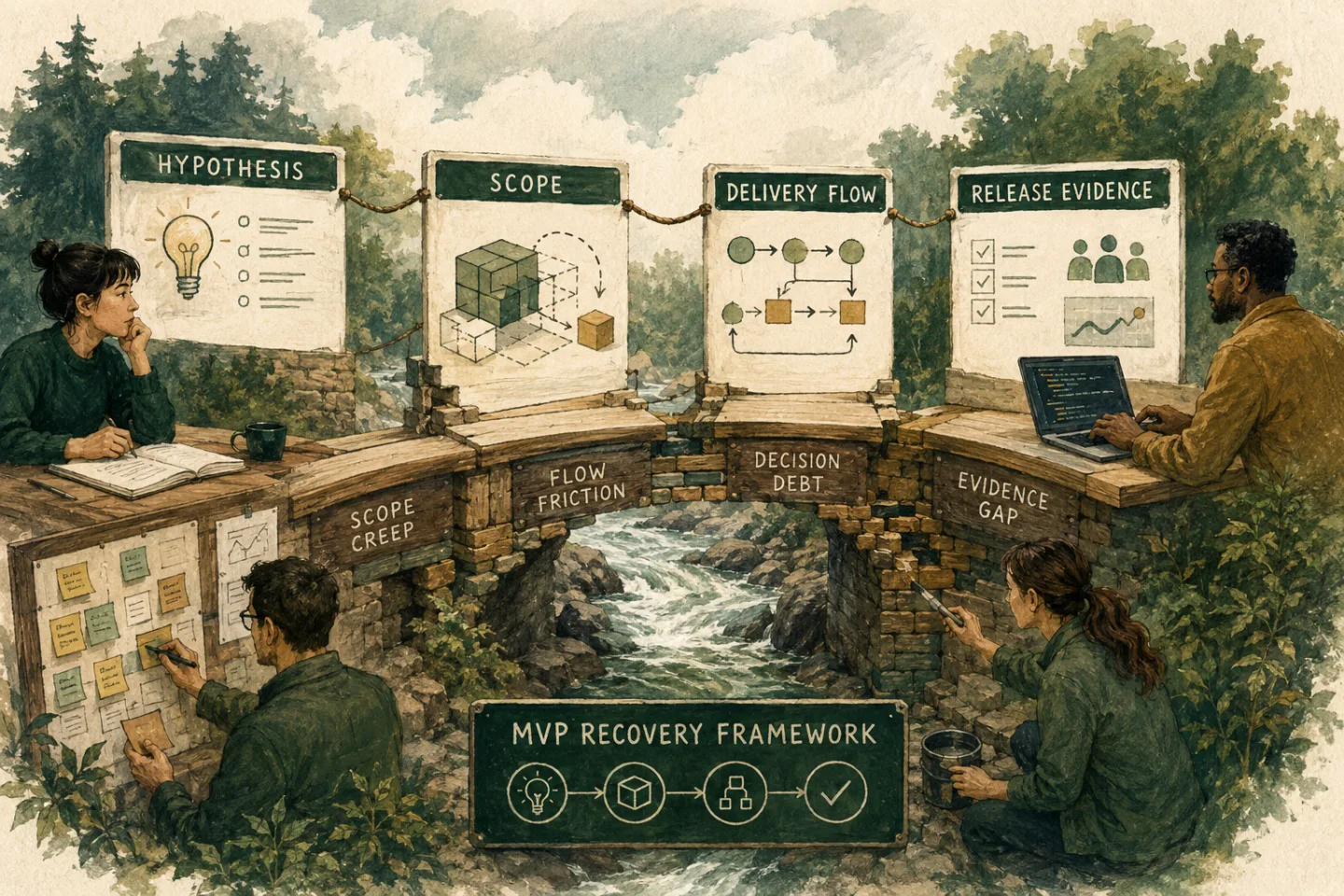
If an MVP is taking forever, the team usually does not need a louder deadline. It needs a clearer learning objective, smaller scope, visible delivery flow, accountable decisions, and a quality floor matched to the consequence of failure.
“MVP” is often used to mean the first complete version of a founder’s product vision. That is not minimum, and it may not test the most important assumption. A recovery should begin by asking what decision the release must inform.
- Diagnose the delay before changing the team
- Restate the hypothesis
- Cut a thin, complete test
- Make delivery flow visible
- Set a responsible quality floor
- Resolve ownership
- Run a 30-day recovery
- A worked example: reduce a booking product to one test
- Create a scope decision worksheet
- Separate a technical spike from an MVP
- Recover an agency-built MVP without restarting blindly
- Make the release decision explicit
- Questions founders ask about delayed MVPs
- Use a release gate, not perfection
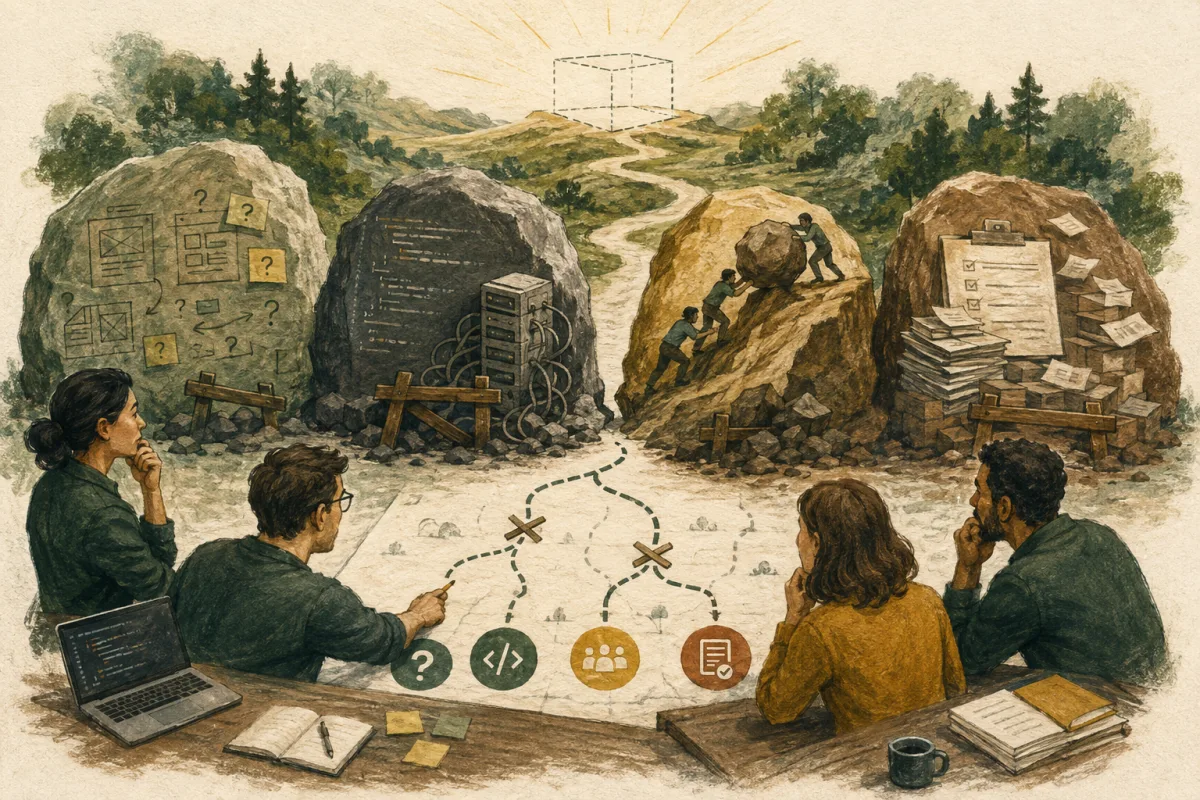
Diagnose the delay before changing the team
Different constraints require different responses.
Product uncertainty
The user, problem, workflow, or success signal is still unclear. Features expand because no one can say which behavior matters. The remedy is customer and product decision work, not faster coding.
Technical constraint
Identity, data, integration, device, performance, security, or deployment complexity genuinely blocks the test. The remedy may be a smaller technical path, a managed capability, a simulation, or a deliberate spike—not a promise to “work harder.”
Team capacity
The company lacks enough capable time to design, build, review, deploy, and support the product. Capacity can be internal or external, but the owner and acceptance must be clear.
Decision debt
Work waits for founder feedback, conflicting stakeholders, absent architecture choices, or unclear acceptance. The visible delay occurs in engineering, but the constraint is authority.
Measure where time actually goes. Count waiting, rework, handoffs, unresolved questions, environment problems, and defects—not only hours spent writing code.
Restate the hypothesis
Write one sentence:
We believe that [specific user] will [specific action] to achieve [specific result], and we will learn from [observable signal].
Then list assumptions that must be true: access to the user, willingness to change behavior, data availability, integration feasibility, acceptable risk, and a path to repeat use or payment.
The MVP should test the most consequential uncertain assumption. If a human-assisted service can test the workflow before automation, that may be the responsible minimum. If the risk is technical feasibility, a product-like prototype may matter more than a polished onboarding flow.
Cut a thin, complete test
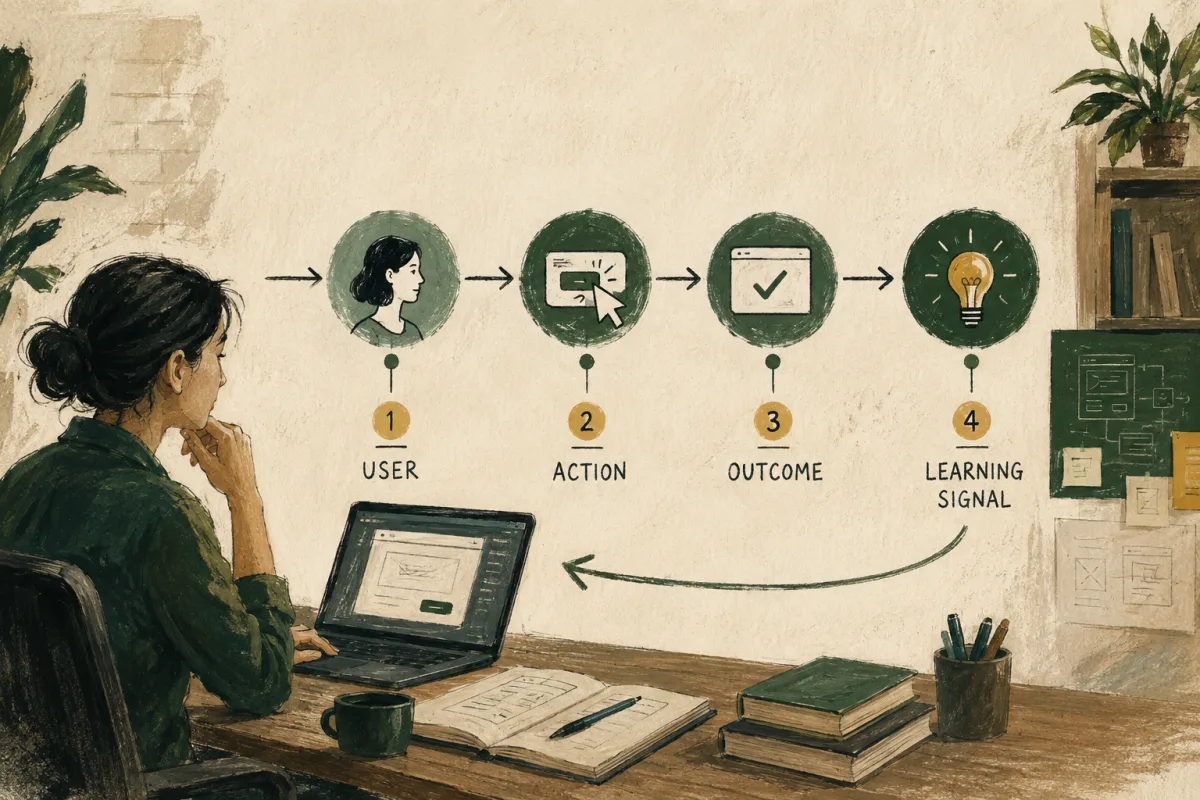
A thin test has:
- one defined user;
- one meaningful starting condition;
- one core action or workflow;
- one useful outcome;
- one way to observe the result;
- an explicit boundary around what is not included.
Cut optional roles, edge-case automation, configuration, reporting, integrations, and visual refinement unless they are necessary to make the test valid. “We may need it later” is not evidence for including it now.
Do not cut the controls that make the learning unsafe or untrustworthy. A payment test must handle money correctly. A health workflow must respect patient consequence and sensitive data. A B2B integration may need credible identity and auditability before a customer can use it.
Make delivery flow visible
Large status updates can hide where work waits.

Track a small number of real work items from decision through use. Ask:
- How long did the item wait before anyone started?
- Which question or dependency blocked it?
- How large was the change?
- How long did review and correction take?
- Could the team deploy it safely?
- Did it reach a user?
- What did the company learn?
Reduce work in progress. Finish the core path before opening several secondary streams. Bring product, design, and technical questions forward. Make acceptance visible before building. Keep changes small enough to review and release.
If an agency or contractor is involved, the company must own priorities, accounts, source, access, acceptance, and the product decision. Outsourcing delivery does not outsource accountability.
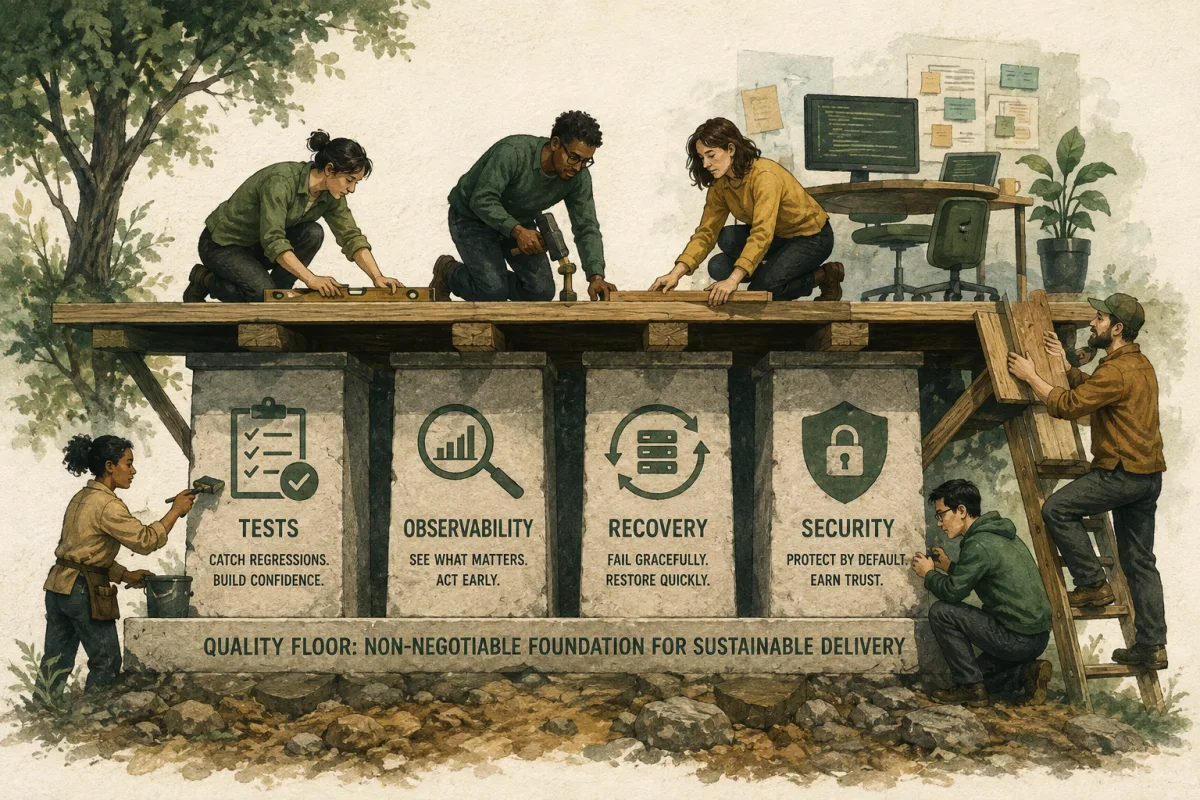
Set a responsible quality floor
“It is only an MVP” is not a control.
Define the minimum evidence for:
- the core behavior working;
- important data remaining correct;
- access being limited to the right people;
- failures being visible;
- a bad release being reversible;
- backups or recovery where loss matters;
- user support and escalation;
- known limitations being communicated.
The floor should fit the product’s consequence and exposure. It can be lightweight without being accidental. Avoid attempting comprehensive automation before the workflow is stable; do automate checks whose failure would invalidate the experiment or create costly rework.
Resolve ownership
One person must decide product scope. One person must own technical risk. One person must own delivery coordination. In a very small team these may be the same person, but the responsibilities still need to be named.
A fractional CTO is useful when founders need an executive to connect scope, architecture, external builders, quality, delivery, and the next team decision. It is not useful as a ceremonial reviewer who joins after choices have already been made.
The mandate should state:
- the learning outcome;
- decisions the CTO owns;
- sustained delivery capacity;
- ordinary and urgent availability;
- the release and quality boundary;
- the 30/60/90-day transition.
Read when to hire a fractional CTO before adding the role.
Run a 30-day recovery
Days 1–3: pause scope expansion, map the work, identify the core hypothesis, and name decision owners.
Days 4–7: select the thin test, resolve the largest technical unknown, define the quality floor, and remove nonessential work.
Days 8–21: deliver in small increments, review daily blockers and decisions, and put the core path in front of a real user or realistic environment.
Days 22–30: release the test, inspect behavior and operational evidence, document what changed, and decide the next investment.
Do not turn the 30-day period into a universal promise. Some products have hardware, regulated, scientific, or integration constraints that make the test longer. The principle is to shorten the decision loop, not ignore reality.
A worked example: reduce a booking product to one test
Consider a hypothetical team building booking software for independent service businesses. Its first release has accumulated staff calendars, multi-location scheduling, subscriptions, promotional codes, reports, automated reminders, and a customer mobile app. The founder calls all of this the MVP because established competitors have those features. No real customer result is claimed in this example.
The first question is which uncertainty justifies the next investment. Suppose the team does not yet know whether a particular type of business will use an online booking link instead of handling every request manually. That is a narrower question than whether the company can reproduce a mature scheduling suite.
A possible thin test lets one participating business publish a limited set of available slots, lets a customer request one, and gives the business a reliable way to confirm it. The team can handle some administrative steps manually if the process is disclosed and sustainable for the test. Multi-location scheduling and a native app may be unnecessary for this question. Preventing conflicting confirmations and explaining the status of a booking may be essential.
Write down what the test will and will not establish. It may reveal whether customers start and complete the workflow and whether the business finds it useful. It will not establish performance at large scale, demand across every industry, or a profitable acquisition channel. If the team confuses these questions, a small successful test can produce an unjustified expansion plan.
Choose an observation window and a decision meeting before building. The exact sample and duration depend on customer access and the decision being made; do not invent statistical confidence from a handful of participants. Combine observed behavior with interviews about why people continued or stopped. The next decision might be to improve the core workflow, test another segment, or stop pursuing the concept.
Create a scope decision worksheet
The following worksheet is an original planning aid. Use it in a short meeting with the person responsible for the product decision and the people who will build and operate the test. The point is to make competing assumptions visible before they become code.
| Question | What a usable answer contains | Warning sign |
|---|---|---|
| Who is the first user? | A specific reachable group and starting situation | Everyone who might eventually buy |
| What must they accomplish? | One observable workflow and useful outcome | A list of disconnected features |
| What are we uncertain about? | A belief that could change the investment decision | A goal to launch something impressive |
| What evidence will we collect? | Behavior, operational evidence, and follow-up questions | Page views alone for a workflow product |
| What can remain manual? | A disclosed process with an owner and capacity | Hidden work nobody has agreed to perform |
| What must be safe? | Controls tied to money, data, access, or other consequences | Quality postponed without examining impact |
| When will we decide again? | A review date or evidence trigger and decision owner | Indefinite feature addition after release |
For each proposed feature, ask which row it supports. A feature without a clear connection may belong in a later version. This does not mean every valuable feature is measurable immediately; it means the team should explain why the work is necessary now.
Keep an explicit deferred list so that removing scope does not require arguing about whether an idea is ever worthwhile. Record the condition that would bring it back. For example, multi-location support might become relevant after the first business demonstrates repeated use and a second location is ready to participate. A trigger is more useful than a vague promise to build it soon.
Separate a technical spike from an MVP
A technical spike investigates feasibility or uncertainty in a limited area. An MVP tests a product or business assumption through a usable experience. A prototype can serve either purpose, but the evidence must be interpreted according to the question it was designed to answer.
If the main uncertainty is whether a third-party system exposes the necessary data, a small integration experiment may be the next responsible step. Building polished onboarding before validating that dependency could waste effort. Conversely, proving that an API call works does not show that customers want the resulting product or can use it successfully.
Give a spike an explicit question, time boundary, output, and disposal decision. The output may be a feasibility finding, a risk list, or an estimate range supported by the experiment. Decide whether any code can become production code only after reviewing its assumptions and controls. Experimental shortcuts should not quietly become permanent architecture because nobody assigned the cleanup.
A fractional CTO can help distinguish these evidence needs and sequence the work. The role should connect technical investigation to the product decision, not add a layer of approval to every small implementation choice. If the actual constraint is product research or customer access, involve the person who can resolve that constraint.
Recover an agency-built MVP without restarting blindly
When an external team is building the product, frustration can make a complete restart feel attractive. Before replacing the vendor or discarding the code, establish what exists, what can be demonstrated, and who controls the assets. Request a walkthrough of the core workflow in an environment the company can access legitimately.
Compare the agreed scope with working behavior. Separate unfinished work, changed requirements, defects, and unavailable dependencies. These categories imply different actions. A feature that was never agreed is not the same as a promised feature that fails its acceptance criteria. A blocked integration may require a commercial or access decision from the company rather than another developer.
Establish ownership of repositories, hosting, domains, service accounts, design files, and operational documentation through the appropriate agreements and access processes. Do not assume that a demo video proves the company can deploy or maintain the product. Ask the receiving technical owner to perform a controlled deployment or equivalent handover check.
Then compare continuation, a narrower release, targeted remediation, and replacement. Include the cost of knowledge transfer and disruption in the comparison. A new team still has to learn the problem, validate the existing work, and make decisions that the first team may have been unable to obtain. For leadership model choices, review outsourced CTO services.
Make the release decision explicit
A release meeting should be short because the evidence has already been prepared. The product owner states the learning question and participating users. The technical owner states the known limitations, relevant checks, recovery route, and unresolved risks. The person responsible for operations confirms support and monitoring arrangements.
Record three possible decisions: release within the agreed limits, release only after a named condition is met, or defer because the remaining exposure is unacceptable. A conditional decision should have a clear owner and a verification step. “Finish testing” is too vague to tell the team when the condition has been satisfied.
After release, inspect both behavior and operation. Did the intended users reach the core outcome? Where did they stop? Did manual support exceed the capacity assumed? Did the team collect evidence reliably? A quiet dashboard is ambiguous if the measurement itself is broken.
Use the result to change the plan. Continuing unchanged after evidence contradicts the hypothesis defeats the purpose of a minimum test. Equally, do not treat every small usability problem as proof that the business idea is invalid. Distinguish problems with the test, problems with the workflow, and problems with the underlying demand.
Questions founders ask about delayed MVPs
How long should an MVP take?
There is no responsible universal duration. The test depends on the uncertainty, product consequences, customer access, integrations, and available delivery capacity. A calendar estimate should describe a bounded scope and its assumptions. If the scope keeps changing, a precise date can conceal more uncertainty than it resolves.
Should we add more developers to catch up?
First identify the constraint. More people may help when there is well-defined parallel work and enough capacity to onboard and review it. They may add coordination load when the core problem is unresolved product decisions, a single integration, or unclear ownership. Ask which work can begin independently and who will make it ready.
Is a no-code product a valid MVP?
It can be when it tests the relevant workflow with acceptable data handling, reliability, and operational effort. Evaluate limits such as access control, integrations, portability, and manual support against the actual test. Choosing no-code does not remove the need for clear ownership or make every product safe to launch.
What if investors expect a larger release?
Clarify which evidence the release needs to provide and distinguish a commercial demonstration from a product learning test. Make scope, limitations, and unresolved assumptions explicit. A larger demonstration may have a legitimate purpose, but calling it minimum does not reduce its cost or prove customer demand. Avoid presenting simulated behavior as a working production capability.
When does the MVP become the product?
There is no single automatic transition. After the test, decide which parts should be retained, strengthened, replaced, or removed. Review operating ownership, security, data integrity, support, and the next customer commitments. Some experimental code can remain; some shortcuts should not. Make those decisions consciously before expanding exposure.
Can a fractional CTO guarantee delivery?
An executive can own decisions, improve visibility, challenge scope, and coordinate risks within an agreed mandate. Delivery still depends on implementation capacity, timely business decisions, external dependencies, and the nature of the product. Prefer clear responsibilities and observable review points to an unconditional promise made before the work is understood.
Use a release gate, not perfection
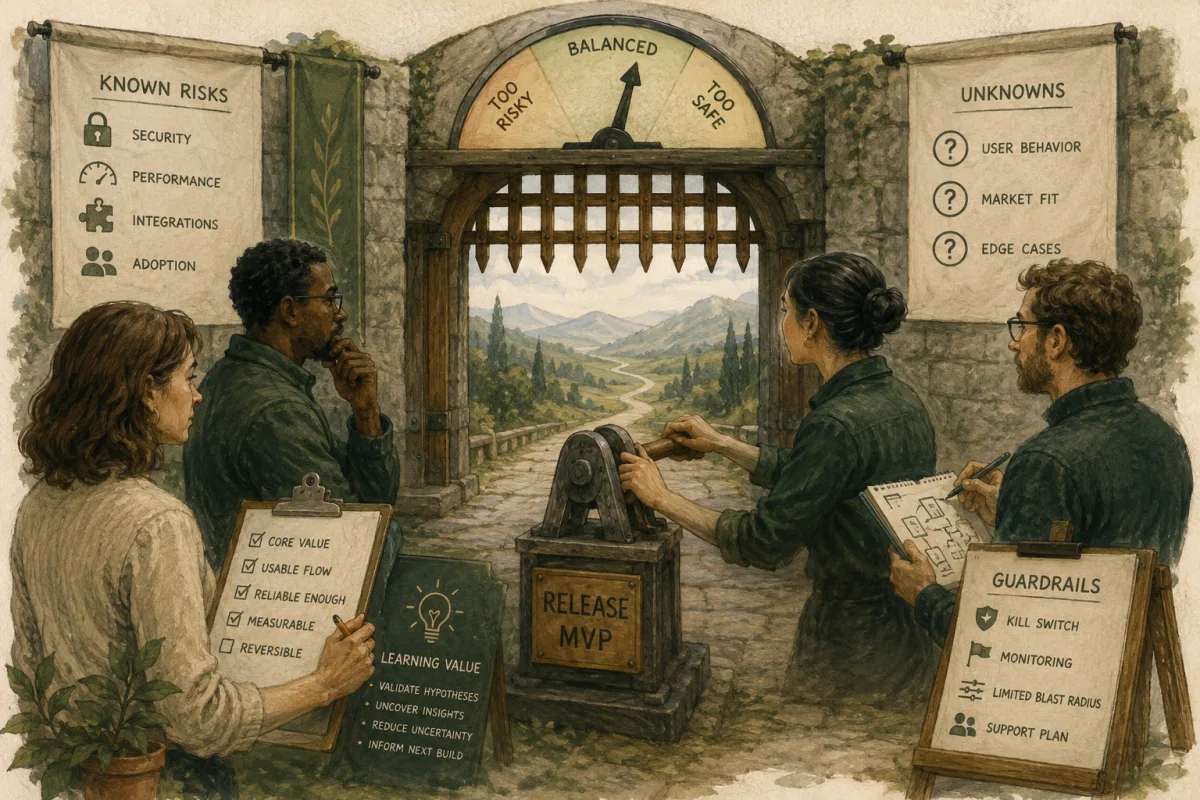
Before release, ask:
- Which known failures remain?
- Which unknowns could create unacceptable harm?
- What guardrails limit exposure?
- Can the team see and reverse a problem?
- Is the user and support path ready?
- Will this release produce evidence worth the remaining risk?
Launch when the learning value exceeds the bounded remaining risk—not when every idea is complete and not when pressure becomes embarrassing.
The result of a rescued MVP is not merely deployed software. It is a company that can state what it learned, make the next decision, and repeat a safer delivery loop.
Frequently asked questions
Why does MVP development take so long?
Common causes are an unclear hypothesis, expanding scope, unresolved decisions, large work batches, external dependencies, weak review and deployment flow, quality rework, or a team that lacks authority rather than effort.
Should we add more developers to finish the MVP?
Not until the constraint is clear. More people can increase coordination and rework when scope, ownership, architecture, or acceptance remains unresolved.
How much quality does an MVP need?
Enough to make the learning trustworthy and prevent disproportionate harm. Identity, data, payments, recovery, and customer consequence may require stronger guardrails than a temporary presentation detail.
Can a fractional CTO rescue a delayed MVP?
A fractional CTO can help when the missing capability is cross-functional decision ownership and the company has delivery capacity. If nobody can build the product, the plan must also secure that capability. A rescue outcome should not be guaranteed before diagnosis.
Sources and further reading
Turn research into a mandate
See the cost and hiring model before you shortlist.
Use the free calculator, then save a candidate search or post a transparent role when the mandate is ready.