
Private equity technology leadership
Fractional and Interim CTOs for Private Equity
Scope fractional or interim CTO work in private equity: diligence follow-through, initial planning, integration, governance and checkable operating evidence.
- By
- Fractional CTO Experts
- Published
- 2026-07-30
- Reviewed
- 2026-09-07
- Reading time
- 13 minutes
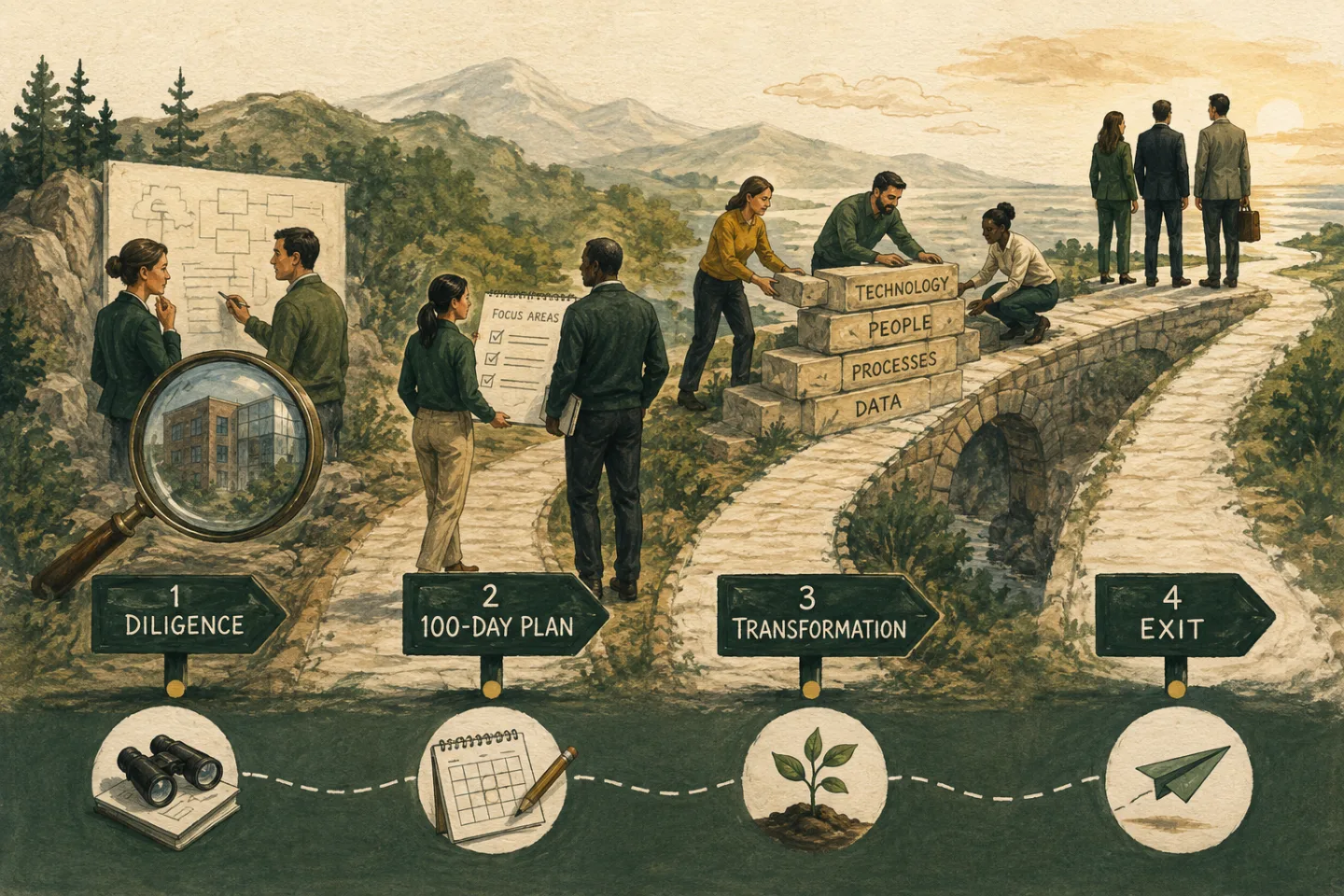
Private-equity technology leadership must translate between an investment thesis and the operating system of a portfolio company. The work may begin in diligence, intensify through the first 100 days, support a vacancy or integration, and evolve into transformation and exit readiness.
The external executive should strengthen management accountability. They should not create a remote shadow organization that issues technical instructions from the sponsor.
- Connect technology to the thesis
- Match leadership intensity to the event
- Define sponsor, board, and management boundaries
- Create a compact governance system
- Build the value-creation plan
- Select the right executive
- Separate oversight from implementation economics
- Plan the leadership transition
- Measure what persists
- Turn an investment assumption into a technology decision
- Revalidate diligence findings after access improves
- Worked example: enterprise growth with limited engineering capacity
- Use a first-100-days plan with explicit decisions
- Handle integration and carve-out work as operating transitions
- Build board reporting around evidence and decisions
- Make security governance proportionate and explicit
- Prepare exit evidence throughout the holding period
- Questions sponsors and portfolio-company leaders ask
- Build a repeatable portfolio standard without forcing sameness
Connect technology to the thesis
Start with the value path:
- revenue growth through product, channel, market, or enterprise capability;
- margin through automation, platform economics, vendor change, or operating leverage;
- risk reduction through resilience, security, compliance, data, or key-person coverage;
- multiple expansion through repeatable delivery, product quality, and credible technology evidence;
- transaction execution through carve-out, integration, or acquisition.
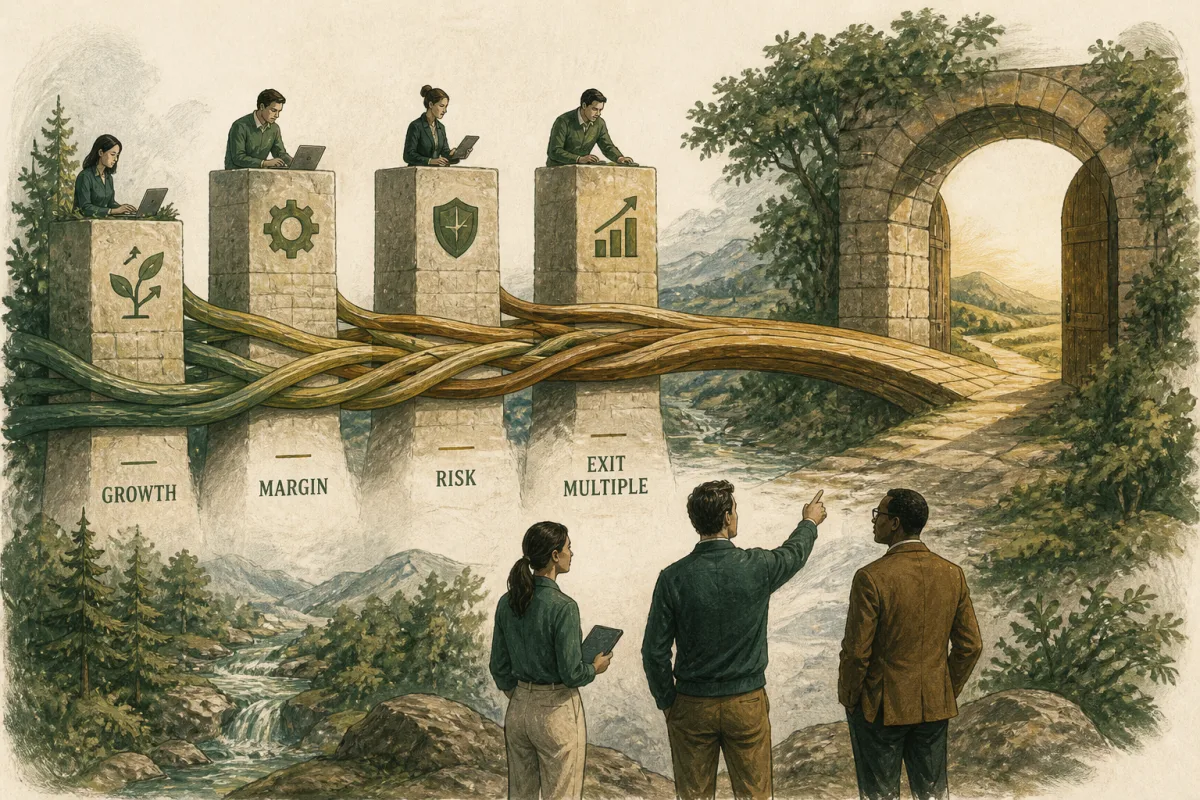
For every workstream, state how technology affects the thesis, which evidence supports the baseline, what investment is required, who owns the result, and when the board must decide.
Avoid labelling every modernization idea “value creation.” Some work protects continuity, some enables options, and some is ordinary maintenance. Those are legitimate but economically different.
Match leadership intensity to the event
Pre-close diligence
An independent leader assesses how product, platform, security, data, team, delivery, and technology economics affect the thesis, price, structure, and post-close plan.
First 100 days
The executive turns material findings into management-owned workstreams, validates assumptions with deeper access, and establishes board reporting.
Vacancy
An interim CTO may need to hold the seat, retain leaders, stabilize commitments, and support the permanent search.
Carve-out or integration
Technology decisions affect separation, identity, data, infrastructure, contracts, systems, operating processes, and synergies. Concentrated authority may be necessary.
Transformation
A fractional CTO can own a bounded portfolio where internal leaders run daily execution. A broad turnaround may require interim or permanent leadership.
Define sponsor, board, and management boundaries
The sponsor and board set the thesis, governance, capital, and oversight. Portfolio management runs the company. The CTO should have one clear reporting and escalation route.
Define:
- who sets outcomes;
- which decisions remain with management;
- board approval thresholds;
- access to evidence and people;
- how sponsor concerns reach the CTO;
- how findings are corrected or challenged;
- confidentiality across the portfolio;
- conflicts and competing vendors;
- whether the executive may sell implementation.
Do not require the CTO to please both management and sponsor through separate narratives. One evidence base should support honest disagreement.
Create a compact governance system
Board reporting can include:
- thesis-linked technology workstreams;
- current baseline and target;
- owner and executive sponsor;
- milestones and evidence;
- investment and forecast;
- material risks and decisions;
- dependencies across commercial, product, people, and operations;
- transition or capability plan.
Avoid a huge red-amber-green dashboard. A green status can hide a weak baseline. Report what changed, what evidence exists, and which decision is required.
Build the value-creation plan
For each workstream:
- link to thesis;
- establish baseline and uncertainty;
- state business outcome;
- sequence decisions before delivery;
- assign management ownership;
- fund people, vendors, and change;
- define leading and outcome evidence;
- review whether assumptions remain valid.
Examples include enterprise platform readiness, product-delivery recovery, cloud economics, security and customer assurance, data capability, integration, or leadership rebuilding.
Do not force a two-year rewrite into a hold period without intermediate value and migration evidence.
Select the right executive
Ask candidates to reconstruct comparable events:
- How did the investment thesis shape priorities?
- Which diligence finding changed after close?
- How did they disagree with management or sponsor?
- Which workstream did they stop?
- How did they handle a leadership gap?
- What did board reporting omit and why?
- How did internal capability change?
- Which reference can verify the account?
Test operating context, not only PE vocabulary. Someone who advised boards may not have led people through a turnaround. Someone who transformed a large enterprise may not work within a smaller portfolio company’s capital and team.
Check availability, conflicts across investments, travel, time zones, direct reports, and whether fees or vendor interests affect recommendations.
Separate oversight from implementation economics
An external CTO may identify work their firm can deliver. Disclose:
- assessment standard;
- implementation interest;
- referral or reseller fees;
- alternative providers;
- internal delivery options;
- how the board and management retain choice.
Independence does not require refusing implementation. It requires visible incentives and decision-grade evidence.
Plan the leadership transition
Use workload, authority, horizon, and internal team:
- advisory for periodic challenge;
- fractional for bounded recurring decisions;
- interim for temporary seat ownership;
- permanent for continuous leadership and organization building.
An interim should leave a truthful role brief, current decision log, roadmap, risks, organization view, and successor onboarding. A fractional leader should transfer operating capability and recommend when the model no longer fits.
Measure what persists
Beyond milestones, ask:
- Can management explain technology investment and risk?
- Are delivery and reliability observable?
- Are critical decisions owned?
- Is security evidence maintained?
- Can the team execute without the external executive?
- Does the architecture support the value path?
- Are key-person and vendor dependencies reduced?
- Can an exit buyer reconstruct the story from evidence?
The right PE technology leader does not promise that technology alone creates the return. They make the role of technology in the thesis visible, owned, and testable.
Turn an investment assumption into a technology decision
A private-equity operating plan may assume that a portfolio company can enter a larger market, combine acquired products or improve operating efficiency. The CTO's job is to identify what must be true technically for that assumption to hold. That requires more than labelling a roadmap with the sponsor's preferred themes.
For a proposed enterprise expansion, investigate the actual buying requirements: access control, customer-specific integrations, service reliability, implementation support and credible security evidence. Determine which are already available, which require development and which depend on changes outside engineering. A sales team may need a repeatable onboarding process as much as the product needs a new feature.
State the decision in a form management can approve. For example: whether to fund a limited enterprise-readiness programme for a defined customer segment, subject to evidence from the first implementations. Record assumptions, dependencies, cost ranges and the point at which the plan should be reconsidered. The purpose is to expose choices rather than convert uncertainty into a confident schedule.
Revalidate diligence findings after access improves
Pre-close technical diligence often operates with limited time, selected evidence and constrained access. Once the operating team can investigate more deeply, some findings may become less concerning and others more specific. Treat that as a normal improvement in evidence, while preserving the original reasoning.
Create a finding register with the initial observation, evidence source, uncertainty, potential business effect, post-close validation action and management owner. Do not simply copy a diligence report into a backlog. A recommendation to investigate backup recovery, for example, needs a concrete rehearsal and acceptance record before it becomes a completed risk action.
Distinguish a confirmed deficiency from an unanswered question. If no restoration record was supplied during diligence, that establishes an evidence gap; it does not prove that restoration is impossible. The next task is to obtain or produce appropriate evidence. Conversely, a polished policy document does not establish that the team can perform the process under realistic conditions.
Use the technical due-diligence guide for the assessment structure. The post-close plan should retain a traceable connection to the findings while adapting to information that was unavailable during the transaction.
Worked example: enterprise growth with limited engineering capacity
Consider an illustrative software company acquired with a plan to serve larger customers. Management has a capable product team, but the first enterprise pilots reveal inconsistent customer provisioning, manual permission changes and lengthy security-questionnaire responses. The sponsor proposes hiring more developers and accelerating the roadmap.
A CTO first separates the constraints. Provisioning may require a clearer operating process, permission changes may require a product-control improvement, and security responses may require maintained evidence owned jointly by engineering and operations. Additional developers could help one workstream while leaving the others unchanged.
The initial plan might select one representative pilot, document its acceptance requirements and build the smallest repeatable process that meets them. Management identifies the people who will own onboarding, access review and customer assurance after the pilot. Engineering implements the necessary control changes and checks that they work for more than one customer configuration.
The board receives evidence of the pilot's outcome and the remaining uncertainty before approving wider rollout. It does not receive an assumed revenue uplift merely because features shipped. This is an illustrative decision process, not a client case study, investment recommendation or promise that enterprise expansion will succeed.
Use a first-100-days plan with explicit decisions
A first-100-days plan is a coordination horizon, not a requirement to finish every transformation within that period. Focus on the decisions and operating capabilities that make later work credible. The appropriate pace depends on access, business continuity, management capacity and transaction obligations.

| Period | Main question | Reviewable output |
|---|---|---|
| Initial access and continuity | Can management operate critical services safely? | Ownership, service map and urgent risk register |
| Evidence validation | Which deal assumptions remain supported? | Updated findings with confidence and owners |
| Prioritisation | What should be funded, sequenced or stopped? | Approved workstreams and dependencies |
| Early delivery | Can the organisation execute the selected approach? | Representative outcomes and operating evidence |
| Next-phase decision | What changes after the first cycle? | Revised scope, leadership capacity and investment request |
Each workstream should identify an accountable management owner. The sponsor may challenge priorities and approve capital within the governance arrangement, but day-to-day ambiguity should not be resolved through an informal second chain of command. Escalate disagreements through the agreed route and use the same evidence in sponsor and management discussions.
Handle integration and carve-out work as operating transitions
A systems integration is not complete when data has moved or an application has been switched on. People must be able to perform the business process, support the system and understand the remaining exceptions. Map those operating responsibilities alongside technical interfaces.

For a carve-out, identify dependencies on the former parent: identity, email, hosting, finance systems, licenses, data feeds, service desks and specialist staff. Record the transition deadline and the evidence needed before each dependency can end. Have the relevant commercial and legal owners review agreements and entitlements; a technical assumption about continued access is not a substitute for an agreed arrangement.
For an acquisition integration, compare the choices to retain, connect, consolidate or retire systems. A single platform may reduce some duplication while introducing migration cost and operational disruption. Two products may share useful services without needing an immediate full rewrite. Choose based on the operating goal and evidence, rather than treating technical uniformity as an outcome by itself.
Rehearse the critical transition paths and define who can stop a cutover. Track data reconciliation, user access, support readiness and recovery limits. A rollback plan needs to address changes made during the transition, not merely describe how to restart an old server.
Build board reporting around evidence and decisions
A useful technology board update identifies what changed, what the evidence establishes and which decision requires attention. Limit status reporting that cannot be traced to an observable result. A project described as ninety percent complete may still contain its hardest integration and acceptance work.

For each material workstream, show the baseline, current evidence, remaining uncertainty, spending against the agreed scope and the next decision. Separate delivery progress from business outcomes. Shipping a self-service onboarding flow is a delivery milestone; customers successfully completing onboarding with less support is an operating result that requires observation.
Use consistent definitions over time. If cloud cost is reported, specify whether it includes support contracts, software licenses and shared infrastructure. If delivery reliability is reported, explain which releases or incidents are included. Changes in measurement should be visible so the board does not mistake a new definition for performance improvement.
Keep sensitive details in the appropriate restricted record while preserving a clear summary for governance. Management should be able to explain the principal risks without exposing credentials, customer data or unnecessary incident details in a broad presentation.
Make security governance proportionate and explicit
The NIST Cybersecurity Framework offers a reference for organising cybersecurity risk management. It can help management describe its current condition and intended outcomes. Using the framework does not by itself establish certification, legal compliance or the absence of security risk.
Ask who owns risk decisions, how important services and dependencies are identified, how controls are verified and how incidents are handled. A portfolio company may need specialist security leadership in addition to a CTO, particularly where customer commitments or the operating environment demand deeper expertise. Avoid assuming that one executive title covers every specialist responsibility.
Distinguish immediate exposure from longer-term improvement. A known access-control failure may require urgent containment, while a broader governance programme needs a funded sequence. Record any accepted residual risk with the appropriate decision-maker and review date. The objective is accountable management of the actual condition, not a large checklist disconnected from the business.
Prepare exit evidence throughout the holding period
An eventual buyer will need to understand how the technology operates and how the company reached its current condition. Maintain the evidence as ordinary management work: architecture decisions, service ownership, material incidents, remediation records, delivery measures, key contracts and leadership responsibilities.
Keep the history of important tradeoffs. If management chose to defer a migration, record the reason, the accepted consequence and the trigger for reconsideration. A candid decision record is more useful than retroactively presenting every choice as part of a perfect plan.
Review whether the evidence remains current and reproducible. A security assessment from a previous architecture or an obsolete recovery test may still be historical context, but it does not describe today's system. Identify the period and scope of each artifact so a future reviewer can judge its relevance.
The CTO should help management explain both strengths and limitations. Do not manufacture an exit narrative from unsupported metrics or attribute company performance solely to technology work. A credible account connects verified changes to the operating plan and distinguishes demonstrated outcomes from remaining expectations.
Questions sponsors and portfolio-company leaders ask
When does a portfolio company need an interim CTO rather than fractional support?

Use interim leadership when the company needs concentrated temporary ownership of the technology seat, including daily decisions, people leadership and major transition work. Fractional support fits a bounded recurring mandate when internal leaders can execute between engagements. The interim CTO guide provides a fuller comparison of availability and responsibilities.
Can one CTO serve several portfolio companies?
Potentially, if the mandates fit the executive's capacity and each company has clear operating ownership. Assess the actual decision load and confidentiality requirements. Shared sponsorship does not remove the need to separate data, manage conflicts and agree who receives each company's information.
Should the diligence adviser become the operating CTO?
That can preserve useful context, but the two roles require different capabilities and incentives. Check whether the adviser has led implementation, managed teams and worked within comparable constraints. Disclose any commercial interest in follow-on work and evaluate the appointment separately from the quality of the diligence presentation.
How should technology cost savings be reported?
Agree the baseline, scope and treatment of transition costs with finance. Distinguish reduced spending, avoided future spending and released staff capacity. Those are different outcomes. Do not report a reduction in a vendor invoice without considering replacement services or the internal work needed to operate the new arrangement.
What should a fractional CTO leave behind?
Management-owned decisions, a realistic roadmap, current evidence of risk and service operation, clear internal responsibilities and a plan for the next leadership need. The engagement is stronger when the company can continue operating the improvements without depending indefinitely on the external executive.
Build a repeatable portfolio standard without forcing sameness
A sponsor can define a small evidence standard across investments:
- named technology owner;
- current service and incident view;
- security and material-risk governance;
- technology investment against the operating plan;
- key-person and vendor dependencies;
- major roadmap decisions;
- leadership and succession;
- transaction-specific milestones.
Management should adapt the measures to its business model and stage. Comparing raw deployment frequency, cloud spend, or headcount across unrelated companies creates noise and incentives to game.
Use portfolio-wide specialists for common leverage—security exercises, procurement, architecture challenge, or hiring—while keeping each company’s executive accountable. Record when one provider has commercial interests across several workstreams.
For a cross-portfolio fractional CTO, cap the number and intensity of assignments. Require secure separation of data and systems, explicit conflict management, and a named management counterpart in every company. Portfolio context creates leverage only while attention and confidentiality remain credible.
Frequently asked questions
What does a CTO do for a private-equity portfolio company?
They connect technology architecture, delivery, security, data, organization, vendors, and spend to the investment thesis and value-creation plan, while making risk and evidence visible to management and the board.
When should a PE firm use an interim CTO?
Use interim leadership when a vacancy, carve-out, integration, turnaround, or search needs concentrated temporary seat ownership. Use fractional leadership when the decision portfolio can be bounded.
Can a fractional CTO work across several portfolio companies?
Yes for advisory or carefully bounded mandates, but conflicts, capacity, governance, data separation, management authority, and local context must be explicit. One person should not become a remote shadow CTO for an entire portfolio.
How should PE technology work be measured?
Tie measures to the thesis: risk retired, operating capability, delivery and reliability, cost visibility, integration or separation milestones, team strength, and evidence supporting growth and exit readiness.
Sources and further reading
Turn research into a mandate
See the cost and hiring model before you shortlist.
Use the free calculator, then save a candidate search or post a transparent role when the mandate is ready.