
Cloud transformation
Cloud Migration Consultant: Scope, Cost and Selection
Choose a cloud migration consultant with a clear brief, workload assessment, cost comparison, rollback plan and handover. Evaluate the work before committing.
- By
- Fractional CTO Experts
- Published
- 2026-07-30
- Reviewed
- 2026-09-07
- Reading time
- 13 minutes
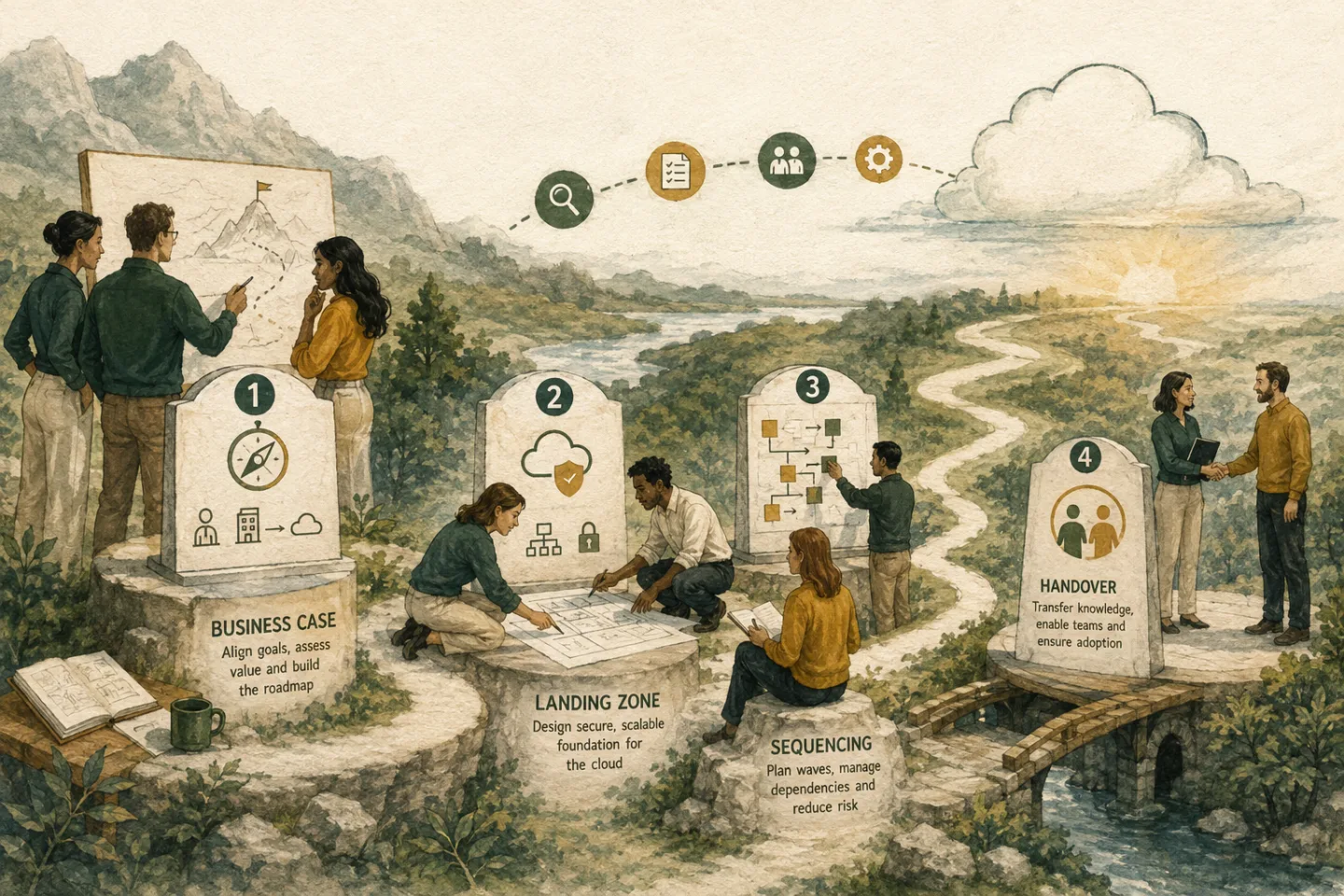
A cloud migration consultant should help an organization make and execute a business decision, not merely relocate servers. The assignment connects workload architecture, data, identity, resilience, security, cost, delivery capacity, vendor contracts, and the internal operating model.
The first question is not “AWS, Azure, or Google Cloud?” It is “which business constraints should change, which risks must not increase, and who will operate the result?”
- Define the migration outcome
- Discover the estate and its dependencies
- Choose a treatment, not one migration verb
- Sequence migration waves
- Model total economics
- Build controls before workload scale
- Select the consultant
- Define done as operable
- A migration brief that produces comparable proposals
- Worked example: move an order-processing service without losing orders
- Write a rollback plan that accounts for new data
- Use a wave acceptance record
- Compare migration economics across three scenarios
- What should remain with your team after the consultant leaves?
- Cloud migration questions a leadership team should answer
- Questions to put in the request for proposal
- Practical next step
Define the migration outcome
“Move to cloud” is an activity. Useful outcomes are observable:
- exit a data-center contract before a fixed date;
- support geographic expansion or data residency;
- improve recovery objectives for critical services;
- reduce lead time for new environments;
- replace unsupported platforms;
- create reliable cost attribution;
- enable a product or data capability the current estate blocks;
- separate or integrate systems around a transaction.
A migration can raise short-term cost and complexity while creating future options. The business case should state the expected value, investment horizon, dependencies, and conditions that would stop or change the plan.
Discover the estate and its dependencies
Inventory alone is insufficient. The consultant needs to map how workloads behave and what they depend upon.
For each important service, examine:
- business owner, users, critical periods, and downtime tolerance;
- compute, storage, network, data, integration, and identity dependencies;
- licensing and vendor restrictions;
- deployment and configuration mechanisms;
- monitoring, recovery, backup, and support;
- security classification and regulatory constraints;
- current run cost and change effort;
- internal knowledge and key-person exposure.
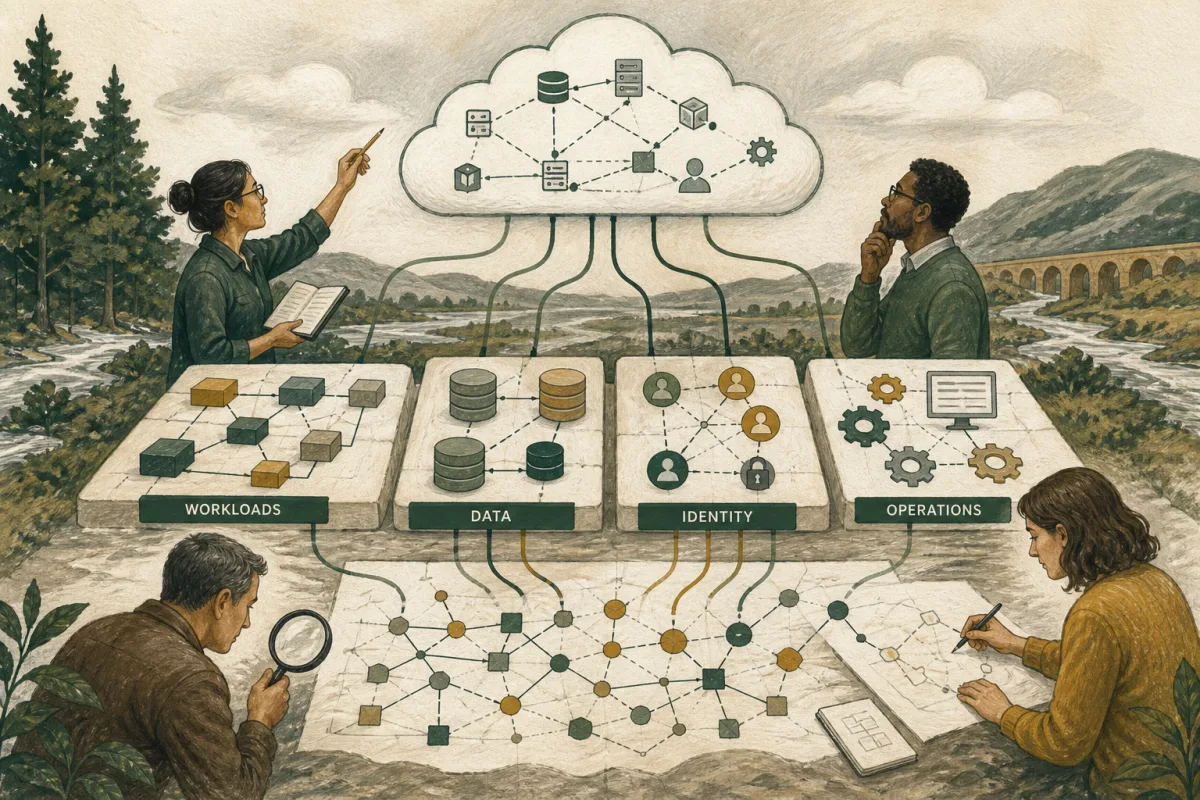
Classify uncertainty explicitly. A dependency that has never been tested is different from one proven absent. Discovery should reduce the chance that a “simple” workload turns out to be coupled to an undocumented batch process during cutover.
Choose a treatment, not one migration verb
Workloads may be retired, retained, relocated, replatformed, refactored, repurchased, or replaced. The popular “R” lists are prompts, not answers.
Use evidence:
- Does the application still serve a valuable outcome?
- Which constraint is the migration intended to remove?
- Is the team able to operate a more complex target?
- Does modernization pay back within the business horizon?
- Can data move safely and within the available window?
- Which change can be reversed?
- What happens if volume, cost, or vendor terms change?
Avoid refactoring everything during infrastructure exit unless the economics and timeline support it. Avoid copying every legacy weakness into cloud and calling the program complete.
Sequence migration waves
Start with a pilot that teaches the organization about the real target environment without exposing a critical service. Then establish a repeatable path, move representative workloads, address high-risk or tightly coupled systems deliberately, and retire old assets only after evidence.

Each wave needs:
- scope and accountable owners;
- entry criteria and dependency evidence;
- target service levels and controls;
- data validation;
- cutover, communication, and rollback;
- operational acceptance;
- cost and performance review;
- learning applied to the next wave.
Migration factories can increase throughput, but they must not turn exceptions into hidden risk. Escalate where the standard pattern does not fit.
Model total economics
Cloud cost is not only virtual machines. Include:
- compute, storage, databases, managed services, and support;
- data transfer and inter-region architecture;
- observability, security, backup, and third-party tooling;
- duplicated environments during transition;
- software licensing and contractual commitments;
- migration labor and specialist support;
- training, platform engineering, and operating capacity;
- retained legacy cost until decommissioning;
- expected growth and pricing sensitivity.
Compare plausible scenarios rather than a single confident forecast. Savings may come from retirement, licensing, automation, or team productivity—not automatically from cloud unit prices.
The consultant should disclose cloud partnerships, resale margins, and incentives. Platform accreditation is evidence of capability, not proof that a recommendation is independent.
Build controls before workload scale
A landing zone should provide the smallest coherent control plane for the organization:
- identity, privileged access, and separation of duties;
- account, subscription, or project structure;
- network boundaries and connectivity;
- encryption, key management, and secrets;
- policy, configuration, and change controls;
- logging, observability, and security monitoring;
- backup, recovery, resilience, and incident routes;
- cost allocation, budgets, and anomaly response;
- infrastructure automation and approved patterns.
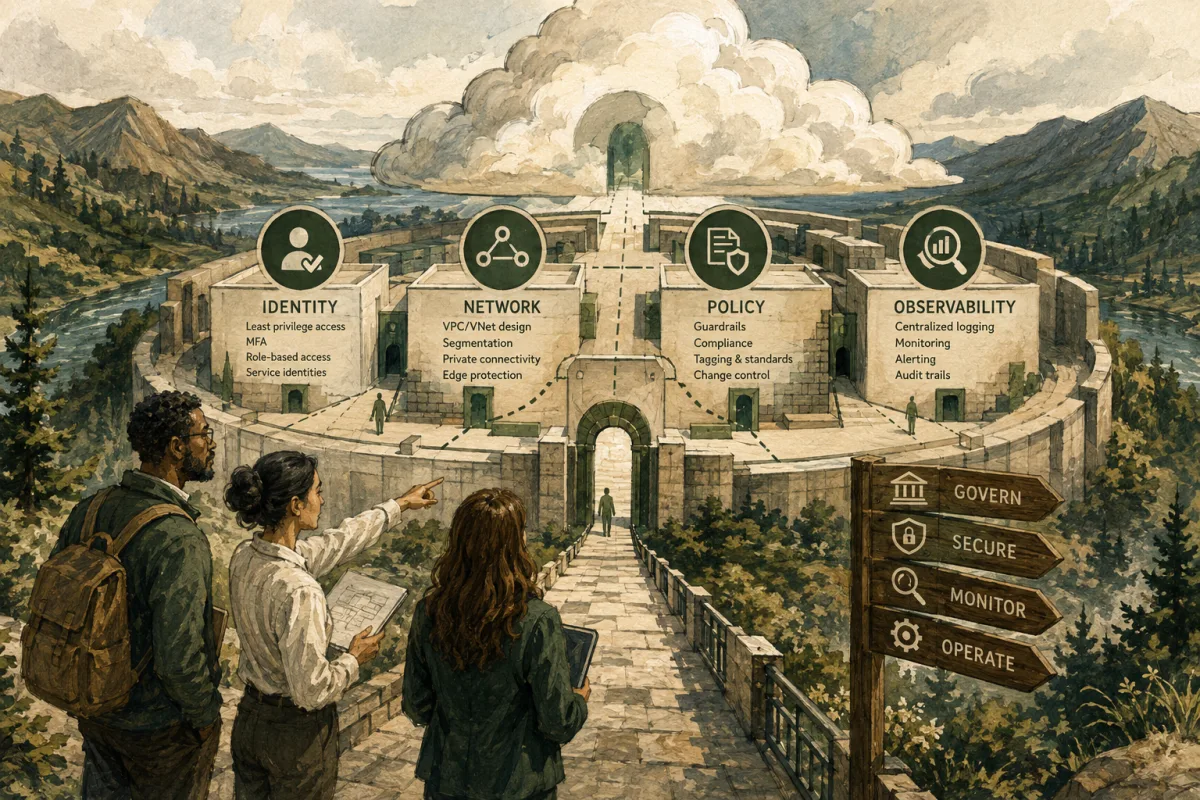
Do not overbuild an enterprise platform for a small estate. Do not move critical workloads onto an improvised foundation. Controls should follow the business exposure and be operable by the team.
Select the consultant
Ask candidates to reconstruct a comparable migration:
- Why did the organization migrate?
- What changed after discovery?
- Which workload did they not move, and why?
- How did they model cost?
- What failed during a cutover?
- How was rollback designed?
- Which controls existed before the first critical workload?
- What did the client operate without the consultant at the end?
Require references from leaders accountable for business continuity and cost, not only engineers who enjoyed the tools.
The proposal should separate discovery, target design, foundations, migration execution, modernization, and managed services. Bundling everything hides decision gates and makes it difficult to stop an unsuitable approach.
Define done as operable
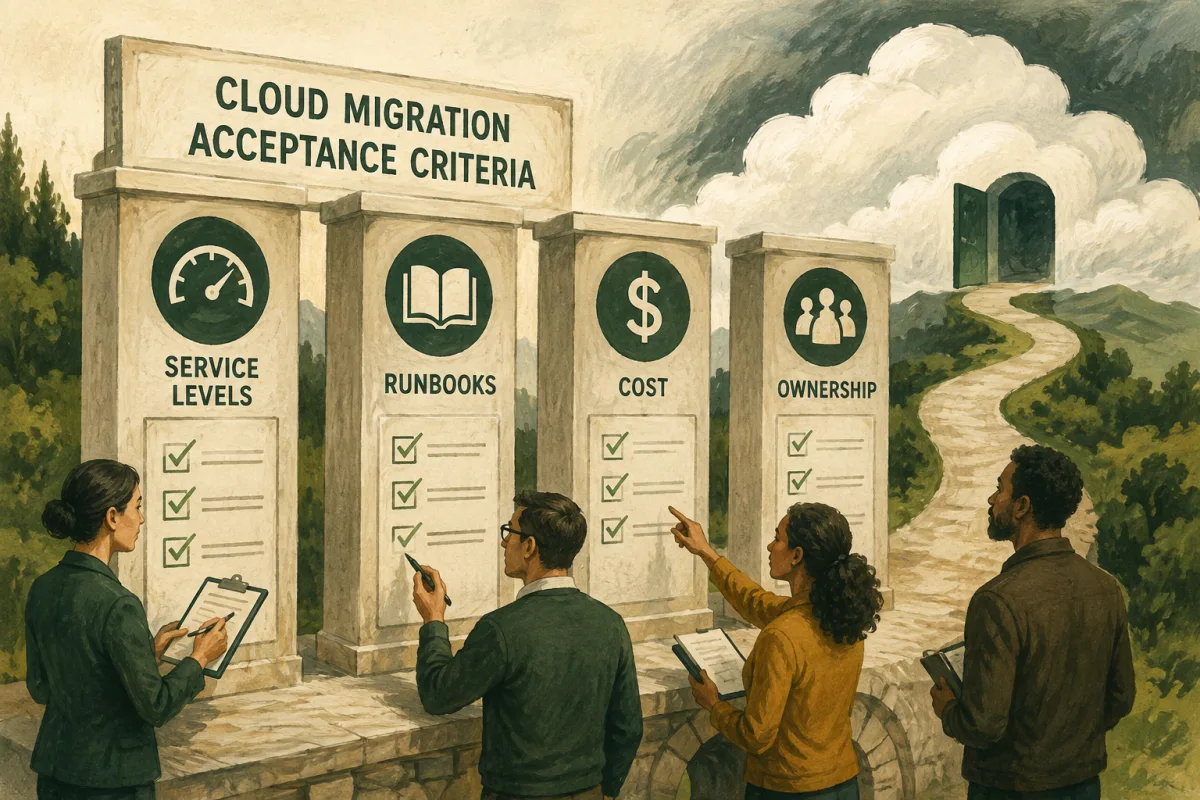
A workload is not complete because it responds in cloud. Acceptance should verify:
- functional and data integrity;
- performance and service objectives;
- security and compliance controls;
- backup and recovery;
- monitoring and incident routes;
- cost baseline and ownership;
- runbooks, access, and support;
- legacy decommissioning plan;
- internal capability and handover.
The best migration leaves the organization able to choose, operate, and improve without permanent consultant dependence. That is why the operating model belongs in scope from the first business-case conversation.
A migration brief that produces comparable proposals
A useful brief gives a consultant enough context to challenge the assignment. Include the business deadline, the systems in scope, the approximate usage pattern, the people available to participate, and the decisions already made. Separate a genuine constraint, such as the expiry of a hosting agreement, from a preference, such as using the same cloud provider as another team.
Ask for separate prices and acceptance criteria for discovery, foundations, migration execution, and any continuing managed service. A provider may reasonably avoid a fixed implementation price before discovering an undocumented estate. It should still explain what discovery will establish, what access it needs, and what happens if the findings make the proposed migration uneconomic.
The proposal should also describe your obligations. Who can approve network changes? Who understands the old database? Who will test the business process after cutover? A supplier's schedule may assume prompt answers from people who are already fully occupied. Make those assumptions visible before comparing delivery dates.
For a small estate, a concise dependency map and a limited pilot may provide enough evidence. For a complex estate, discovery may require deeper traffic observation, licensing review, data classification, and interviews across several business units. The purpose is proportionate confidence, not producing the largest possible inventory.
Worked example: move an order-processing service without losing orders
Consider a hypothetical business that runs its customer portal, order database, scheduled exports, and warehouse integration on an ageing hosted environment. The hosting contract ends in six months. Management wants to migrate the service while preserving the ability to reconcile every order. This example is an editorial scenario, not a client case study or a delivery-time promise.
The consultant first identifies the critical business path: a customer places an order, payment is confirmed, stock is reserved, the warehouse receives instructions, and the customer sees the correct status. A successful homepage response proves very little about that chain. Discovery must include background workers, retry queues, scheduled exports, and the identities each integration uses.
Next, the team distinguishes data that can be copied repeatedly from data that changes during cutover. Product images may tolerate an initial copy followed by a small update. Orders and payment states require a defined consistency strategy. The team needs to know where writes originate, whether events can be replayed safely, and how duplicate processing will be detected.
The pilot should exercise a representative transaction in the target environment using approved test data. It should include a failed downstream request and the subsequent retry. A test that only demonstrates the happy path leaves the most consequential operating behaviour unexamined. The service owner should agree what evidence is sufficient before the pilot begins.
For the production wave, the cutover plan might pause selected writes, apply a final synchronisation, validate agreed control totals, switch traffic, and monitor business transactions. The actual sequence depends on the architecture. The important point is that every step has an owner, an observable completion condition, and a decision about what to do if the condition fails.
After traffic moves, the team reconciles orders across the application, payment provider, and warehouse interface. It also checks latency, failed jobs, support contacts, and the rate of manual intervention. Infrastructure health can look normal while the business process quietly accumulates exceptions. Operational acceptance should therefore include both system measures and transaction evidence.
Write a rollback plan that accounts for new data
“Switch DNS back” is not a complete rollback plan if users have already written data into the new environment. The old system may now be stale. Returning traffic without reconciling those writes can create lost changes, duplicated transactions, or inconsistent customer records.
Define the rollback boundary before the migration. Which steps are reversible? Which changes require reconciliation? At what point does fixing forward become safer than restoring the previous environment? Who has authority to make that decision, and what information will they receive? These questions deserve a rehearsal when the workload is consequential.
Record triggers in terms the team can observe. Examples include a failed reconciliation check, an unavailable critical integration, or performance outside an agreed tolerance for a defined observation period. Avoid a vague trigger such as “if the migration goes badly.” It leaves the team debating the meaning of failure while the recovery window closes.
Keep rollback resources available for the agreed period, but price that decision. Running two environments incurs cost and can create its own security and configuration risks. Assign an owner to decide when the old environment can be retired. Retention should follow evidence and business need rather than continuing indefinitely because nobody wants to approve deletion.
Use a wave acceptance record
The following record turns a migration wave into a reviewable decision. Adapt it to the workload; it is not a claim that every row requires a separate document or committee.
| Area | Evidence before acceptance | Owner who can explain it |
|---|---|---|
| Business behaviour | Representative user journeys and transaction reconciliation | Business service owner |
| Data | Agreed completeness checks and handling of changed records | Data or application owner |
| Recovery | Restore or failover evidence appropriate to the service | Operations owner |
| Access | Working user access and reviewed privileged identities | Identity or security owner |
| Performance | Measurements under representative demand | Application and platform leads |
| Cost | Allocated baseline, unusual charges, and forecast assumptions | Service and finance owners |
| Support | Runbook, monitoring, escalation, and support responsibilities | Team operating the service |
| Retirement | Dependencies cleared and retention decisions recorded | Legacy service owner |
The consultant can prepare this evidence and coordinate the review. The business must still accept its own operational risk. A migration supplier should not be the only party declaring that a service is ready when another team will inherit the consequences.
An exception should name the unresolved condition, its impact, the temporary mitigation, and the person who accepted it. Give the exception a review date. A list of unowned exceptions is effectively an undocumented second project waiting to emerge after the migration team leaves.
Compare migration economics across three scenarios
Use a baseline scenario, the proposed migration, and at least one credible alternative. The baseline should include the cost of remaining where you are, including unavoidable renewal, maintenance, or unsupported-system work. Treating the current estate as free makes almost any change appear expensive; treating every old cost as immediately removable creates the opposite distortion.
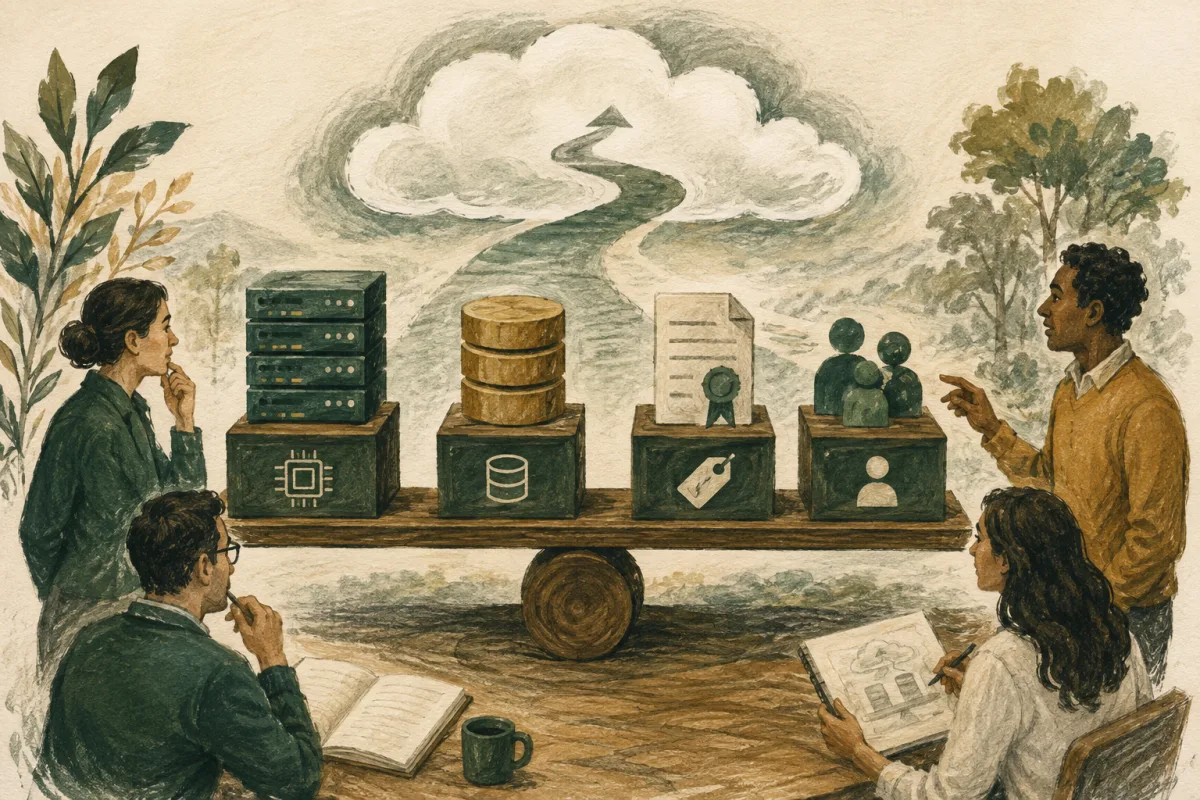
For the proposed migration, separate one-time work from recurring operation. Include discovery, engineering effort, testing, dual running, data movement, training, and decommissioning. Then model the target service at expected demand and at a plausible higher-demand case. Explain which costs vary with traffic, stored data, resilience choices, or customer geography.
The alternative might retain part of the estate, retire an unnecessary application, adopt a managed product, or migrate with less refactoring. It should be a viable option, not an obviously inferior proposal included to make the preferred approach look better. Record what capability the company gives up or gains under each scenario.
Use sensitivity analysis for uncertain inputs. If data-transfer cost, licence treatment, or growth assumptions dominate the decision, show how the conclusion changes when those inputs change. The business does not need a perfect forecast. It needs to understand which assumptions could make the choice wrong and how those assumptions will be tested.
Cloud commitments and discounts should follow a sufficiently understood usage pattern. A headline discount is not a saving if the company commits to capacity it does not need. Ask the consultant to explain the relationship between commitment length, workload stability, and the organisation's ability to change direction.
What should remain with your team after the consultant leaves?
The handover should enable the internal team to operate and change the service. That means more than receiving architecture slides. Engineers should be able to locate infrastructure definitions, understand deployment and recovery procedures, trace an alert to an owner, and explain how access is granted and removed.
Use practical demonstrations. Ask an internal operator to follow the runbook in a safe environment while the consultant observes. Ask the finance owner to identify which services explain the bill. Ask a developer to make a routine change through the approved pipeline. Difficulty with these tasks reveals missing knowledge more reliably than a signed attendance sheet from a training session.
Clarify the support boundary after project completion. Cloud-provider support, a managed-service contract, application maintenance, and internal incident leadership are different responsibilities. The team should know which party investigates a database problem, which party fixes application behaviour, and who communicates with customers while diagnosis is still incomplete.
Finally, agree what continuing consultancy would actually add. A limited optimisation review may be useful after real production usage emerges. It should have a clear purpose and evidence requirement. Indefinite dependence on the migration team is not an automatic sign of success.
Cloud migration questions a leadership team should answer
Should every application move to the cloud?
No. Decide workload by workload using business value, dependencies, operating capability, contractual constraints, and the cost of change. Retaining or retiring an application can be a sound outcome of a migration assessment. A consultant should be able to explain why a workload should remain where it is without treating that answer as a failed sale.
Can a consultant guarantee a cheaper cloud bill?
A credible provider can describe the method, assumptions, and actions behind a cost estimate. It cannot responsibly promise universal savings independent of architecture, usage, contracts, and internal behaviour. Require a comparable baseline and a measurement plan, then distinguish forecast savings from reductions actually observed after old costs have been removed.
How do we know the migration is finished?
Completion means the service meets agreed business and operational acceptance criteria, the receiving team can operate it, and the old estate has an owned retirement decision. A working deployment alone is insufficient. The acceptance record should make remaining exceptions visible so the company knows exactly what it is taking over.
Do we need a migration consultant or a fractional CTO?
A migration consultant supplies focused discovery, architecture, or execution expertise. A fractional CTO connects that work to wider technology investment, supplier governance, and leadership decisions. Some assignments need both. Use the outsourced CTO guide to define the authority boundary and avoid paying two suppliers to assume the other owns the business decision.
Questions to put in the request for proposal
Give every provider the same decision questions so proposals remain comparable:
- Which assumptions must discovery validate before you recommend a platform or timeline?
- Which work will our team own, and what capability must exist before each wave?
- How will you distinguish relocation from modernization?
- Which commercial relationships or resale margins could influence your advice?
- How will you measure customer impact during cutover?
- Which costs are excluded from the headline migration estimate?
- What evidence permits a legacy system to be decommissioned?
- How will design decisions, automation, operating knowledge, and access transfer to us?
Require providers to state unknowns rather than hiding them inside contingency. A responsible proposal may price discovery before fixed migration work. That is preferable to false precision followed by change requests.
Finally, assign an executive sponsor and internal service owners before contracting. A consultant can provide analysis and delivery leadership, but only the organization can accept business risk, prioritize disruption, and commit the people who will operate the target.
Practical next step
For an AWS-specific procurement decision, use the AWS consultant buying guide. Its scope worksheet covers access ownership, deliverable acceptance, cost assumptions and the operating handover, with links to official AWS guidance.
Frequently asked questions
What does a cloud migration consultant do?
A cloud migration consultant builds the business case, maps dependencies, designs the target controls and operating model, sequences migration waves, governs cutover risk, and transfers operation to accountable internal teams.
How much does cloud migration consulting cost?
Cost depends on estate size, dependency complexity, data movement, compliance, downtime tolerance, cloud foundations, and internal capability. Separate assessment, foundation, migration, modernization, and managed-operation costs.
Should I choose an AWS, Azure, or Google Cloud specialist?
Choose platform depth after clarifying business, workload, data, integration, commercial, and team constraints. A platform specialist is useful, but the recommendation should not be predetermined by the consultant's partnership.
How do I verify a cloud migration consultant?
Ask for comparable migration evidence, architecture reasoning, cutover and rollback examples, cost outcomes, security controls, incident experience, internal handover, and references from accountable client leaders.
Sources and further reading
Turn research into a mandate
See the cost and hiring model before you shortlist.
Use the free calculator, then save a candidate search or post a transparent role when the mandate is ready.