
Fractional executive careers
Fractional CTO Interview Preparation: Evidence and Scenarios
Prepare for a fractional CTO interview with evidence stories, a worked scenario, capacity planning, mandate questions, and a practical follow-up outline.
- By
- Fractional CTO Experts
- Published
- 2026-07-30
- Reviewed
- 2026-09-07
- Reading time
- 12 minutes

A fractional CTO interview is a mutual mandate assessment. The company is testing whether your evidence and working model fit a consequential problem. You are testing whether the company has a real outcome, sponsor, authority, budget, internal capacity, and ethical basis for the work.
Prepare to reason from incomplete evidence without pretending to have diagnosed the company from a job brief.
- Research the business event
- Build an evidence portfolio
- Prepare for scenario questions
- Qualify the mandate
- Understand the stakeholder map
- Discuss commercial fit after product clarity
- Handle questions about failure
- Prepare references
- Recognize red flags
- A practical preparation schedule
- Answer “tell us about yourself” through mandate relevance
- Work through an ambiguous rewrite scenario
- Show your actual capacity with a sample operating week
- Prepare a concise follow-up note
- Check the interview logistics before the meeting
- Questions candidates commonly ask
- Send a decision-focused follow-up
Research the business event
Understand what can be learned responsibly:
- product and business model;
- stage, ownership, and funding;
- customers and sales motion;
- team and public leadership;
- public technology signals;
- regulated or sector context;
- recent launch, transaction, hiring, outage, or leadership change;
- stated role outcome;
- likely decision stakeholders.
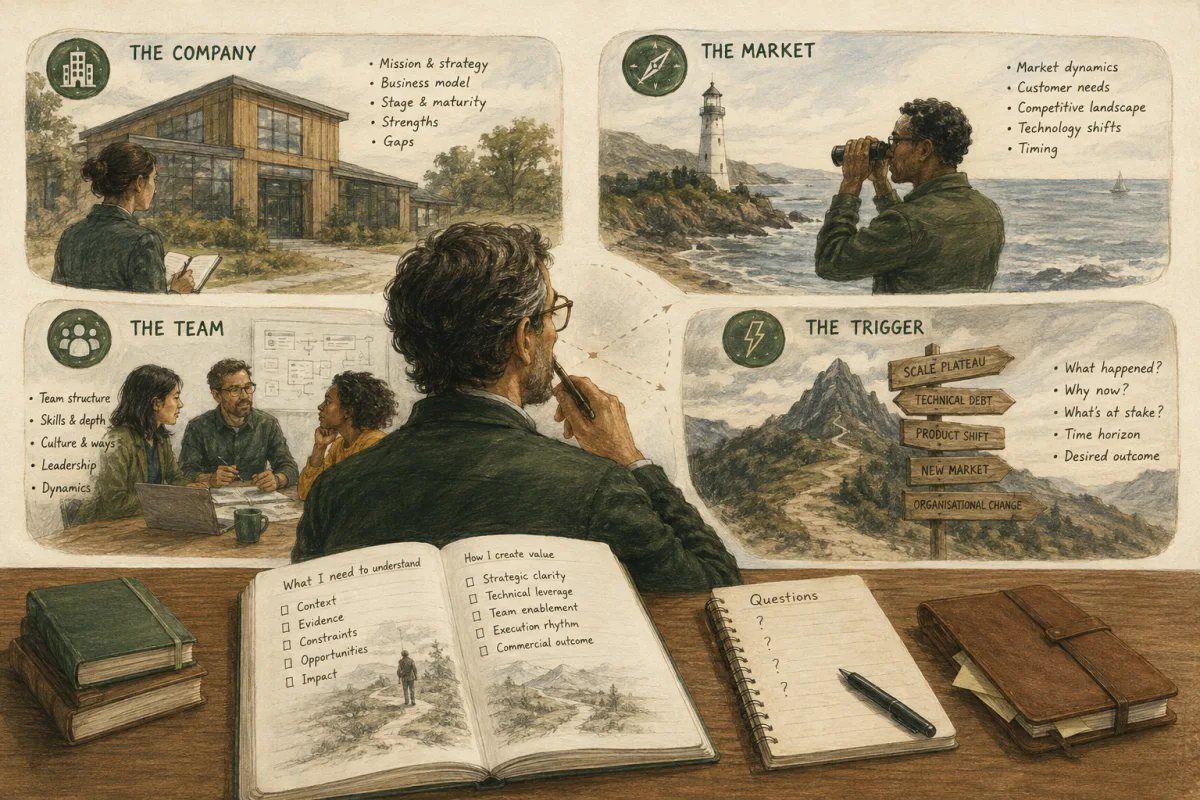
Do not use invasive personal data, confidential sources, or speculative claims. Turn public information into questions:
“The company is moving toward enterprise customers. Which platform, security, and operating commitments are already affecting sales?”
This shows preparation without presenting inference as fact.
Build an evidence portfolio
Prepare three to five stories covering the mandate. For each:
- context and business outcome;
- evidence known at the time;
- uncertainty;
- real options;
- decision you personally owned;
- trade-offs and opposition;
- result and attribution boundary;
- what failed or changed;
- internal capability left behind;
- reference.

Keep stories concise, then let the interviewer choose depth. Avoid memorized monologues. State confidential boundaries rather than becoming vague: “I cannot name the client or disclose the transaction value, but I can explain the decision process and provide an approved reference.”
Use “I” and “we” accurately. Buyers need personal ownership and evidence that you can work through a team.
Prepare for scenario questions
Likely scenarios include:
- the CEO wants a rewrite while delivery is already late;
- a strategic customer requests a risky commitment;
- an engineering leader resists executive oversight;
- the board asks whether technical debt threatens the plan;
- an incident occurs outside your scheduled day;
- the company cannot provide the data needed for a recommendation;
- an investor asks for certainty that evidence does not support;
- the role scope expands without more capacity.
Think aloud. Clarify assumptions, stakeholders, decision rights, immediate containment, evidence, options, and review. Do not race to display a favorite architecture.
Qualify the mandate
Ask the sponsor:
- Why is the search happening now?
- What must be observably different after 90 days?
- Which decisions are currently unowned?
- Who is the executive sponsor?
- Who operates between fractional days?
- What authority can the CTO receive?
- Which evidence and systems will be accessible?
- What has been tried?
- Which budget exists for implementation and specialists?
- What capacity, time zones, travel, and incident access are expected?
- Which conflicts matter?
- What would make this interim or permanent work?

The interview is not successful if you win an impossible mandate.
Understand the stakeholder map
Ask to meet the people whose work and authority intersect the role: CEO, product, engineering, finance, security, operations, board sponsor, or investor. You do not need a long process, but a single sponsor’s version may hide important disagreement.
Observe:
- whether leaders describe the same outcome;
- who can decide;
- where conflict lives;
- whether the internal team expects help or replacement;
- whether technology is blamed for a product or commercial problem;
- whether the company can hear unwelcome evidence.
Do not triangulate or promise different things to each stakeholder. Summarize differences openly.
Discuss commercial fit after product clarity
Confirm a plausible budget range early enough to avoid wasted work. Final economics should follow:
- advisory, fractional, interim, or project model;
- expected capacity;
- meeting and async load;
- direct people management;
- incident expectations;
- travel and time zones;
- risk and specialist scarcity;
- duration and cancellation;
- deliverables and dependencies.
Do not negotiate by reducing price while preserving every expectation. Offer a narrower outcome, longer timeline, stronger internal owner, or different model.
Be ready to explain why a retainer differs from hourly advice. State overage and change-review principles without turning the interview into contract negotiation.
Handle questions about failure
Prepare a real failure. Explain:
- what you believed;
- why it seemed reasonable;
- which signal you missed;
- customer or team impact;
- how you responded;
- what changed in your decision system.
Avoid a disguised strength such as “I cared too much.” Avoid blaming the team. Executive trust increases when you can be accountable without performing shame.
Prepare references
Ask permission before sharing details. Match references to the mandate:
- CEO or board member for executive judgment;
- engineering or product leader for operating collaboration;
- customer or business leader for cross-functional impact;
- investor for transaction or portfolio work.
Tell the reference what role is being considered, but never script praise. A platform or buyer should protect contact information and obtain consent before contact.
Recognize red flags
Pause when:
- no one can state the outcome;
- the title is used for fundraising appearance;
- authority remains entirely with a disengaged sponsor;
- expectations imply full-time availability at fractional capacity;
- payment depends wholly on uncertain equity;
- the company asks you to misrepresent compliance, security, traction, or evidence;
- access is withheld but guarantees are expected;
- the client expects you to replace an employee without a truthful process;
- every issue is blamed on current engineers;
- contract, data, or conflict questions are dismissed as bureaucracy.
Declining can protect both parties.
A practical preparation schedule
Prepare around decisions you may need to discuss, not an exhaustive dossier on the business. The schedule below is a suggested allocation for a normal first interview. Adjust it to the actual mandate and material supplied; a transaction, regulated product, or inherited incident may require a separate paid assessment.
| Preparation block | What to produce | Stop condition |
|---|---|---|
| Public business research | One paragraph on the trigger and three hypotheses | You can distinguish observed facts from questions |
| Evidence selection | Three relevant decision stories | Each has personal ownership and a limitation |
| Mandate qualification | Five questions that could change your willingness to accept | The questions cover authority and operating capacity |
| Commercial boundaries | A capacity range and explicit exclusions | You can explain what changes if scope expands |
| Rehearsal | A concise opening and one scenario walkthrough | You can stop talking and invite investigation |
Begin with the information the company supplied. If the brief says the immediate problem is engineering management, do not spend most of your preparation researching a speculative AI strategy. Read public product material, customer-facing commitments, and relevant leadership information. Note what you cannot learn publicly. A technology logo on a careers page does not establish the current architecture or the cause of a delivery problem.
Create a two-column note headed “observed” and “to validate.” An observed fact might be a public enterprise product launch. The corresponding question might be whether that launch has changed security reviews, service commitments, or integration demand. Keep dates and source links in your private notes so that you do not accidentally describe old information as current.
Finish preparation by choosing what to leave out. A long presentation can prevent the interviewer from investigating the evidence they care about. Have supporting details available, but lead with a short account of your relevant operating experience and the questions you need to resolve.
Answer “tell us about yourself” through mandate relevance
Your opening should connect experience to this company's decision without claiming a diagnosis. A useful structure is current working model, relevant situations, evidence of personal ownership, and the fit you want to test. Avoid walking through every employer in chronological order unless asked.
Here is an illustrative answer structure, not a biography to copy as your own:
“I work with companies that need senior technology decisions while retaining day-to-day engineering ownership internally. The most relevant part of my background for this brief is leading through an inherited delivery problem and then transferring the operating cadence to an internal manager. I can explain the decisions I owned, what did not work, and how the handover was tested. I would like to understand whether your immediate need is that kind of operating leadership or a more intensive interim role.”
Replace every experience claim with something true and supportable. If you have not held a fractional engagement before, say so and explain which parts of your employed leadership experience transfer. Then address the new constraint directly: how you will protect availability, avoid conflicts, and operate through an internal owner when you are absent.
A good opening gives the interviewer several directions to investigate. It does not try to close the sale before the mandate is understood. If they ask for a technical example, move into one concrete decision rather than repeating the positioning statement.
Work through an ambiguous rewrite scenario
Consider this practice prompt: “Our platform is slow, the team misses dates, and the CEO wants a rewrite. What would you do?” This is an interview exercise, not a diagnosis of a real company. An immediate yes or no may sound decisive, but it skips the information needed for a responsible recommendation.
Start by clarifying what slow means. Is the problem customer response time, developer lead time, deployment frequency, or the time required to change a business rule? Ask which customers or workflows are affected, what has been measured, and what deadline or business event makes the decision urgent. You are separating symptoms that could have different causes.
Next identify immediate exposure. If customers cannot complete a critical transaction, containment may need to precede a broad architecture review. If the system works but future changes are expensive, the decision horizon may allow a narrower investigation. State what you would protect while learning: existing customer commitments, access to operational evidence, and the team's ability to maintain the current service.
Then compare a small set of options. Those might include targeted performance work, removing a delivery bottleneck, replacing one component, or a larger migration. Explain what evidence would favor each option and what would make you reject it. Do not invent cost or schedule estimates without a basis. Offer a way to obtain the missing evidence, such as a bounded investigation with a decision review.
Close with ownership and a review trigger. Identify who will approve investment, who will run implementation, and what observation would change the recommendation. The interviewer can now assess your reasoning even if neither of you knows the final technical answer. For more detailed buyer-side probes, review the fractional CTO interview questions.
Show your actual capacity with a sample operating week
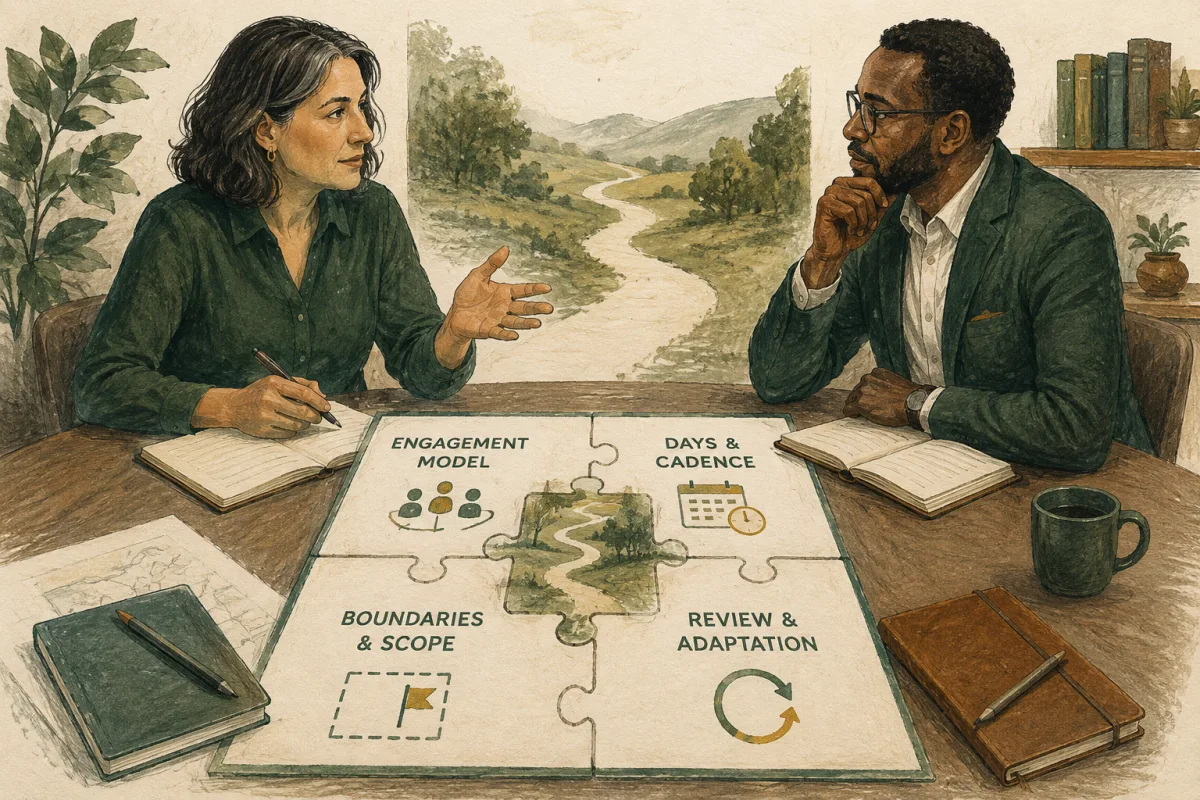
Fractional availability is easier to evaluate when expressed as a calendar and decision process. Prepare a representative week using your real capacity. Do not disclose confidential client names or pretend that tentative availability is committed.
For example, a hypothetical two-day engagement might reserve one block for the leadership review and architecture decisions, another for engineering coaching and roadmap work, and a defined asynchronous review window. Meetings, preparation, documentation, and follow-up all consume the agreed capacity. Two visible meeting days plus unlimited invisible work is not a coherent model.
Explain who acts between those blocks. The company may need an engineering manager to run delivery, an incident lead to coordinate urgent response, and an executive sponsor to resolve commercial tradeoffs. If those owners do not exist, acknowledge the additional demand instead of assuming that a fractional title solves it.
Discuss a collision scenario explicitly: two clients need an urgent decision at the same time. Explain the boundaries, escalation route, and coverage you can actually provide. A credible answer might reveal that your current portfolio cannot support the proposed response expectation. That is useful information before either party commits.
Prepare a concise follow-up note
A follow-up should make the next decision easier. It should not quietly expand a discovery conversation into an unpriced strategic engagement. Use the following outline as a drafting aid and adapt it to what was actually discussed.
Understanding: “My understanding is that the immediate priority is restoring confidence in release commitments while preserving the current customer roadmap.”
Uncertainty: “We have not yet established whether the main constraint is work intake, management capacity, architecture, or interruption from incidents.”
Proposed next step: “A bounded assessment could produce an agreed problem statement, options, and a recommended operating mandate. Its scope would depend on access to the delivery history and the relevant team leads.”
Working fit: “The cadence discussed appears plausible if an internal owner runs day-to-day delivery. Incident coverage and decision authority remain open.”
These sentences are illustrative, not claims about a prospective client. Replace them with the actual facts, avoid promises made by implication, and give the sponsor an opportunity to correct your understanding. If there is no fit, a brief explanation is more useful than a proposal you cannot responsibly deliver.
Check the interview logistics before the meeting
Confirm the attendees, expected duration, format, and whether the company wants slides or a conversation. For a remote session, check your microphone, connection, and screen-sharing setup. Keep any shareable artifacts in a separate folder so that confidential client names, browser tabs, notifications, or calendar details are not exposed accidentally.
Prepare a short version of each example in case the agenda changes. Have your availability and unanswered mandate questions to hand, but avoid reading a script. If the company introduces a stakeholder with a different view of the role, use that information to clarify the mandate rather than defending an assumption from the original brief.
After the meeting, record what changed your view of the opportunity while the details are fresh. Separate firm commitments from suggestions and identify anything that requires confirmation before a proposal. This small discipline helps prevent an enthusiastic conversation from becoming a scope promise neither party intended.
Questions candidates commonly ask
How technical should my answers be?
Go deep enough to make the decision and its consequences inspectable. A technical interviewer may ask about failure modes, migration sequencing, or architecture constraints. A founder may need the same reasoning translated into customer risk, budget, and delivery choices. Explain acronyms and check whether the interviewer wants more detail. Neither jargon nor oversimplification demonstrates executive judgment by itself.
Should I bring a 30-, 60-, and 90-day plan?
Bring a provisional learning and decision sequence, with assumptions clearly marked. The first month might establish evidence and ownership; later stages depend on what is found. Do not prescribe a reorganization, hiring plan, or platform replacement before the facts support it. A plan should show how you will reach decisions, not create false certainty about their outcome.
How do I discuss rates without underpricing the role?
Relate the commercial model to the required capacity and responsibility. Clarify meeting load, asynchronous work, travel, response windows, and implementation ownership. If the budget is lower than the proposed scope, change the scope or operating model explicitly. The pricing guide provides a framework for comparing assumptions rather than treating every retainer as equivalent.
What should I do when I do not know an answer?
State the boundary and describe how you would investigate it. You can distinguish a domain requiring specialist advice from a decision you can own with more evidence. Avoid bluffing about regulatory interpretation, security assurance, or unfamiliar systems. The interviewer needs to understand your judgment and your escalation process, not believe that one executive can personally cover every specialty.
Can I use AI to prepare?
You can use an assistant to organize public research or rehearse questions, while checking its claims against sources and your own experience. Do not upload confidential client documents or personal reference details without appropriate authorization and controls. Never turn an invented example into a personal achievement. During an interview, agree any recording, transcription, or assistance with the participants rather than making assumptions about consent.
Send a decision-focused follow-up
Within a day, send:
- your understanding of the business condition;
- proposed 90-day outcome;
- important assumptions and unknowns;
- likely model and capacity;
- requested evidence or stakeholder;
- open commercial question;
- next step.

Do not send a full unpaid strategy. Give enough structure to confirm alignment, then price discovery where significant analysis is required.
The best candidate is not the person with an instant answer to everything. It is the executive who can make context, evidence, trade-offs, authority, and uncertainty visible—and who can say when the mandate should belong to someone else.
Frequently asked questions
How should I prepare for a fractional CTO interview?
Research the business event, prepare evidence from comparable decisions, understand your availability and conflicts, define questions about authority and capacity, and be ready to distinguish facts, assumptions, and unknowns.
What examples should a fractional CTO bring?
Bring three to five decision stories relevant to the mandate: context, evidence, alternatives, personal ownership, trade-off, result, learning, transition, and a reference who can verify appropriate details.
When should compensation be discussed?
Confirm early that the budget and model are plausible, but define the operating product before final price. Scope, authority, capacity, access, risk, and duration drive economics.
What questions should a candidate ask the CEO?
Ask why now, what must change, what evidence exists, who owns the budget, which decisions are available, what internal capacity exists, how conflict is handled, and what the company expects after 90 days.
Sources and further reading
Next useful move
Build your free evidence-led executive profile.
Executives never pay to appear or rank. Keep your availability current, create job alerts, and track applications in one workspace.