
CTO fundamentals
CTO Meaning, Role and Responsibilities: A Practical Guide
What does a CTO do? Understand the full title, responsibilities, CEO and CIO boundaries, skills, first-90-day priorities and ways to evaluate the role.
- By
- Fractional CTO Experts
- Published
- 2026-07-30
- Reviewed
- 2026-09-09
- Reading time
- 14 minutes

The chief technology officer owns the company-level choices that connect technology with business strategy, products, customers, capital, risk, and organization capability. The title is not standardized. A ten-person startup, global bank, biotech platform, and private-equity turnaround may all hire a CTO for different work.
Define the role from context and decisions before copying a responsibility list.
- What does CTO stand for?
- The role changes with the company
- Technology strategy and capital
- Architecture and platform direction
- Organization and leadership
- Product and customer interface
- Security, resilience, data, and AI
- Executive interfaces
- CTO versus CIO, CISO, and VP Engineering
- How technical should the CTO remain?
- Build a balanced scorecard
- Write the mandate before hiring
- What does a CTO do in an ordinary week?
- Use a responsibility matrix to prevent title confusion
- CTO versus CEO: technology leadership within company leadership
- CTO versus a technical lead or software architect
- Skills that matter beyond technical knowledge
- A practical first-90-days agenda
- How to evaluate CTO performance fairly
- Questions people ask about the CTO role
- Publish a role charter after hiring
- What is an office of the CTO?
What does CTO stand for?
In a business leadership context, CTO usually stands for Chief Technology Officer. The CTO is the executive responsible for important technology choices and their consequences for the company. Some organisations use Chief Technical Officer; the exact title and responsibilities should be checked in that organisation's role description.
The abbreviation alone does not establish the reporting line, budget, team size or decision authority. In a small software company, the CTO may build the product directly. In a larger organisation, the role may concentrate on technology direction, platforms, research or external customer relationships. A useful definition therefore includes both the title and the company's operating context.
The U.S. Bureau of Labor Statistics overview of computer and information systems managers includes CTO among titles that vary with organisational structure. Its occupation-wide pay and employment data cover a broader group than CTOs alone, so they should not be presented as a specific CTO salary benchmark.
The role changes with the company
Startup CTO
May combine product discovery, architecture, hands-on building, hiring, customer conversations, and fundraising. The danger is remaining the primary developer after leadership work becomes the constraint.
Scale-up CTO
Often owns platform investment, engineering leadership, enterprise readiness, reliability, security, data, and the transition from founder-led decisions to a repeatable organization.
Enterprise CTO
May focus on technology strategy, standards, platforms, innovation, architecture governance, and external technology relationships while CIO and business technology leaders run large operating portfolios.
Turnaround or interim CTO
Prioritizes continuity, risk containment, decision clarity, organization reset, transaction milestones, and permanent transition.

The job description should state which context applies and what event made the role necessary.
Technology strategy and capital
The CTO translates the company plan into a technology investment thesis:
- which capabilities create or protect value;
- which constraints threaten the plan;
- which options should remain open;
- what the company should build, buy, partner for, or stop;
- how investment is sequenced;
- which evidence changes the plan;
- how trade-offs reach the executive team and board.
Strategy is not a target architecture diagram. It is a set of choices under constraints.
Architecture and platform direction
The CTO creates the context for technical decisions:
- architecture principles;
- major platform and data choices;
- technology lifecycle and modernization;
- integration and ecosystem boundaries;
- scalability, reliability, security, and cost;
- technical debt investment;
- exception and review routes.
They should not approve every design. Senior engineers need delegated authority. The CTO owns the coherence and business consequences of the portfolio.
Organization and leadership
Responsibilities may include:
- organization design;
- leadership hiring and succession;
- manager and technical-leader coaching;
- role clarity across product, engineering, data, security, and IT;
- workforce and vendor strategy;
- performance and compensation decisions;
- culture, standards, and sustainable pace;
- critical-skill and key-person risk.
The CTO’s output is partly an organization able to decide and deliver without constant executive intervention.
Product and customer interface
In technology products, the CTO may:
- contribute to product strategy;
- assess feasibility and sequencing;
- join important customer and partner conversations;
- govern technical commitments;
- connect support and operational evidence to roadmap decisions;
- explain platform and security posture;
- shape ecosystem and developer strategy.
They should not replace accountable product leadership. Define whether product reports to the CTO or works as a peer.
Security, resilience, data, and AI
The CTO ensures these risks have appropriate executive ownership and specialists:
- security and privacy strategy;
- customer assurance;
- service objectives and recovery;
- incident preparedness;
- data rights, quality, governance, and platforms;
- AI opportunity, evaluation, safety, cost, and oversight;
- regulatory and compliance collaboration;
- third-party technology risk.
The CTO is not automatically the CISO, privacy officer, lawyer, or model-risk specialist. They must know when independent expertise and authority are required.
Executive interfaces
With the CEO, the CTO aligns company strategy, risk, investment, and leadership.
With product, they connect customer outcomes, feasibility, platform options, and learning.
With finance, they make technology economics, capital, vendors, cloud, and hiring visible.
With sales and customer success, they govern promises, enterprise evidence, integrations, and feedback.
With the board, they present decisions, material risk, investment, capability, and uncertainty—not tool-level activity.
Poor interfaces create shadow decisions: sales sells architecture, finance cuts capacity without outcome context, or engineering makes product strategy by default.
CTO versus CIO, CISO, and VP Engineering
Common boundaries:
- CIO: enterprise systems, information, internal technology services, governance, and transformation;
- CISO: security risk and program leadership;
- VP Engineering: engineering organization, managers, delivery, and operations;
- CTO: company-level product/platform technology strategy, future capability, and connected executive decisions.
Actual structure depends on the business. A company may combine roles while small and separate them as workload and independence needs grow.
How technical should the CTO remain?
The CTO must evaluate architecture reasoning, understand system and security evidence, ask credible questions, and earn technical trust. Writing production code can help in a small company. It can also become avoidance.
As the organization grows, the CTO creates leverage through leaders, systems, and decisions. Track whether hands-on work is the highest-value use of executive capacity or work that should transfer.
Build a balanced scorecard
Possible measures:
- company outcomes enabled or protected;
- technology investment against strategy;
- roadmap outcome evidence;
- delivery flow and predictability;
- customer-impact reliability;
- security and control evidence;
- platform and support economics;
- team capability, retention, and succession;
- decision speed and quality;
- reduction in unowned material risk.
Do not attribute revenue or valuation to one executive without evidence. Do not measure only output volume or uptime. Use a coherent set and narrative.
Write the mandate before hiring
State:
- company context and trigger;
- observable 12-month result;
- first 90-day decisions;
- reporting line and executive interfaces;
- team and budget;
- authority;
- material constraints and risks;
- location and access;
- success evidence;
- why fractional, interim, or permanent capacity fits.
Then interview candidates with the same scorecard. A title at another company does not prove fit for this job.
The CTO role is successful when the company can make and execute better technology decisions in service of its strategy—and when that capability becomes an organizational property rather than the personal heroism of one executive.
What does a CTO do in an ordinary week?
The work usually combines decisions about the future with attention to current operating conditions. A CTO might review an architecture tradeoff, discuss a product commitment with sales, coach an engineering leader and prepare a technology investment decision for the executive team. The mix should follow the mandate rather than a generic calendar template.
Consider an illustrative software-company CTO whose next quarter includes a major customer integration and a growing engineering team. One part of the week may focus on whether the integration should use an existing interface or require a new capability. Another may focus on whether team leaders have the authority and skills to deliver it. Customer conversations help clarify the actual requirement, while a financial review establishes the capacity available.
Operational incidents can change the schedule. The CTO should ensure that response ownership is clear and that major lessons reach the appropriate decision process. They need not personally diagnose every error. If routine incidents repeatedly consume all executive attention, the organisation may need stronger operational ownership, simpler systems or a different allocation of work.
A productive week leaves decisions clearer and the organisation better able to act. A large number of meetings is not evidence of that result. Review which decisions were made, what changed as a consequence and which uncertainties still need investigation.
Use a responsibility matrix to prevent title confusion
The following matrix is an example of how a software company might divide responsibilities. It is a starting point for a conversation, not a universal organisation chart. Some companies combine these roles; others use different titles entirely.

| Decision or activity | Example accountable role | CTO contribution |
|---|---|---|
| Company strategy and major capital allocation | CEO with the appropriate governance body | Explain technology options, constraints and consequences |
| Product priorities and customer outcomes | Product leader | Assess feasibility, platform implications and sequencing |
| Engineering team execution | VP Engineering or engineering leader | Set technical direction and resolve executive tradeoffs |
| Enterprise information systems | CIO or IT leader | Coordinate shared technology dependencies |
| Security programme and specialist risk advice | CISO or security leader | Ensure product and platform decisions address relevant risks |
| Major platform architecture | CTO with delegated technical leaders | Own coherence, decision boundaries and business rationale |
For each row, agree how disagreements are resolved and which decisions require escalation. Avoid assigning several people as equally accountable without explaining how a final choice is made. Collaboration works better when participants understand both their contribution and the limits of their authority.
The matrix should also make delegation visible. A senior engineer should be able to make ordinary design decisions within agreed principles. The CTO becomes a bottleneck when every reversible technical choice requires executive approval. Reserve the executive role for decisions whose consequences, dependencies or uncertainty justify it.
CTO versus CEO: technology leadership within company leadership
The CEO is responsible for the overall direction and operation of the company within its governance structure. The CTO contributes technology judgment to that broader responsibility and may own a substantial operating function. A CTO's technical expertise does not automatically grant authority over every commercial or product decision.

A healthy relationship makes tradeoffs explicit. If the CEO wants to enter a new market, the CTO should explain what the technology can support, what must change and which assumptions need evidence. The CEO and relevant leaders then decide how that fits the company's priorities and constraints. The CTO should not simply veto the goal or agree to an unsupported delivery promise.
The reverse matters too. A CEO should not expect the CTO to be accountable for outcomes while removing the ability to influence scope, staffing or platform investment. Agree the mandate, resources and escalation process. Revisit that agreement when the company changes its strategy or the operating conditions change materially.
CTO versus a technical lead or software architect
A technical lead usually concentrates on the technical work of a team or delivery area. A software architect focuses on system design, interfaces and qualities such as reliability or maintainability. Both may have deep technical expertise without holding company-level executive responsibility.
The CTO connects those technical choices to the organisation's business direction, people, investment and risk. They may perform architecture or hands-on leadership work in a small company, but the executive responsibility remains broader. The important distinction is the level of accountability, not whether the person writes code.
For example, an architect might compare database designs and explain their tradeoffs. The CTO may need to decide how much uncertainty the company can accept, whether migration should happen now and what other work must be deferred to fund it. That decision requires input from engineering, product, operations and finance.
Hiring a technical lead when the company needs executive coordination can leave important decisions unowned. Hiring a CTO when the main gap is daily implementation can leave the team short of building capacity. Describe the missing work before choosing the seniority of the appointment.
Skills that matter beyond technical knowledge
A CTO needs enough technical depth to assess reasoning, identify weak evidence and understand consequential tradeoffs. They also need to communicate those tradeoffs clearly to people who are not specialists. Translating a reliability concern into a customer or operating consequence is often more useful than presenting a list of technologies.
Organisational judgment matters because technical plans depend on people. The CTO must recognise when the team needs a clearer boundary, a stronger manager, a specialist or a simpler scope. They should develop leaders who can make good decisions independently rather than making personal availability the main coordination mechanism.
Commercial understanding helps the CTO distinguish an attractive technical idea from a useful investment. That includes asking how the company earns revenue, what customers value, which commitments create risk and which constraints the budget imposes. It does not require pretending to be the CFO or making unsupported financial forecasts.
The ability to revise a view is equally important. A candidate who can explain when evidence changed their architecture or staffing decision may demonstrate more useful judgment than one who describes every past project as an obvious success. Ask about uncertainty, disagreement and decisions to stop work.
A practical first-90-days agenda
During the initial period, establish the operating picture before making broad promises. Meet the people who own the product, engineering, customers, finance and relevant risks. Inspect representative work and service evidence. Identify which decisions are urgent and which require further context.
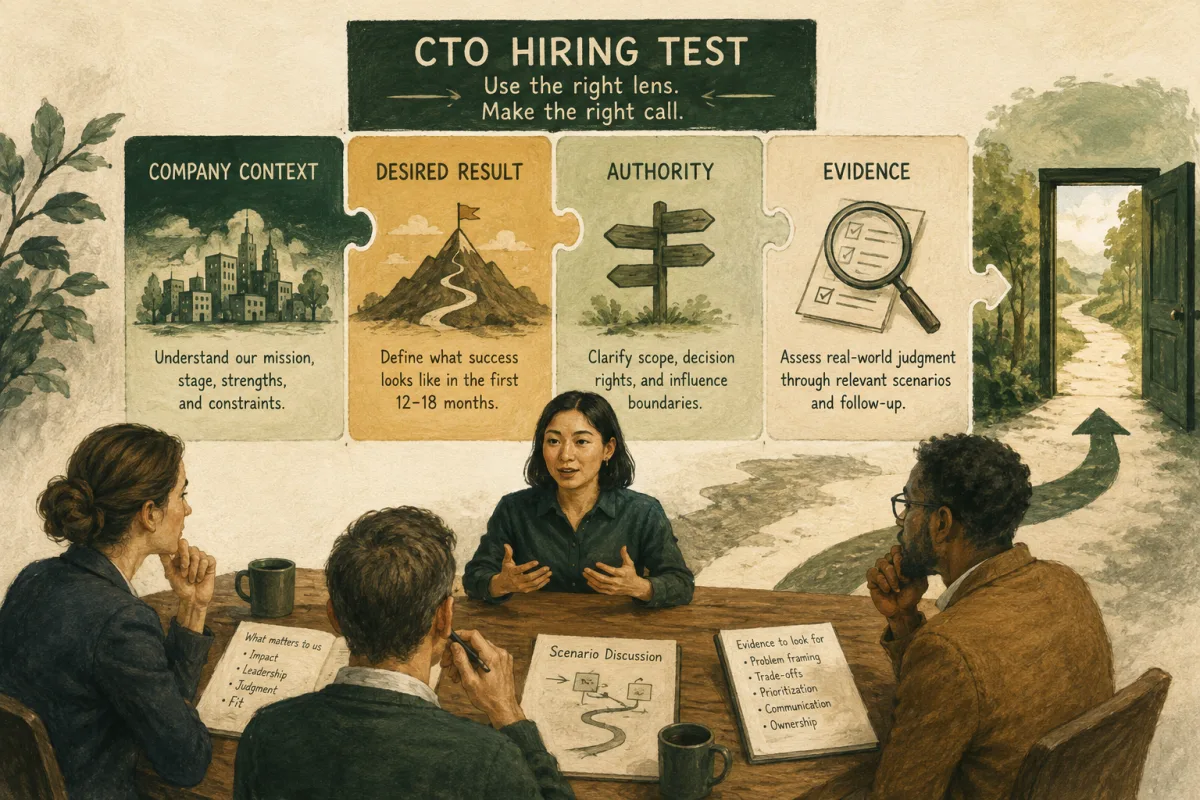
Next, align the leadership team on the mandate. Write the most important outcomes, the decision boundaries and the resources available. A CTO hired to improve delivery should clarify whether the main constraint is product uncertainty, team organisation, platform reliability or something else. Different diagnoses imply different actions.
Then select a small number of improvements that demonstrate how the organisation will work. That could be a clearer architecture decision process, a reliable customer-onboarding path or a more explicit delegation model. Choose work that addresses an observed constraint and can be evaluated with evidence.
At the end of the initial cycle, explain what has been learned and what should change in the plan. Avoid treating the first ninety days as a theatrical deadline for a complete transformation. The useful result is a credible operating direction supported by the people who must execute it.
How to evaluate CTO performance fairly
Begin with the agreed mandate and the conditions the executive could influence. Evaluate decisions, operating results and the capability left in the organisation. Include the quality of collaboration with other leaders because technology outcomes rarely belong to one function alone.

Use several complementary forms of evidence. Delivery measures can reveal how work moves; service measures show customer-impacting reliability; hiring and succession evidence show whether leadership capacity is improving. Each measure needs a definition and context. A higher deployment count is not automatically better if changes do not solve useful problems.
Inspect the treatment of uncertainty. Did the CTO identify an important risk early, explain the choices and obtain an appropriate decision? Did they update the plan when evidence changed? A good decision can still encounter an adverse outcome, while an unexamined gamble can sometimes appear successful. Review the reasoning as well as the result.
Avoid measuring the CTO only by personal technical output. As the organisation grows, success may involve other leaders making sound decisions without executive intervention. Conversely, delegation without support or oversight can leave serious gaps. The performance discussion should examine how accountability actually operates.
Questions people ask about the CTO role
Is a CTO higher than a CIO?
There is no universal hierarchy between CTO and CIO. They may be peers, one may report to the other, or the company may combine the responsibilities. Check the organisation chart, decision authority and actual scope. A title comparison without that context can be misleading.
Does every startup need a CTO?
Every startup needs appropriate ownership of its technology decisions, but not every startup immediately needs a separate full-time CTO position. The requirement depends on product complexity, technical differentiation, team capability and the frequency of consequential decisions. A technical founder, senior engineering leader or bounded external engagement may cover some stages; the arrangement should be explicit.
Does a CTO need to code?
Some CTO roles require substantial hands-on development, especially in small teams. Others require technical judgment and leadership without regular production coding. State the expectation in the role brief. A CTO who codes should still have time and support for the executive responsibilities the company expects them to own.
Is a technical cofounder automatically the CTO?
No. Founder status describes a relationship to the company's creation and ownership; CTO describes an operating role. A technical founder may hold that role, another role or no continuing executive position. The company should agree responsibilities and authority rather than relying on the founder label to settle every decision.
What qualifications are required to become a CTO?
Requirements vary by employer and industry. Demonstrated technical, organisational and business judgment is central to evaluating fit. Education and certifications may matter for a particular role, but no single course establishes readiness for every CTO mandate. Compare a candidate's actual responsibilities and verified experience with the work the company needs.
Can the CTO role be fractional?
Yes, when the recurring executive work fits part-time capacity and other people can operate and execute between engagements. A fractional arrangement needs clear scope, authority, ordinary availability and escalation boundaries. Use the fractional CTO definition guide to assess whether that model fits the company's operating needs.
Publish a role charter after hiring
The job description attracts candidates; the role charter aligns the operating team. During the first month, agree:
- decisions the CTO owns;
- decisions shared with CEO, product, CIO, CISO, and finance;
- delegated authority for engineering leaders;
- board and customer representation;
- budget and people thresholds;
- material risk escalation;
- measures and review cadence;
- conditions that change the role.
Share the charter with leaders affected by it. This reduces the quiet conflict that occurs when one person expects an architecture visionary, another expects a delivery manager, and the CTO believes product reports to them.
Review the charter after a funding round, acquisition, significant team growth, new regulatory exposure, or change in business model. A CTO can appear to fail when the company has changed the job without acknowledging it. Explicit role evolution makes performance, support, and succession fairer.
For reporting lines, shared ownership and hiring examples, use the CIO versus CTO comparison.
What is an office of the CTO?
An office of the CTO can describe a corporate technology leadership function or a named public-sector institution. The organisation and context matter. F5 publishes technical perspectives through its Office of the CTO, while the District of Columbia's OCTO is a government technology organisation. These examples should not be treated as interchangeable service models.
For a company considering a corporate office of the CTO, define the work before creating a new organisational layer. A proposed team might coordinate architecture decisions, investigate emerging capabilities or bring specialist input to a cross-product technology question. Specify what it can decide, what it can recommend and which delivery teams remain responsible for execution.
Use a concrete charter. Name the executive sponsor, the questions the team will address, the evidence it must produce and the route for resolving disagreements with product or engineering leaders. Set a review point for whether the function adds useful expertise or merely creates another approval queue. A smaller company may be better served by a clear CTO mandate and access to specialists than by a separate office with unclear authority.
When interpreting a candidate's experience, ask what their particular office did and what they personally owned. Membership of a CTO office does not automatically mean the person held the chief executive technology seat, controlled the engineering budget or managed the entire technology organisation.
Frequently asked questions
What are the main responsibilities of a CTO?
A CTO connects company strategy to technology investment, architecture, product and engineering capability, security and risk, data and AI choices, executive communication, and long-term organization design.
What is the difference between a CTO and CIO?
A common distinction is that a CTO focuses on technology behind products, platforms, and future capability, while a CIO focuses on enterprise systems, information, service delivery, and internal transformation. Real roles vary.
Does a CTO need to code?
They need enough technical judgment to evaluate evidence and lead decisions. Hands-on coding can fit small companies, but should not crowd out executive responsibilities as the organization grows.
How should a CTO be measured?
Use business and capability outcomes, technology investment quality, delivery and reliability, risk, customer trust, organization strength, and the quality and speed of consequential decisions.
Sources and further reading
Turn research into a mandate
See the cost and hiring model before you shortlist.
Use the free calculator, then save a candidate search or post a transparent role when the mandate is ready.