Data leadership
Fractional CDO: Mandate, First 90 Days and Hiring Scorecard
Decide whether you need a fractional chief data officer or a data engineer. Includes a mandate template, 90-day plan, cost model and hiring scorecard.
- By
- Fractional CTO Experts
- Published
- 2026-10-15
- Reviewed
- 2026-10-15
- Reading time
- 16 minutes
A fractional CDO is a chief data officer who works for your company part time, usually a few days a month. They own the data decisions nobody else owns: which numbers are official, who is responsible for each dataset, who can access what, and where data spending should go. Hire one when the problem is disagreement and missing ownership. When the problem is broken pipelines or a build backlog, you need a data engineer instead.
This guide covers how to tell those two needs apart, what to put in the mandate, a realistic first 90 days, and what evidence to ask candidates for. It also includes a cost model you fill in with your own quotes and a scorecard for comparing candidates. It does not quote market rates or client results. The examples are hypothetical, and they're labeled that way.
Which CDO? Chief data officer versus chief digital officer
The acronym is ambiguous, and the ambiguity causes real hiring mistakes. In this guide, CDO means chief data officer. Wikipedia's chief data officer entry describes the role as a corporate officer responsible for enterprise-wide governance and use of information as an asset. It notes that the same abbreviation is used for chief digital officer, a different role.
A chief digital officer usually leads digital channels, customer-facing digital products or a broader digital transformation program. A chief data officer usually leads data governance, data quality, analytics direction and the data platform strategy. The two can overlap in a company whose product is data, but the candidate pools, evidence and success measures are different.
Before you contact anyone, write one sentence that settles it. For example: "We are hiring a part-time chief data officer to own our metric definitions, data ownership model and data investment priorities." If a provider responds with a digital-marketing transformation proposal, you have learned something useful about their fit. Search terms add to the confusion too: "fractional chief data officer" and "fractional head of data" usually mean the data role, while "fractional CDO" on its own can mean either.
Do you need data leadership or a data engineer?
Most companies that search for data help have one of two problems, and they look similar from the executive team's seat. The first is an engineering problem: data arrives late, jobs fail, a dashboard breaks after a schema change, or a backlog of pipelines never gets built. The second is a leadership problem: the data arrives fine, but the finance and sales numbers disagree, nobody can say who owns a table, and every new report restarts the same argument about definitions.
A data engineer solves the first problem. If your pipelines are failing right now, start with the broken data pipeline recovery guide, which covers containment, backfills and reconciliation. If you need build capacity with clear acceptance checks, see the guide to hiring a data engineering consultant. A fractional CDO costs more per hour than you need for either job, and hiring one for pipeline work usually leaves them doing work that isn't theirs.
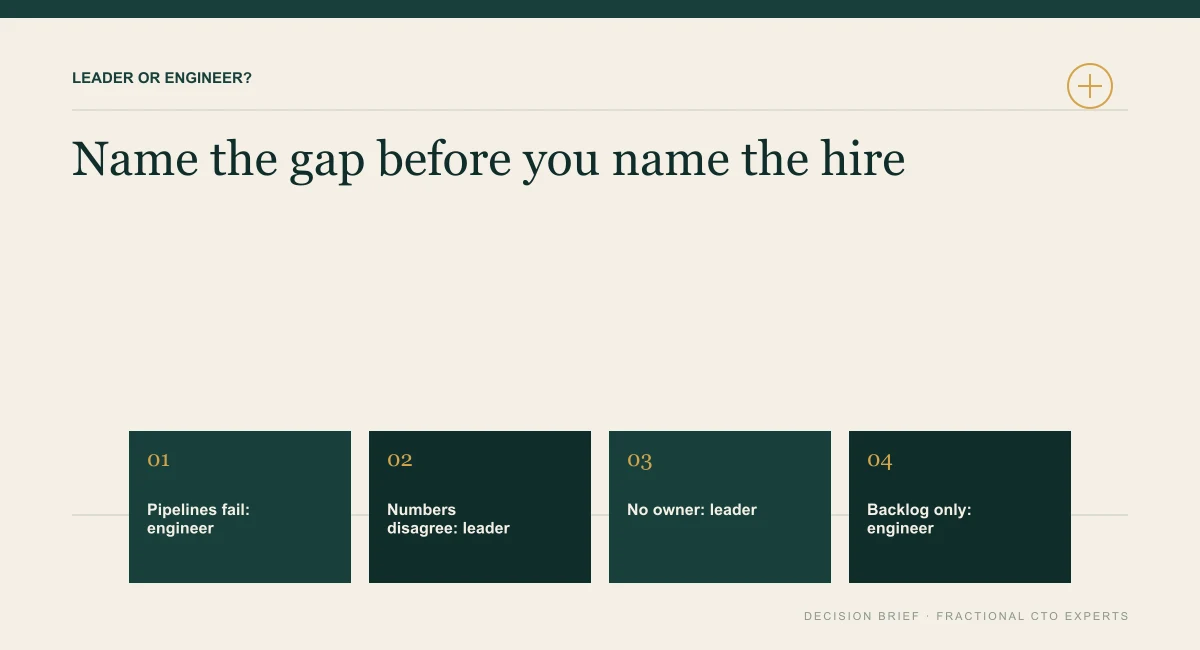
Use this table to sort your symptoms before you write a brief.
| Symptom you can observe | Likely gap | First hire to consider |
|---|---|---|
| Scheduled jobs fail or run late; reports are stale | Engineering reliability | Data engineer or consultant |
| A backlog of well-specified pipelines waits for capacity | Engineering capacity | Data engineer or consultant |
| Two teams report different revenue or customer counts from the "same" data | Metric ownership and definitions | Data leader (CDO or head of data) |
| Nobody can name the owner of an important dataset | Ownership model | Data leader |
| Access requests are approved ad hoc, or never reviewed | Governance | Data leader, working with security |
| The board asks what data investment will return, and nobody can answer | Strategy and prioritization | Data leader |
| Analysts spend most of their time rebuilding the same extracts | Mixed: platform and ownership | Often both, in that order: leader scopes, engineer builds |
| A regulator, auditor or enterprise customer asks how data is governed | Governance evidence | Data leader, with legal and security |
Two tests help with mixed cases. First, ask what would happen if you doubled engineering capacity tomorrow. If the arguments about definitions and ownership would continue at the same volume, the gap is leadership. Second, ask whether anyone has the authority to settle a definition dispute between two departments. If the answer is "the CEO, eventually," you are using your most expensive executive as an unpaid data governance function.
What a fractional chief data officer owns
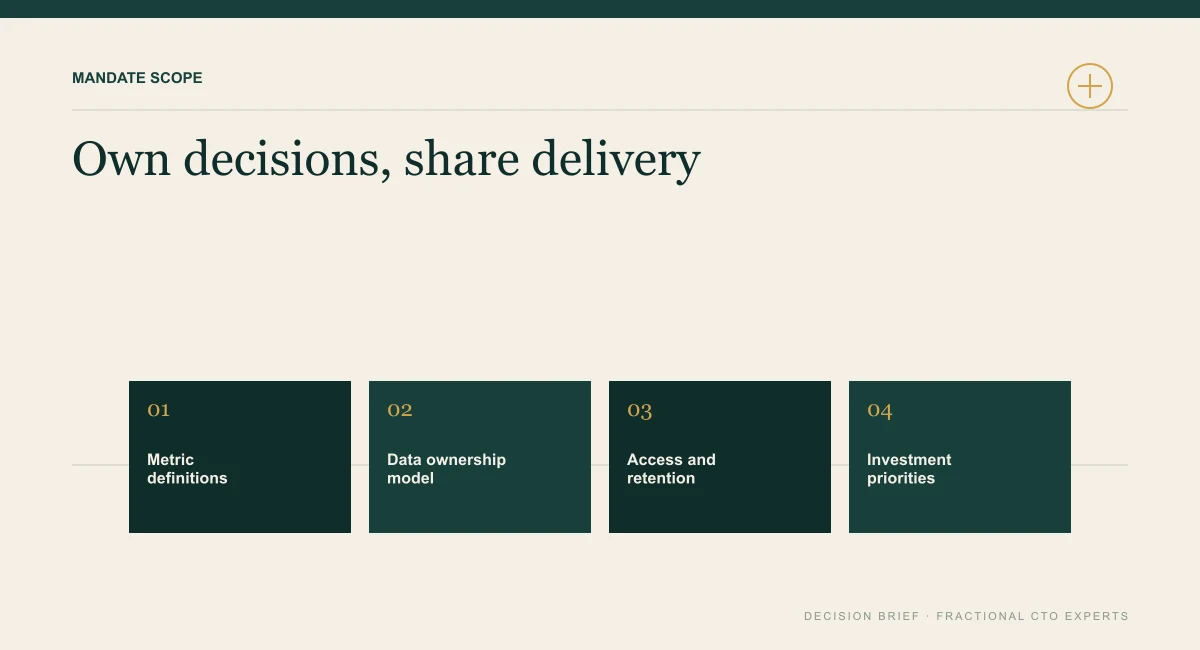
The mandate should list decisions, not activities. "Improve data culture" can't be tested. "Decide and publish the official definition of active customer, with named owners in finance and product" can. A useful fractional CDO mandate usually covers four decision areas.
- Metric definitions. The official definition of the numbers the company runs on, the source of record for each, and the process for changing a definition.
- Data ownership. A named business owner for each important dataset, with a clear split between the business owner who decides what the data means and the technical owner who keeps it running.
- Access, retention and quality policy. Who can see what, how long data is kept, and what quality standard each critical dataset must meet, set with security, legal and privacy colleagues.
- Investment priorities. Which data work gets funded, in what order, and what the company expects in return, stated in a form the executive team can challenge.
Just as important is what the CDO doesn't own. The boundaries with neighboring roles need to be written down.
| Neighboring role | What they typically keep | Boundary to agree with the CDO |
|---|---|---|
| CTO or head of engineering | Architecture, platform engineering, engineering management | Who approves changes to the data platform, and who staffs data engineering work |
| CIO | Internal systems, IT operations and business applications | Who owns data held in business systems such as the CRM and ERP; see the fractional CIO guide for that role's scope |
| CISO | Security controls, access enforcement, incident response | The CDO sets access policy with security; the fractional CISO or security lead enforces and monitors it |
| Data protection officer (where required) | Independent privacy oversight | Whether combining roles creates a conflict of interests (see below) |
| Finance | Financial reporting and its controls | Which metric definitions finance must approve before they change |
| Product leadership | Product analytics questions and experiments | Who owns event definitions and product metrics |
A note on privacy roles. Under GDPR Article 37, some organizations must designate a data protection officer, and the DPO may be a staff member or work under a service contract. Article 38 says the DPO must not receive instructions about how they carry out their tasks and that any other duties must not create a conflict of interests. A CDO whose job is to expand how data is used may not be the right person to oversee that use independently. This guide does not give legal advice. If GDPR applies to you, ask privacy counsel before combining the two roles.
If your data work includes machine learning or generative AI, add model and training-data questions to the mandate or link it to an existing owner. The AI governance consulting guide covers that territory. A CDO who owns the underlying data should know who decides what data may be used to train or prompt a model.
Fractional head of data versus fractional CDO
Titles are inconsistent across companies, so compare the decisions rather than the words. In many smaller companies, "head of data" means the leader of a data and analytics team: they hire and manage analysts and engineers, run the team's roadmap and deliver the reporting the business needs. "Chief data officer" usually implies a cross-company remit: setting definitions and policies that other departments must follow, and reporting to the CEO, COO or CFO.
A company with a data team of three and one set of disputed metrics may need a fractional head of data with a narrow governance remit. A company with several business units, regulated data or a board asking about data strategy may need the broader CDO mandate even if the internal data team is small. Pick the title that matches the authority you are actually delegating. A grand title with no authority is a common reason these appointments fail.
Why data leadership mandates fail
The failure pattern is well documented for full-time CDOs, and a part-time CDO carries the same risks with fewer hours to fix them. MIT Sloan's 2022 report on CDO tenure cites an average tenure of about 2.5 years, drawing on research by Randy Bean and Tom Davenport. It says an unclear role definition is a central cause. The article puts the core difficulty plainly: when you create a CDO role for the first time, you're "carving off an area of responsibility from someone else" without clear boundaries.
A fractional arrangement adds its own risks:
- Authority without presence. The CDO sets a definition on Tuesday and isn't there on Thursday when a department ignores it. Fix this by naming an internal deputy who enforces decisions between visits.
- Strategy with no delivery capacity. A data strategy that assumes engineering hours nobody has approved is just a wish list. Tie every priority to named capacity.
- Undocumented judgment. If the reasoning behind a decision lives only in the fractional leader's head, the company loses it when the engagement ends. Require a decision log from week one.
- Scope creep into hands-on work. When the analytics backlog is long, a capable data leader gets pulled into building dashboards. That feels productive, but the governance work stops.
Each of these has a matching clause in the mandate template below.
A mandate template you can adapt
Copy this into your brief and replace the bracketed text. It is a starting structure, not legal contract language. Put the commercial terms in a proper agreement; the fractional CTO contract guide covers clauses that also apply to data leadership engagements.
Role: Fractional chief data officer (chief data officer, not chief digital officer).
Reports to: [CEO / COO / CFO]. Internal deputy: [name, role], who holds decisions between sessions.
Allocation: [number] days per month, including [number] fixed working sessions. Response window for urgent decisions: [for example, one business day].
Decisions owned:
- Official definitions for [list of metrics, for example: revenue, active customer, churn].
- The dataset ownership register: a named business owner and technical owner for [list of critical datasets].
- Data access and retention policy, approved jointly with [security lead] and [legal or privacy lead].
- A ranked data investment plan for the next [two] quarters.
Decisions shared (CDO recommends, [named role] approves): data platform changes, new data vendors, data hires.
Explicitly out of scope: building pipelines, day-to-day dashboard requests, security enforcement, [DPO duties, if applicable].
Evidence of progress at day 90: see the 90-day plan below; each item has an observable output.
Records: a decision log, the ownership register and the metric dictionary, kept in [company system], owned by the company.
Exit: [notice period]; a two-week handover with a walkthrough of all records to [named successor or deputy].
The first 90 days
A good first 90 days moves from inventory to decisions to a working rhythm. It avoids the common trap of producing a long strategy document in month two that nobody acts on. The outputs below are observable, so you can check them without taking anyone's word for progress.
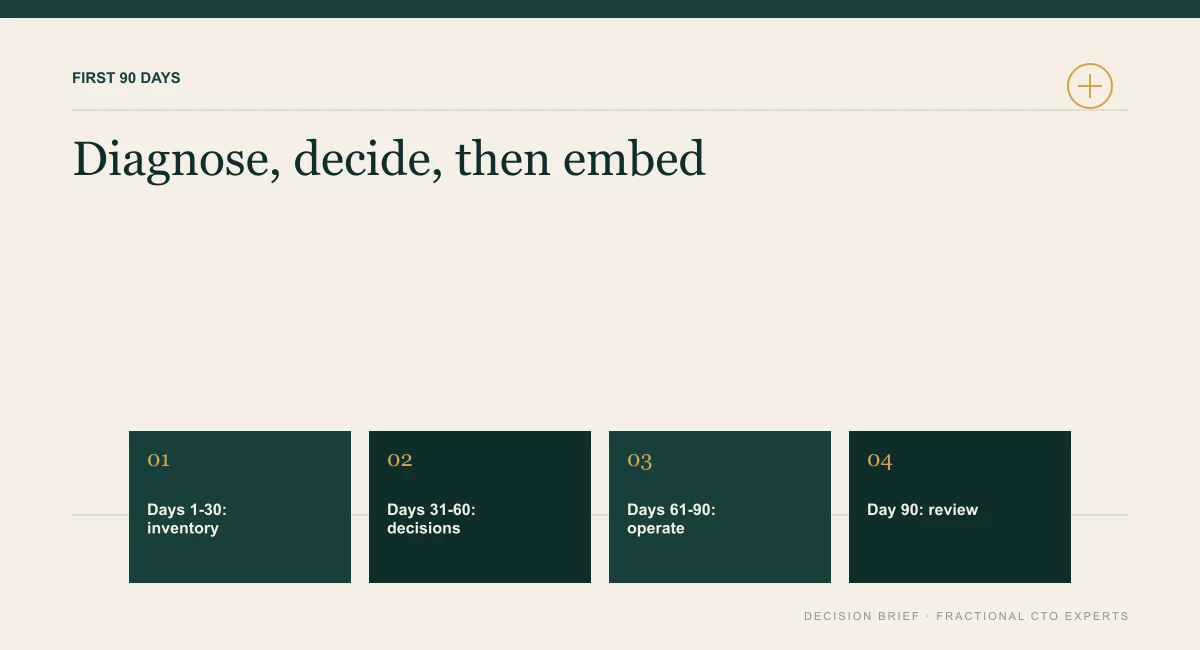
Days 1–30: inventory and listening
- Interview the executives and the heaviest data users. Ask which numbers they don't trust, which decisions they delay for lack of data, and which reports they rebuild by hand.
- Build a first inventory of critical datasets and the reports that depend on them. It doesn't need to be complete; it needs to cover the numbers the business actually runs on.
- List every metric that has more than one definition in use. For each one, record who uses which version and why.
- Review current access: who can reach sensitive data, how access is granted and whether anyone reviews it.
- Output at day 30: a short written diagnosis, the draft metric conflict list and a draft ownership register with gaps marked.
Days 31–60: decisions
- Settle the three to five metric conflicts that cause the most rework or the most risk. Each decision names the definition, the source of record and the approving owner.
- Confirm named business and technical owners for the critical datasets. Owners should accept the role in writing, not just be assigned it.
- Draft the access and retention policy with security and legal colleagues.
- Rank the data investment backlog and tie each item to engineering capacity that someone has actually approved.
- Output at day 60: a published metric dictionary for the settled metrics, an owner-accepted register, a draft policy and a ranked plan.
Days 61–90: operating rhythm
- Start a regular data governance review, short and decision-focused, run by the internal deputy with the CDO present.
- Put a change process in place for metric definitions so changes are proposed, reviewed and announced rather than discovered.
- Start the first funded item on the investment plan with clear acceptance checks.
- Output at day 90: a review with the reporting executive covering what was decided, what changed in practice, what remains contested, and whether the allocation or scope should change.
Judge the day-90 review on evidence. Can a new analyst find the official definition of a key metric without asking anyone? Did the ownership register settle a real dispute? Did the governance review take at least one decision without escalating to the CEO? If the answers are yes, the mandate is working.
Worked example: two revenue numbers (hypothetical)
This is an illustrative scenario, not a client story. A B2B software company with around 150 people reports monthly recurring revenue to its board. Finance calculates it from the billing system. Sales operations calculate it from the CRM, including signed contracts that haven't started billing yet. The numbers differ every month, and each board meeting opens with ten minutes spent explaining the gap.
The company's first instinct is to hire a data engineer to "fix the dashboard." But the pipelines work fine, since both numbers are computed exactly as designed. The problem is that two departments hold two valid but different definitions, and nobody has the authority to choose. That is a leadership gap.
A fractional CDO takes the question in the first month. They document both definitions and who relies on each, and propose three official metrics: billed recurring revenue as the board figure, contracted recurring revenue as a forward-looking sales figure, and a published reconciliation between them. The CFO approves the board definition, and the chief revenue officer approves the sales definition. The data engineer then builds the reconciliation, with acceptance checks against the billing system. The engineering work is small; the decision was the hard part.
The same pattern shows up with active users, churn and inventory counts. When two careful teams produce different numbers from the same data, the fix is usually a decision, not a pipeline.
Evidence to ask candidates for
Data leadership vocabulary is easy to learn and hard to verify. Candidates can speak fluently about governance frameworks and data mesh without having settled a single real dispute. Ask for evidence of decisions instead.
- A decision record. Ask them to walk through a metric or ownership dispute they resolved: the competing positions, who had authority, what they decided, and what happened six months later. Redacted documents are fine; invented ones are not.
- Governance that ran without them. Ask what governance process they set up that kept running after they left or reduced their hours. Who ran it? How do they know it continued?
- A failure. Ask about a data initiative that didn't deliver. Strong candidates describe their own misjudgment specifically; weak ones blame "culture."
- Technical judgment. Give them a short description of your current data stack and ask what they would check first and what they would not change. You are testing whether they can challenge an engineer's estimate, not whether they can write the pipeline.
- Boundaries with security and privacy. Ask how they have split responsibility with a CISO or DPO before, and where it went wrong.
- References with context. Ask for a reference from a peer executive, not only from their own team, and ask the reference what the candidate decided, not whether they were pleasant to work with.
Watch for red flags. One is a proposal to start with a large platform migration before any definitions are settled. Another is an inability to name a decision they owned. A third is heavy reliance on a specific vendor they also resell; ask directly about referral fees or partnerships.
Cost model with explicit assumptions
This guide does not publish fractional CDO rates. Rates vary by market, seniority and scope, and we haven't verified a reliable public benchmark. What you can do is build the model from your own quotes, so the comparison is fair across providers and against a full-time hire.
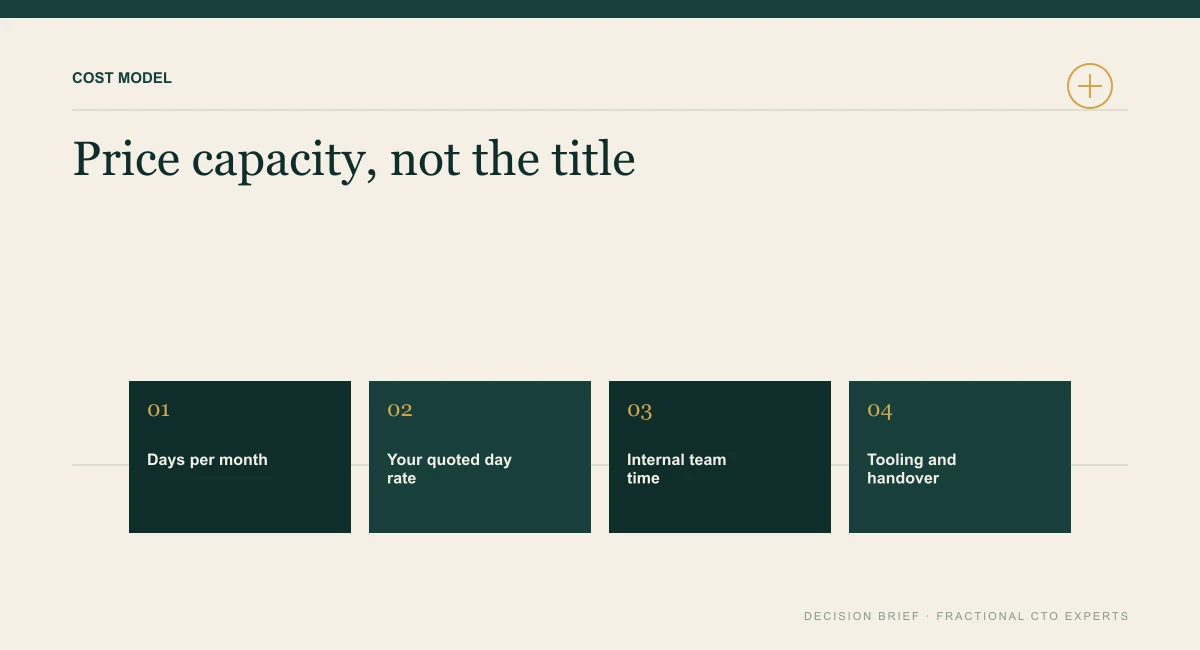
The formula:
Monthly cost = (CDO days per month × quoted day rate) + (internal staff hours consumed × internal hourly cost) + monthly tooling or vendor cost introduced by the plan.
Estimate the days from the mandate, not from a package. List the recurring sessions and work:
| Work item | How to estimate it |
|---|---|
| Executive and governance sessions | Count meetings per month and multiply by length plus preparation |
| Stakeholder interviews and decisions | Higher in the first 60 days, lower afterward |
| Policy drafting and review | Front-loaded; mostly in days 31 to 60 |
| Coaching the internal deputy | A fixed amount per month for the whole engagement |
| Written records and follow-through | Often forgotten; budget it explicitly |
Illustrative worked example. The figures below were chosen to make the arithmetic readable. They are not market rates, and you should replace every one with your own quotes and payroll data.
- Assumed allocation: 4 days per month in the first quarter, dropping to 3 days per month after that.
- Assumed quoted day rate: 1,000 currency units (a placeholder).
- Assumed internal time: 12 hours per month of the deputy's and data team's time, at an assumed internal cost of 60 units per hour.
- Assumed new tooling: none in the first quarter.
First-quarter monthly cost = (4 × 1,000) + (12 × 60) + 0 = 4,720 units. After the first quarter: (3 × 1,000) + (12 × 60) = 3,720 units.
Compare with a full-time hire on the same basis. Annual full-time cost = base salary × (1 + your employment cost load factor) + recruiting cost spread over your expected tenure. Use your own salary research and your finance team's load factor. MIT Sloan's reported average CDO tenure of about 2.5 years is one input for spreading recruiting cost, but your own retention history is a better one.
Three checks before you sign:
- Is the proposal pricing the same mandate you wrote? A lower quote for fewer decisions is not cheaper.
- Does the internal time estimate look realistic? A CDO who needs 40 hours of your team's time a month costs more than the invoice shows.
- What does the plan assume you'll spend on tooling? New platform commitments should be decisions in the plan, not side effects of the engagement.
Hiring scorecard
Score each candidate on the same criteria, with evidence written next to each score. Agree on the weights before the first interview so that a charismatic candidate can't reshape them afterward. The weights below are a starting point; change them to fit your mandate.
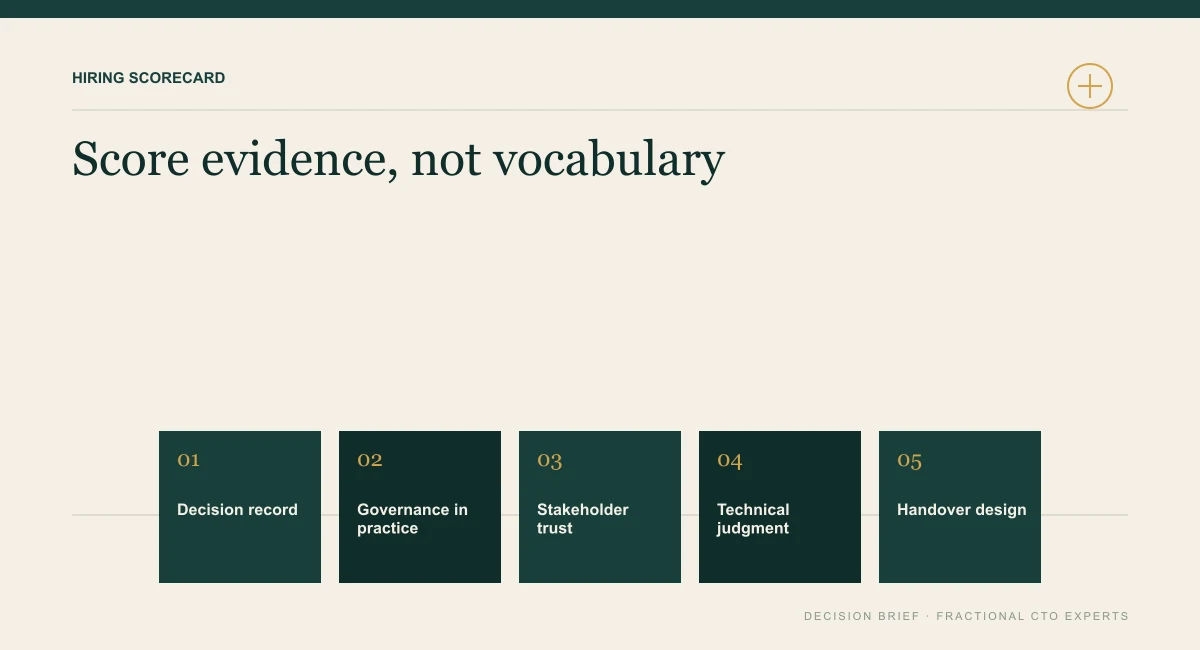
| Criterion | Weight | 1: weak evidence | 3: adequate evidence | 5: strong evidence |
|---|---|---|---|---|
| Decision record | 25% | Describes activities, not decisions | Names decisions but can't show outcomes | Walks through contested decisions, authority and later results |
| Governance in practice | 20% | Cites frameworks only | Set up a process that ran while they were present | Process kept running after they reduced hours, and they can show how |
| Stakeholder trust | 20% | Talks about "getting buy-in" in general terms | Has worked with finance or sales on definitions | Settled a cross-department dispute that both sides accepted |
| Technical judgment | 15% | Defers entirely to engineers or wants to rebuild everything | Asks sensible questions about the current stack | Pinpoints what to check first and what to leave alone, and explains why |
| Boundaries with security, privacy and IT | 10% | Hasn't considered them | Has worked alongside a CISO or DPO | Can describe a specific boundary they agreed and how they handled a conflict |
| Handover design | 10% | Hasn't thought about exit | Mentions documentation | Proposes named deputies, records and a transition plan unprompted |
Multiply each score by its weight and add them up. Treat any criterion scored 1 as a flag to discuss, whatever the total. A candidate who scores 5 on stakeholder trust and 1 on decision record may be excellent company and still unable to do the job.
Public sector and regulated organizations
In US federal government, the CDO is a required role, not an optional hire. HHS's summary of the Evidence Act notes that Title II requires agencies to designate a chief data officer to coordinate its data activities and policies. Contractors supporting agencies often work alongside these officials rather than in place of them. If you supply data services to federal agencies, expect to meet this role in procurement and governance discussions.
In regulated industries such as financial services and healthcare, a fractional CDO needs to work within the existing risk and compliance structures. The governance decisions still apply, but approvals will involve compliance functions and may take longer. Build that time into the 90-day plan rather than treating it as a delay.
Ending or converting the engagement
Plan the exit when you plan the start. A fractional CDO engagement usually ends in one of three ways. The company hires a full-time data leader, and the fractional CDO helps define the role and hands over. Or the internal deputy grows into the role, and the fractional CDO steps down to occasional advisory hours. Or the mandate is complete because the definitions and ownership are settled and running, and the engagement stops.
Each ending needs the same records: the metric dictionary, the ownership register, the decision log and the investment plan. They should all be kept in company systems and walked through with whoever takes over. If you can't hand those records to a new person and have them run the next governance review, the engagement isn't finished.
Before you contact candidates, write the one-sentence role definition, sort your symptoms with the table above and draft the mandate. That gives every provider the same brief and gives you a fair basis for comparing them.
Frequently asked questions
Is a fractional CDO a chief data officer or a chief digital officer?
On this page it means chief data officer: the executive accountable for how an organization defines, governs and uses its data. Some companies use CDO for chief digital officer, a role centered on digital channels and transformation. Confirm which one a candidate or provider means before comparing proposals.
How many days a month does a fractional chief data officer usually work?
There is no reliable standard. Size the allocation from the decisions and meetings the mandate requires, then add preparation, stakeholder work and follow-through. The cost model on this page shows how to turn that estimate into a monthly figure using your own quoted rates.
Can a fractional CDO also be our data protection officer?
Possibly, but check carefully. GDPR Article 38 requires that other tasks given to a DPO do not create a conflict of interests, and a CDO often decides how data is used. Take privacy counsel's view before combining the roles.
What is the difference between a fractional head of data and a fractional CDO?
Titles vary, but a head of data usually leads the data team and its delivery, while a chief data officer mandate adds cross-company decisions such as metric ownership, governance policy and data investment priorities. Choose the title that matches the decisions you are delegating.
Should a fractional CDO write pipeline code?
Usually not as the main job. Hands-on build work is better bought from a data engineer or consultant with clear acceptance checks. A data leader should be able to review designs and challenge estimates, but their scarce hours belong on decisions and ownership.
When should a company replace a fractional CDO with a full-time hire?
Consider it when data decisions need daily executive attention, the data team has grown beyond what part-time leadership can support, or regulators and customers expect a named full-time owner. Plan the transition with a written handover.
Sources and further reading