
Technology leadership diagnostics
Data Pipeline Broken? Restore Trust Before Throughput
Diagnose a broken data pipeline, contain bad outputs, plan safe retries and backfills, reconcile business results and prevent silent data failures.
- By
- Fractional CTO Experts
- Published
- 2026-07-30
- Reviewed
- 2026-09-07
- Reading time
- 13 minutes

When a data pipeline breaks, the most important question is not how quickly the jobs can be rerun. It is which business decisions, customers, money flows, product behavior, and obligations now depend on data whose correctness is unknown.
Treat the event as a trust incident. Contain the impact, trace lineage, preserve evidence, choose a safe recovery order, reconcile at the business level, and then change the controls and ownership that allowed the failure to remain hidden.
- Establish the business impact
- Contain without destroying evidence
- Trace lineage end to end
- Identify the failure class
- Choose the recovery order
- Reconcile the business result
- Build controls that detect drift
- Clarify ownership
- A focused 30-day recovery
- Start with the symptom, then test competing explanations
- Worked example: duplicate orders after a retry
- Define the recovery interval precisely
- Make backfills repeatable and observable
- Build a reconciliation pack the business can understand
- Measure data reliability from the consumer’s perspective
- Decide whether you need a data engineer, platform team or technology leader
- Questions teams ask during a data incident
- Restore trust with evidence
Establish the business impact
Data failures range from a delayed internal dashboard to incorrect customer balances. Response intensity should follow consequence.

Map exposure across:
Reports and decisions: executives, finance, sales, operations, forecasts, experiments, and automated decisions.
Product behavior: recommendations, limits, permissions, personalization, messages, and customer-visible state.
Money: billing, settlement, pricing, revenue recognition, commissions, inventory, and refunds.
Obligations: regulatory reports, customer contracts, audit evidence, retention, and privacy rights.
State what is known, what period is affected, which outputs remain usable, and who decides whether a downstream process pauses. Do not mark the incident “fixed” when the scheduler turns green if consumers still cannot trust the result.
Contain without destroying evidence
Possible containment actions include:
- pause downstream publication or automated actions;
- label dashboards and extracts with the affected period;
- preserve logs, source snapshots, code version, configuration, and job metadata;
- prevent overlapping reruns;
- isolate a bad source or transformation;
- notify named consumers and business owners;
- open a decision log for recovery choices.
Avoid deleting intermediate data or repeatedly rerunning jobs before understanding idempotency. A restart can create duplicate records, advance watermarks, overwrite valid history, or make the original failure harder to reconstruct.
Trace lineage end to end
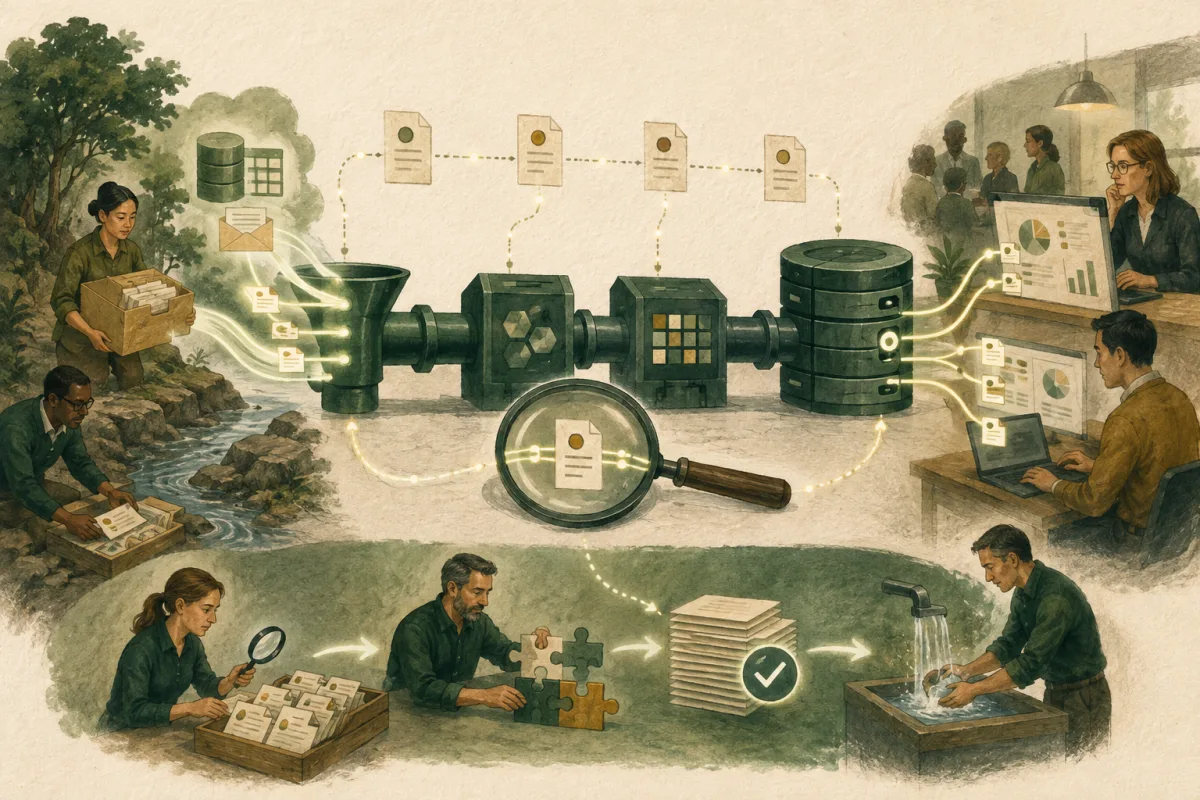
Follow an affected business entity or measure through:
- source system and extraction;
- transport, queue, or ingestion;
- raw and staged storage;
- transformations and joins;
- models, aggregates, and serving layer;
- report, API, product, or operational use.
At each step, ask:
- What identifies a record?
- Which timestamp controls ordering or incrementality?
- Can late or corrected data arrive?
- What schema and semantic assumptions exist?
- How are duplicates and deletes handled?
- Which code and configuration version ran?
- What quality evidence exists?
- Who owns the source and the business meaning?
A pipeline can be technically successful while producing a wrong business answer. Lineage must include semantics and consumers, not only infrastructure.
Identify the failure class
Common classes include:
- source outage, delay, or unexpected correction;
- credential, quota, network, or vendor failure;
- schema or type change;
- semantic drift without schema change;
- faulty code or configuration deployment;
- late, duplicate, missing, or out-of-order data;
- capacity exhaustion;
- partial writes or inconsistent checkpoints;
- incorrect joins, filters, or time boundaries;
- downstream assumptions that no longer match the source.
Several can coexist. Distinguish the trigger from the condition that made impact broad or detection slow. A source change may trigger the incident; missing contracts, ownership, tests, and consumer alerts may determine its severity.
Choose the recovery order
Correctness, freshness, and completeness may conflict during recovery.
A controlled sequence is:
- Freeze: prevent further incorrect propagation and preserve a stable boundary.
- Repair: correct the source, code, configuration, access, or capacity condition.
- Backfill: replay an explicit range using idempotent logic and isolated outputs where possible.
- Validate: compare technical and business evidence, including exceptions.
- Release: republish with consumer communication and active observation.
Decide whether old and new data can coexist, whether downstream caches or derived tables must be rebuilt, and how changes are reconciled. For money or regulated records, involve the appropriate business and control owners.
Reconcile the business result
Row counts and job success are weak proof by themselves.
Validate:
- totals and balances that should agree;
- expected counts by meaningful business dimension;
- uniqueness and relationship constraints;
- completeness across the affected time range;
- freshness and event ordering;
- sample records traced to source;
- independent reports or control totals;
- known exceptional cases;
- downstream product or operational behavior.
Set acceptance thresholds before reviewing the final result. Otherwise a team under pressure can redefine “close enough” after seeing the mismatch.
Build controls that detect drift
Useful controls include:
- source and interface contracts;
- schema compatibility checks;
- business-semantic tests;
- freshness, volume, null, uniqueness, and distribution monitoring;
- lineage and ownership metadata;
- idempotent processing and explicit checkpoints;
- isolated backfill and replay procedures;
- consumer-facing status and confidence;
- tested runbooks and escalation;
- post-incident corrective work with an owner.
Not every dataset deserves the same control level. Classify by consequence and usage. A board metric, customer balance, or automated eligibility decision needs stronger evidence than an exploratory dataset.
Clarify ownership
The source owner understands why data exists. The platform owner understands ingestion and operation. The model owner understands transformation. The business owner understands meaning and consequence. The consumer understands use.
Write who:
- approves semantic changes;
- responds to an incident;
- can pause publication;
- accepts a backfill;
- communicates with users;
- funds preventive work.
If responsibility is spread across teams without one incident and investment owner, the pipeline will continue to fail between boundaries.
A focused 30-day recovery
Days 1–3: contain impact, trace the affected lineage, repair safely, reconcile, and communicate confidence.
Days 4–10: complete the incident review, name the systemic contributors, classify critical data products, and assign owners.
Days 11–20: add the highest-value contracts, quality checks, alerts, replay procedures, and consumer communication.
Days 21–30: rehearse a failure and backfill, verify ownership, and fund the next reliability constraints.
A data engineering consultant fits when the scope is a bounded technical diagnosis and repair. A fractional CTO or data leader fits when the company also needs executive choices about platform investment, governance, organization, risk, and product use. The data engineering specialist page describes that boundary.
Start with the symptom, then test competing explanations
A useful diagnosis connects the observed business problem to a specific failure mechanism. “The ETL is broken” is too broad to guide recovery. Record what changed, when the problem first appeared and which consumers are affected. Compare the incident period with a known-good period, but check that the comparison uses the same definitions and time boundaries.
| Symptom | Possible explanation | Evidence that helps distinguish it |
|---|---|---|
| Dashboard is stale but jobs are green | No new source data, wrong partition or an unchanged downstream cache | Source arrival time, processed interval and serving-layer refresh time |
| Totals increase after a retry | Duplicate writes or a repeated side effect | Business-key uniqueness, run identifiers and destination write behavior |
| Totals fall after a source change | Dropped records, a changed filter or new null values | Rejected-record samples, schema history and counts before each transformation |
| A few customers are missing | Join behavior, tenant filtering or late-arriving reference data | Entity-level lineage and unmatched-key counts |
| Backfill changes unrelated dates | Mutable input, current-time logic or an incorrect interval boundary | Input snapshot, code version and explicit start/end parameters |
| Pipeline duration steadily increases | Growing volume, skew, contention or an inefficient transformation | Stage timings, partition sizes, resource use and concurrency |
These are hypotheses, not automatic diagnoses. A green scheduler only reports what its tasks consider successful. If the task accepts an empty source response as valid, the scheduler may be correct about execution while the business output is unusable.
Use a small number of representative records to understand the mechanism, then measure the full affected population. A sample can explain how a bug works without establishing how many customers or reporting periods it affected.
Worked example: duplicate orders after a retry
Consider an illustrative order-reporting pipeline. The source contains 1,000 orders for a defined interval. A load writes 600 destination records and then fails. A retry inserts all 1,000 records again because the destination does not enforce the intended business key. The resulting table contains 1,600 rows, although only 1,000 distinct orders exist.
A row-count check would notice a difference if the expected count were known. But a check that only confirms “more than zero rows loaded” would pass. A revenue total might also look plausible during a busy sales period, allowing the error to reach an executive dashboard.
The recovery should first identify which destination records belong to the failed run and which records are legitimate. Do not delete every duplicate-looking row without understanding whether the business allows multiple events per order. An order table, an order-line table and an order-event table have different uniqueness rules.
Repair the write behavior for the intended data model, test the same interval more than once and verify that the result remains stable. Apache Airflow’s task best practices explicitly address repeatable retries, partition-specific inputs and avoiding duplicate inserts. The appropriate implementation still depends on the destination and business key; an upsert is not a substitute for defining correct identity.
Finally, reconcile the affected dashboard and any extracts already delivered. Fixing the underlying table does not automatically replace a CSV sent to finance or invalidate a cached report. The incident owner needs a list of consumers and a clear statement of which outputs have been corrected.
Define the recovery interval precisely
“Rerun yesterday” is ambiguous. It could mean the date an event occurred, the date it arrived, the date a transaction settled or the scheduler’s logical interval. Time zones and daylight-saving changes can make an informal date boundary particularly misleading.
Specify the timestamp field, time zone, inclusive start and exclusive end, or another explicitly documented convention. Identify how late arrivals and corrections are handled. If the source can change historical records, decide whether the backfill uses the current source state or a preserved snapshot representing the original period.
Record the code and configuration version used for recovery. A historical interval processed with new transformation logic may intentionally produce different results. That difference must be understood before the business compares the repaired output with an older report.
Also define the downstream rebuild boundary. A daily aggregate may feed a weekly measure, a customer segment or an automated model. Correcting one partition can require recalculating those derived outputs. Follow the lineage through to the actual consumer rather than stopping at the first repaired table.
Make backfills repeatable and observable
A backfill should be a controlled production operation with an owner, a defined scope and a way to observe progress. Estimate the amount of work and its effect on ordinary processing. A recovery job that consumes all available resources can create a second incident by delaying current data.

Where the architecture permits, write repaired output to an isolated destination or version before publishing it. Compare it with the existing output and preserve a practical reversal path. The exact mechanism may be a table swap, a versioned object, a partition replacement or another platform-specific approach. Choose it based on the system’s consistency guarantees and the consumers’ behavior.
Track more than task completion. Record which partitions or entities have been processed, which failed, how many records were rejected and which validation checks remain unresolved. If a run stops midway, the next operator should know whether to resume, restart or inspect a partial result.
Test the recovery procedure before using it for a broad historical range. A small representative interval should include the known failure case and important exceptions. Confirm that rerunning it does not create new duplicates or trigger unintended external actions such as customer messages.
Build a reconciliation pack the business can understand
A reconciliation pack explains what was repaired and why the result can be trusted within a stated boundary. It should be concise enough for the responsible business owner to assess while linking to technical evidence for deeper inspection.

Include the affected interval and entities, the failure mechanism, the repair version and the validation criteria. Show comparisons by meaningful dimensions: date, customer, product, region or another dimension relevant to the incident. An overall total can conceal offsetting errors between groups.
For example, a total that matches the source may still assign transactions to the wrong customers. A uniqueness test can pass while the wrong time zone shifts events into a neighboring day. Select checks that address the actual failure mechanism and the ways a repair could introduce a new error.
List exceptions separately. If ten records cannot be reconciled because the source no longer retains the necessary detail, record that limitation, its consequence and the owner’s decision. Do not silently exclude the records and label the entire dataset correct.
The approval should answer a concrete question: which outputs may now be used, for which period and purpose? Some consumers may be able to resume before others. A dashboard used for directional planning can have different acceptance needs from an automated payment process.
Measure data reliability from the consumer’s perspective
Google’s data-processing pipeline guidance distinguishes freshness and correctness and emphasizes end-to-end measurement. Apply that distinction to the data product your users actually consume. A fast intermediate table is not enough if the final report remains stale or wrong.

Define a freshness target using an observable event, such as source arrival to availability in the final serving layer. Define correctness checks around business meaning, not only technical format. Track completeness separately where missing records matter. A dataset can be fresh but incomplete, or complete for yesterday while failing today’s timeliness requirement.
Avoid alerting on every small fluctuation with the same urgency. Identify critical data products and the consequences of failure. An alert should reach someone who can investigate and should explain the affected output, the observed condition and the relevant runbook. A dashboard full of red indicators without ownership does little to reduce time to recovery.
Review detection coverage after the incident. Ask whether the team could have discovered the problem before a consumer reported it. The highest-value improvement may be a simple business-key check or a clear consumer status message rather than a new observability platform.
Decide whether you need a data engineer, platform team or technology leader
A bounded pipeline defect often needs an experienced data engineer who can inspect the system, repair the processing logic and verify the result. A broader reliability problem may require platform work, shared standards and support capacity. Persistent disagreement about priorities, ownership or investment may need an executive decision.
Write the engagement brief accordingly. For a technical repair, state the affected data product, known symptoms, access constraints, recovery requirements and acceptance evidence. For a broader mandate, explain the number of teams and consumers involved, the critical decisions and the operating responsibilities that lack an owner.
Do not buy a platform replacement simply because the current incident is painful. Compare targeted repairs, changes to ownership, improved recovery procedures and replacement against the same requirements. A migration can reproduce the same semantic and organizational problems in a different tool if those problems are not addressed.
Questions teams ask during a data incident
Should we rerun the failed job immediately?
Only after understanding whether rerunning is safe for the affected task. Check partial writes, business keys, checkpoints and external side effects. A retry that duplicates data or advances the recovery boundary can make the incident harder to resolve.
Why did all the jobs succeed when the data was wrong?
Task success usually reflects the checks implemented in the task or orchestrator. It may not test completeness, business meaning or the final consumer output. Add validation at the relevant boundaries and make business-level acceptance part of the operating process.
Can we fix the dashboard without repairing the pipeline?
A temporary correction may help a specific consumer if it is clearly labeled and controlled. It does not repair other downstream outputs or prevent recurrence. Record the temporary measure, its limits and how it will be removed after the underlying recovery.
How much historical data should we backfill?
Use evidence to identify the affected range and downstream dependencies. The range may start before the first visible complaint if detection was delayed. Avoid assuming that every historical period is affected, but verify a known-good boundary before narrowing the repair.
When can we close the incident?
Close it when the affected outputs have been reconciled or their remaining limitations accepted by the responsible owners, consumers have been informed and ongoing processing is stable. Preventive work may continue afterward with named owners and dates. A green scheduler alone is not sufficient closure evidence.
Restore trust with evidence
Trust has returned when the organization can explain where a number came from, detect when it becomes unreliable, stop harmful use, recover a defined range, reconcile the result, and communicate the confidence boundary.
The goal is not a pipeline that never fails. It is a data system whose failures are visible, bounded, recoverable, and owned before a customer or board discovers them.
Frequently asked questions
What should we do first when a data pipeline fails?
Identify which decisions, customers, money, and obligations are exposed. Stop downstream use where incorrect data creates more harm than delay, preserve evidence, name an incident owner, and communicate the known confidence boundary.
Should we immediately rerun or backfill the pipeline?
Not until the failure mode, source condition, idempotency, and downstream effects are understood. A blind rerun can duplicate, overwrite, or propagate corrupted data.
How do we know a repaired pipeline is trustworthy?
Reconcile business-level totals and relationships, validate freshness and completeness, compare independent sources where available, inspect exceptions, and confirm downstream users can explain the result.
Do we need a data engineering consultant or a fractional CTO?
Use a specialist for a bounded pipeline diagnosis and implementation. Use fractional technology or data leadership when ownership, investment, governance, team design, and business decisions are also unowned.
Sources and further reading
Turn research into a mandate
See the cost and hiring model before you shortlist.
Use the free calculator, then save a candidate search or post a transparent role when the mandate is ready.