Agricultural technology leadership
Fractional CTO for AgriTech: Field Systems and Hiring
Scope agritech CTO leadership around field workflows, offline apps, agricultural data, connected systems and pilots. Includes a hiring and validation framework.
- By
- Fractional CTO Experts
- Published
- 2026-09-09
- Reviewed
- 2026-09-09
- Reading time
- 17 minutes
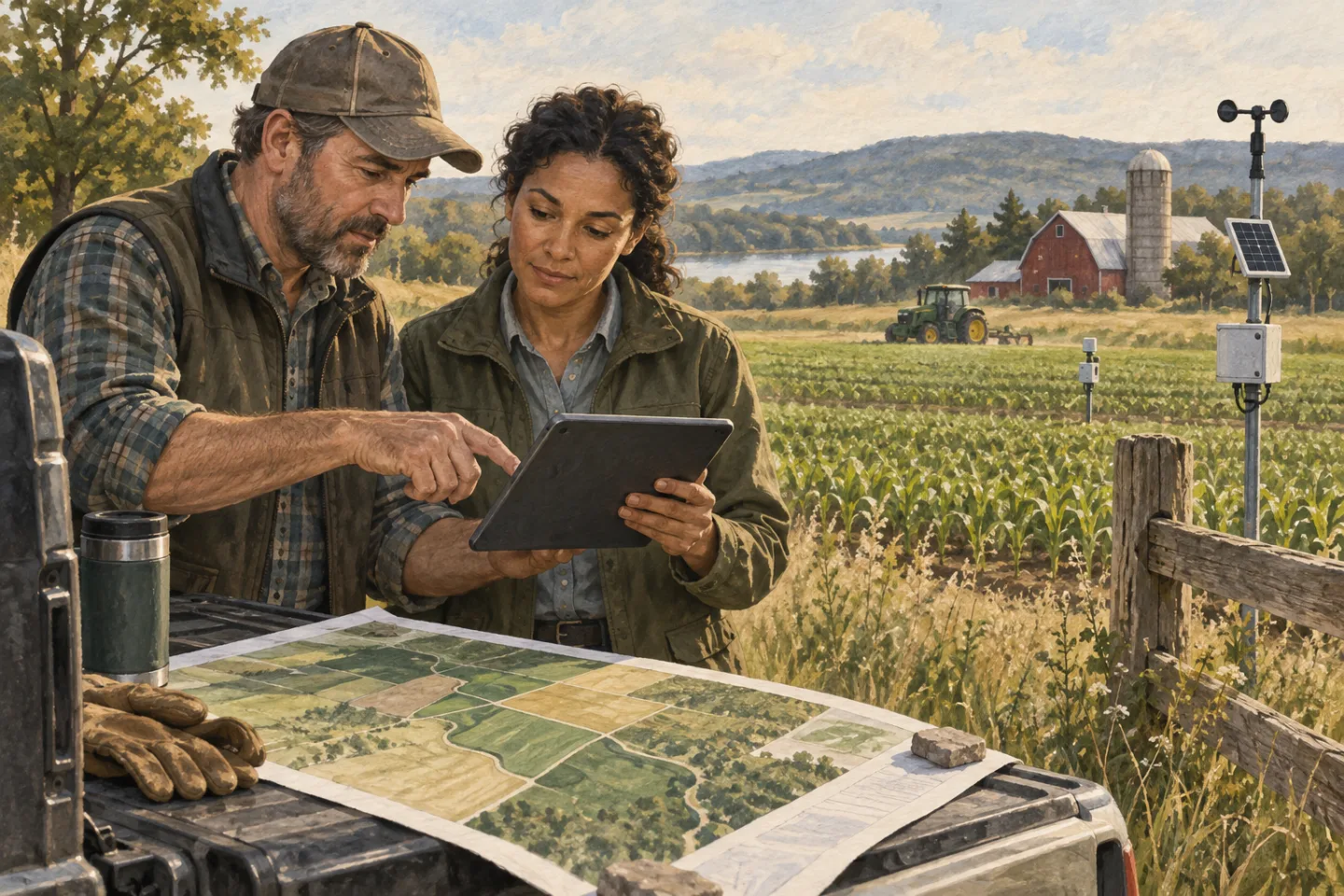
A fractional CTO for agritech provides recurring technology leadership for an agricultural business or product within an agreed part-time mandate. For digital agriculture, that can mean making decisions about field applications, sensors, machinery interfaces, agricultural data, engineering delivery and product reliability. The right brief starts with the farming workflow and the consequence of failure, not a preferred cloud platform or a fashionable AI feature.
This guide focuses on software and connected agricultural products. Scientific leadership for crop development, biological discovery or laboratory research is a different mandate and requires different evidence of experience. Fractional CTO Experts offers executive discovery and matching routes; relevant agricultural experience, availability and engagement terms must be assessed for the specific request. No yield improvement, agronomic result or candidate availability is implied by this guide.
- Define the agritech problem before the executive role
- Start with the person doing the work
- Make offline behaviour a product decision
- Give agricultural data a clear meaning
- Separate sensing, interpretation and action
- Evaluate the entire connected system
- Plan around the operating calendar
- Run a pilot that answers a defined question
- A worked offline-observation pilot
- Assess AI against the actual agricultural task
- Understand data access and supplier dependence
- Scope the leadership engagement and delivery budget
- Interview for agricultural operating experience
- Leave the product supportable after the engagement
Define the agritech problem before the executive role
Agritech includes very different businesses. A farm management application, a grain-storage monitoring service, a machinery integration platform and a biological research company do not share one universal technology brief. List the users, operating environment, product boundary and decisions that the business cannot currently make well.
For a field application, the challenge might be reliable work capture when connectivity is intermittent. For a data platform, it might be reconciling records from equipment and software suppliers. For a monitoring product, it might be understanding the difference between a sensor that reports a normal value and a sensor that has stopped reporting altogether.
Describe the recurring leadership gap. If the company already has a clear product direction and needs one connector built, a specialist engineer may be the appropriate hire. If several important decisions span product, hardware, data, suppliers and delivery, a CTO mandate can provide a place for those trade-offs to be evaluated together.
Do not assume that an agricultural CTO title proves software expertise. AgKnowledge's fractional leadership description includes a scientific CTO mandate for crop development and biological protection discovery. That illustrates why candidates must be assessed against the actual work, rather than matched through the title alone.
Start with the person doing the work
Observe a complete workflow with the intended operator. Where are they standing? What device can they carry? What happens when the screen is wet, the battery is low or the application cannot connect? Who corrects an observation after the worker has left the field? These questions should inform the product brief before a team estimates features.
Separate the buyer from the daily user. An agribusiness executive may approve the purchase while a field worker, contractor or farm manager performs the workflow. A dashboard that satisfies the buyer can still fail if recording the underlying information is too slow or confusing for the operator.
Document the current workaround and why it exists. A paper notebook or spreadsheet may provide portability, flexibility or a trusted fallback. A new application should preserve the useful properties of that workaround while addressing a specific limitation. Simply replacing paper with a form does not establish a better process.
A practical discovery output is a workflow card: user, task, environment, required information, completion evidence, failure consequence and fallback. Review the card with the operator and product owner. It gives the technical team something more concrete to design against than a broad promise to modernise agriculture.
Make offline behaviour a product decision
Offline support is more than storing a copy of the last screen. Define which tasks can be completed without a connection, which records can be changed, what information may be stale and what must wait. Show the user whether an action has been saved locally, sent to the server or accepted by the receiving system.
Consider two workers editing the same field record before either reconnects. Decide which changes can be combined, which need review and who resolves a conflict. The user should not discover after a day's work that the application silently discarded their observations. Preserve enough information to investigate a disagreement without exposing unnecessary personal or commercial data.
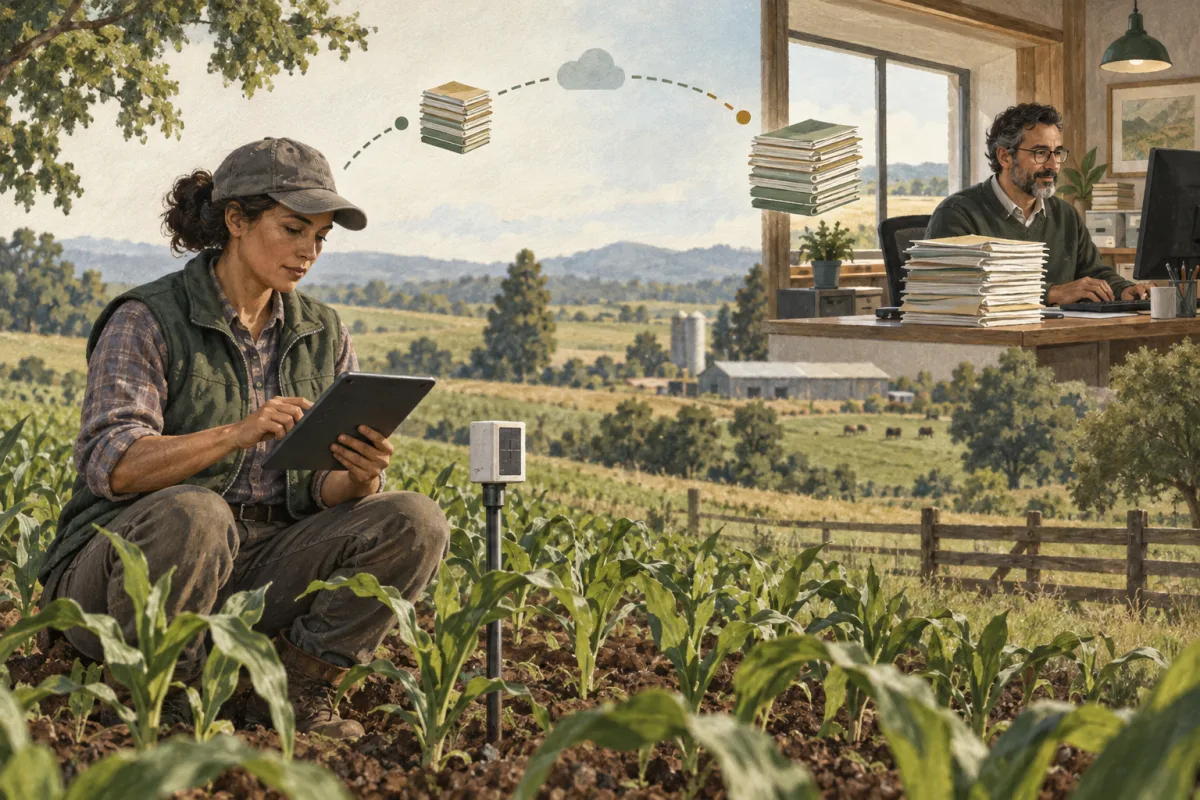
Test interruption at awkward moments. The connection can disappear during an upload, the device can restart after local entry, and a server can acknowledge a request after the client has already retried it. Engineers should demonstrate that retries do not accidentally create duplicate business records and that users can understand the recovery state.
The CTO should ensure these behaviours are specified and tested with realistic conditions. The product owner must decide what the workflow should permit, and engineers must implement and verify the design. A statement that the application is offline-first is not a substitute for those decisions.
Give agricultural data a clear meaning
A measurement is not useful without context. Record what was measured, the unit, relevant location, observation time, source and known limitations. Distinguish the time an event occurred from the time it reached the platform. A delayed upload should not appear to be a new field observation merely because it was received today.
Field and farm identifiers need deliberate ownership. Boundaries can change, operators can use different names for the same place, and a supplier can introduce its own identifiers. Preserve the relationships and history needed for the product's purpose. Do not resolve ambiguous records by silently choosing whichever name was imported most recently.

AgGateway's ADAPT Standard provides a model for exchanging agricultural production data, including defined data types and units. Evaluate its documented scope and the formats your partners support. A published standard is a useful interoperability reference; it does not mean every device or software product in a customer's environment implements it.
Create a small set of representative exchange examples before committing to an integration. Include missing values, changed identifiers, delayed records and units that need explicit handling. Ask both sides to explain how a rejected or ambiguous record is surfaced and who must act on it. A successful import of one clean demonstration file proves very little about the operating workflow.
Separate sensing, interpretation and action
A connected product may collect an observation, interpret it and recommend or trigger an action. Treat those as separate responsibilities. The system should make it possible to identify which observation and model or rule version produced an output. The people evaluating that output need to understand its limits.
A missing reading is not the same as a safe or normal condition. Decide how the product represents sensor health, stale data and uncertain interpretation. Give the user a meaningful route to investigate an alert or absence of information. Avoid a reassuring status display that hides the fact that the underlying device has not communicated.
For products that can affect equipment, animals, crops or worker safety, involve the relevant domain and safety specialists in the requirements and release decisions. A general software leader should not invent agronomic thresholds or operational safety rules. Technical leadership should clarify where qualified judgement is required and make the agreed boundaries visible in the product.
A bounded prototype may be appropriate for collecting evidence. It should remain clearly separated from an approved operational control system. The evidence needed to demonstrate an interesting concept is different from the evidence needed to rely on it during an important field operation.
Evaluate the entire connected system
A field product can depend on a device, firmware, a communications link, a receiving service, a data pipeline and an application. Ask who owns each component and how failures are detected. An application support team needs enough information to distinguish a failed sensor from an unavailable supplier endpoint.
| Component | Decision to clarify | Evidence before wider use |
|---|---|---|
| Field device | Who maintains it and knows whether it is functioning? | Device inventory, health signals and replacement process |
| Local application | What work can continue without connectivity? | Interruption and recovery demonstrations |
| Data exchange | How are records identified, validated and reconciled? | Representative samples and exception handling |
| Platform | How are delayed, duplicate or invalid events handled? | Replay, retry and investigation evidence |
| User workflow | Who reviews uncertain information or resolves conflicts? | Tested operating procedure and named owner |
| Support | Who responds during the customer's critical period? | Support agreement, escalation and practical fallback |

Build a failure map across those boundaries. For each important failure, identify what the operator sees, which team receives evidence and what action is available. This is especially useful when several suppliers each support only their own component. The customer should not have to assemble the incident timeline from five separate support tickets.
The map also helps scope the fractional CTO's role. Executive oversight can coordinate standards, suppliers and investment decisions, but it does not automatically include field maintenance, device installation or continuous technical support. Assign and fund those responsibilities separately.
Plan around the operating calendar
Ask the customer which periods make change difficult and which provide a useful opportunity to test. The answer may depend on the crop, region, business model and particular workflow. Do not use a generic seasonal assumption in place of the customer's actual operating calendar.
A release plan should identify the last sensible point for introducing a material change before a critical period. Specify the evidence needed at that point and the fallback if it is not available. It may be better to defer a feature than to introduce an untested workflow when staff have little time to adapt.
Use the quieter period to rehearse recovery, train operators and resolve known data problems. Keep the support arrangement explicit during high-demand periods. A part-time executive who attends one planning meeting cannot also be assumed to cover every incident across locations and time zones.
Review the calendar with sales and customer-success teams. Commercial promises should reflect the delivery evidence and the customer's capacity to adopt change. A product launch date that ignores installation, training or field access can create an obligation the engineering team cannot responsibly meet.
Run a pilot that answers a defined question
A useful pilot begins with a question that could change a decision. For example: can operators complete the observation workflow without a connection and later reconcile their records accurately? Define the user group, environment, duration, evidence and acceptance conditions before inviting participants.
Choose a bounded scope and an explicit exit route. Explain what the pilot does not yet support and how participants should continue their normal work if the product fails. Give the team permission to stop or narrow the pilot when the evidence reveals a material problem.
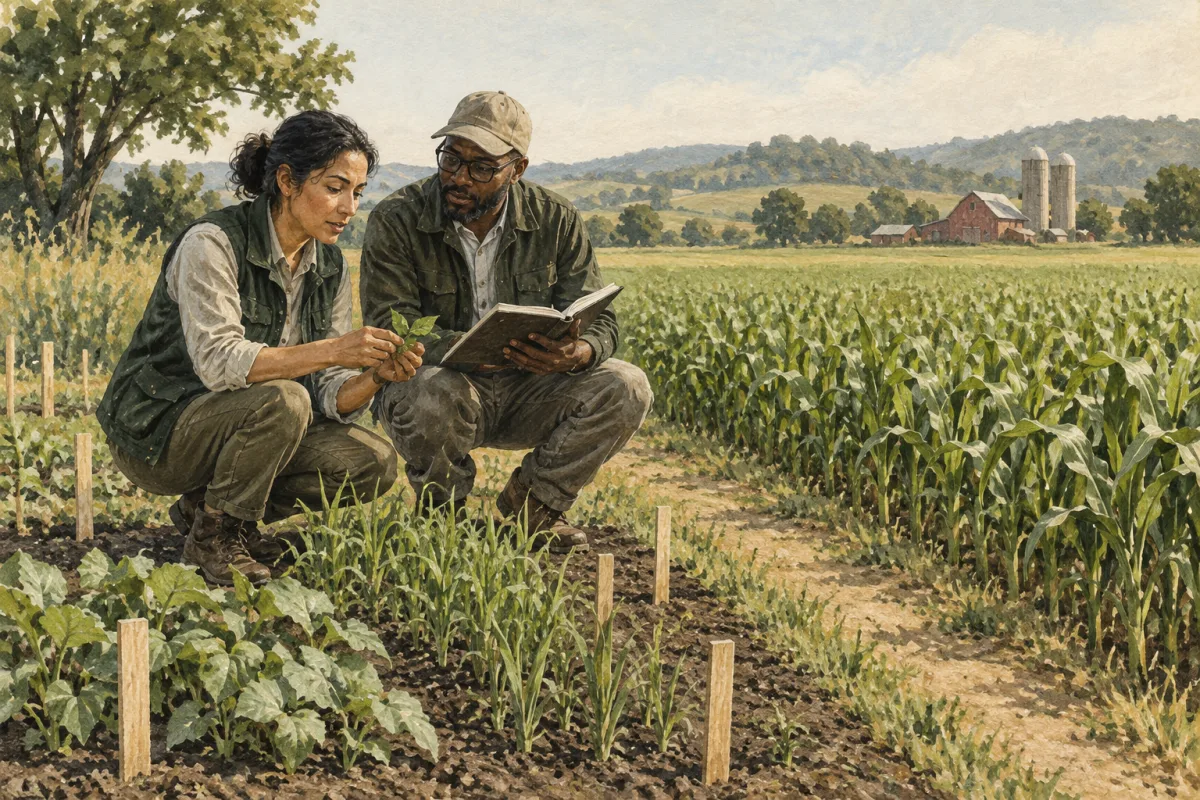
Do not confuse product adoption evidence with an agronomic outcome. A pilot may demonstrate that users can complete a workflow, that records reconcile or that an alert reaches the right person. It does not automatically establish higher yield, lower input use or an improvement attributable to the product. Such claims require appropriate domain expertise and evidence designed for the specific question.
Record who participated and which conditions were represented. A successful demonstration on one farm, device or dataset may not generalise to other environments. Use the results to identify the next uncertainty and decide whether to expand, revise or stop. A pilot report is most useful when it includes limitations and negative findings alongside successes.
A worked offline-observation pilot
Consider a hypothetical software company building a field-observation application. Its proposed pilot includes six operators across two customer sites. These numbers are illustrative, not a recommended sample size or a claim of statistical validity. The question is whether the workflow preserves observations through intermittent connectivity and makes conflicts understandable.
The team prepares representative tasks and records the expected outcome for each. One task is completed without connectivity, another is interrupted during upload, and a third involves conflicting edits. Participants use the product in an agreed, supervised setting with their existing process available as a fallback.
| Pilot evidence | What it can show | What it cannot establish alone |
|---|---|---|
| Completed task and reconciled record | The tested workflow preserved that observation | Reliability across all devices and operating conditions |
| Duplicate submission handled correctly | The tested retry did not create a duplicate outcome | Correct handling of every possible interruption |
| Conflict visibly resolved | The participant understood that tested conflict | That all users will understand every future conflict |
| Support request and response log | The pilot escalation route worked in those cases | Continuous production support capacity |
| Participant feedback | Specific usability concerns and useful behaviours | A guaranteed commercial or agricultural result |
The CTO can help agree the technical evidence, ensure the team can investigate failures and present the release options. Product leadership owns the customer problem and acceptance decision with the relevant sponsors. Agricultural specialists contribute where the workflow affects domain interpretation. Keep those responsibilities distinct rather than asking one person to certify every dimension of the pilot.
Assess AI against the actual agricultural task
Begin with the decision the user needs to make and the information available at that moment. A model that performs well on a prepared dataset may behave differently with poor lighting, a different device, unfamiliar conditions or missing context. Identify which of those variations matter to the proposed product.
Define an evaluation set and review process with appropriate domain expertise. Record the data sources, intended use, important limitations and the consequences of an incorrect output. Include a way to report a questionable result and a clear decision about when human review is required.
Compare an AI approach with simpler alternatives. A rule, a better data-collection process or a clearer user interface may address the immediate problem with less uncertainty. If AI is justified, explain what new evidence would cause the team to change or withdraw the model. Avoid making the choice irreversible before the product need has been demonstrated.
For generated advice or summaries, preserve the boundary between organising information and providing authoritative agronomic guidance. The product should not imply that fluent text is validated professional advice. The CTO's contribution is to make the technical and operating limits explicit and ensure that qualified reviewers can evaluate the proposed use.
Understand data access and supplier dependence
List the external data, devices and services on which the product relies. For each, identify permitted access, operational limits, change notifications, support arrangements and the consequence of losing the relationship. Ask relevant legal or procurement specialists to review the applicable agreements rather than inferring rights from the availability of an API.
Keep the product capable of explaining data provenance. A customer may need to understand which source supplied a record, when it was obtained and whether it has been transformed. If an integration changes, the team should be able to identify the affected records and outputs without reconstructing the entire history manually.
Evaluate an exit scenario before a supplier becomes deeply embedded. What can be exported? Which functions depend on proprietary behaviour? What would the company need to maintain or replace? An attractive demonstration price should be considered alongside the effort required to operate and eventually change the dependency.
These questions also belong in a candidate interview. Ask how the proposed CTO would balance speed, interoperability and supplier dependence for the actual stage of the company. There is no universal rule that building everything or buying everything is the safer choice.
Scope the leadership engagement and delivery budget
State the decisions the fractional CTO will own, the people they will lead and the capacity reserved for preparation and follow-through. Name the product sponsor, engineering lead and domain specialists. Clarify whether supplier evaluation, customer field visits, recruitment and incident participation are included or separately scoped.
Build a budget that separates executive leadership from software development, hardware, connectivity, field work, specialist review and ongoing support. Include the internal time required to provide evidence and make decisions. A leadership retainer does not automatically purchase the team or equipment needed to carry out the plan.
If the immediate need is a narrow integration or prototype, compare a specialist project. If the company needs a temporary full executive seat during a transition, compare an interim arrangement. If engineering management is the missing capability, review the fractional head of engineering role. The appropriate model depends on responsibility and capacity, not the perceived prestige of the title.
The fractional CTO services guide explains broader engagement boundaries. Platform terms are described on the pricing page; an executive's services and implementation costs must be agreed separately. This guide does not establish an agritech service price or a ready-made delivery team.
Interview for agricultural operating experience
Ask for a relevant example involving the actual constraint you face: unreliable connectivity, device integration, field-data ambiguity, seasonal release planning or adoption by operational users. Request a clear account of the candidate's personal responsibility and the evidence that informed their decisions.
Explore something that did not work as expected. How did the team detect the problem, communicate it to users and decide whether to continue? What would the candidate do differently? A careful explanation of limits is more useful than an unsupported claim that their architecture can scale indefinitely or that they know every agricultural domain.
Use a short synthetic scenario with non-confidential sample records and an interrupted workflow. Ask what the candidate would investigate, which decisions they would defer and which specialists they would involve. Evaluate technical judgement, communication, respect for domain expertise and the ability to create a workable operating arrangement.
Leave the product supportable after the engagement
Maintain a handover record throughout the work. Include the system and supplier map, key technical decisions, data definitions, known limitations, release procedure, support contacts and outstanding risks. Assign an internal owner who can use each record. Documentation is less useful when it exists but nobody knows when to consult it.
Before the executive steps back, rehearse an ordinary support case and an important failure with the people who will remain. Confirm access, escalation and the customer communication route. Make sure the company controls its records and can continue the work without relying on the departing person's personal accounts or memory.
A useful agritech CTO brief therefore names the agricultural workflow, technical constraint, evidence needed, delivery team and operating responsibility. With those details, you can assess whether a candidate's experience matches the problem and whether a fractional arrangement provides enough leadership for the work ahead.
Frequently asked questions
What does a fractional CTO do for an agritech company?
For a digital agriculture product, the role can own recurring decisions across software, connected devices, data, engineering and suppliers within an agreed mandate. Define the workflow, technical constraints, authority and capacity. Scientific crop or biological research leadership is a different mandate and needs different evidence of expertise.
Does our farm application need offline support?
Assess where and how users work, which tasks must continue without a connection and the consequence of delay. Define local saving, synchronisation, conflict handling and recovery for those tasks. An offline label alone does not establish that the application preserves work correctly.
Can an agricultural data standard solve every integration problem?
No. A standard can provide a shared representation within its documented scope, but partner support, source quality, identifiers and exception handling still need verification. Test representative records and confirm who resolves rejected or ambiguous data before relying on an exchange.
Can an agritech pilot prove higher yield or lower input use?
A software pilot can demonstrate specific workflow or technical behaviour. Agricultural outcome claims need evidence designed for the particular question and appropriate domain expertise. Do not treat a successful demonstration, small user test or anecdote as proof of a general agronomic benefit.
What should we verify when hiring an agritech CTO?
Ask for relevant operating examples, personal decision ownership, field constraints, data and device experience, failure handling and collaboration with domain specialists. Match the evidence to the actual product. A CTO title or agricultural company logo alone does not establish fit.
Sources and further reading