Executive hiring templates
Chief of Staff Job Description: Editable Template and Scorecard
Copy an editable chief of staff job description with two level variants, a decision-rights table, 30/60/90-day outcomes and an interview scorecard.
- By
- Fractional CTO Experts
- Published
- 2026-11-23
- Reviewed
- 2026-11-23
- Reading time
- 17 minutes
- What a chief of staff is responsible for
- Chief of staff vs COO vs executive assistant
- Worked example: sort the work before you choose the title
- Editable chief of staff job description template
- Level variants: first chief of staff to a founder, or chief of staff in a larger executive team
- Decision-rights table for a chief of staff
- 30/60/90-day outcomes
- Interview scorecard for a chief of staff
- Write it so the right candidates apply, and keep it lawful
- When a fractional chief of staff or a different role fits instead
- Final review before you publish the description
A chief of staff job description should name the principal the person works for, usually the CEO or founder, and the specific work they take off that principal's desk: running the leadership operating rhythm, preparing decisions, driving cross-functional priorities that no single function owns, and following through on commitments. It should also state what the chief of staff can decide alone, what they only recommend, and how success will be judged at 30, 60 and 90 days. Without those three things the title means almost nothing, because companies use it for everything from a senior assistant to a deputy CEO.
This page covers the business chief of staff who works in a company's executive office. Military, White House, congressional and state-government chiefs of staff share the title but are different jobs with different rules, and they are not covered here. Below is an editable template you can copy into your applicant tracking system, two level variants (the first chief of staff to a founder, and a chief of staff inside a larger executive team), a decision-rights table, 30/60/90-day outcomes and an interview scorecard. This is a hiring resource, not a vacancy at Fractional CTO Experts. Replace every bracketed field and have the relevant internal owners review the finished version.
What a chief of staff is responsible for
There is no standard occupational definition to copy. The federal O*NET profile for chief executives lists sample job titles such as CEO, chief operating officer, chief financial officer and president, and chief of staff is not among them. The closest public baseline describes the people a chief of staff supports. The US Bureau of Labor Statistics says top executives "plan strategies and policies to ensure that an organization meets its goals," and lists duties that include consulting with other executives, staff and board members about general operations, analyzing performance indicators and identifying places to improve performance, policies and programs.
A chief of staff extends the principal's capacity to do that work. They do not replace the functional leaders who own it. In practice, chief of staff responsibilities fall into six areas. A real role rarely includes all six at full weight, so pick the ones your company needs and delete the rest.
- Leadership operating rhythm: the calendar of executive meetings, planning cycles, business reviews and board preparation, with agendas built around decisions rather than status updates.
- Decision preparation: assembling the facts, options, trade-offs and a recommendation before a decision reaches the principal, and recording what was decided and why.
- Cross-functional priorities: leading or coordinating the few company-level initiatives that span several functions and have no natural single owner.
- Follow-through: tracking commitments made in leadership meetings, chasing them without drama and telling the principal early when one is slipping.
- Communication on the principal's behalf: drafting internal updates, board materials and all-hands content, and carrying approved messages to teams.
- Gatekeeping and triage: deciding with the principal which requests need their attention, which can be redirected to an existing owner and which can wait.
The list hides one distinction that matters more than any other. The chief of staff roles and responsibilities above are all exercised through someone else's authority. The chief of staff has influence because the organization believes they speak accurately for the principal. That belief is earned by being right about what the principal wants and by never overstating it. Write the description so candidates understand they are being hired for judgment and trust, with limited formal power.
Chief of staff vs COO vs executive assistant
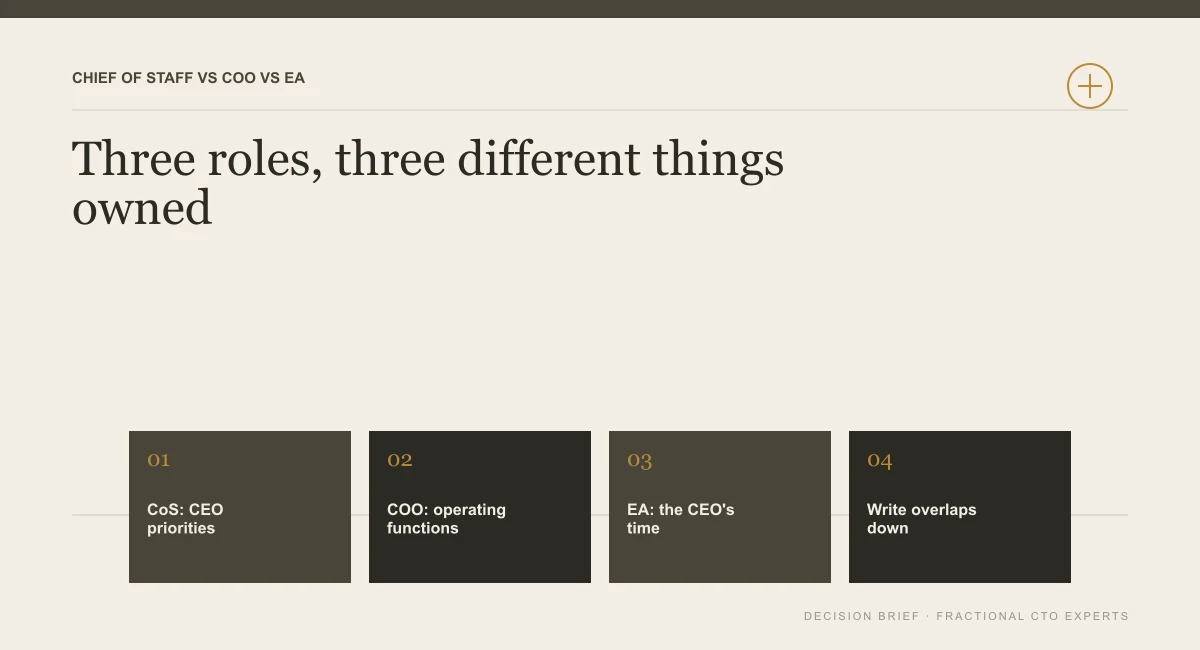
These three roles overlap in daily contact with the CEO, which is why companies confuse them. They differ in what each one owns. The public definitions help with two of them. The BLS groups chief operating officers with chief executives and notes that general and operations managers "oversee activities that are too diverse to be classified into one area of management or administration." It describes executive secretaries and executive administrative assistants as people who "provide high-level support for an office and for top executives of an organization" and who often handle complex responsibilities such as reviewing incoming documents, conducting research and preparing reports.
The table below describes common usage, not a universal standard. Your company may combine roles, and that is fine as long as the description says so.
| Question | Chief of staff | COO | Executive assistant |
|---|---|---|---|
| What do they own? | The CEO's priorities and the leadership operating rhythm | Named operating functions, their budgets and results | The CEO's time, logistics and correspondence |
| Whose authority do they act with? | The CEO's, as delegated | Their own, as an officer of the company | The CEO's, for scheduling and access |
| Direct reports | None, or a small office of the CEO | Functional leaders and their teams | Usually none |
| Typical output | Decision briefs, plans, meeting systems, shipped initiatives | Operating results against plan | A calendar and inbox that match the CEO's priorities |
| Measured on | Decisions made on time, commitments kept, initiatives delivered | Revenue, cost, quality or delivery metrics for owned functions | Reliability, responsiveness and the CEO's effective use of time |
| When the role is missing | Decisions stall and cross-functional work drifts | Functions run without a single accountable operator | The CEO spends hours on scheduling and logistics |
None of this is a ladder. An excellent executive assistant holds more context and exercises more judgment than a weak chief of staff, and a chief of staff is not a junior COO. If your problem is that several operating functions need one accountable leader with a budget, write a COO job description instead. If the CEO role itself is unclear, start with the CEO job description template, because a chief of staff cannot compensate for a principal whose own mandate is undefined.
Worked example: sort the work before you choose the title
Before writing the description, list the work the CEO wants to hand over and sort it. The example below uses an invented company. Every number is an assumption chosen for illustration and none is a benchmark.
Assumptions. The founder of a 90-person software company keeps a two-week diary and finds 22 hours a week of work they want off their desk. They sort each item by asking one question: does this need someone who can stand in for my judgment, someone who owns a function, or someone who manages my time?
| Work the founder wants to hand over | Hours per week | Needs | Belongs with |
|---|---|---|---|
| Preparing the weekly leadership meeting and chasing actions | 4 | Judgment about priorities | Chief of staff |
| Quarterly planning and board pack assembly | 3 (averaged) | Judgment and cross-functional access | Chief of staff |
| Running a pricing change across product, sales and finance | 4 | Cross-functional leadership | Chief of staff |
| First drafts of internal updates and investor notes | 2 | Knowing the founder's voice and views | Chief of staff |
| Scheduling, travel, expenses and inbox triage | 5 | Reliability and context | Executive assistant |
| Resolving support escalations and vendor renewals | 4 | Functional ownership | Head of support or operations |
Result. In this invented case, 13 of the 22 hours are chief of staff work, 5 are executive assistant work and 4 belong to a functional owner who should already exist. Three conclusions follow. First, there is a real chief of staff role, though at 13 hours of handed-over work it starts narrower than a full week, so the description must say what else fills the role, such as two named initiatives. Second, hiring a chief of staff without solving the 5 hours of scheduling will turn a senior hire into an expensive assistant within a month. Third, the 4 hours of escalations point to an ownership gap that no executive-office hire will fix.
Run the same exercise with your own diary. If most hours land in the functional column, you need an operator. If most land in the time-management column, read the fractional executive assistant guide before you write a chief of staff description.
Editable chief of staff job description template
Copy the template and replace every bracketed field. Delete any responsibility outside the real mandate. A short, accurate description attracts better candidates than a long one that lists every task the CEO dislikes.
JOB TITLE: Chief of Staff [to the CEO / to the Founder / to the (executive title)]

COMPANY: [Company name] — [one sentence on what you do and for whom]

REPORTS TO: [Name and title of the principal]
DIRECT REPORTS: [None / executive assistant / program manager / analyst]
LEVEL: [e.g. manager / director / vice president equivalent]
SITS IN: [executive team meeting: yes, as a member / yes, as facilitator / no]
LOCATION AND WORKING ARRANGEMENT: [location, remote or hybrid, expected travel]
ENGAGEMENT: [full-time employee / fixed-term / fractional], [working pattern]
EXPECTED TENURE IN ROLE: [e.g. an 18 to 24 month tour leading to a line
role / an ongoing career role]

WHY WE ARE HIRING NOW
[The specific problem: leadership meetings reopen the same decisions /
cross-functional initiatives have no owner / the CEO is the bottleneck for
planning and board preparation / the executive team doubled this year.]
Explain what changes if this role succeeds.

PURPOSE OF THE ROLE
The Chief of Staff extends the capacity of [principal] by running the
leadership operating rhythm, preparing decisions and driving [number]
company-level priorities that span functions, so that decisions are made
on time and commitments are kept.

RESPONSIBILITIES
- Run the executive operating rhythm: [weekly leadership meeting, monthly
  business review, quarterly planning, board preparation].
- Prepare decision briefs for [principal]: facts, options, trade-offs and
  a recommendation, with the relevant owners consulted.
- Keep the record of decisions and commitments, and follow up on them.
- Lead these cross-functional priorities: [initiative 1], [initiative 2].
- Coordinate annual and quarterly planning with [finance / functional leaders].
- Draft internal communications, all-hands content and board materials
  for [principal]'s review.
- Triage requests for [principal]'s attention with [executive assistant].
- Represent [principal] in [named meetings or forums] within delegated limits.
- [Manage the office of the CEO: executive assistant, program manager.]
- Handle confidential matters, including [board, personnel, transaction]
  information, under the company's confidentiality rules.

WHAT THIS ROLE DOES NOT DO
- It does not manage [functional leaders]; they report to [principal].
- It does not own [calendar and travel / a functional budget / customer
  accounts]; those stay with [owner].
- It does not approve [spend, hires, pricing, external commitments]
  unless delegated in writing.

DECISION RIGHTS
The Chief of Staff decides: [leadership meeting agendas, planning calendar
and templates, how commitments are tracked, the plan for assigned
initiatives within approved scope].
The Chief of Staff recommends, and [principal] approves: [company
priorities, changes to initiative scope, the board agenda, messages sent
in the principal's name].
Reserved to [principal / board]: [strategy, budget, executive hiring and
performance, anything binding the company externally].

WHAT SUCCESS LOOKS LIKE
- First 30 days: [map of decisions, meetings and commitments; agreed
  working rules with the principal]
- First 60 days: [operating rhythm running; decision record in use]
- First 90 days: [one cross-functional result delivered; planning cycle
  prepared]
- First 12 months: [named initiatives delivered; principal's time moved
  toward agreed priorities; leadership team rates the operating rhythm useful]

EXPERIENCE WE NEED
- Has structured and delivered cross-functional work without formal
  authority over the people doing it.
- Writes clear, short decision documents. [Work sample requested.]
- Has handled confidential information in a role of trust.
- Comfortable with [financial models / product metrics / the specific
  domain], to the level the initiatives require.
[Add only requirements the work needs. Separate "essential" from
"helpful". Do not add degree or years-of-experience rules by default.]

COMPENSATION AND BENEFITS
[Base pay range where required by applicable law], [bonus structure, if
any], [equity, if any], [benefits].

HOW TO APPLY
[Process, stages, work sample, timeline, contact for adjustments.]
Two sections in this chief of staff job description template are missing from most published examples. "What this role does not do" protects the hire from becoming the place where every unowned task lands. "Expected tenure" tells candidates whether this is a development tour or a career seat. Both answers are legitimate, but they attract different people.
Level variants: first chief of staff to a founder, or chief of staff in a larger executive team
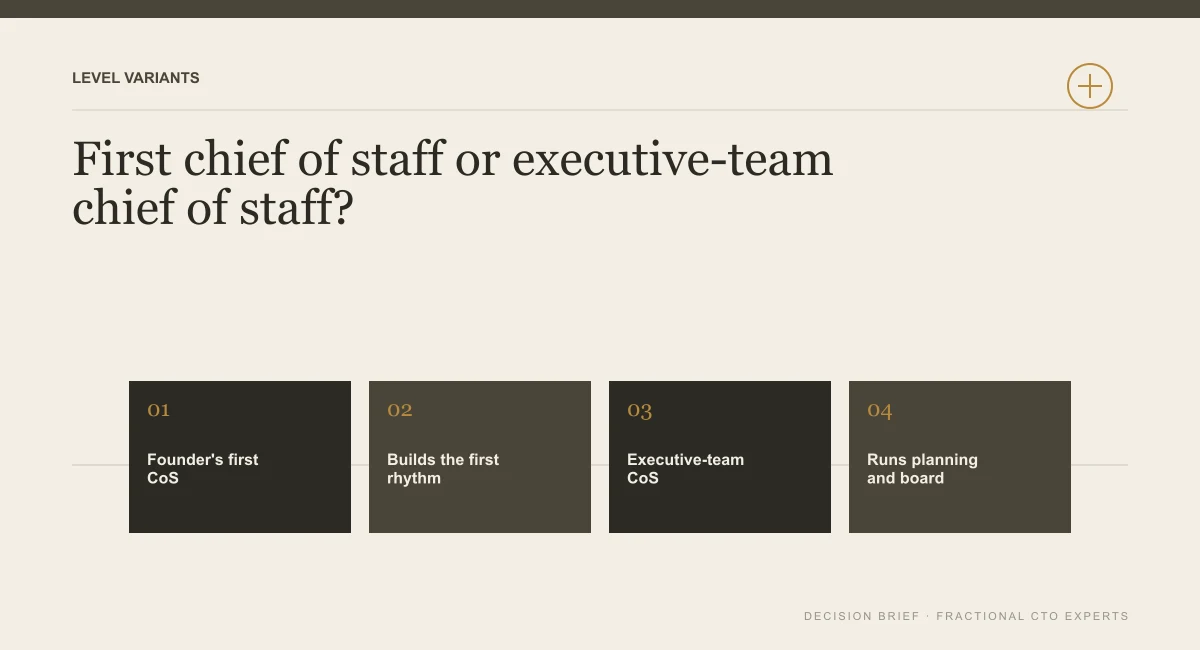
The title covers a wide range of seniority. The Chief of Staff Network's leveling framework describes six levels, from analyst or associate up to executive, and warns that "the 'Chief' in CoS can be deceptive, as not every CoS is at the CXO level." It also names company size as a key reason the role takes such different forms. Two variants cover most company hiring. Choose one, because a description that blends them will confuse candidates about seniority and pay.
| Dimension | Variant A: first chief of staff to a founder or CEO | Variant B: chief of staff in a larger executive team |
|---|---|---|
| Starting point | No operating rhythm; the founder holds most context in their head | Established executive team, planning cycle and board calendar |
| Main job | Build the first leadership rhythm and take whole problems off the founder | Run the system across many executives and keep it honest |
| Scope of work | Broad and hands-on: analysis, project leadership, drafting, some gaps nobody else covers | Narrower and more formal: planning, governance, executive alignment, board process |
| Team | Usually none | Often a small office of the CEO |
| Relationship with executives | Peer-like with a small leadership group, often less experienced than them | Facilitator among senior executives; needs standing to challenge them |
| Typical level | Manager to director equivalent | Director to vice president equivalent, sometimes executive |
| Main risk | Becomes a catch-all assistant or a shadow decision-maker | Becomes a bureaucratic layer between the CEO and their reports |
| Evidence to ask for | Built process from nothing; delivered varied projects alone | Ran planning or governance across senior stakeholders at comparable scale |
Variant A additions: first chief of staff to a founder or CEO
Add or swap these lines into the template when nobody has held the role before:
- Design the first weekly leadership meeting, decision record and quarterly planning process, and revise them after one cycle.
- Take ownership of [two or three named problems] from the founder, from diagnosis to a delivered result.
- Fill short-term gaps in [a named area, such as recruiting coordination or investor reporting] until an owner is hired, with an end date for each.
- Agree working rules with the founder in the first two weeks: how you disagree, what you can say in their name and how fast urgent items reach them.
- Experience: has worked directly with a founder or senior executive in a fast-changing company, and is willing to do unglamorous work personally.
Put an end date on every gap-filling task. Without one, the first chief of staff becomes the permanent owner of recruiting coordination, office moves and anything else that arrived before a functional hire did.
Variant B additions: chief of staff in a larger executive team
Add or swap these lines when the executive team is established and the job is to run its system:
- Own the annual planning calendar and the process that turns company goals into functional plans, with finance and each executive.
- Manage the board and committee calendar, the board pack and follow-up on board actions with the company secretary or general counsel.
- Lead the office of the CEO: [executive assistant, program managers, analysts].
- Facilitate executive team meetings and off-sites, including surfacing disagreements that executives are avoiding.
- Run [a named portfolio] of strategic initiatives with executive sponsors and a regular review.
- Experience: has run planning or governance processes among senior executives, and can show a time they changed an executive's position with evidence.
Decision-rights table for a chief of staff
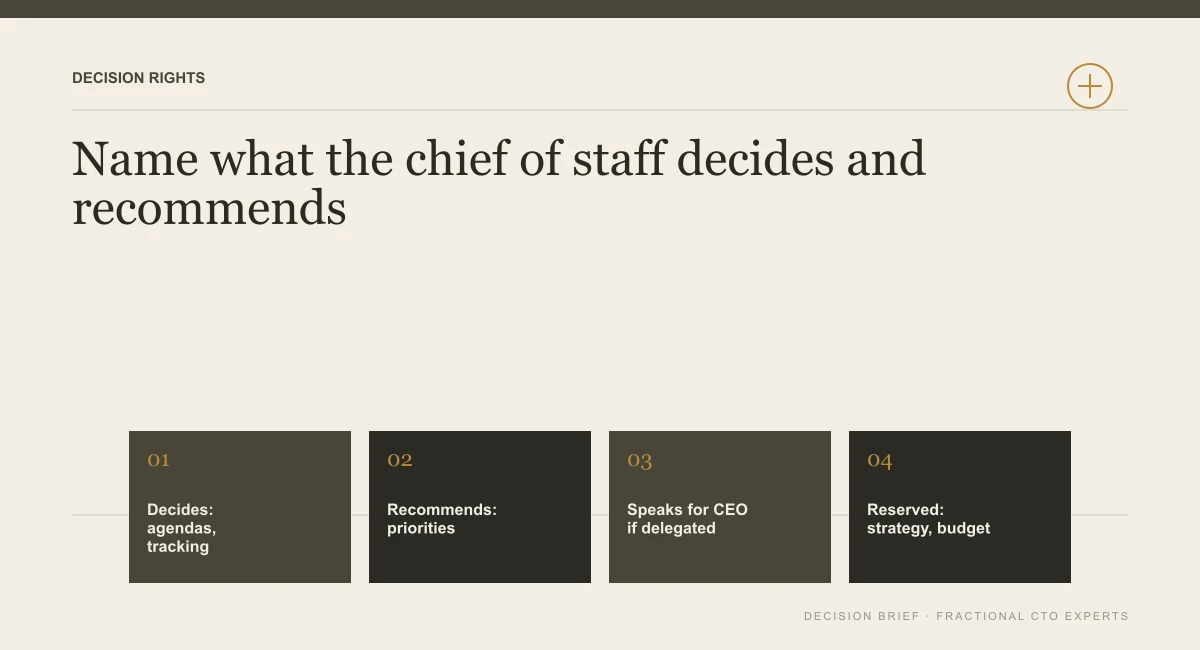
Most chief of staff failures are authority failures. Either the person acts with more of the CEO's authority than they were given, and executives stop trusting them, or they have none, and they become a note-taker. Fill in this table with the principal before the description is published, and share it with the executive team on the hire's first day. The entries are a suggested starting point, not a standard.
| Decision | Chief of staff decides | Chief of staff recommends, principal approves | Reserved to principal or board |
|---|---|---|---|
| Leadership meeting agenda and pre-reads | Yes | ||
| Format of the decision record and commitment tracker | Yes | ||
| Planning calendar and templates | Yes | ||
| Plan and sequencing for an assigned initiative | Yes, within approved scope | Changes to scope, budget or deadline | |
| Which requests reach the principal | Day-to-day triage | Standing rules for access | |
| Company priorities for the quarter | Yes | ||
| Messages sent in the principal's name | Yes, every time unless a category is delegated | ||
| Board agenda and materials | Yes | Final sign-off | |
| Resolving a disagreement between two executives | Frames options and facilitates | Makes the call | |
| Spend, hiring and vendor commitments | Within own approved budget only | Requests beyond it | Functional and company budgets |
| Executive hiring, pay and performance | Input when asked | Yes | |
| Strategy, financing and anything binding the company | Yes |
Add one more column in your own version if it helps: who must be consulted. A chief of staff who recommends a change to the product roadmap without consulting the product leader has damaged the relationship the role depends on, even if the recommendation is right.
The table also settles the most sensitive question in the role, which is when the chief of staff speaks for the CEO. A workable rule is that the chief of staff may communicate a decision the principal has made, may say what they believe the principal would want only when they label it as their own reading, and may never invent an instruction. Write that rule down.
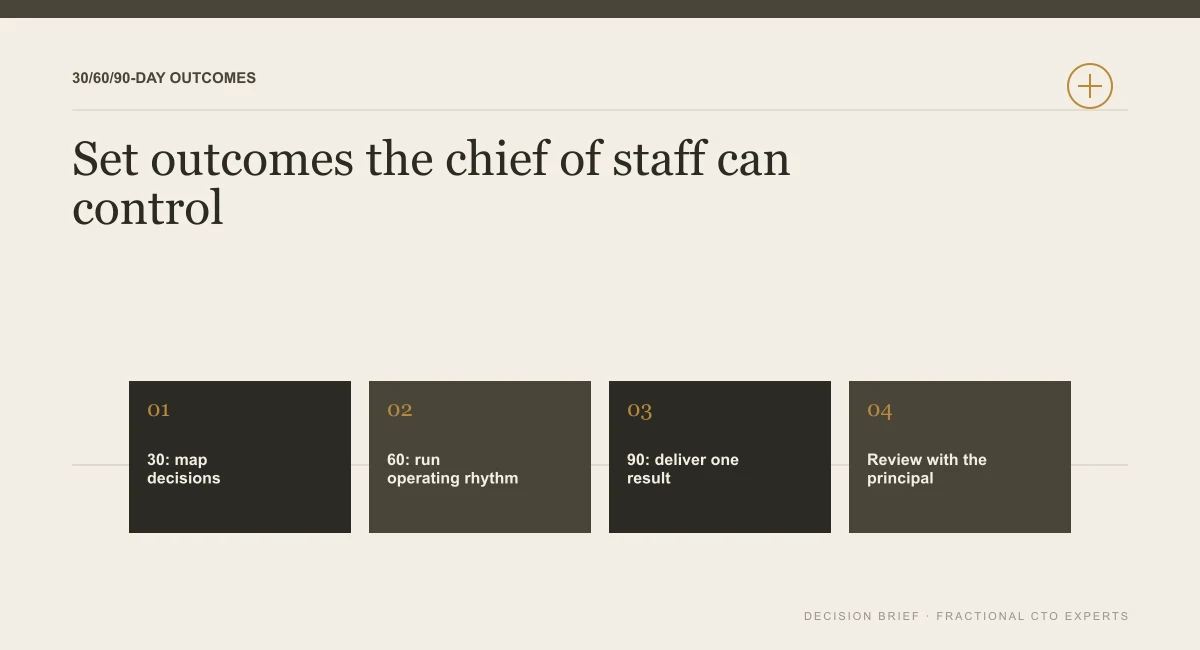
30/60/90-day outcomes
Set outcomes the chief of staff can control. Company results in the first quarter were set in motion before they arrived. What they can change is how decisions get made and whether commitments are kept.
Days 1 to 30: map how decisions really get made.
- Meet every member of the leadership team and ask what they need from the principal that they are not getting.
- Sit in on each recurring executive meeting and record what it decides, compared with what it is supposed to decide.
- List open commitments from the last quarter of leadership meetings and their real status.
- Agree written working rules with the principal: disagreement, delegation, confidentiality and escalation.
- Deliver a short assessment: where decisions stall, which meetings can be cut or changed, and the two initiatives to take on first.
Days 31 to 60: run the operating rhythm.
- Relaunch the leadership meeting with a decision-first agenda and pre-reads sent on a fixed schedule.
- Put the decision record and commitment tracker into use, with owners and dates accepted by the people named.
- Start work on the first assigned cross-functional initiative with a one-page plan the sponsors have agreed.
- Agree the triage rules for the principal's time with the executive assistant.
- Hold a first review with the principal against the working rules and adjust them.
Days 61 to 90: deliver one visible result.
- Complete a defined milestone on the first initiative, or bring a clear recommendation to stop or change it.
- Prepare the next planning cycle or board meeting from start to finish.
- Report the share of leadership commitments closed on time since the tracker began, with the reasons for the misses.
- Ask the leadership team for structured feedback on the operating rhythm and publish what will change.
- Agree priorities for the next two quarters with the principal.
At day 90 the principal should be able to answer three questions with evidence. Do leadership meetings now end in decisions? Do commitments get tracked and closed? Has the chief of staff delivered one piece of cross-functional work that would not have happened without them?
Interview scorecard for a chief of staff
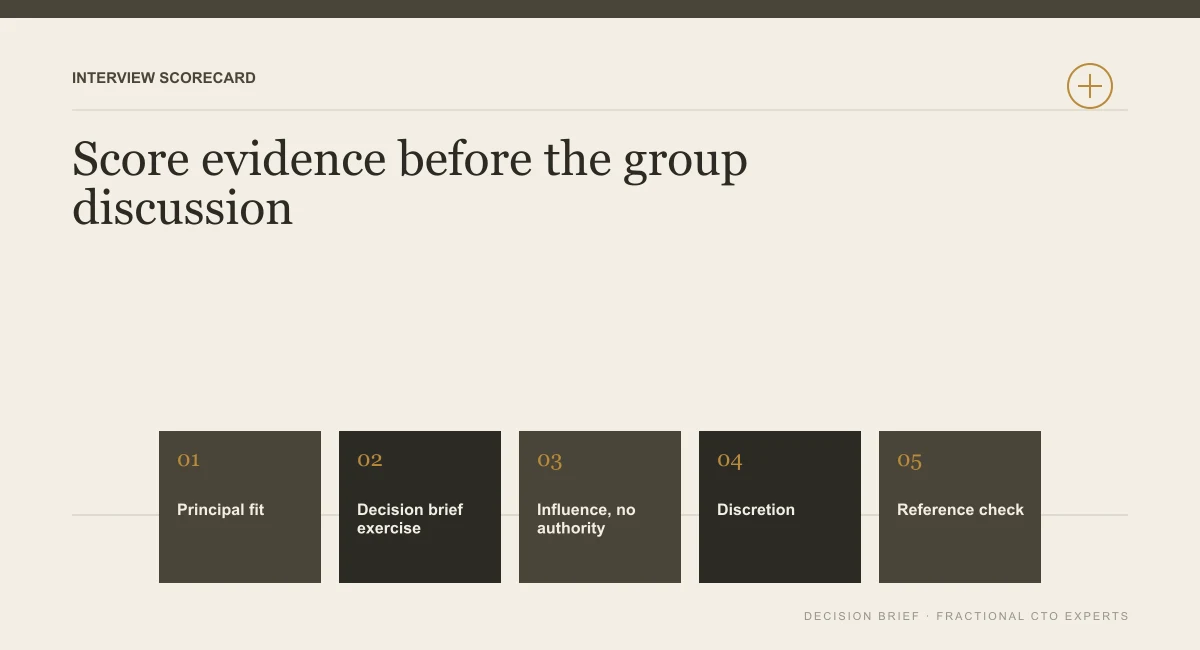
Agree the criteria before the first interview and give each interviewer a different part of the scorecard. Each interviewer should score and write down their evidence before the group discussion. The principal must interview personally and at length, because the working relationship is most of the job.
| Criterion | Question or exercise | Strong evidence | Weak signals |
|---|---|---|---|
| Structured thinking | Give a messy two-page scenario and ask for a one-page decision brief in 45 minutes | Clear question, real options, trade-offs, a recommendation and what they would check next | A summary with no recommendation, or a recommendation with no options |
| Influence without authority | "Tell me about a time you needed something from a senior person who did not report to you and did not want to do it." | Understood their constraints, changed the proposal, kept the relationship | Went over their head first; borrowed the boss's name as the main tactic |
| Speaking for the principal | "When did you represent your manager's view and get it wrong? What happened?" | Owns the error, describes the rule they adopted afterwards | Claims it never happened |
| Disagreeing with the principal | The principal states a deliberately weak plan in the interview and asks for a reaction | Challenges it respectfully with reasons and an alternative | Agrees immediately, or lectures |
| Follow-through | "Describe the system you used to track commitments across a team. What broke?" | A simple system, real failure modes, how they chased without damaging trust | Tool names with no account of behavior |
| Discretion | "Describe a situation where you held information others wanted. How did you handle requests for it?" | Clear boundaries, honest refusals, no hint of what the information was | Shares confidential detail from a past employer in the answer |
| Range | Ask them to walk through two very different projects they delivered | Different skills in each, with their personal contribution clear | One kind of work described twice |
| Motivation and tenure | "What do you want to be doing after this role?" | An answer that fits the tenure you are offering | Wants a line role immediately, or sees the role as proximity to power |
Use a four-point scale: no evidence, partial evidence, sufficient evidence and strong relevant evidence. Record why you chose each score. Keep interview questions tied to the work. The EEOC advises that information requested before hiring should generally be limited to what is essential for determining whether a person is qualified for the job.
For references, ask permission and follow your company's recruitment process. Speak to a former principal and to at least one peer executive who was on the receiving end of the candidate's follow-up. Useful questions include: "What did you hand to this person that you would not have handed to anyone else?", "How did other executives respond when they spoke for you?" and "What would you not give them responsibility for?"
Write it so the right candidates apply, and keep it lawful
Experienced candidates read a chief of staff posting for three signals: who the principal is, whether the mandate is real and what happens afterwards. Name the principal. Name the first two initiatives. Say whether the role sits in the executive meeting. Vague phrases such as "act as the CEO's right hand" and "wear many hats" tell a strong candidate that nobody has decided what the job is.
Keep the language about the work. The EEOC explains that it is illegal to publish a job advertisement that shows a preference for, or discourages someone from applying because of, protected characteristics, including age for people 40 or older. Its example is an ad seeking "recent college graduates," which may discourage people over 40 from applying. Chief of staff postings often drift into this territory with phrases like "early-career high flyer" or a requirement for a degree from a particular kind of school. Describe the evidence you need instead.
Compensation needs care, because the level range is so wide. Some jurisdictions require a pay range in job postings. In New York State, for example, the Department of Labor says businesses with four or more employees must list compensation ranges for advertised jobs, promotions and transfers. Check the rules that apply where the role is based and where candidates may live, and have the completed description reviewed.
There is no federal wage series for chief of staff. For context only, the BLS reported May 2025 median annual wages of $76,590 for executive secretaries and executive administrative assistants, $105,770 for general and operations managers and $213,990 for chief executives. Those occupations span every industry and company size, and none of them is a chief of staff. The spread shows why the level you choose in the template matters more than the title. It does not tell you what to pay.
When a fractional chief of staff or a different role fits instead
A full-time chief of staff is the wrong hire when the work is bounded, when the real gap is functional ownership or when the principal has not decided what to delegate. The table describes common situations. Treat it as a starting point for your own decision.
| Situation | Better first step | Why |
|---|---|---|
| One planning cycle, fundraise or integration needs running, then the need shrinks | A fractional chief of staff with a defined mandate | The work has an end; a permanent seat would need a second job invented for it |
| The CEO's week is consumed by scheduling, travel and inbox | An executive assistant, full-time or fractional | A chief of staff hired for this will leave or be wasted |
| Several operating functions need one accountable leader | A COO, or a fractional COO while you scope the role | The gap is ownership with a budget, which a chief of staff does not have |
| One large project needs coordination and nothing else | A program or project manager | The work needs delivery discipline more than access to the principal |
| The executive team is growing and decisions are stalling across functions | A full-time chief of staff, Variant B | The operating rhythm needs continuous ownership |
| A founder is the bottleneck and has never had a deputy | A full-time chief of staff, Variant A, with a narrow first mandate | Start with two named problems and widen the role as trust builds |
| The principal cannot name what they would hand over | Run the diary exercise above before hiring anyone | No description can fix an undefined delegation |
A fractional arrangement can also be a low-risk way to test the role. A principal who has never worked with a chief of staff learns in one quarter what they are willing to delegate, and the permanent description gets better for it. When your description is ready, you can post the role on the marketplace as full-time, interim or fractional and assess each candidate's evidence yourself.
Final review before you publish the description
Run through these checks before the description goes to candidates:
- The principal is named, and the role reports to that person.
- Every responsibility has matching authority or a named approver in the decision-rights table.
- The "does not do" section exists and is specific.
- The variant matches your situation: first chief of staff or executive-team chief of staff, not a blend.
- The level and whether the role sits in the executive meeting are stated.
- Expected tenure and the likely next step are stated.
- The 30/60/90-day outcomes are things the hire can control.
- Requirements are split into essential and helpful, with no arbitrary degree or years-of-experience rules.
- Compensation is described accurately, with any pay range required where the role is based.
- Someone outside the hiring team can read it and explain what the chief of staff will own and what stays with the CEO.
This page is an editorial hiring resource. The worked example uses an invented company and illustrative assumptions, not benchmarks or client results. It does not announce a vacancy at Fractional CTO Experts, and it does not replace advice from the people responsible for employment compliance in your jurisdiction.
Frequently asked questions
Is a chief of staff a C-suite position?
Not automatically. The Chief of Staff Network's leveling framework describes six levels, from analyst to executive, and notes that the word chief can be deceptive. State the level in the description through scope: who the person reports to, whether they sit in the executive meeting and what they can decide.
Who does a chief of staff report to?
Almost always to the principal they support, usually the CEO or founder, and sometimes another executive such as a COO or division president. A chief of staff who reports to someone other than the person whose priorities they carry will struggle to speak with that person's authority.
Does a chief of staff manage people?
It depends on the variant. A first chief of staff to a founder usually has no direct reports and works through influence. A chief of staff in a larger executive team may lead a small office of the CEO, such as an executive assistant, a program manager and an analyst. Say which in the description.
How long should someone stay in a chief of staff role?
There is no fixed rule. Many companies treat the role as a defined tour that leads to a line role, while others keep a career chief of staff. Decide which you are offering and write it into the description, because it changes who applies and what they expect next.
What background makes a good chief of staff?
Look for evidence of the work rather than a specific prior title: structuring ambiguous problems, writing clear decision briefs, moving cross-functional work without formal authority and handling confidential information. Consulting, operations, product, finance and program management backgrounds can all supply that evidence.
Can a chief of staff role be part-time or fractional?
Yes, when the work can be bounded, such as running one planning cycle or one cross-functional initiative, and functional leaders carry decisions between sessions. A principal who needs near-continuous support is describing a full-time role.
Sources and further reading
- US BLS Occupational Outlook Handbook: Top Executives
- O*NET OnLine: 11-1011.00 Chief Executives
- US BLS Occupational Outlook Handbook: Secretaries and Administrative Assistants
- Chief of Staff Network: Leveling Framework
- US EEOC: Prohibited Employment Policies/Practices
- New York State Department of Labor: Pay Transparency