Fractional CTO Rates: Hourly, Day Rate & Retainer Comparison
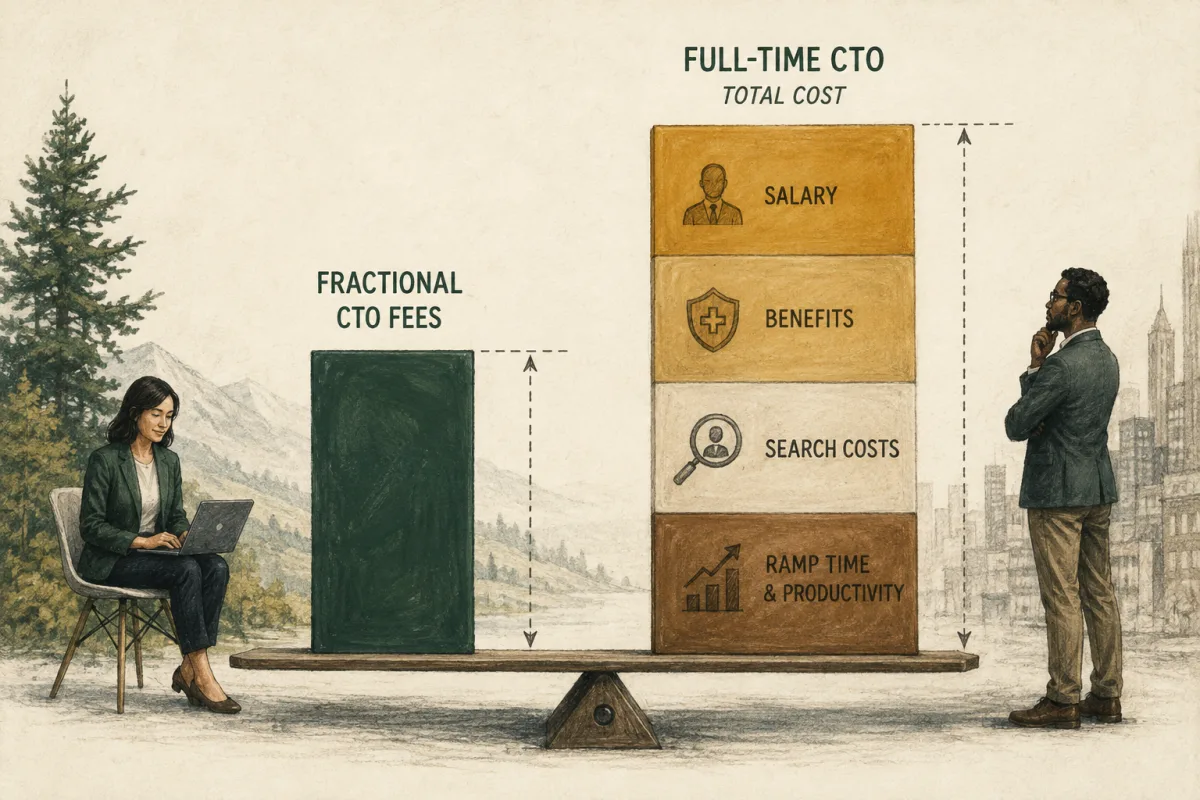
Fractional CTO rates vary significantly based on pricing model. Hourly rates range from $200-$600/hour, day rates from $2,000-$5,000/day, and monthly retainers from $8,000-$25,000/month. But which model gives you the best value?
The answer: Monthly retainers offer 30-40% better value than hourly rates while providing ongoing strategic partnership instead of transactional consulting.
Here's the math: A $14,000/month retainer for 50 hours equals $280/hour effective rate. The same fractional CTO billing hourly would charge $400-450/hour, costing you $20,000-$22,500 for those same 50 hours.
This comprehensive guide breaks down all three pricing models - hourly, day rate, and monthly retainer - with real numbers, detailed comparisons, and calculation examples so you know exactly what to expect and which model makes sense for your situation.
Understanding the Three Pricing Models
Before diving into specific rates, let's understand how each model works and when it's used.
Model Overview Comparison
| Pricing Model | Rate Range | Best For | Common Usage |
|---|---|---|---|
| Hourly | $200-$600/hour | One-time projects, variable needs | 15% of engagements |
| Day Rate | $2,000-$5,000/day | Project-based work, workshops | 5% of engagements |
| Monthly Retainer | $8,000-$25,000/month | Ongoing relationships, strategic partnership | 80% of engagements |
Why Most Fractional CTOs Prefer Monthly Retainers:
- Predictable revenue
- Deeper client relationships
- Better context and strategic impact
- Less administrative overhead (time tracking)
Why Clients Prefer Monthly Retainers:
- 30-40% cost savings vs. hourly
- Predictable monthly costs
- Priority access to CTO
- Ongoing relationship vs. transactional
Let's break down each model in detail.
Fractional CTO Hourly Rates
Hourly billing is straightforward: you pay for actual hours worked. But hourly rates vary widely based on experience, location, and specialization.
Hourly Rate Ranges by Experience
Junior Fractional CTO (5-10 years experience)
- Rate: $200-$300/hour
- Background: Senior engineer, first-time CTO, limited leadership experience
- Best For: Early-stage startups, straightforward technical needs
- Typical Engagement: Architecture reviews, technical advice, hiring support
Mid-Level Fractional CTO (10-15 years experience)
- Rate: $300-$400/hour
- Background: Multiple CTO roles, scaled teams 10-50 engineers, fundraising experience
- Best For: Seed to Series A, scaling challenges, moderate complexity
- Typical Engagement: Strategic guidance, team building, architecture decisions
Senior Fractional CTO (15-20 years experience)
- Rate: $400-$500/hour
- Background: Multiple successful CTO roles, scaled teams 50-100+, proven track record
- Best For: Series A-B, complex technical challenges, regulatory compliance
- Typical Engagement: Comprehensive CTO services, board-level work, M&A support
Executive Fractional CTO (20-25+ years experience)
- Rate: $500-$600/hour
- Background: CTO at major exits/IPOs, scaled teams to 200-500+, industry thought leader
- Best For: Series B+, high-stakes situations, complex transformations
- Typical Engagement: Strategic transformation, investor relations, executive-level advisory
Hourly Rate Breakdown Table
| Experience Level | Years | Hourly Rate | Typical Project (20 hrs) | Monthly (40 hrs) | Annual (500 hrs) |
|---|---|---|---|---|---|
| Junior | 5-10 | $200 - $300 | $4,000 - $6,000 | $8,000 - $12,000 | $100,000 - $150,000 |
| Mid-Level | 10-15 | $300 - $400 | $6,000 - $8,000 | $12,000 - $16,000 | $150,000 - $200,000 |
| Senior | 15-20 | $400 - $500 | $8,000 - $10,000 | $16,000 - $20,000 | $200,000 - $250,000 |
| Executive | 20-25+ | $500 - $600 | $10,000 - $12,000 | $20,000 - $24,000 | $250,000 - $300,000 |
What's Included in Hourly Rate
Typically Included:
- Actual meeting time (video calls, in-person sessions)
- Deliverable creation (documents, presentations, code reviews)
- Research and analysis time
- Interview time (for hiring support)
Typically NOT Included (Unless Billed):
- Email and Slack communication (some CTOs bill, some don't)
- Travel time (often billed at 50% rate or not at all)
- Administrative tasks
- Thinking time between sessions
Billing Increments:
- Most common: 15-minute increments
- Some: 30-minute increments
- Rare: 6-minute (0.1 hour) increments
Example Hourly Billing:
Fractional CTO: Senior level, $450/hour
Month 1 Activity Breakdown:
- Initial assessment meeting: 2 hours = $900
- Architecture review: 5 hours = $2,250
- Technical interviews (4 candidates): 4 hours = $1,800
- Strategy document creation: 6 hours = $2,700
- Follow-up calls: 2.5 hours = $1,125
- Code review: 1.5 hours = $675
Total Hours: 21 hours
Total Cost: $9,450
Effective Rate: $450/hour
When Hourly Billing Makes Sense
Scenario 1: One-Time Projects
- Architecture review before major build
- Technical due diligence for acquisition
- Technology stack evaluation
- Duration: 2-4 weeks, 15-30 total hours
- Why Hourly: Bounded scope, won't need ongoing relationship
Scenario 2: Uncertain or Variable Needs
- Just exploring fractional CTO concept
- Needs vary month-to-month (5 hours one month, 25 hours next month)
- Testing relationship before retainer commitment
- Why Hourly: Pay only for what you use, maximum flexibility
Scenario 3: Very Early Stage with Minimal Budget
- Pre-seed, 2-3 person team
- Limited cash, can only afford 5-10 hours/month
- Don't need regular ongoing engagement
- Why Hourly: Can't commit to $8K+ monthly retainer, want occasional expert input
Scenario 4: Specific Expert Consultation
- Need expert opinion on specific technology (e.g., ML infrastructure, blockchain)
- 2-3 hour consultation sufficient
- Don't need general CTO services
- Why Hourly: Targeted expertise, minimal time needed
When Hourly Billing Doesn't Make Sense
Red Flag 1: Ongoing Regular Needs If you need 30-50+ hours/month consistently, monthly retainer saves 30-40%.
Example:
- Hourly: 40 hours × $400/hour = $16,000/month
- Retainer: 40 hours = $12,000/month
- Savings: $4,000/month ($48K/year)
Red Flag 2: Strategic Partnership Hourly creates transactional mindset. CTO hesitates to send quick Slack message because "am I billing for this?" Retainer encourages open communication.
Red Flag 3: Unpredictable Costs Hourly billing creates budget uncertainty. One month $6K, next month $18K. Hard to forecast.
Real Example: Hourly Engagement
Company: Seed-stage B2B SaaS, 8 engineers, technical founder
Need: Architecture review and technology roadmap before Series A fundraising
Engagement:
- Fractional CTO: Mid-level, $350/hour
- Scope: Architecture assessment, roadmap creation, investor materials
- Duration: 3 weeks
Actual Hours:
Week 1:
- Kickoff meeting: 1.5 hours
- Codebase review: 6 hours
- Team interviews: 3 hours
Subtotal: 10.5 hours × $350 = $3,675
Week 2:
- Architecture analysis: 8 hours
- Technology roadmap creation: 5 hours
- Draft review meeting: 1.5 hours
Subtotal: 14.5 hours × $350 = $5,075
Week 3:
- Investor presentation prep: 4 hours
- Final presentation: 2 hours
- Follow-up documentation: 2 hours
Subtotal: 8 hours × $350 = $2,800
Total: 33 hours × $350 = $11,550
Outcome:
- Comprehensive architecture assessment delivered
- Technology roadmap for 12-18 months
- Investor-ready technical materials
- Series A raised successfully 2 months later
Why Hourly Worked:
- Bounded project with clear deliverable
- Didn't need ongoing relationship (yet)
- Budget certainty (quoted 30-35 hours upfront)
What Happened Next: After successful Series A, company hired same fractional CTO on monthly retainer ($14K/month) for ongoing strategic guidance.
Fractional CTO Day Rates
Day rates are less common but used for specific project-based work like workshops, intensive planning sessions, or on-site engagements.
Day Rate Ranges
What Is a "Day"?
- Typically 6-8 hours of focused work
- Often on-site or intensive remote session
- Includes preparation and follow-up (usually)
Junior Fractional CTO
- Day Rate: $2,000-$3,000/day
- Hourly Equivalent: $250-$375/hour (assuming 8-hour day)
- When: Workshops, planning sessions, team off-sites
Mid-Level Fractional CTO
- Day Rate: $3,000-$4,000/day
- Hourly Equivalent: $375-$500/hour
- When: Strategic planning, architecture workshops, board prep
Senior Fractional CTO
- Day Rate: $4,000-$5,000/day
- Hourly Equivalent: $500-$625/hour
- When: Executive workshops, complex technical planning, M&A due diligence
Executive Fractional CTO
- Day Rate: $5,000-$7,500/day
- Hourly Equivalent: $625-$937/hour
- When: Board-level sessions, major strategic initiatives, crisis management
Day Rate Breakdown Table
| Experience Level | Day Rate | 3-Day Project | 5-Day Project | 10-Day Project |
|---|---|---|---|---|
| Junior | $2,000 - $3,000 | $6,000 - $9,000 | $10,000 - $15,000 | $20,000 - $30,000 |
| Mid-Level | $3,000 - $4,000 | $9,000 - $12,000 | $15,000 - $20,000 | $30,000 - $40,000 |
| Senior | $4,000 - $5,000 | $12,000 - $15,000 | $20,000 - $25,000 | $40,000 - $50,000 |
| Executive | $5,000 - $7,500 | $15,000 - $22,500 | $25,000 - $37,500 | $50,000 - $75,000 |
What's Included in Day Rate
Standard Day Rate Includes:
- 6-8 hours of focused work on scheduled day
- Preparation time (1-2 hours before)
- Basic follow-up (1 hour after, documentation)
- Materials and deliverables from session
- Travel time to/from (if on-site)
NOT Typically Included:
- Travel expenses (flights, hotels, meals) - billed separately
- Extensive pre-work (>2 hours)
- Extensive post-work (>2 hours)
- Follow-up meetings beyond initial session
Multi-Day Discounts: Many fractional CTOs offer discounts for multi-day projects:
- 3-5 days: 10% discount
- 5-10 days: 15-20% discount
- 10+ days: 20-25% discount or convert to monthly retainer
Example Day Rate Calculation:
Senior Fractional CTO: $4,500/day
3-Day On-Site Strategic Planning:
- Day 1: Architecture workshop (8 hours)
- Day 2: Team structure planning (8 hours)
- Day 3: Technology roadmap session (8 hours)
- Preparation: 3 hours (included)
- Follow-up documentation: 2 hours (included)
Base Cost: 3 days × $4,500 = $13,500
Multi-day discount (10%): -$1,350
Subtotal: $12,150
Travel Expenses:
- Flight: $450
- Hotel (2 nights): $600
- Meals: $150
Total Expenses: $1,200
Total Project Cost: $13,350
Effective Hourly Rate: $495/hour (27 hours total work)
When Day Rates Make Sense
Scenario 1: Intensive Workshops or Planning Sessions
- Quarterly strategic planning (2-3 days)
- Architecture design sprint (3-5 days)
- Team off-site facilitation (1-2 days)
Why Day Rate: Focused, intensive work requiring full days of attention. Hourly doesn't make sense when it's 8 solid hours.
Scenario 2: On-Site Engagements
- Visit headquarters for team assessment (2-3 days)
- Board presentation and strategy session (1-2 days)
- Technical due diligence on-site (3-5 days)
Why Day Rate: On-site work justifies day-rate pricing. Travel time and expenses make hourly billing complicated.
Scenario 3: Project-Based Work with Clear Duration
- 2-week technical assessment (10 days)
- 1-week crisis management engagement (5 days)
- Monthly deep-dive sessions (1 day/month)
Why Day Rate: Clear scope measured in days, not hours. Simpler billing than tracking hours.
When Day Rates Don't Make Sense
Not Ideal For:
- Ongoing regular engagement (retainer better)
- Variable hour needs (some days 2 hours, some 8 hours)
- Remote async work (hourly more appropriate)
- Long-term relationships (retainer provides better value)
Day Rate vs. Hourly Comparison
When Is Day Rate Better Value Than Hourly?
Example: Senior fractional CTO needs to deliver full-day workshop.
Hourly Billing:
- 8 hours workshop × $450/hour = $3,600
- 2 hours prep × $450/hour = $900
- 1 hour follow-up × $450/hour = $450
- Total: $4,950
Day Rate Billing:
- 1 day (includes prep and follow-up) = $4,500
- Total: $4,500
Savings: $450 with day rate
Why: Day rate bundles prep and follow-up, creating efficiency.
When Is Hourly Better Value?
If actual work is only 3-4 hours (not a full day):
Hourly: 4 hours × $450 = $1,800 Day Rate: $4,500 Savings: $2,700 with hourly
Real Example: Day Rate Engagement
Company: Series A FinTech, 22 engineers, preparing for Series B
Need: 3-day on-site strategic planning session before Series B fundraising
Engagement:
- Fractional CTO: Senior level, $4,200/day
- Scope: On-site strategic planning, architecture review, board prep
- Duration: 3 days on-site + prep/follow-up
Project Breakdown:
Pre-Work (Week Before):
- Codebase review: 4 hours (remote)
- Team interviews: 3 hours (remote)
- Document review: 2 hours (remote)
(Included in day rate)
Day 1 (On-Site):
- Morning: Executive team alignment (4 hours)
- Afternoon: Engineering team workshop (4 hours)
Day 2 (On-Site):
- Morning: Architecture deep-dive (4 hours)
- Afternoon: Technology roadmap planning (4 hours)
Day 3 (On-Site):
- Morning: Board presentation prep (3 hours)
- Afternoon: Investor Q&A preparation (3 hours)
- Evening: Wrap-up and next steps (2 hours)
Follow-Up (Week After):
- Documentation and deliverables: 6 hours
- Follow-up call: 1 hour
(Included in day rate)
Pricing:
Base: 3 days × $4,200 = $12,600
Multi-day discount (10%): -$1,260
Subtotal: $11,340
Expenses:
Flight: $520
Hotel (3 nights): $750
Meals: $200
Ground transport: $80
Total Expenses: $1,550
Total Project Cost: $12,890
Total Hours Worked: ~35 hours
Effective Rate: $368/hour
Outcome:
- Comprehensive strategic plan delivered
- Board presentation materials ready
- Technology roadmap aligned with Series B goals
- Series B raised $25M, 3 months later
- CTO engagement cited by investors as confidence factor
Why Day Rate Worked:
- Intensive on-site work (couldn't be done hourly)
- Clear deliverable and timeline
- Travel justified day-rate bundling
- Company got senior CTO expertise at effective $368/hour (vs. $450-500/hour on pure hourly)
What Happened Next: Company engaged same fractional CTO on monthly retainer ($18K/month, premium package) for ongoing Series B execution support.
Monthly Retainer Rates
Monthly retainers are the most common pricing model (80% of fractional CTO engagements) because they offer the best value for both client and CTO.
Monthly Retainer Ranges
Starter Package: $8,000-$11,000/month
- Hours: 20-30 hours/month (1-1.5 days/week)
- Effective Rate: $267-$550/hour
- Best For: Pre-seed to seed, 2-10 engineers, strategic guidance only
Standard Package: $12,000-$16,000/month
- Hours: 40-50 hours/month (2-2.5 days/week)
- Effective Rate: $240-$400/hour
- Best For: Seed to Series A, 10-25 engineers, active engagement
Premium Package: $18,000-$25,000/month
- Hours: 60-80 hours/month (3-4 days/week)
- Effective Rate: $225-$417/hour
- Best For: Series A-B, 25-50+ engineers, comprehensive CTO services
Custom Package: $25,000+/month
- Hours: 80-120+ hours/month (4-6 days/week)
- Effective Rate: $208-$312/hour
- Best For: Series B+, 50+ engineers, complex needs, near full-time
Monthly Retainer Breakdown Table
| Package | Monthly Cost | Hours/Month | Days/Week | Effective Hourly Rate | Annual Cost |
|---|---|---|---|---|---|
| Starter | $8,000 - $11,000 | 20-30 | 1-1.5 | $267 - $550 | $96,000 - $132,000 |
| Standard | $12,000 - $16,000 | 40-50 | 2-2.5 | $240 - $400 | $144,000 - $192,000 |
| Premium | $18,000 - $25,000 | 60-80 | 3-4 | $225 - $417 | $216,000 - $300,000 |
| Custom | $25,000 - $35,000+ | 80-120+ | 4-6 | $208 - $437 | $300,000 - $420,000+ |
What's Included in Monthly Retainer
Comprehensive Inclusions:
- All strategic and tactical work within hour allocation
- Regular meetings (weekly or biweekly)
- Unlimited email and Slack communication (within reason)
- Emergency availability (within scope)
- Standard deliverables (roadmaps, reports, presentations)
- Hiring support (interviews, offers)
- Architecture reviews and decisions
- Team leadership and mentorship
What Sets Retainer Apart from Hourly:
Hourly Mindset:
- "Should I send this Slack message? It'll cost the client $200 for 30 minutes of my time."
- Transactional: client hesitates to ask questions
- CTO tracks every 15-minute block
- Focus on time, not outcomes
Retainer Mindset:
- "How can I provide maximum strategic value this month?"
- Partnership: open communication, proactive guidance
- CTO focuses on impact, not time tracking
- Focus on outcomes and results
The Retainer Advantage:
Example: Client has urgent question about database architecture.
Hourly Model:
- Client emails question
- CTO responds: "Happy to discuss. This will likely take 1-2 hours at $400/hour. Confirm you want to proceed?"
- Client hesitates: "Let me think about it..." (delays decision)
- Finally schedules call 3 days later
- Total Time Lost: 3 days, suboptimal decision made in interim
Retainer Model:
- Client Slacks question
- CTO responds within 2 hours with detailed answer and follow-up call offer
- Issue resolved same day
- Value: Fast decision, better outcome, no time-tracking friction
This is worth 30-40% premium in effective hourly rate.
Retainer Hour Flexibility
Most retainer contracts include flexibility:
Hour Rollover:
- Unused hours (up to 10-20%) roll to next month
- Prevents "use it or lose it" mentality
- Example: 50-hour package, use 42 hours in Month 1 → 8 hours bank for Month 2
Hour Overages:
- If regularly exceeding package, discuss upgrade
- Occasional overages (10-20%) usually absorbed
- Consistent overages (>20%) trigger package adjustment discussion
- Some contracts bill overages at hourly rate (20-30% premium)
Example:
Standard Package: $14,000/month, 45 hours
Month 1: 38 hours used (OK, within flex)
Month 2: 52 hours used (7 hours over)
Month 3: 44 hours used (on target)
Month 4: 58 hours used (13 hours over, 2 months in a row)
Action: Discuss upgrade to Premium Package (60 hours) for better value
Monthly Retainer Commitment Lengths
Month-to-Month:
- Commitment: 30-60 days notice to cancel
- Premium: No discount (baseline pricing)
- Best For: Testing engagement, uncertain needs
- Typical: First 3 months of new relationship
3-Month Minimum:
- Commitment: 3 months, then month-to-month
- Discount: 0-5% vs. month-to-month
- Best For: Standard engagements
- Typical: 50% of contracts
6-Month Commitment:
- Commitment: 6 months, then month-to-month
- Discount: 10-15% vs. month-to-month
- Best For: Established relationships, significant projects
- Typical: 30% of contracts
12-Month Commitment:
- Commitment: 12 months, then month-to-month
- Discount: 15-20% vs. month-to-month
- Best For: Long-term strategic partnerships
- Typical: 20% of contracts
Discount Impact Example:
Standard Package, 50 hours/month:
- Month-to-month: $15,000/month ($180,000/year)
- 6-month commit: $13,500/month ($162,000/year) - Save $18,000
- 12-month commit: $12,750/month ($153,000/year) - Save $27,000
Recommendation: Start month-to-month for 3 months to prove value, then commit to 6-12 months for discount.
Real Example: Monthly Retainer Engagement
Company: Series A B2B SaaS, 18 engineers, non-technical founder
Need: Ongoing CTO leadership while scaling from 18 to 35 engineers over 12 months
Engagement:
- Package: Standard, evolving to Premium
- Fractional CTO: Senior level, 16 years experience
- Duration: 12 months (ongoing)
Month 1-3: Standard Package ($14,000/month, 50 hours)
Weekly Activities:
- Strategic session with CEO (90 min)
- Engineering all-hands (1 hour)
- Architecture office hours (1 hour)
- Hiring: interviews and offers (6-8 hours)
- Ad-hoc Slack/email (4-6 hours ongoing)
Monthly Activities:
- Technology roadmap review
- Metrics and reporting
- Board prep (when needed)
Total Hours/Month: 45-52 hours
Effective Rate: $269-$311/hour
Month 4-8: Upgraded to Premium ($19,000/month, 70 hours)
Why Upgrade:
- Team grew to 28 engineers
- Needed more hands-on leadership
- Added compliance work (SOC2)
- Weekly 1-on-1s with 5 engineering leads
Weekly Activities:
- Everything from Standard, plus:
- 1-on-1s with engineering leads (5 × 30 min = 2.5 hours)
- Daily Slack engagement (additional 5 hours/week)
- SOC2 compliance work (4-6 hours/week)
Total Hours/Month: 65-75 hours
Effective Rate: $253-$292/hour
Month 9-12: Premium Package Continued
Activities Added:
- Series B preparation (investor materials, technical diligence)
- VP Engineering hiring (led search)
- Platform architecture evolution
Total Hours/Month: 68-78 hours
Annual Average: ~62 hours/month
12-Month Financials:
Month 1-3: $14,000 × 3 = $42,000
Month 4-12: $19,000 × 9 = $171,000
Total Year 1: $213,000
Total Hours: ~745 hours
Average Effective Rate: $286/hour
vs. Hourly Billing (if same CTO at $425/hour):
745 hours × $425 = $316,625
Savings with Retainer: $103,625 (33% cost reduction)
vs. Full-Time CTO:
Salary + benefits: $350,000 (Year 1 with recruiting)
Savings with Fractional: $137,000 (39% cost reduction)
Outcomes:
- Scaled team from 18 to 34 engineers successfully
- Hired VP Engineering (fractional CTO transitioned to strategic oversight)
- Achieved SOC2 Type 2 compliance
- Prepared and executed Series B raise ($20M)
- ROI: ~400% (see pricing guide for detailed ROI calculations)
What Happened Next: After Series B, company kept fractional CTO on Premium retainer ($20K/month) for strategic oversight and to support new VP Engineering. Engagement continues 2+ years later.
Pricing Model Comparison: Which Is Best?
Let's directly compare the three models side-by-side with real scenarios.
Direct Comparison Table
| Factor | Hourly | Day Rate | Monthly Retainer |
|---|---|---|---|
| Effective Cost | Highest ($300-$600/hr) | Medium ($350-$625/hr) | Lowest ($225-$400/hr) |
| Cost Predictability | Low (varies widely) | Medium (project-based) | High (fixed monthly) |
| Commitment Required | None | Project-based | 1-12 months |
| Communication Friction | High ("Is this billable?") | Medium | Low (open communication) |
| Strategic Partnership | Low (transactional) | Medium | High (invested relationship) |
| Best For | One-time projects | Intensive workshops | Ongoing needs |
| Typical Discount vs. Hourly | Baseline (0%) | 10-20% | 30-40% |
| Invoicing Complexity | High (track all time) | Medium | Low (monthly flat fee) |
| CTO Availability | Limited (on-demand) | Scheduled days only | Priority access |
| Relationship Depth | Transactional | Project-focused | Strategic partnership |
Cost Efficiency Analysis: Real Scenarios
Let's compare all three models for identical work scenarios.
Scenario 1: 20 Hours of Work
Hourly Billing:
- 20 hours × $400/hour = $8,000
- Plus: Time tracking overhead
- Plus: Communication friction (billable vs. non-billable discussions)
Day Rate Billing:
- Not efficient for 20 hours
- Would need to use 3-4 days ($12,000-$16,000)
- Or split across multiple sessions (adds complexity)
Monthly Retainer (Starter):
- $9,000/month package (25 hours included)
- 20 hours used this month
- 5 hours available for urgent needs or rolls over
- Includes unlimited Slack/email
Winner: Hourly ($8,000) vs. Retainer ($9,000)
- Hourly is $1,000 cheaper IF you only need exactly 20 hours and never want to communicate outside of billable hours
- Retainer is better value IF you need open communication and occasional extra hours
Scenario 2: 50 Hours of Work
Hourly Billing:
- 50 hours × $400/hour = $20,000
- Time tracking required
- Communication friction
Day Rate Billing:
- ~6 days (assuming 8 hours/day)
- 6 days × $3,500/day = $21,000
- Structured as 2-day sessions over 3 months
Monthly Retainer (Standard):
- $14,000/month package (50 hours included)
- All 50 hours used
- Open communication included
- Priority access
Winner: Monthly Retainer (saves $6,000-$7,000 = 30-35%)
Scenario 3: 75 Hours of Work
Hourly Billing:
- 75 hours × $425/hour = $31,875
- Significant time tracking
- Transactional relationship
Day Rate Billing:
- ~9-10 days
- 10 days × $3,800/day = $38,000
- 10% multi-day discount = $34,200
Monthly Retainer (Premium):
- $20,000/month package (75 hours included)
- Open communication, strategic partnership
- Priority emergency access
Winner: Monthly Retainer (saves $11,875-$14,200 = 37-42%)
Break-Even Analysis: When Does Retainer Pay Off?
Question: At what point does monthly retainer become more cost-effective than hourly?
Analysis:
Assumptions:
- Hourly rate: $400/hour (mid-level fractional CTO)
- Retainer packages: Starter $9K (25 hrs), Standard $14K (50 hrs), Premium $20K (75 hrs)
Break-Even Calculations:
Starter Package:
- Monthly cost: $9,000
- Hours included: 25
- Effective rate: $360/hour
- Break-even vs. $400/hour: 22.5 hours
- If you need >22.5 hours, retainer saves money
Standard Package:
- Monthly cost: $14,000
- Hours included: 50
- Effective rate: $280/hour
- Break-even vs. $400/hour: 35 hours
- If you need >35 hours, retainer saves money
Premium Package:
- Monthly cost: $20,000
- Hours included: 75
- Effective rate: $267/hour
- Break-even vs. $400/hour: 50 hours
- If you need >50 hours, retainer saves money
Visual Break-Even Chart:
Hours/Month | Hourly Cost | Starter | Standard | Premium | Best Choice
------------|-------------|---------|----------|---------|-------------
10 hours | $4,000 | $9,000 | $14,000 | $20,000 | Hourly
20 hours | $8,000 | $9,000 | $14,000 | $20,000 | Hourly
25 hours | $10,000 | $9,000 | $14,000 | $20,000 | Starter
35 hours | $14,000 | $9,000* | $14,000 | $20,000 | Starter* or Standard
50 hours | $20,000 | $9,000* | $14,000 | $20,000 | Standard
75 hours | $30,000 | $9,000* | $14,000* | $20,000 | Premium
100 hours | $40,000 | $9,000* | $14,000* | $20,000 | Premium
* = Package doesn't include enough hours, would need overages or upgrade
Key Insight: If you need 30+ hours/month consistently, monthly retainer almost always saves 25-40% vs. hourly.
Hybrid Models: Combining Approaches
Some engagements combine pricing models for optimal value.
Hybrid Model 1: Retainer + Hourly Overages
- Base: Standard retainer ($14K/month, 50 hours)
- Overage: Additional hours at $350/hour
- When: Most months need 40-50 hours, occasional month needs 60-70 hours
- Benefit: Predictable base cost, flexibility for high-intensity months
Example:
Month 1: 48 hours (within package) = $14,000
Month 2: 65 hours (15 hours over) = $14,000 + (15 × $350) = $19,250
Month 3: 52 hours (2 hours over) = $14,000 + (2 × $350) = $14,700
Month 4: 46 hours (within package) = $14,000
Quarterly Total: $62,950
Average Monthly: $15,737
Effective Rate: $297/hour
vs. Pure Hourly (211 hours × $400): $84,400
Savings: $21,450 (25% cost reduction)
Hybrid Model 2: Day Rate for Projects + Retainer for Ongoing
- Retainer: Starter package ($9K/month) for strategic guidance
- Day Rate: 3-5 day intensive projects quarterly
- When: Need light ongoing support + periodic intensive work
Example:
Ongoing (Monthly): $9,000 × 12 = $108,000
Project 1 (Q1): 3 days × $4,000 = $12,000
Project 2 (Q2): 5 days × $4,000 = $20,000
Project 3 (Q4): 4 days × $4,000 = $16,000
Annual Total: $156,000
Total Hours: ~430 hours (25/mo ongoing + 96 project hours)
Effective Rate: $363/hour
vs. Pure Hourly (430 hours × $425): $182,750
Savings: $26,750 (15% cost reduction)
Hybrid Model 3: Project-Based Day Rate Converting to Retainer
- Phase 1: Day rate project (architecture review, 5 days)
- Phase 2: If successful, convert to monthly retainer for ongoing
Why This Works:
- Client gets to "try before they buy" with bounded project
- Fractional CTO demonstrates value
- Natural transition to retainer if chemistry is good
Example:
Phase 1 (Month 1):
5-day architecture review project
Cost: $18,000 (5 days × $4,000, discounted from $20K)
Phase 2 (Month 2-12):
Standard monthly retainer
Cost: $14,000/month × 11 = $154,000
Total Year 1: $172,000
Effective Rate: $278/hour (~620 total hours)
Factors That Affect Fractional CTO Rates
Rates vary widely based on several key factors. Understanding these helps you know what to expect and negotiate fairly.
Factor 1: Experience and Track Record
5-10 Years Experience:
- Rates: $200-$350/hour, $2,000-$3,500/day, $8K-$12K/month
- Background: Senior engineer, first CTO role, limited scaling experience
- Value: Solid technical skills, limited strategic depth
10-15 Years Experience:
- Rates: $300-$450/hour, $3,000-$4,500/day, $12K-$18K/month
- Background: Multiple CTO roles, scaled teams 20-50, fundraising experience
- Value: Proven track record, strategic + tactical
15-20 Years Experience:
- Rates: $400-$550/hour, $4,000-$5,500/day, $16K-$24K/month
- Background: Senior CTO, scaled teams 50-200+, successful fundraises/exits
- Value: Deep expertise, pattern recognition, high-impact decisions
20-25+ Years Experience:
- Rates: $500-$600+/hour, $5,000-$7,500/day, $22K-$35K+/month
- Background: Executive CTO, IPOs or major exits, industry thought leader
- Value: Rare expertise, board-level credibility, transforms organizations
Why Experience Matters:
Real Example: Wrong Architecture Decision
Junior Fractional CTO (8 years experience, $250/hour):
- Recommends microservices architecture for 10-person startup
- Reason: "It's best practice and will scale"
- Cost: 6 months of over-engineering, $200K+ wasted effort
Senior Fractional CTO (18 years experience, $450/hour):
- Recommends monolith with clear module boundaries
- Reason: "I've seen this movie before. Microservices at your stage creates complexity you can't manage"
- Cost: $450/hour seems expensive...
- Savings: $200K+ in avoided wrong direction
ROI of Experience: The $200/hour difference paid for itself 100x over.
Factor 2: Geographic Location and Market
Tier 1 Markets (Premium: +20-30%)
San Francisco / Silicon Valley:
- Hourly: $350-$600/hour (vs. $300-$500 baseline)
- Monthly: $15K-$30K/month (vs. $12K-$25K baseline)
- Why: Highest cost of living, most competitive market, client expectations
New York City:
- Hourly: $325-$575/hour
- Monthly: $14K-$28K/month
- Why: Financial services premium, high cost of living
Tier 2 Markets (Premium: +5-15%)
Seattle, Austin, Boston, Los Angeles:
- Hourly: $300-$525/hour
- Monthly: $12K-$26K/month
- Why: Major tech hubs, but lower cost of living than SF/NYC
Tier 3 Markets / Remote (Baseline or -5-10%)
Other US Cities, Fully Remote:
- Hourly: $280-$500/hour
- Monthly: $11K-$24K/month
- Why: Lower cost of living, remote-first pricing
International (Variable: -20% to +10%)
Western Europe (UK, Germany, France):
- Similar to US Tier 2 markets (€250-€450/hour)
Eastern Europe:
- 30-50% below US rates ($150-$300/hour)
- Quality varies, time zone challenges
Geographic Rate Table:
| Location | Hourly Rate (Mid-Level) | Monthly Retainer (Standard) | Premium vs. Baseline |
|---|---|---|---|
| San Francisco | $400 - $500 | $15,000 - $20,000 | +25% |
| New York City | $375 - $475 | $14,000 - $19,000 | +20% |
| Seattle / Austin | $350 - $450 | $13,000 - $17,000 | +10% |
| Remote / Other US | $325 - $425 | $12,000 - $16,000 | Baseline |
| Western Europe | €280 - €400 | €11,000 - €14,000 | Similar to US |
| Eastern Europe | $200 - $300 | $7,000 - $10,000 | -30% |
Important Note: Remote work has reduced geographic variation. Many fractional CTOs charge the same rate regardless of client location since work is remote.
Factor 3: Industry Specialization and Compliance
Certain industries command premium rates due to specialized expertise or compliance requirements.
Baseline Industries (1.0x pricing):
- General B2B SaaS
- E-commerce
- Consumer apps
- Marketing/Sales tech
Medium Premium Industries (1.1-1.3x):
- Enterprise SaaS (+10-20%)
- Data/Analytics platforms (+15-20%)
- Developer tools (+10-15%)
- EdTech (+10-15%)
High Premium Industries (1.3-1.6x):
- FinTech: +30-40% (PCI-DSS, SOC2, regulatory compliance, banking integrations)
- HealthTech: +30-50% (HIPAA, FDA for devices, clinical workflows, PHI)
- InsurTech: +25-35% (regulatory, actuarial integration, compliance)
- Blockchain/Crypto: +35-50% (specialized technology, regulatory uncertainty, security)
Why Industry Premiums Exist:
FinTech Example:
- Standard SaaS fractional CTO: $14K/month
- FinTech fractional CTO: $19K/month (+36%)
What the extra $5K/month buys:
- PCI-DSS compliance expertise (payment card security)
- SOC2 audit preparation and management
- Banking API integration knowledge (Plaid, Stripe, etc.)
- Regulatory risk assessment
- Financial services security standards
- Experience with FinCEN, AML, KYC requirements
Value: Compliance consultant alone would cost $250-$400/hour × 15-20 hours/month = $3,750-$8,000/month. Plus fractional CTO provides strategic tech leadership.
Industry Rate Premiums Table:
| Industry | Compliance Needs | Rate Premium | Standard Package Cost |
|---|---|---|---|
| General SaaS | Minimal | Baseline | $12,000 - $15,000 |
| Enterprise SaaS | SOC2, GDPR | +15% | $14,000 - $17,000 |
| FinTech | PCI-DSS, SOC2, FinCEN | +35% | $16,000 - $20,000 |
| HealthTech | HIPAA, SOC2, FDA | +40% | $17,000 - $21,000 |
| Crypto/Blockchain | AML, FinCEN, specialized | +45% | $17,500 - $22,000 |
Factor 4: Demand and Availability
Like any market, supply and demand affect rates.
High Demand Factors (Drive Rates Up):
1. Specialized Skills in Short Supply
- Machine learning/AI expertise: +20-30%
- Blockchain/Web3: +30-40%
- Legacy system modernization: +15-25%
- Specific compliance (HIPAA, FDA): +25-35%
2. Executive-Level Experience
- Previous IPO experience: +25-40%
- Unicorn CTO ($1B+ company): +40-60%
- Multiple successful exits: +30-50%
3. Market Timing
- Fundraising season (Q1, Q4): +10-15%
- High-demand periods: +5-10%
Low Demand Factors (Rates More Flexible):
1. General Skills
- Standard web development CTO: baseline
- Common tech stacks (Rails, Node, React): baseline
2. Economic Downturn
- Recession periods: -10-20% negotiation room
- More fractional CTOs available: -5-15%
3. Fractional CTO Building Portfolio
- New to fractional (from full-time): -15-25%
- Building client base: -10-20%
Availability Impact Example:
Scenario: Series A FinTech needs fractional CTO with PCI-DSS experience.
Standard Rate (General): $14K/month Premium for FinTech: +35% = $19K/month Scarcity Premium (Only 3 available fractional CTOs with PCI-DSS): +15% = $22K/month
Total: $22K/month (57% premium over baseline)
Is it worth it? Yes - wrong CTO without compliance expertise could cost $100K-$500K in failed audits, security breaches, or regulatory issues.
Factor 5: Commitment Level and Contract Length
Longer commitments yield better rates.
Month-to-Month Flexibility:
- Premium: Baseline (no discount)
- Cancellation: 30-60 days notice
- Best For: Testing relationship, uncertain needs
3-Month Commitment:
- Discount: 0-5% vs. month-to-month
- Benefit: Fractional CTO can plan medium-term initiatives
- Most Common: 50% of contracts start here
6-Month Commitment:
- Discount: 10-15% vs. month-to-month
- Benefit: Meaningful engagement, strategic planning
- Common: 30% of contracts after proving value
12-Month Commitment:
- Discount: 15-20% vs. month-to-month
- Benefit: True strategic partnership, CTO fully invested
- Common: 20% of long-term relationships
Commitment Impact Example:
Standard Package, 50 hours/month:
| Commitment | Monthly Rate | Annual Cost | Effective Rate | Savings vs. Month-to-Month |
|---|---|---|---|---|
| Month-to-Month | $15,000 | $180,000 | $300/hour | Baseline |
| 3-Month | $14,625 | $175,500 | $292/hour | $4,500 (2.5%) |
| 6-Month | $13,500 | $162,000 | $270/hour | $18,000 (10%) |
| 12-Month | $12,750 | $153,000 | $255/hour | $27,000 (15%) |
Strategic Value of Commitment:
Beyond cost savings, longer commitments provide:
- Deeper Relationship: CTO learns your business deeply
- Long-Term Planning: CTO can execute 6-12 month initiatives
- Priority Access: Committed clients get priority during high-demand periods
- Proactive Guidance: CTO thinks ahead for you
Recommendation: Start month-to-month for 2-3 months, then commit to 6-12 months after proving value.
Factor 6: Scope and Complexity of Work
More complex work commands higher rates.
Low Complexity (Baseline Rates):
- Standard web/mobile application
- Established tech stack (Rails, Node, React, etc.)
- 10-30 engineers
- No special compliance
- Standard AWS/GCP deployment
Medium Complexity (+10-20% premium):
- Microservices or complex architecture
- 30-75 engineers, multiple teams
- Real-time features (streaming, WebSocket)
- Multi-region deployment
- SOC2 compliance
- Integrations with 10-20 services
High Complexity (+25-40% premium):
- Distributed systems at scale
- 75-200+ engineers
- Machine learning/AI components
- High-throughput data processing (millions of events/day)
- Multiple compliance regimes (HIPAA + SOC2 + PCI-DSS)
- Platform migrations or legacy modernization
- Custom infrastructure or protocols
Complexity Premium Example:
Company A: Standard SaaS
- React + Node.js monolith
- 20 engineers, 2 teams
- AWS standard deployment
- Fractional CTO Rate: $14K/month (standard package)
Company B: High Complexity
- Microservices architecture (15 services)
- 45 engineers, 7 teams
- Real-time data processing (1M events/hour)
- Multi-region (US, EU, APAC)
- HIPAA + SOC2 compliance
- Legacy system migration in progress
- Fractional CTO Rate: $20K/month (+43% premium)
Why Premium Justified:
- Requires significantly more senior CTO (20+ years vs. 12-15 years)
- More time needed for architecture decisions (complexity)
- Higher stakes (mistakes cost more at scale)
- Specialized expertise (distributed systems, compliance)
When Each Pricing Model Makes Sense
Clear decision framework for selecting the right model.
Choose Hourly Rates When:
Scenario 1: One-Time Project with Clear Scope
- Example: Architecture review before rebuilding platform (20-30 hours)
- Why Hourly: Bounded work, won't need ongoing relationship
- Expected Cost: $6,000-$12,000 (20-30 hours × $300-$400/hour)
Scenario 2: Uncertain or Highly Variable Needs
- Example: Pre-seed startup, might need 5 hours one month, 20 hours another
- Why Hourly: Can't predict monthly hours, want maximum flexibility
- Expected Cost: $2,000-$8,000/month (highly variable)
Scenario 3: Testing Fractional CTO Relationship
- Example: Never worked with fractional CTO, want to test fit before committing
- Why Hourly: Try 10-15 hours over 3-4 weeks before monthly commitment
- Expected Cost: $3,000-$6,000 trial engagement
Scenario 4: Very Early Stage with Minimal Budget
- Example: 2-person pre-seed team, $5K/month max budget
- Why Hourly: Can afford 10-15 hours/month at $300-$400/hour
- Expected Cost: $3,000-$6,000/month
When NOT to Use Hourly:
- Need 30+ hours/month consistently (retainer saves 30-40%)
- Want strategic partnership (hourly creates transactional relationship)
- Need open communication (hourly creates "is this billable?" friction)
Choose Day Rates When:
Scenario 1: Intensive Workshops or Planning
- Example: Quarterly strategic planning session (2-3 days)
- Why Day Rate: Focused, intensive work requiring full days
- Expected Cost: $8,000-$15,000 per session (2-3 days × $4,000-$5,000/day)
Scenario 2: On-Site Engagements
- Example: On-site team assessment and reorganization (3-5 days)
- Why Day Rate: Travel justifies day-rate bundling, easier than hourly tracking
- Expected Cost: $12,000-$25,000 (3-5 days + travel expenses)
Scenario 3: Project-Based Work with Clear Timeline
- Example: 2-week technical due diligence for acquisition (8-10 days)
- Why Day Rate: Clear scope measured in days, not hours
- Expected Cost: $28,000-$45,000 (8-10 days with multi-day discount)
Scenario 4: Periodic Deep-Dive Sessions
- Example: Monthly 1-day strategic sessions (12 days/year)
- Why Day Rate: Regular cadence of full-day intensive work
- Expected Cost: $42,000-$54,000/year (12 days × $3,500-$4,500)
When NOT to Use Day Rates:
- Work is less than 6-8 hours (use hourly)
- Need ongoing regular engagement (use monthly retainer)
- Work is primarily remote and async (hourly or retainer better)
Choose Monthly Retainer When:
Scenario 1: Ongoing Strategic Partnership (Most Common)
- Example: Series A company scaling from 12 to 30 engineers over 12 months
- Why Retainer: Consistent needs, long-term relationship, best value
- Expected Cost: $14,000-$18,000/month for standard engagement
Scenario 2: 30+ Hours/Month Needed Consistently
- Example: Active hiring (10 hours/week) + strategic guidance (5 hours/week) = 60 hours/month
- Why Retainer: Break-even at 35+ hours, retainer saves 30-40%
- Expected Cost: $18,000-$22,000/month (premium package)
Scenario 3: Want Priority Access and Open Communication
- Example: Growing startup wants fractional CTO as trusted advisor, not hourly consultant
- Why Retainer: Eliminates "is this billable?" friction, encourages proactive guidance
- Expected Cost: $12,000-$16,000/month (standard package)
Scenario 4: Complex Ongoing Work
- Example: FinTech with SOC2 + PCI-DSS, scaling team, fundraising
- Why Retainer: Multi-faceted ongoing work, long-term initiatives
- Expected Cost: $18,000-$24,000/month (premium package for FinTech)
When NOT to Use Monthly Retainer:
- Only need 10-15 hours/month (hourly more cost-effective)
- Very short-term engagement (1-2 months only)
- One-time bounded project (use hourly or day rate)
Cost Efficiency: How Monthly Retainers Save 30-40%
The math behind why retainers offer better value.
Direct Cost Comparison
Scenario: 50 Hours of Work Per Month
Hourly Model:
Senior Fractional CTO: $400/hour
50 hours × $400/hour = $20,000/month
Annual Cost: $240,000
Effective Rate: $400/hour
Monthly Retainer Model:
Standard Package: $14,000/month (50 hours included)
Annual Cost: $168,000
Effective Rate: $280/hour
Savings:
- Monthly: $6,000 (30% savings)
- Annual: $72,000 (30% savings)
What You Get Extra with Retainer (Beyond Cost Savings):
- Unlimited Slack/email communication (not billed separately)
- Priority access during emergencies
- Proactive strategic thinking (CTO thinking about your business between sessions)
- Less administrative overhead (no time tracking)
- Stronger relationship and partnership
Time Tracking Overhead Cost
Hourly Billing Creates Hidden Costs:
Fractional CTO Time Spent on Admin:
- Time tracking: 15 min/day × 10 work days = 2.5 hours/month
- Invoice preparation: 1 hour/month
- Billable vs. non-billable decisions: 30 min/month
- Total: 4 hours/month at $400/hour = $1,600/month
Client Time Spent on Admin:
- Reviewing timesheets: 30 min/month
- Invoice approval and questions: 30 min/month
- Budgeting/forecasting with variable costs: 1 hour/month
- Total: 2 hours internal time/month
Communication Friction Cost:
Hourly Model Example:
- Client has quick question (10 min fractional CTO time to answer)
- Client hesitates: "Is this worth $67 to ask?"
- Delays 2 days, makes suboptimal decision in interim
- Cost of Delay: $5,000-$50,000 in wrong decision
Retainer Model Example:
- Client asks immediately via Slack
- Fractional CTO responds within 2 hours
- Right decision made same day
- Value: Fast, optimal decision
This friction cost is worth 10-20% premium in itself.
Relationship Value Premium
Hourly Mindset:
- Transactional: "I'm buying hours"
- CTO thinks: "How do I maximize billable hours?"
- Focus: Time spent, not value delivered
Retainer Mindset:
- Partnership: "We're aligned on outcomes"
- CTO thinks: "How do I maximize impact this month?"
- Focus: Results and strategic value
Real Example:
Company Problem: Deciding between building in-house notification system vs. using Twilio/SendGrid
Hourly Model:
- Client books 2-hour consultation ($800)
- Fractional CTO prepares, delivers recommendation
- Total Time: 3 hours (2 hours meeting + 1 hour prep) = $1,200
- Value: Good decision made
Retainer Model:
- Client Slacks question Friday afternoon
- Fractional CTO responds Saturday morning (thinks about it over weekend)
- Provides detailed analysis via Slack (30 min)
- Follow-up call Monday (30 min)
- Ongoing refinement via Slack
- Total Time: 1.5 hours (within retainer)
- Value: Great decision made faster, plus CTO thinking about it deeply over weekend
Difference: Retainer model encourages fractional CTO to think deeply, not just during billable hours. This creates significantly more value.
This "thinking time" value is worth 15-25% premium.
Total Value Calculation
Retainer Premium Breakdown:
Base Service:
- Hourly at $400/hour for 50 hours = $20,000
Retainer Includes:
- Base service: $20,000 value
- Unlimited communication (vs. billable): +$2,000 value
- No time tracking overhead: +$1,600 value
- Proactive thinking and strategy: +$3,000 value
- Priority access and emergency availability: +$1,500 value
- Relationship and partnership value: +$2,500 value
- Total Value: $30,600
Retainer Price: $14,000
Value Ratio: $30,600 value / $14,000 cost = 2.2x value-to-price ratio
This is why retainers save 30-40% AND deliver more value.
Geographic Rate Variations
Detailed breakdown of how location affects pricing.
United States Market Rates
San Francisco / Silicon Valley (Highest Rates):
| Experience | Hourly | Day Rate | Monthly (Standard) |
|---|---|---|---|
| Mid-Level | $400 - $500 | $4,000 - $5,000 | $15,000 - $19,000 |
| Senior | $500 - $600 | $5,000 - $6,500 | $18,000 - $24,000 |
| Executive | $600 - $750 | $6,500 - $8,000 | $24,000 - $32,000 |
Why Premium (+25-30% vs. national average):
- Highest cost of living in US
- Most competitive tech market
- Client expectations for top-tier talent
- Local presence often expected (expensive real estate)
New York City:
| Experience | Hourly | Day Rate | Monthly (Standard) |
|---|---|---|---|
| Mid-Level | $375 - $475 | $3,800 - $4,800 | $14,000 - $18,000 |
| Senior | $475 - $575 | $4,800 - $6,000 | $17,000 - $23,000 |
| Executive | $575 - $700 | $6,000 - $7,500 | $23,000 - $30,000 |
Why Premium (+20-25% vs. national average):
- High cost of living
- Financial services and enterprise clients (higher budgets)
- Competitive talent market
Seattle / Austin / Boston (Tier 2 Tech Hubs):
| Experience | Hourly | Day Rate | Monthly (Standard) |
|---|---|---|---|
| Mid-Level | $350 - $450 | $3,500 - $4,500 | $13,000 - $17,000 |
| Senior | $450 - $550 | $4,500 - $5,500 | $16,000 - $22,000 |
| Executive | $550 - $650 | $5,500 - $6,500 | $22,000 - $28,000 |
Why Moderate Premium (+10-15% vs. national average):
- Growing tech hubs with strong talent pools
- Lower cost of living than SF/NYC
- Competitive but less expensive than top-tier markets
Remote / Other US Markets (Baseline):
| Experience | Hourly | Day Rate | Monthly (Standard) |
|---|---|---|---|
| Mid-Level | $325 - $425 | $3,200 - $4,200 | $12,000 - $16,000 |
| Senior | $425 - $525 | $4,200 - $5,200 | $15,000 - $21,000 |
| Executive | $525 - $625 | $5,200 - $6,200 | $21,000 - $27,000 |
Why Baseline:
- Average US cost of living
- Remote work enables competitive pricing
- Broader market, more competition
International Market Rates
Western Europe (UK, Germany, Netherlands, France):
| Experience | Hourly (€) | Day Rate (€) | Monthly (€) |
|---|---|---|---|
| Mid-Level | €280 - €400 | €2,800 - €4,000 | €10,000 - €14,000 |
| Senior | €400 - €500 | €4,000 - €5,000 | €14,000 - €18,000 |
| Executive | €500 - €650 | €5,000 - €6,500 | €18,000 - €24,000 |
Comparison to US:
- Roughly equivalent to US Tier 2 markets when converted to USD
- UK (London) premium similar to NYC
- Continental Europe 10-20% below US rates
Eastern Europe (Poland, Czech Republic, Ukraine, Romania):
| Experience | Hourly | Day Rate | Monthly |
|---|---|---|---|
| Mid-Level | $150 - $250 | $1,500 - $2,500 | $6,000 - $10,000 |
| Senior | $200 - $350 | $2,000 - $3,500 | $8,000 - $14,000 |
| Executive | $300 - $450 | $3,000 - $4,500 | $12,000 - $18,000 |
Why Lower (-40-60% vs. US):
- Lower cost of living
- Large talent pool
- Growing fractional CTO market
Tradeoffs:
- Time zone differences (6-10 hours vs. US East Coast)
- Potential communication challenges
- Less familiar with US market/fundraising
Asia-Pacific (Singapore, Australia, Hong Kong):
| Experience | Hourly | Day Rate | Monthly |
|---|---|---|---|
| Mid-Level | $250 - $375 | $2,500 - $3,750 | $10,000 - $15,000 |
| Senior | $350 - $475 | $3,500 - $4,750 | $14,000 - $19,000 |
| Executive | $450 - $600 | $4,500 - $6,000 | $18,000 - $24,000 |
Comparison to US:
- Singapore/Hong Kong similar to US Tier 1-2 markets
- Australia similar to US Tier 2 markets
- Significant time zone challenges for US companies
Remote Work Impact on Geographic Pricing
Pre-COVID (2019):
- Geographic location heavily influenced pricing
- SF CTO charging 30-40% more than remote CTO was normal
- On-site presence expected (or frequent travel)
Post-COVID (2025):
- Geographic pricing gap narrowed to 10-20%
- Most fractional CTO work is remote
- Clients care more about expertise than location
- "Remote premium" emerging (no relocation costs, broader talent access)
Current Trends:
- Top-tier fractional CTOs (executive level) charge similar rates regardless of location
- Mid-level fractional CTOs show 10-15% geographic variation
- Junior fractional CTOs show 20-30% geographic variation (more competition in lower tiers)
Example:
Executive Fractional CTO with IPO experience:
- Based in SF: $28K/month
- Based in Austin: $27K/month
- Based in Portugal (remote): $26K/month
- Difference: Only 7% (vs. 30-40% pre-COVID)
Why: Expertise is rare, geography less relevant for remote work
Minimum Commitments and Contract Flexibility
Understanding commitment expectations and cancellation terms.
Typical Minimum Commitments
Hourly Engagements:
- Minimum: Usually none (though some require 5-10 hour minimum project)
- Cancellation: Can end relationship anytime (just stop booking hours)
- Notice: None typically required
Day Rate Projects:
- Minimum: Project scope (e.g., 3-day project, 5-day project)
- Cancellation: Mid-project cancellation rare; usually completion expected
- Notice: Project timeline defines commitment
Monthly Retainers:
- Minimum (Most Common): 3 months
- Cancellation: 30-60 days notice after minimum
- Notice: Written notice required
Commitment Length Distribution:
| Commitment Type | % of Contracts | Typical Use Case |
|---|---|---|
| Month-to-Month | 20% | Testing relationship, uncertain needs |
| 3-Month Minimum | 50% | Standard engagement, balanced flexibility |
| 6-Month Commitment | 20% | Established relationship, meaningful project |
| 12-Month Commitment | 10% | Long-term strategic partnership |
Monthly Retainer Commitment Details
Month-to-Month Retainer:
- How It Works: Pay monthly, cancel with 30-60 days notice anytime
- Premium: No discount (baseline pricing)
- Pros: Maximum flexibility
- Cons: Higher cost, less CTO commitment
3-Month Minimum Retainer:
- How It Works: Commit to 3 months minimum, then month-to-month with 30 days notice
- Discount: 0-5% vs. month-to-month
- Pros: Allows CTO to plan medium-term, slight discount
- Cons: Must pay for 3 months even if not working out
Early Termination Clause: Most contracts include:
- If client cancels before 3-month minimum, pay 50% of remaining commitment
- Example: Cancel after Month 1 of 3-month contract → Pay 50% × 2 months remaining
6-Month Commitment Retainer:
- How It Works: Commit to 6 months, then month-to-month with 30 days notice
- Discount: 10-15% vs. month-to-month
- Pros: Meaningful discount, allows for strategic initiatives
- Cons: Longer commitment if relationship doesn't work
12-Month Commitment Retainer:
- How It Works: Annual contract, renew or cancel at end
- Discount: 15-20% vs. month-to-month
- Pros: Maximum discount, true strategic partnership
- Cons: Year-long commitment
Cancellation and Termination Terms
Standard Cancellation (After Minimum Period):
- Notice Required: 30-60 days written notice
- Payment: Pay through notice period
- Transition: Fractional CTO provides knowledge transfer during notice period
For Cause Termination (Immediate):
- Reasons: Breach of contract, gross negligence, violation of confidentiality
- Notice: Immediate termination possible
- Payment: Pay only through termination date
Mutual Termination:
- How It Works: Both parties agree relationship isn't working
- Notice: Can be immediate or negotiated (typically 30 days)
- Payment: Negotiate final payment (often prorated)
Example Cancellation Scenarios:
Scenario 1: Standard Cancellation After 6 Months
Contract: 3-month minimum, then month-to-month with 60 days notice
Current: Month 6
Action: Client provides 60 days notice
Timeline:
- Month 6: Notice provided
- Month 7: Continue working, paid $14K
- Month 8: Continue working, paid $14K
- Month 9: Engagement ends
Total Cancellation Cost: $28K (2 months notice period)
Scenario 2: Early Termination (Month 2 of 3-Month Minimum)
Contract: 3-month minimum at $14K/month ($42K total)
Current: Month 2, not working out
Action: Client wants to cancel early
Early Termination Penalty:
- Paid Month 1: $14K
- Paid Month 2: $14K
- Remaining commitment: 1 month × 50% = $7K
Total Cost to Exit: $35K (vs. $42K if completed full 3 months)
Savings: $7K for early exit
Scenario 3: Mutual Agreement to Part Ways
Contract: 6-month commitment, currently Month 3
Situation: Both parties agree relationship isn't working
Mutual Termination:
- Fractional CTO: "This isn't a good fit, let's part ways professionally"
- Client: Agrees
- Negotiation: 2-week transition period
Total Cost: Current month + 2 weeks prorated = $21K
Better than enforcing 3-month remaining commitment ($42K)
Pause or Reduce Engagement
Can You Pause Fractional CTO Engagement?
Depends on Contract:
Flexible Contracts (Minority):
- Allow 1-2 month pauses with 30 days notice
- Good for cash crunches or slower periods
- Resume when ready
Standard Contracts (Majority):
- Don't allow pauses during commitment period
- After commitment, can cancel and re-engage later
- Most fractional CTOs will work with you if you're transparent
Better Alternative: Reduce Hours
Instead of pausing, many contracts allow downgrading package:
Example:
Current: Standard package ($14K/month, 50 hours)
Situation: Cash crunch, need to reduce costs
Option: Downgrade to Starter package ($9K/month, 25 hours) for 3 months
Savings: $5K/month × 3 = $15K
Maintains relationship: Still have strategic guidance
Avoids cancellation: Can scale back up when cash improves
Most Fractional CTOs Prefer:
- Reduced engagement over full cancellation
- Transparency about financial situation
- Commitment to resume full engagement when possible
Calculation Examples: Real Scenarios with Total Costs
Let's calculate total costs for real company scenarios.
Example 1: Pre-Seed Startup Architecture Review
Company Profile:
- Pre-seed, 2 founders + 1 engineer
- Building MVP, need architecture validation
- Budget: $10K max for CTO help
Engagement Options:
Option A: Hourly
Fractional CTO: Mid-level, $350/hour
Scope: Architecture review and recommendations
Hours Breakdown:
- Initial meeting and codebase review: 4 hours
- Architecture analysis: 8 hours
- Recommendation document: 4 hours
- Presentation and Q&A: 2 hours
Total: 18 hours
Cost: 18 hours × $350/hour = $6,300
Option B: Day Rate
Fractional CTO: Mid-level, $3,500/day
Scope: 2-day architecture sprint
Day 1: Review and analysis (8 hours)
Day 2: Recommendations and presentation (6 hours)
Cost: 2 days × $3,500 = $7,000
Option C: Monthly Retainer (Not Ideal)
Starter package: $9,000/month
Issues: Over budget, too much for one-time need
Recommendation: Hourly (Option A)
- Cost: $6,300 (within budget)
- Duration: 3 weeks
- Outcome: Architecture validation before MVP build
- Value: Prevents $50K-$200K in wrong technology decisions
Example 2: Seed Stage Scaling from 8 to 20 Engineers
Company Profile:
- Seed stage, $2M raised
- Currently 8 engineers
- Plan to hire 12 more over 12 months
- Non-technical founder
- B2B SaaS
Engagement Options:
Option A: Hourly
Fractional CTO: Senior level, $425/hour
Estimated Monthly Hours: 45-55 hours (hiring, strategy, team management)
Monthly Cost: 50 hours × $425 = $21,250/month
Annual Cost: $255,000
Effective Rate: $425/hour
Option B: Monthly Retainer (Standard)
Standard Package: $14,500/month, 50 hours included
Monthly Cost: $14,500
Annual Cost: $174,000
Effective Rate: $290/hour
Savings vs. Hourly: $81,000/year (32% savings)
Option C: Monthly Retainer with 12-Month Commitment
Standard Package: $13,000/month (15% discount for annual commit), 50 hours
Monthly Cost: $13,000
Annual Cost: $156,000
Effective Rate: $260/hour
Savings vs. Hourly: $99,000/year (39% savings)
Savings vs. Month-to-Month Retainer: $18,000/year (10% savings)
Recommendation: Option C (12-Month Retainer)
- Cost: $156,000/year
- Why: Need ongoing support for 12+ months, maximum savings, strategic partnership
- ROI: Prevents 2-3 bad hires ($180K+ value) + strategic guidance ($200K+ value) = 350%+ ROI
Total Investment Calculation:
Year 1 Fractional CTO: $156,000
Engineering Team Growth (12 new hires × $150K avg): $1,800,000
Total Engineering Investment: $1,956,000
Fractional CTO as % of Engineering: 8%
vs. Full-Time CTO Alternative:
Full-time CTO: $300K (salary) + $60K (recruiting) = $360,000
Savings: $204,000 (57% cost reduction)
Plus: Get more experienced CTO (18 years vs. 10 years for $300K full-time)
Example 3: Series A FinTech with Compliance Needs
Company Profile:
- Series A, $10M raised
- 22 engineers
- FinTech (payment processing)
- Need: SOC2 + PCI-DSS compliance, team scaling, Series B prep
- Timeline: 18 months
Engagement Options:
Option A: Hourly
Fractional CTO: Senior FinTech specialist, $500/hour
Estimated Hours: 65-75 hours/month (compliance, strategy, hiring, board prep)
Monthly Cost: 70 hours × $500 = $35,000/month
18-Month Cost: $630,000
Effective Rate: $500/hour
Option B: Day Rate (Not Ideal for Ongoing)
Would need ~9-10 days/month
Day Rate: $5,000/day
Monthly Cost: 10 days × $5,000 = $50,000/month
Issues: Too expensive, not designed for ongoing work
Option C: Monthly Retainer (Premium)
Premium Package: $20,000/month, 70 hours included
FinTech Premium: +$3,000/month (compliance expertise)
Total: $23,000/month
18-Month Cost: $414,000
Effective Rate: $329/hour
Savings vs. Hourly: $216,000 (34% savings)
Option D: Monthly Retainer with 12-Month Commitment
Premium Package with Annual Commit: $20,700/month (10% discount)
18-Month Cost: $372,600
Effective Rate: $296/hour
Savings vs. Hourly: $257,400 (41% savings)
Recommendation: Option D (Premium Retainer, 12-Month)
- Cost: $372,600 over 18 months
- Value Delivered:
- SOC2 + PCI-DSS compliance (vs. $250K+ in consultants)
- Team scaling from 22 to 40+ engineers
- 3-5 avoided bad hires ($300K+ value)
- Series B preparation and raise ($30M raised)
- ROI: 600%+ (compliance alone justifies cost)
Total Investment Calculation:
18-Month Fractional CTO: $372,600
Engineering Team Growth: $2,700,000 (18 new hires)
Compliance (SOC2 + PCI-DSS): Included in CTO (vs. $250K separate consultants)
Total Technology Investment: $3,072,600
vs. Full-Time CTO + Compliance Consultants:
Full-time CTO: $350K × 1.5 years = $525,000
Compliance Consultants: $250,000
Total: $775,000
Savings: $402,400 (52% cost reduction)
But wait: Fractional CTO is more experienced (20 years, FinTech specialist)
Equivalent full-time CTO would cost $450K+/year = $675K over 18 months
Total Alternative Cost: $675K + $250K = $925K
Actual Savings: $552,400 (60% cost reduction)
Example 4: Series B Preparing for Acquisition
Company Profile:
- Series B, $35M raised
- 55 engineers
- Preparing for acquisition (M&A)
- Need: Technical due diligence prep, platform modernization, buyer readiness
- Timeline: 9 months
Engagement:
Chosen Model: Custom Premium Retainer
Package: Custom, 85 hours/month
Rate: $26,000/month (high complexity, M&A expertise)
Month 1-3 (Due Diligence Prep):
- Technical documentation and architecture review
- Code quality and security audit
- Scalability assessment
- Cost: $26,000 × 3 = $78,000
Month 4-6 (Platform Modernization):
- Legacy code cleanup
- Technical debt reduction
- Infrastructure optimization
- Cost: $26,000 × 3 = $78,000
Month 7-9 (Buyer Readiness):
- Buyer technical diligence support
- Technology presentation materials
- Post-acquisition integration planning
- Cost: $26,000 × 3 = $78,000
Total 9-Month Cost: $234,000
Total Hours: ~765 hours
Effective Rate: $306/hour
Value Delivered:
Acquisition Outcome: $180M exit (technology cited as key strength)
Alternative Costs:
- M&A Technical Consultant: $400-$600/hour × 300 hours = $120,000-$180,000
- CTO (if hired full-time): $450K/year × 0.75 = $337,500
- Code Quality Consultant: $350/hour × 200 hours = $70,000
Total Alternative Cost: $527,500+
Savings with Fractional CTO: $293,500 (56% cost reduction)
ROI Analysis:
Technology issues kill 20-30% of M&A deals
Technology problems reduce valuations by 10-25%
If fractional CTO prevented 10% valuation reduction: $18M value
Investment: $234K
ROI: 7,592%
Conservative ROI (smooth deal, no valuation issues): 300-500%
Recommendations: Which Pricing Model to Choose
Decision tree for selecting the right model.
Quick Decision Framework
Step 1: How many hours do you need per month?
- Less than 20 hours: Hourly or Starter Retainer
- 20-40 hours: Standard Retainer
- 40-70 hours: Standard or Premium Retainer
- 70+ hours: Premium or Custom Retainer
Step 2: How long do you need fractional CTO?
- One-time project (2-4 weeks): Hourly or Day Rate
- Short-term (3-6 months): Hourly or Month-to-Month Retainer
- Long-term (6-12+ months): Monthly Retainer with commitment
Step 3: What's your primary need?
- Strategic advice only: Starter Retainer or Hourly
- Active ongoing support: Standard Retainer
- Comprehensive CTO services: Premium Retainer
- Intensive workshop/project: Day Rate
Step 4: What's your budget?
- Under $10K/month: Hourly or Starter Retainer
- $10K-$18K/month: Standard Retainer
- $18K-$30K/month: Premium Retainer
- $30K+/month: Custom or consider full-time CTO
Recommended Models by Company Stage
Pre-Seed (0-5 engineers):
- Best Model: Hourly for one-time projects or Starter Retainer ($8K-$10K/month)
- Why: Limited budget, uncertain needs, strategic validation
- Duration: 1-3 months project-based or 3-6 months retainer
Seed (5-15 engineers):
- Best Model: Standard Retainer ($12K-$15K/month)
- Why: Scaling team, need ongoing support, best value
- Duration: 6-12 months, often extends indefinitely
Series A (15-35 engineers):
- Best Model: Standard to Premium Retainer ($14K-$20K/month)
- Why: Active scaling, compliance, fundraising prep
- Duration: 12+ months, strategic partnership
Series B+ (35+ engineers):
- Best Model: Premium Retainer or Custom ($20K-$35K+/month)
- Why: Complexity, compliance, M&A, board-level work
- Duration: 12-24+ months, often until hire full-time CTO
Special Situations
Situation 1: Non-Technical Founder
- Recommended: Monthly Retainer (Standard or Premium)
- Why: Need regular strategic partner, not hourly consultant
- Avoid: Hourly (creates communication friction when you need frequent guidance)
Situation 2: Technical Founder, Just Need Validation
- Recommended: Hourly or Starter Retainer
- Why: You can handle day-to-day, just need expert sounding board
- Duration: 3-6 months, then reassess
Situation 3: Rapid Scaling (Doubling Team in 6 Months)
- Recommended: Premium Retainer
- Why: Need active hiring support and team structure guidance
- Commitment: 6-12 months minimum
Situation 4: Compliance-Heavy (FinTech, HealthTech)
- Recommended: Premium Retainer with industry specialist
- Why: Compliance requires ongoing oversight, specialist commands premium but delivers value
- Budget: Expect 30-40% premium over baseline ($18K-$24K/month vs. $14K baseline)
Situation 5: Preparing for Fundraising
- Recommended: Day Rate or Hourly for preparation (2-4 weeks intensive), then Retainer for ongoing
- Timeline:
- Weeks 1-3: Intensive prep (day rate, $12K-$20K)
- Month 3-12: Ongoing support during fundraising (Standard Retainer, $14K/month)
Situation 6: Testing Fractional CTO Concept
- Recommended: Hourly for 15-20 hours over 3-4 weeks
- Why: Low commitment, test relationship and value
- Budget: $5K-$8K trial
- Then: Convert to monthly retainer if working well (and save 30-40%)
Next Steps: Get Custom Rate Quote
You now understand fractional CTO rates across all pricing models: hourly ($200-$600/hour), day rate ($2,000-$5,000/day), and monthly retainer ($8,000-$25,000/month).
Key Takeaways:
- Monthly retainers offer 30-40% better value than hourly billing for ongoing needs
- If you need 30+ hours/month consistently, retainer makes financial sense
- Longer commitments (6-12 months) yield 10-20% discounts and better partnership
- Industry and complexity drive pricing - FinTech/HealthTech command 30-50% premiums
- Experience matters - $500/hour executive CTO often worth 2x $250/hour junior CTO in value delivered
What to Do Next:
1. Determine Your Needs
- How many hours/month? (Use 30-50 hours as baseline for most Series A companies)
- How long? (6-12 months typical for strategic value)
- What complexity? (FinTech/HealthTech? Compliance? Scale?)
2. Calculate Your Budget
- Rule of Thumb: 3-7% of total engineering spend
- Example: 15 engineers × $150K avg = $2.25M → CTO budget $67K-$157K/year
3. Choose Your Model
- One-time project: Hourly or Day Rate
- Ongoing (3+ months): Monthly Retainer
- Uncertain: Start hourly, convert to retainer
4. Get Custom Quote
Every company is different. We'll assess your specific situation and provide transparent, custom pricing.
What you'll get in free consultation:
- 30-minute discovery call (no obligation)
- Assessment of your stage, team, technical needs
- Custom package recommendation with transparent pricing
- Sample deliverables and success metrics
- References from similar companies
Typical Packages We Recommend:
Seed Stage ($13,500/month):
- 45 hours/month
- Weekly strategic sessions
- Active hiring support
- Architecture guidance
- Series A preparation
Series A ($17,000/month):
- 60 hours/month
- Team leadership
- Compliance support
- Board preparation
- Comprehensive CTO services
Schedule Free 30-Minute Rate Consultation
View Detailed Pricing Packages
Compare Fractional vs. Full-Time CTO Costs
About Fractional CTO Experts: We provide transparent, value-driven fractional CTO services to startups from seed through Series C. Our CTOs average 18+ years of experience, with proven track records scaling teams, achieving compliance, and supporting successful fundraises and exits.
Rate Transparency Guarantee: We provide upfront rate cards with no hidden fees. Our pricing is competitive and justified by the value we deliver. If you're not seeing measurable value within 90 days, we'll work with you to adjust the engagement or part ways professionally.
Flexible Commitments: Start month-to-month to prove value, then commit longer-term for discounts. All our contracts include clear cancellation terms and knowledge transfer provisions.