Executive hiring templates
VP of Sales Job Description: Editable Template and Scorecard
Copy an editable VP of sales job description with stage-specific variants, vice president of sales responsibilities, 90-day outcomes and an interview scorecard.
- By
- Fractional CTO Experts
- Published
- 2026-10-05
- Reviewed
- 2026-10-05
- Reading time
- 16 minutes
- What a VP of sales is responsible for
- Editable VP of sales job description template
- Stage-specific variants: first sales leader or scaling leader
- Worked example: test the plan behind the number
- 90-day outcomes the VP can actually influence
- Interview scorecard for a VP of sales
- Write it so the right candidates apply, and keep it lawful
- When a fractional sales leader or CRO fits instead
- Final review before you publish the description
A VP of sales job description should say which sales motion the company runs: who buys, typical deal size and sales cycle. It should name the team and territories the VP will own and the decisions they can make without escalation, such as hiring, the forecast method and discount limits. It should also set out the outcomes that will judge them in the first 90 days and the first year. A list of traits like "driven" and "strategic" does not help a strong candidate decide whether the role is real.
Below you'll find an editable template you can copy straight into your applicant tracking system and two stage-specific variants: a first sales leader and a scaling leader. There is also an illustrative capacity check to test the plan behind your number, a 90-day outcomes section, an interview scorecard and a decision table for when a fractional sales leader or CRO fits better. This page is a hiring resource, not a vacancy at Fractional CTO Experts. Adapt every bracketed field to your company and have the relevant internal owners review the finished version.
What a VP of sales is responsible for
Start with a neutral baseline. The US Bureau of Labor Statistics describes sales managers as people who "plan, direct, or coordinate the delivery of a product or service to the customer." Its list of typical duties includes preparing budgets and approving expenditures, analyzing sales data, setting sales goals and monitoring progress, resolving escalated customer complaints and planning training programs. The O*NET profile for sales managers adds tasks such as determining price schedules and discount rates and planning staffing, training and performance evaluations.
Those are occupational descriptions covering many levels of manager, so treat them as a starting vocabulary rather than a VP-level specification. A vice president of sales takes that work to the executive layer. They own the team's results rather than a single territory. They present a forecast that the CEO and board rely on and design the hiring plan. They also negotiate with marketing, customer success, product and finance about what sales needs from each. In practice, the vice president of sales responsibilities fall into seven areas:
- Team leadership: hiring, onboarding, coaching and performance management of sellers and, at scale, of sales managers.
- Pipeline and forecast: definitions of pipeline stages, a forecast method, an inspection cadence and an honest forecast to the executive team.
- Sales process and playbook: how opportunities are qualified, advanced and closed, written down well enough that a new hire can follow it.
- Capacity and territory planning: how many sellers, where, with which accounts, and when they need to be hired to hit the plan.
- Pricing and deal governance: discount limits, approval routes and non-standard terms, within limits set by the CEO and finance.
- Compensation input: recommendations on commission plans and quotas, usually approved by the CEO and finance rather than decided alone.
- Cross-functional alignment: lead definitions with marketing, handoff to customer success or onboarding, and customer feedback to product.
The distinction between adjacent titles matters because companies use them loosely. The table describes common usage, not a universal standard.
| Title | Usual scope | Usually measured on |
|---|---|---|
| Sales manager | One team of sellers; coaching and deal inspection | Team bookings against target, rep development |
| Head of sales | Varies; often the first sales leader in a small company | Early bookings, a repeatable playbook, first hires |
| VP of sales | The whole sales function, sometimes including managers of managers | Bookings, forecast accuracy, hiring plan delivery, sales efficiency |
| Chief revenue officer | The revenue system: sales, often marketing, customer success and revenue operations | Total revenue including retention and expansion, go-to-market design |
Editable VP of sales job description template
Copy the template below and replace every bracketed field. Delete any responsibility outside the real mandate. A shorter, accurate description attracts better candidates than a long one padded with duties nobody will give the new VP authority over.
JOB TITLE: Vice President of Sales

COMPANY: [Company name] — [one sentence on what you sell and to whom]

REPORTS TO: [CEO / Founder / Chief Revenue Officer]
DIRECT REPORTS: [number] [account executives / sales managers / SDR lead]
LOCATION AND WORKING ARRANGEMENT: [location, remote or hybrid, expected travel]
ENGAGEMENT: [full-time employee / interim / fractional], [working pattern]

OUR SALES MOTION TODAY
- Buyers: [job titles, company size, industry]
- Typical first-year contract value: [range, from your own data]
- Typical sales cycle: [range, from your own data]
- How deals start: [inbound / outbound / partners / product-led signups]
- Current team: [who sells today, including the founder]
- Revenue last [period] from new customers: [figure, or "pre-revenue"]
- Tools: [CRM, sales engagement, forecasting]

WHY WE ARE HIRING NOW
[The specific problem: the founder is still closing every deal / the team
has grown past one manager / forecasts miss by a wide margin / we are
entering a new segment.] Explain what changes if this role succeeds.

PURPOSE OF THE ROLE
The VP of Sales will lead the sales function to deliver [the agreed
bookings plan] through a repeatable process, a team hired and developed to
the plan, and a forecast the executive team can rely on.

RESPONSIBILITIES
- Own the sales plan: targets, capacity, hiring timeline and territory design.
- Define pipeline stages and exit criteria, and run a weekly inspection cadence.
- Deliver a forecast to [CEO / board] with the method and assumptions visible.
- Hire, onboard, coach and manage [account executives / sales managers].
- Document the sales playbook so new sellers can follow it.
- Set and enforce deal governance within approved discount and term limits.
- Recommend quotas and commission plans to [CEO / finance] for approval.
- Agree lead definitions and handoffs with marketing.
- Agree the post-sale handoff with [customer success / onboarding].
- Feed structured customer and loss feedback to product.
- Manage the sales budget of [amount or "to be agreed"].
- Personally lead [a defined number of / strategic] deals where it helps the team.

DECISION RIGHTS
The VP of Sales decides: [hiring within approved headcount, territory
assignments, pipeline definitions, forecast method, discounts up to X%].
The VP of Sales recommends, and [CEO / finance] approves: [headcount
changes, commission plans, quotas, pricing changes, non-standard terms].
Reserved to [CEO / board]: [list].

WHAT SUCCESS LOOKS LIKE
- First 90 days: [baseline, pipeline definitions, forecast cadence, hiring plan]
- First 12 months: [bookings against the agreed plan, forecast accuracy,
  hires made and ramped, playbook in use]
Targets are set from a documented baseline and reviewed if the plan or
resources change.

EXPERIENCE WE NEED
- Has led sales for a comparable motion: [buyer, deal size, cycle].
- Has hired and developed sellers [and managers, if the role manages managers].
- Can show forecasts they owned and how accurate they were, with context.
[Add only requirements the work actually needs. Separate "essential" from
"helpful". Do not add degree or years-of-experience rules by default.]

COMPENSATION AND BENEFITS
[Base pay range where required by applicable law], [variable pay structure
and what it is tied to], [equity, if any], [benefits].

HOW TO APPLY
[Process, stages, timeline, contact for adjustments or questions.]
The template separates what the VP decides from what they recommend. That one section prevents the most common failure in sales leadership hires: the company expects the VP to fix results but keeps compensation, pricing and hiring decisions with the founder. If the founder will keep those decisions for now, say so. Candidates can work with constraints they know about. They leave over constraints they discover later.
Stage-specific variants: first sales leader or scaling leader
The same title describes two different jobs. A first sales leader takes over from founder-led selling and builds the first repeatable process. A scaling leader inherits a working motion and a team, and must grow it without breaking forecast accuracy or quality. Hiring the wrong one is expensive in both directions. A leader who has only run a large, well-resourced team may struggle without a playbook, brand recognition or sales operations support. A builder may struggle to manage managers and run a formal planning process.
| Dimension | Variant A: first sales leader | Variant B: scaling leader |
|---|---|---|
| Starting point | Founder closes most deals; little written process | Several sellers, a working motion and a pipeline history |
| Main job | Make the sale repeatable without the founder | Grow capacity while keeping quality and forecast accuracy |
| Personal selling | Often significant for a period; state how much | Usually limited to strategic deals and coaching |
| Team | Hires the first sellers personally | Hires and develops managers who hire sellers |
| Process | Writes the first playbook and pipeline definitions | Standardizes, measures and improves an existing process |
| Forecast | Builds the first forecast method from limited history | Improves accuracy and inspection across teams |
| Tools and operations | Chooses and configures basic tools, often without sales operations support | Works with revenue operations on territories, capacity and reporting |
| Evidence to ask for | Built a motion from little or nothing in a comparable market | Grew a team through a comparable stage without losing control of the forecast |
Variant A additions: first sales leader
Add or swap these lines into the template's responsibilities and experience sections when you are hiring your first sales leader:
- Take over [a defined set of] active deals from the founder with a documented handoff, and close them.
- Write the first version of the sales playbook, qualification criteria and pipeline stages from what is working today.
- Hire the first [number] sellers and personally onboard them.
- Select and configure the CRM and basic reporting, or improve the setup that exists.
- Report weekly to the founder on pipeline, wins, losses and what customers are saying.
- Experience: has been an early sales hire or first sales leader and has built process where none existed. Has personally closed deals comparable to ours.
Be explicit about the personal selling expectation. A candidate who expects to manage from day one will be unhappy carrying a full target. A candidate who expects to keep selling may be frustrated if the board expects a team of eight within a year.
Variant B additions: scaling leader
Add or swap these lines when the motion works and the job is to scale it:
- Lead [number] sales managers and set their hiring, coaching and performance standards.
- Build the annual capacity plan with finance, including hiring timing, ramp assumptions and attrition.
- Design territories or account segments and rebalance them as the team grows.
- Run a forecast process across teams, with inspection at deal and team level.
- Partner with revenue operations on reporting, tooling and compensation plan administration.
- Experience: has managed managers, led a team through growth at a comparable deal size and cycle, and can show forecast accuracy over several periods with context.
Worked example: test the plan behind the number
Before you publish a target in a job description, check that the plan is achievable with the team and hiring timeline you can afford. Strong candidates will run this arithmetic in the interview. It is better that you run it first. The example uses an invented company, and every number is an assumption chosen for illustration. None is a benchmark for your market.
Assumptions. The board plan calls for $2.4 million of new annual recurring revenue in the coming fiscal year. There are two fully ramped account executives. The company assumes each ramped seller closes $600,000 of new ARR a year, or $150,000 a quarter. New sellers are assumed to close nothing in their first quarter and half the ramped rate in their second. They reach the full rate from their third quarter.
Existing capacity. Two ramped sellers × $600,000 = $1.2 million. The gap to plan is $1.2 million.
Contribution per new hire, by start date.
| New seller starts at the beginning of | Q1 | Q2 | Q3 | Q4 | Year-one contribution | Hires needed to close a $1.2M gap |
|---|---|---|---|---|---|---|
| Quarter 1 | $0 | $75,000 | $150,000 | $150,000 | $375,000 | 3.2, so 4 |
| Quarter 2 | — | $0 | $75,000 | $150,000 | $225,000 | 5.3, so 6 |
| Quarter 3 | — | — | $0 | $75,000 | $75,000 | 16 |
The timing effect is the point. The same plan needs four hires who are productive from the first day of the year, six who start a quarter later, or an implausible sixteen if hiring slips to mid-year. A new VP who joins in the first quarter cannot hire four ramped sellers on day one. The honest conclusion may be that the plan needs to change, that the founder keeps selling for longer, or that the target in the job description must be phased.
Pipeline check. Assume an average new contract of $40,000 ARR. Then $2.4 million requires 60 wins. At an assumed 25% win rate from qualified opportunity, the team needs about 240 qualified opportunities. With an assumed four-month sales cycle, most of them must exist well before the final quarter. Ask where those opportunities will come from: marketing, outbound, partners or product signups. The VP of sales cannot hire their way out of a pipeline shortage.
Use this example to write two things into the description. First, a responsibility: "build and maintain a capacity plan with visible ramp, timing and pipeline assumptions." Second, an interview exercise: give candidates your real version of this table and ask what they would change. Reward candidates who question assumptions and propose options. Do not reward the most confident promise.
90-day outcomes the VP can actually influence
Avoid a 90-day bookings target for a new VP unless the pipeline for those deals already exists. Most deals that close in the first quarter were created before the new leader arrived. Set outcomes they can control and that make the following quarters more predictable.
Days 1 to 30: establish the baseline.
- Review every open opportunity above an agreed size with the seller who owns it.
- Document current pipeline stage definitions and how they are really used, including gaps between the CRM and reality.
- Establish the baseline: bookings by period, win rate, sales cycle and average deal size, with a note on data quality.
- Meet key customers and review recent losses with the sellers involved.
- Deliver a short written assessment to the CEO: what is working, what is not, and the three decisions needed.
Days 31 to 60: set the operating rhythm.
- Agree pipeline stage definitions and exit criteria with the team and marketing.
- Start a weekly pipeline inspection and a forecast call with a written method.
- Agree lead definitions and the handoff with marketing, and the post-sale handoff with customer success.
- Present a capacity and hiring plan with explicit assumptions, like the example above.
- Where the plan calls for hiring, open the first roles with a scorecard.
Days 61 to 90: show the system working.
- Deliver the first forecast produced by the new method, with assumptions visible.
- Publish version one of the sales playbook, even if short.
- Complete individual development plans for each direct report.
- Agree the next two quarters' targets from the new baseline with the CEO and finance.
- Report on what changed and what did not, with evidence.
These outcomes give the CEO an evidence-based checkpoint at day 90. The question is not whether bookings jumped. It is whether the company now knows its baseline, has a forecast it can inspect and has a hiring plan it believes.
Interview scorecard for a VP of sales
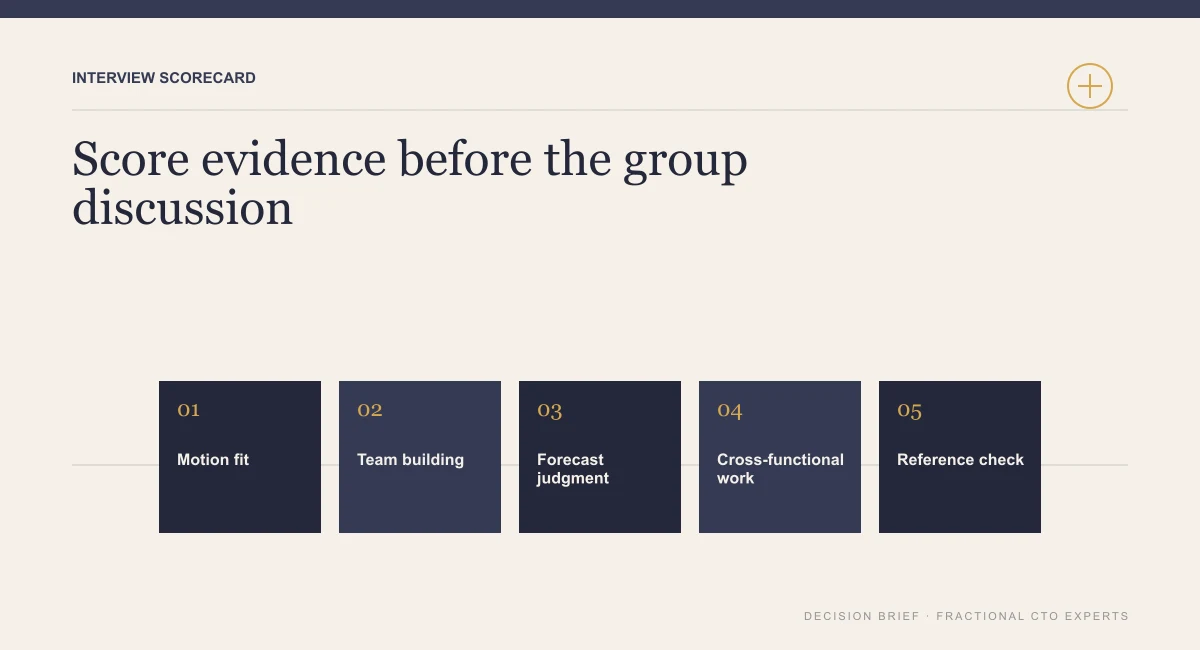
Agree the criteria before the first interview and give each interviewer a different part of the scorecard. Every interviewer should score and write their evidence before the group discussion, so the loudest opinion does not set the outcome.
| Criterion | Question or exercise | Strong evidence | Weak signals |
|---|---|---|---|
| Motion fit | "Walk me through the last motion you led: buyer, deal size, cycle, lead sources." | A comparable motion, with numbers they can explain and their personal role clear | Generic answers; results without deal size, cycle or context |
| Building versus scaling | "What did the team and process look like when you arrived and when you left?" | A clear before-and-after that matches your stage | Only ever inherited a mature machine when you need a builder, or the reverse |
| Forecast judgment | Give them anonymized pipeline data and ask for a forecast and their method | Challenges stage definitions, separates commit from upside, states assumptions | A single confident number with no method |
| Capacity planning | Show the worked capacity table and ask what they would change | Questions ramp, timing and pipeline assumptions; offers options | Accepts the plan, or promises to beat it without reasoning |
| Team building | "Tell me about a hire that did not work out. What did you do?" | Specific actions, what they changed in hiring afterwards | Blames the individual; no change in their process |
| Coaching | Role-play a deal review with an interviewer playing a seller | Asks questions that improve the seller's plan; agrees next steps | Takes over the deal or lectures |
| Cross-functional work | "Describe a disagreement with marketing or customer success and how it ended." | Shared definitions, a documented agreement, a measurable change | Frames other teams as the problem |
Use a four-point scale: no evidence, partial evidence, sufficient evidence and strong relevant evidence. Record why you chose each score. When a candidate cites a result, such as growing bookings by a percentage, ask about the baseline, the time period, market conditions, team size and what they personally decided. A number without that context is hard to compare fairly across candidates.
For references, ask permission first and follow your company's recruitment process. Useful reference questions include: "What did the sales team look like before and after this person joined?", "How accurate were their forecasts, and how did they handle a miss?" and "What would you give them responsibility for again, and what would you not?"
Write it so the right candidates apply, and keep it lawful
Sales leaders read job descriptions for signals about whether the company understands its own sales motion. Specifics attract experienced candidates: real deal sizes, a real cycle and an honest description of what exists today. Superlatives and a long list of unrelated duties make experienced candidates suspect the role is poorly defined.
Keep the language inclusive and focused on the work. The EEOC explains that it is illegal to publish a job advertisement that shows a preference for, or discourages people from applying because of, protected characteristics, including age for people 40 or older. Its example is an ad seeking "recent college graduates," which may discourage older applicants. Phrases such as "young, hungry team" or "digital native" create the same risk and say nothing about the work.
Compensation needs care. Describe the structure truthfully: base pay, variable pay, what the variable portion is tied to, how it is paid and any equity. Some jurisdictions require a pay range in job postings. Check the requirements that apply to where the role is based and where candidates may live, and have the completed description reviewed. For context only, the BLS reported a median annual wage of $148,270 for sales managers in May 2025. That occupation covers many management levels and industries, so it is not a benchmark for a VP of sales role at your company.
When a fractional sales leader or CRO fits instead
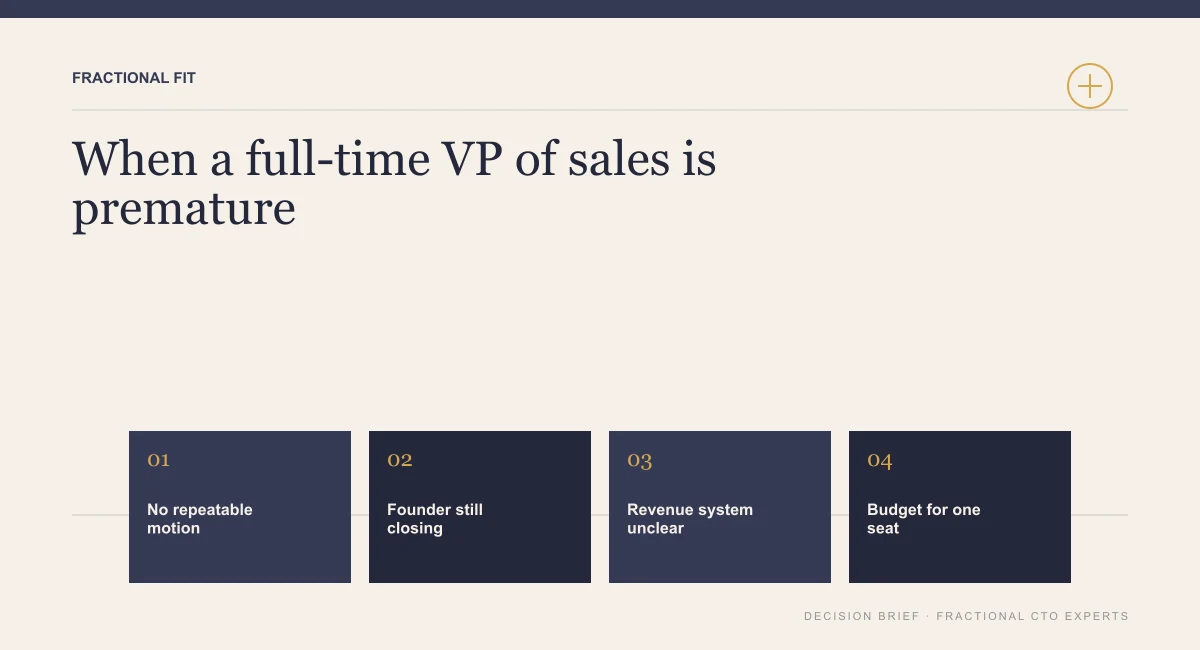
A full-time VP of sales is a large commitment. It is the wrong one if the company has not yet found a repeatable way to sell, or if the real problem sits across the revenue system rather than inside the sales team. The table below describes common situations; it is a starting point for your own decision, not a rule.
| Situation | Better first step | Why |
|---|---|---|
| The founder closes every deal and nobody knows why they win | Keep founder-led sales and document the motion, possibly with a fractional sales leader | A VP needs a motion to scale; hiring one to discover it is expensive and slow |
| A small team of sellers needs coaching and pipeline discipline | A fractional sales manager | Management capacity is the gap, not executive ownership |
| Sales, marketing and customer success disagree about definitions, and the forecast is unreliable | A fractional CRO to design the revenue system | The problem spans functions; a VP of sales owns only one of them |
| The motion works and the plan needs several new sellers and managers | A full-time VP of sales, Variant B | Scaling a working motion needs continuous leadership |
| The company needs a permanent leader but the search will take months | An interim or fractional leader with a handover to the permanent hire | Keeps the pipeline and forecast owned during the search |
| Demand generation is the constraint, not closing | Review the marketing mandate first; see the fractional CMO guide | More sellers without more qualified pipeline raises cost, not bookings |
A fractional revenue leader can also make the permanent hire better. They can write the stage-specific variant, run the capacity check and join interviews, while the company keeps the final decision. Write that into their mandate if you want it. If you are hiring other executives at the same time, the COO job description template uses the same structure of decision rights and evidence-based evaluation. You can also request a shortlist of fractional sales and revenue leaders with your completed brief, and assess each candidate's evidence yourself.
Final review before you publish the description
Run through these checks before the description goes to candidates:
- Every responsibility has matching authority, resources or a named person to approve it.
- The sales motion section uses your own numbers, not ranges copied from another company.
- The stage variant matches your situation: builder or scaler, not both.
- The personal selling expectation is explicit.
- The success section names 90-day outcomes the VP can influence and first-year outcomes set from a documented baseline.
- Requirements are split into essential and helpful, with no arbitrary degree or years-of-experience rules.
- Compensation structure is accurate, and any pay range required where the role is based is included.
- Someone outside the hiring team can read it and explain what the VP will own and what stays with the CEO.
This page is an editorial hiring resource. The worked example uses an invented company and illustrative assumptions, not benchmarks or client results. It does not announce a vacancy at Fractional CTO Experts, and it does not replace advice from the people responsible for employment compliance in your jurisdiction.
Frequently asked questions
What is the difference between a VP of sales and a head of sales?
The titles are used inconsistently. What matters is scope: whether the person manages managers, owns the forecast presented to the board, sets territories and has hiring authority. Write those rights into the description and choose the title that matches them.
Should a VP of sales carry a personal quota?
A first sales leader often keeps some personal deals while building the team, so a partial personal target can be reasonable. A scaling leader who manages managers is usually measured on team results. State the split explicitly so candidates can judge whether it is realistic.
Who should the VP of sales report to?
In an early-stage company it is usually the CEO or founder. Where a chief revenue officer exists, the VP of sales may report to that role. Name the actual reporting line and which decisions stay with it.
How should compensation appear in a VP of sales job description?
Describe the structure truthfully: base pay, variable pay, what the variable portion is tied to and any equity. Include a pay range wherever applicable law requires one, and have the completed description reviewed by the people responsible for compliance.
Can a fractional CRO help hire the permanent VP of sales?
Yes, if that is written into the mandate. A fractional revenue leader can define the motion, draft the scorecard and join interviews, but the company should own the final decision and the reference checks.
Sources and further reading