
Technology leadership diagnostics
Offshore Team Quality Issues: Diagnose the Operating System
Diagnose offshore development quality problems with evidence, acceptance examples, review standards, cost analysis and a practical supplier recovery plan.
- By
- Fractional CTO Experts
- Published
- 2026-07-30
- Reviewed
- 2026-09-07
- Reading time
- 14 minutes
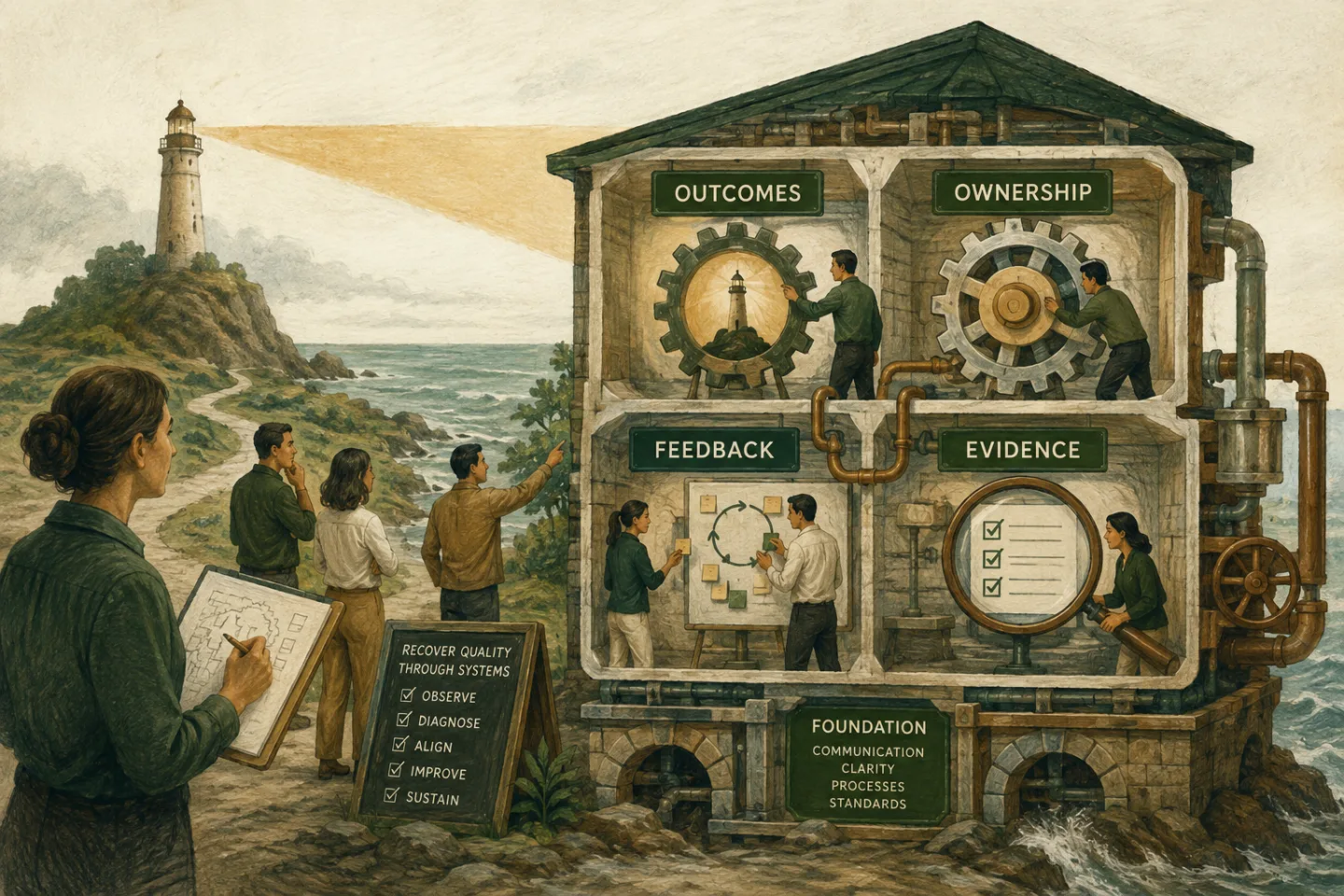
When an offshore development team has quality issues, diagnose the delivery system before blaming location. Distributed teams can perform excellent or poor work. The outcome depends on product clarity, technical authority, capability, incentives, feedback speed, engineering controls, and whether the company has retained ownership of its product.
The immediate objective is to protect customers and the business. The longer-term objective is to create an interface where good work is possible and poor work becomes visible early.
- Define “quality” with evidence
- Inspect the company–team interface
- Retain company ownership
- Put quality into normal flow
- Fix feedback latency
- Examine commercial incentives
- Run a bounded recovery
- Separate a supplier problem from a delivery-system problem
- Run a ten-item evidence review
- Write acceptance examples before the handoff
- Design communication around decisions and time zones
- Establish a review standard people can actually apply
- Evaluate cost using accepted work and continuity
- Decide whether to improve, reduce or replace the engagement
- Questions founders ask about offshore quality
- Decide from observed change
Define “quality” with evidence
“The code is bad” is too broad to guide a recovery. Establish a baseline.

Inspect:
- defects found in review, testing, and production;
- rework caused by misunderstood requirements or weak design;
- time work spends waiting for answers, review, environments, or release;
- incident and support load;
- security and dependency findings;
- maintainability and change difficulty in critical areas;
- deployment frequency and rollback;
- acceptance failures and customer impact;
- ownership, access, and documentation;
- team stability and capability mix.
Separate symptoms. A high defect rate, slow delivery, fragile architecture, and low trust may share causes, but the corrective action for each can differ. Compare trends and real work rather than using one dramatic example to characterize the whole team.
Inspect the company–team interface
Many outsourced teams receive contradictory priorities, incomplete context, late decisions, and acceptance feedback after large batches are delivered.
Clarify:
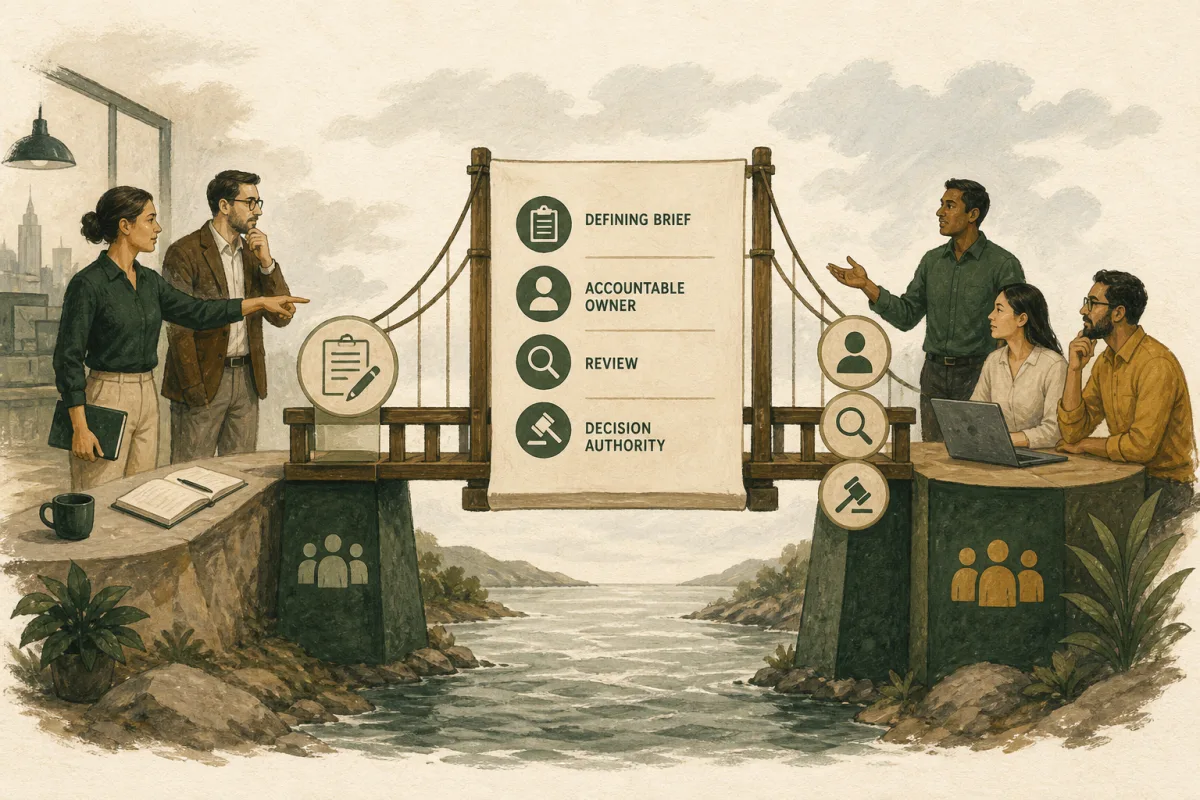
Brief: the user outcome, current evidence, constraints, acceptance, non-goals, and material risks.
Owner: one company person accountable for product priority and one accountable for technical decisions. They may be the same person in a small company.
Review: how design, code, tests, security, and release evidence are inspected while work is still small.
Decision: which choices the vendor can make, which require company approval, and how quickly blockers are resolved.
If a vendor is paid for capacity but the company supplies no product owner, priorities, or acceptance, the vendor will fill the vacuum. If the company prescribes every task but expects the vendor to be strategically accountable, the contract and expectation conflict.
Retain company ownership
The company should control:
- source repositories and administrative access;
- cloud, domain, app-store, identity, analytics, and vendor accounts;
- data rights and environments;
- architecture and material risk decisions;
- product priorities and customer promises;
- acceptance and production release authority;
- incident visibility;
- transferable documentation and operating knowledge.
This does not mean company employees must perform every action. It means access, decisions, and artifacts remain available if the relationship changes. Never solve a trust problem by secretly excluding the partner from the information needed to deliver.
Put quality into normal flow
Late audit and heroic review create queues. Move evidence closer to the change.
A proportionate quality system includes:
- small changes with explicit acceptance;
- peer review and clear ownership;
- automated checks around important behavior;
- secure dependency and secret handling;
- consistent environments and release process;
- observability for customer-critical journeys;
- safe rollback or feature control;
- incident learning that changes code or process;
- quality expectations shared by company and vendor.
Avoid appointing the fractional CTO as the only reviewer. That replaces one bottleneck with another. The CTO should establish standards, review the highest-consequence decisions, coach leaders, and make the team capable of owning normal delivery.
Fix feedback latency
Time-zone difference becomes harmful when questions wait a full cycle and work continues on assumptions. Design overlap and writing deliberately:
- a bounded live overlap window for decisions;
- asynchronous briefs that include context and acceptance;
- a visible question and decision log;
- recorded demonstrations of small increments;
- named urgent-response paths;
- no expectation of continuous availability across both time zones.
Measure how long work waits for company decisions as well as vendor action. A distributed model can create useful deep-work windows, but only if handoffs contain enough context and authority.
Examine commercial incentives
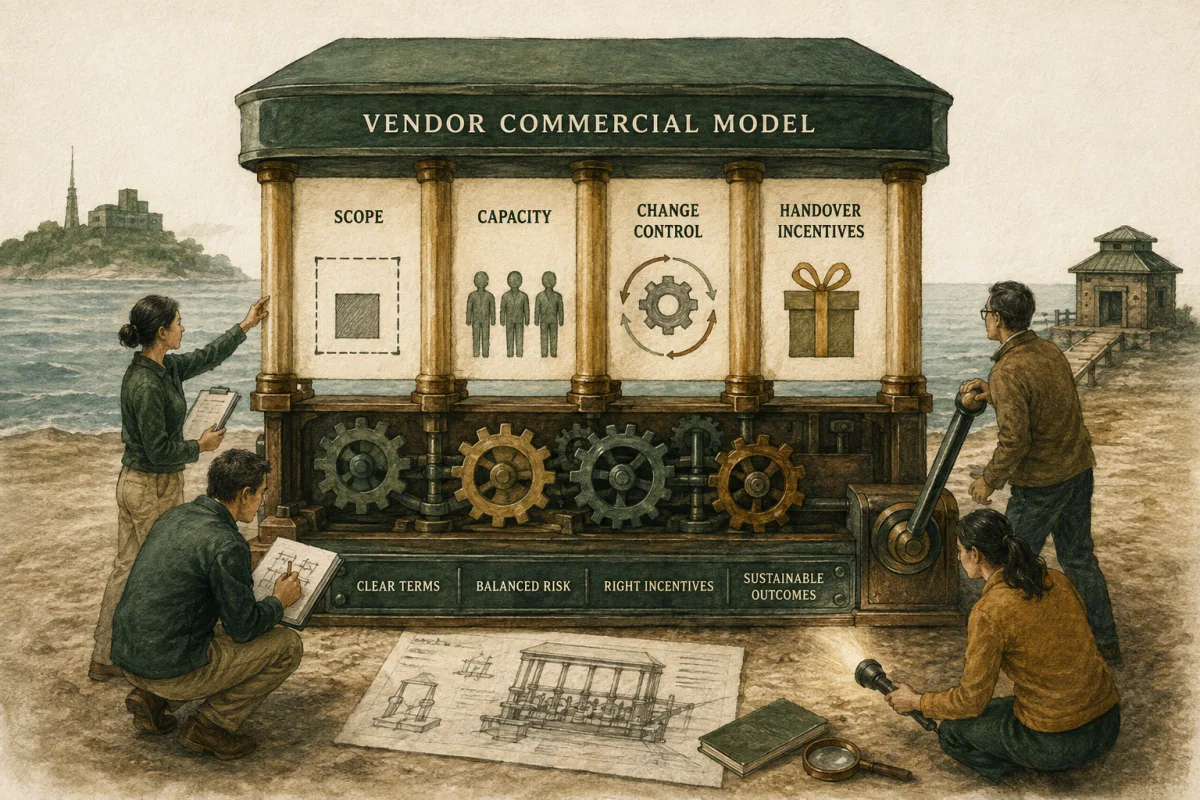
Fixed scope can encourage argument over change when the product is uncertain. Pure time-and-materials can reward occupied capacity without an outcome. Milestones can encourage surface completion if acceptance and quality are weak.
A better commercial design states:
- the product and operating outcome;
- team and capability assumptions;
- included capacity and response;
- company dependencies;
- change and priority process;
- engineering and security expectations;
- acceptance evidence;
- ownership of source, data, and configuration;
- transition, notice, and handover.
No contract removes the need for competent leadership. It can make incentives and failure handling less ambiguous.
Run a bounded recovery
Week 1: contain critical customer, data, access, and security risks. Establish the baseline and meet the actual team.
Weeks 2–3: choose one meaningful product slice, clarify the brief and decisions, reduce work in progress, and install fast review and release evidence.
Weeks 4–6: observe defect, rework, waiting, release, support, and working-relationship changes. Coach or change roles where capability is mismatched.
Weeks 7–8: decide whether to improve, restructure, replace, or insource. Document the transition either way.
The recovery must be fair. Do not set hidden tests or impossible deadlines. Share the condition, outcome, evidence, and decision date. Senior people should be given enough authority to change the system they are being asked to improve.
Separate a supplier problem from a delivery-system problem
An offshore development team can produce poor results because it lacks the required capability. It can also produce poor results because the buyer has made successful delivery unusually difficult. The first investigation should distinguish those explanations. Otherwise, replacing the supplier may simply restart the same pattern with a different group of engineers.
Take three recent changes: one that went smoothly, one that arrived late, and one that reached customers with a defect. Follow each from the original request to release. Record when the team received an answer, who could approve a tradeoff, which environment was available, what changed after development started, and how the outcome was accepted. Interview the people who performed the work before relying on a status presentation.
A useful diagnostic question is whether an experienced replacement team could succeed with the same instructions, access and decision delays. If a crucial pricing rule exists only in a founder's memory, the offshore location is incidental. If the rule was documented, demonstrated and tested but repeatedly ignored, the evidence points more directly toward execution or capability. Both problems can exist together; the purpose is to assign the correct remedy to each.
DORA's guidance on loosely coupled teams connects delivery performance with teams' ability to test, change and release without excessive external dependencies. Applied here, that suggests examining approval queues and architectural dependencies alongside individual skills. Moving work across time zones makes those dependencies more visible; adding meetings does not necessarily remove them.
Run a ten-item evidence review
Choose a small sample that includes successful work, rejected work, customer incidents and routine maintenance. Ten items is a practical starting point for a discussion, not a statistically representative assessment. Explain the selection method so neither the buyer nor the supplier can quietly choose only evidence that supports their position.
For each item, record the original request, acceptance examples, significant scope changes, development start, first review, final acceptance and production outcome. Add links to the actual ticket, pull request, test result and incident record where available. Mark missing evidence explicitly. An empty field is a question to investigate, not automatic proof that someone performed badly.
Classify the main source of avoidable work. Categories might include unclear requirements, missing domain knowledge, implementation errors, unavailable environments, review delays or unexpected external dependencies. Allow more than one cause, but identify which intervention would most likely prevent recurrence. A defect that appears in code may have started with an inconsistent business rule.
| Observation | Evidence to inspect | First intervention to try |
|---|---|---|
| Features repeatedly fail acceptance | Earlier examples and later rejection reasons | Agree representative examples before coding |
| Small changes wait several days | Approval timestamps and responsible people | Delegate reversible decisions within clear limits |
| Similar defects recur | Incident history and regression coverage | Add a focused regression check and review the cause |
| Work cannot be reproduced locally | Setup instructions and dependency access | Establish a repeatable development environment |
| Releases depend on one person | Deployment permissions and rehearsal results | Train a second owner and rehearse the process |
End the review with a short list of changes, an owner for each and a date to inspect fresh work. A large maturity scorecard is less useful if nobody can identify what will change on Monday.
Write acceptance examples before the handoff
Consider an illustrative subscription product that asks its offshore team to add cancellation. The ticket says that customers should be able to cancel from account settings. The developers implement a button, a confirmation message and a database flag. The buyer rejects it because customers should retain access until the end of the paid period and support staff need to reverse accidental cancellation.
The team may have implemented the ticket accurately while still missing the business outcome. A stronger brief describes an active monthly subscription, an annual subscription, a failed payment, a second cancellation request and a support reversal. Each example states what the customer sees, what access remains, what billing action occurs and which record support can inspect. The buyer also identifies who decides an unresolved policy question.
The examples should be small enough to discuss together. Avoid replacing a vague sentence with a lengthy document nobody can confidently interpret. Ask the engineer to explain the behavior back using a realistic account. That conversation often exposes a disagreement before it becomes an expensive implementation dispute.
Acceptance should distinguish essential behavior from preferences. A security boundary, a correct charge and an accessible cancellation path may be release requirements. A preferred animation may be a later improvement. Making that distinction prevents a product review from becoming an unlimited opportunity to redefine the work after delivery.
Design communication around decisions and time zones
An effective distributed team needs predictable access to decisions. It does not require every participant to remain online throughout another country's working day. Start by listing which questions must be answered synchronously, which can wait until the next overlap period, and which the team can decide independently.
For a blocked decision, use a short written record: the question, the relevant context, the available options, the team's recommendation, the consequence of delay and the latest useful answer time. The recipient should be able to respond without reconstructing a long chat thread. If the deadline passes, the record should say whether the team stops, switches work or proceeds with an explicitly authorised default.
Reserve overlap time for uncertainty that benefits from conversation: a new business rule, a design tradeoff or a disagreement about acceptance. Routine progress can be written asynchronously. Publish decisions afterward so absent colleagues do not depend on second-hand recollections. Rotate inconvenient meeting times where the relationship permits it, rather than quietly assigning all disruption to one location.
Also inspect the work boundaries. If every small frontend change requires simultaneous approval from an internal designer, a separate API vendor and a founder, the organisational design creates a coordination burden. A clearer interface, a delegated product owner or a more complete unit of work may help more than another daily meeting.
Establish a review standard people can actually apply
Code review should protect behavior, maintainability and operational safety. It should not depend on whether a reviewer would personally have written the code differently. Google's published code-review standard emphasizes improving code health without demanding unattainable perfection. A buyer and supplier can use that distinction to agree which findings block release and which belong in later work.

Create a brief checklist tailored to the system. For a multi-tenant application, it might ask whether a customer can access another customer's records, whether retries create duplicates, whether failures are visible, and whether the migration can be deployed safely. A content-only change needs a different level of scrutiny from a payment or permission change. Applying the same elaborate procedure to both can hide the important risks in routine paperwork.
Require reviewers to explain the consequence of a blocking comment. An assertion such as 'bad code' provides little guidance. A concrete finding describes the triggering condition, the incorrect result and an acceptable correction. Encourage the author to challenge a finding with evidence; respectful disagreement is part of technical review.
The buyer must also supply review capacity. A supplier cannot resolve an approval bottleneck when the only internal reviewer is unavailable for a week. Agree a realistic response window and an escalation path, then measure the queue as well as the time spent writing code.
Evaluate cost using accepted work and continuity
An hourly rate is only one part of delivery cost. Include internal clarification time, review time, rework, incident response, duplicated environments and the effort required to transfer knowledge. Record these costs consistently across suppliers before claiming that one model is cheaper.
For an illustrative comparison, suppose one team charges less but requires the founder to spend six hours each week resolving issues, while another proposal includes a capable delivery lead. The second proposal may be attractive if it reduces that burden, but the benefit should remain a hypothesis until the working relationship demonstrates it. Do not convert every freed founder hour into assumed revenue.
Separate temporary recovery expense from the expected steady state. A test-environment repair or a documented release process may require an initial investment that benefits future work. Repeated manual correction of the same defect is different. Ask which costs should decline after the intervention and what evidence would show that decline.
Avoid paying solely for activity metrics. Lines of code, tickets closed and hours online can increase while customer outcomes worsen. Commercial terms should support a clear scope, reviewable increments and a fair process for changes. Where contract terms or employment obligations matter, obtain advice for the relevant jurisdictions rather than assuming one global arrangement applies.
Decide whether to improve, reduce or replace the engagement
Continue the relationship when the supplier acknowledges evidence, retains suitable people and demonstrates that agreed changes improve fresh work. The decision should consider capability and cooperation together. A supplier that communicates well but cannot implement a critical security requirement still needs a different scope or additional expertise.

Reduce the scope when the team performs reliably within a narrower boundary. For example, it may be effective at maintaining a well-documented application but unsuitable for defining a new architecture without senior guidance. That can be a valid arrangement if responsibilities, pricing and expectations reflect the actual capability.
Prepare a replacement when repeated material failures continue despite clear requirements, reasonable access and a fair opportunity to correct them. Concealed staffing changes, refusal to provide company-owned artifacts or unsupported claims about completed work deserve explicit investigation. Preserve the evidence and make the commercial decision calmly; a confrontational exit can increase operational risk without improving accountability.
Before transferring responsibility, verify repository access, deployment instructions, service accounts, domain control, issue history and required licenses. Have the receiving team reproduce a build and perform an appropriate deployment rehearsal. A folder labelled 'handover' is not proof that another team can operate the product.
Questions founders ask about offshore quality
Should we hire an internal CTO before replacing the agency?
An internal or fractional technology leader can help when the company lacks the expertise to evaluate the work, define technical expectations or manage a transition. That leader should have a clear mandate and sufficient time to inspect evidence. Adding a title without review capacity or decision authority will not resolve the underlying issue. Use the fractional engineering manager guide when the main need is daily team coordination rather than executive technology strategy.
Can automated testing solve the problem?
Testing helps when it checks meaningful behavior and runs at the right point in delivery. It cannot determine an unexpressed business policy or resolve conflicting instructions. Begin with the defects that matter to customers, then add focused checks that would have detected them. Inspect failures and maintenance effort; a large passing test count alone is not an acceptance decision.
How long should a recovery trial last?
Choose a period that contains enough representative work to evaluate the proposed changes. A team delivering weekly may provide useful evidence sooner than one awaiting a major integration. Set the review date and decision criteria in advance, while retaining an earlier escalation path for serious incidents. Avoid a universal promise that every troubled engagement can be repaired in thirty days.
Is nearshore development automatically safer?
A closer time zone can make conversations easier, but it does not prove domain knowledge, engineering quality or continuity. Compare actual overlap hours, decision rights, review practices, staff stability and handover capability. Select the operating arrangement that fits the work and the buyer's management capacity.
What should the first recovery meeting produce?
Leave with a shared definition of the problem, a small evidence sample, one accountable owner on each side and the next review date. Record the two or three changes that will be tried first. The useful outcome is a testable working agreement that both sides can apply to the next delivery, rather than a general commitment to communicate better.
Decide from observed change
Continue or expand when the team demonstrates clearer ownership, smaller and safer delivery, lower rework, faster decisions, better operational evidence, and credible internal leaders.
Restructure when the model is viable but product ownership, capability mix, team shape, or contract is wrong.
Replace when material capability, trust, security, or incentive gaps persist and cannot be repaired inside the business timeline. Plan access, knowledge, data, source, vendor, and customer continuity before announcing the transition.
Insource where a capability creates continuous strategic advantage, customer risk, or executive decision load that the company should own permanently. Keep external specialists where variable capacity and rare expertise remain economically useful.
A fractional CTO can own the recovery when the company has execution but lacks cross-functional technology authority. The right outcome is not proving that offshore or internal teams are superior. It is a company-owned delivery system with explicit incentives and inspectable quality.
Frequently asked questions
Why is our offshore development quality poor?
Possible causes include unclear product decisions, weak acceptance, missing technical ownership, large work batches, delayed feedback, misaligned contracts, unstable priorities, inadequate review and tests, or capability gaps. Geography alone is not a diagnosis.
Should we replace the offshore team immediately?
Contain any urgent security or operational risk first, then establish a baseline and test whether clearer ownership and a bounded recovery change the evidence. Replace when capability, trust, or incentives cannot meet the mandate.
Who should own quality with an outsourced team?
The company retains product and risk accountability. The delivery partner owns agreed engineering practices and outcomes within its scope. A named company technical leader must own architecture, acceptance, access, and the vendor interface.
Can a fractional CTO manage an offshore team?
Yes when the mandate includes real authority and enough capacity for decisions, review, vendor management, and internal transfer. The CTO should not become the only reviewer or permanent communication bridge.
Sources and further reading
Turn research into a mandate
See the cost and hiring model before you shortlist.
Use the free calculator, then save a candidate search or post a transparent role when the mandate is ready.