
Technology leadership diagnostics
Knowledge Silos in Engineering: A CTO-Led Recovery Playbook
Reduce engineering knowledge silos with a worked handover example, transfer template, safe rehearsals, access ownership, and measurable continuity checks.
- By
- Fractional CTO Experts
- Published
- 2026-07-30
- Reviewed
- 2026-09-07
- Reading time
- 12 minutes
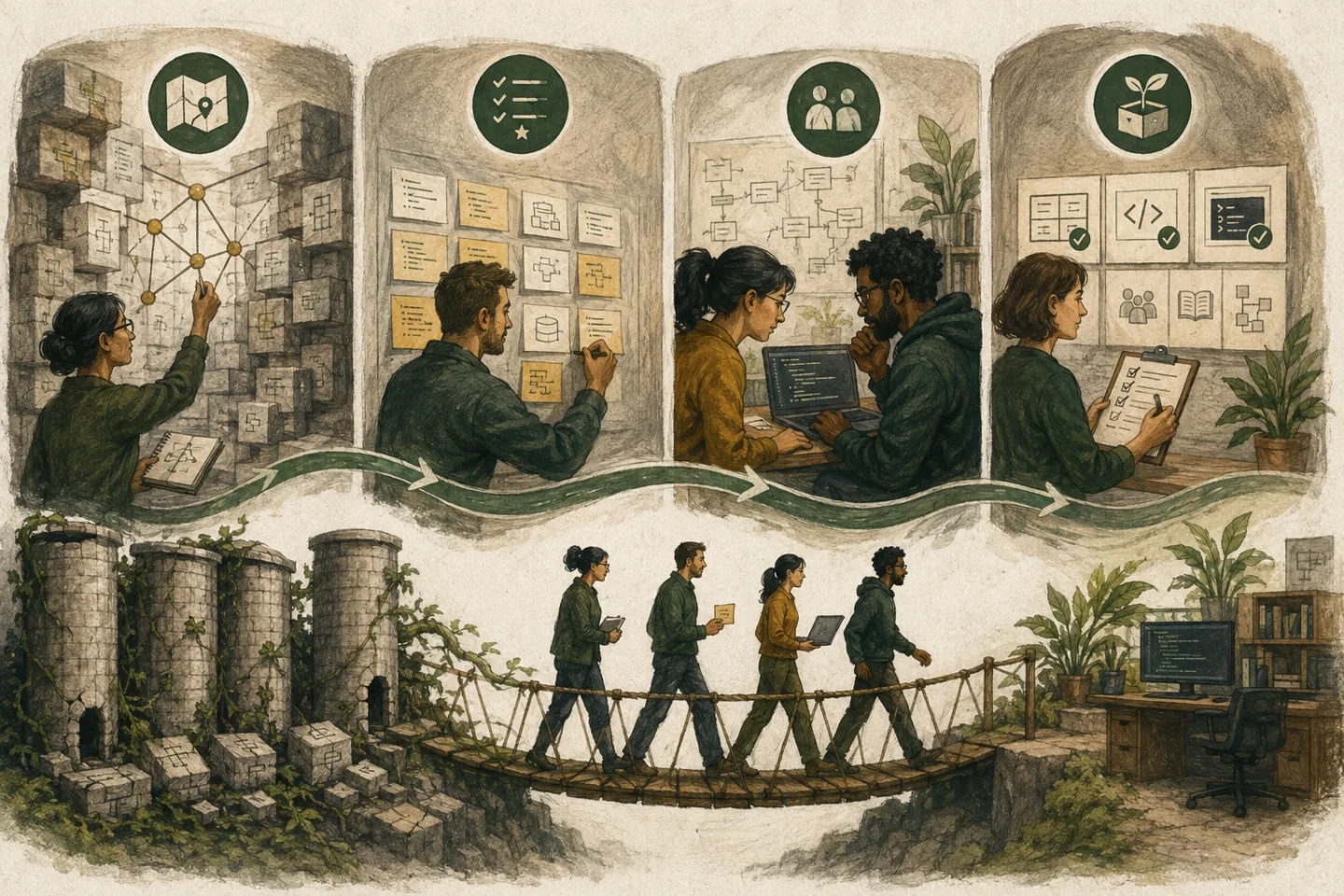
Engineering knowledge silos become dangerous when a company cannot change, operate, support, or explain a critical part of its technology without one person. The problem is not that specialists know different things. Specialization is valuable. The risk appears when the organization has no safe path to act during absence, departure, conflict, overload, or failure.
A CTO-led response should make concentration visible, prioritize by business consequence, transfer knowledge through real work, and prove that ownership has moved. A documentation drive alone usually produces pages that nobody has tested.
- Map consequence, not popularity
- Recognize the signals
- Prioritize the first transfer
- Transfer through real work
- Fix access and company ownership
- Make shared ownership part of delivery
- Change incentives around heroics
- A 60-day recovery sequence
- A worked example: remove a billing integration dependency
- Use a transfer record with observable acceptance
- Distinguish expertise from an unsafe bottleneck
- Test continuity without creating a production incident
- Plan for an imminent departure
- Reserve transfer capacity in the delivery plan
- Common questions about engineering knowledge silos
- Measure demonstrated resilience
Map consequence, not popularity
Begin with business-critical journeys and systems. Do not ask only, “Who knows the codebase best?”

Map four kinds of concentration:
System knowledge: architecture, production behavior, data, integrations, deployment, recovery, and failure modes.
Decision knowledge: why an important choice was made, alternatives rejected, constraints, and triggers for reconsideration.
Customer knowledge: commitments, exceptions, relationships, operational workarounds, and the meaning behind a requested feature.
Operational control: accounts, credentials, approvals, domains, signing keys, vendors, incident actions, and business processes.
For each item, record impact, current owners, credible backups, change frequency, evidence available, and the shortest safe recovery path. A billing integration used daily may deserve more attention than a complex component with low business consequence.
Recognize the signals
Silos are often visible before a person leaves.
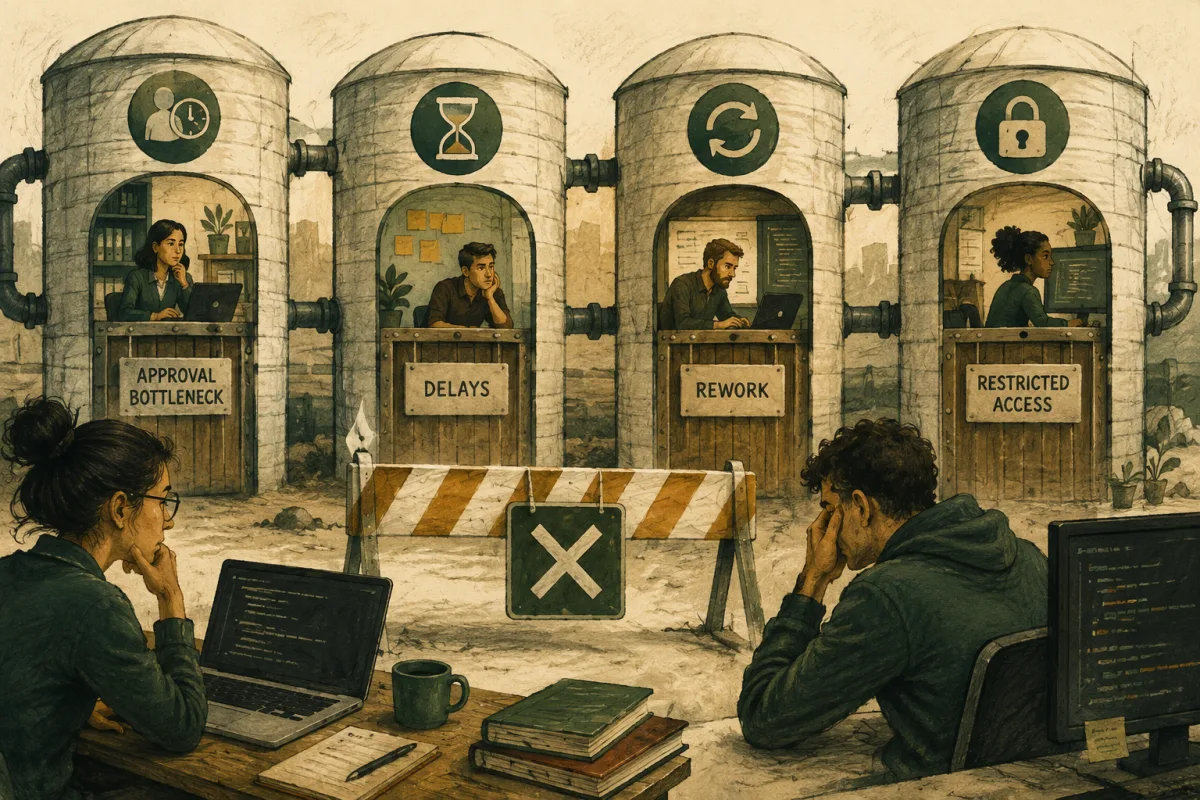
Signals include:
- work waits for one reviewer or approver;
- people avoid changing a component described as fragile;
- incidents escalate immediately to the same person;
- estimates vary wildly because context is hidden;
- only one person can access a vendor or production system;
- product decisions depend on undocumented customer history;
- handoffs repeatedly recreate requirements;
- leave is interrupted because no backup feels safe;
- a senior person appears indispensable and exhausted.
Do not punish the person holding the knowledge. Silos frequently emerge because the organization rewards urgent individual rescue, allocates no transfer capacity, changes priorities constantly, or keeps ownership ambiguous. Treat the pattern as a system condition.
Prioritize the first transfer
Trying to spread all knowledge across the whole team creates shallow meetings and stale documentation.
Prioritize where:
- customer or financial harm is high;
- the single owner is overloaded or likely to leave;
- change is frequent;
- recovery is time-sensitive;
- access or legal responsibility is concentrated;
- future roadmap work depends on the context.
Set a specific transfer outcome. “Document payments” is vague. “A second named engineer can deploy, diagnose a failed settlement, reconcile records, and follow the escalation path without the original owner” is testable.
Transfer through real work
Knowledge moves when another person performs consequential work with support and feedback.
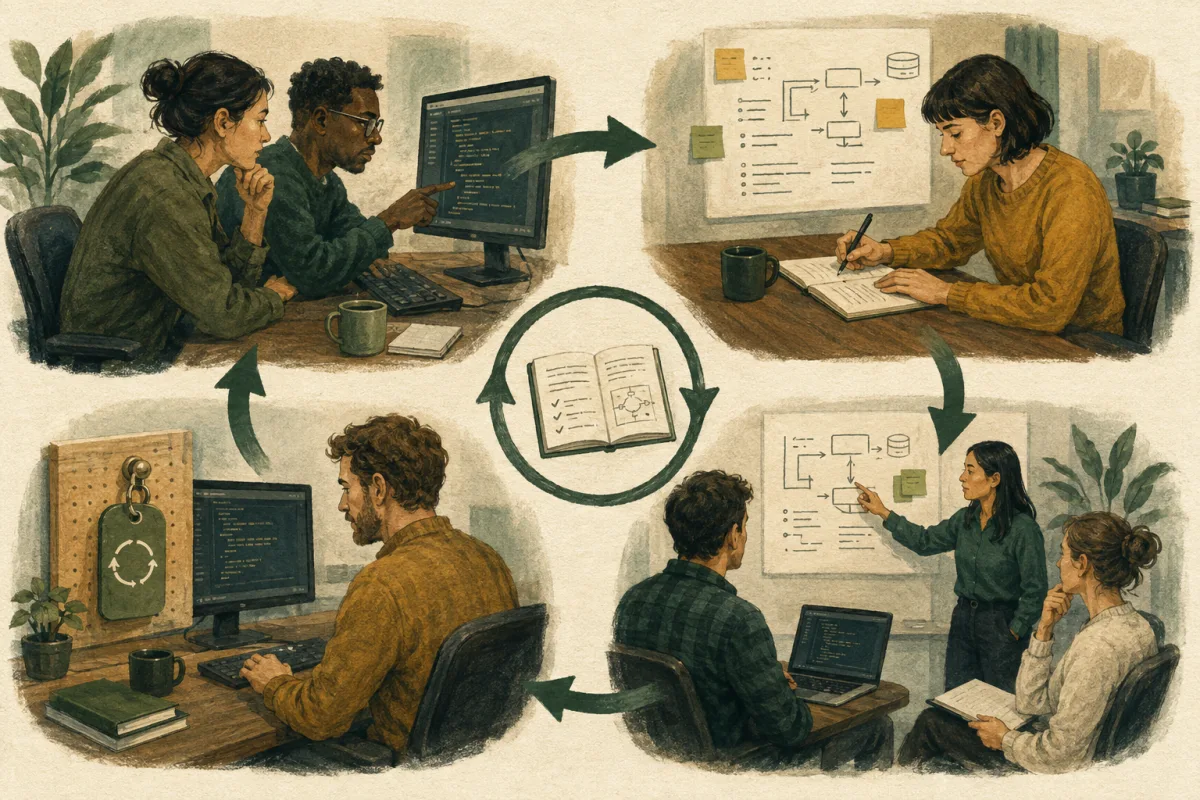
Use a loop:
- Pair: the current owner and receiving owner perform a real change or operational task together.
- Record: capture the system model, decision context, steps, checks, failure modes, and escalation.
- Rehearse: the receiving owner leads a deployment, incident exercise, recovery, or customer explanation.
- Rotate: the receiving owner becomes primary for a period while the original owner observes.
Documentation should be written for the next action. A runbook explains purpose, prerequisites, safe steps, expected evidence, failure conditions, rollback, and escalation. A decision record explains context, options, choice, consequence, and review trigger. Neither needs to become an encyclopedia.
Fix access and company ownership
No critical system should depend on a personal email address, device, payment card, or unshared recovery method. Inventory domains, cloud accounts, code organizations, app stores, analytics, data platforms, signing keys, vendors, monitoring, and support systems.
Use company-controlled identity, named roles, least privilege, auditable elevation, protected recovery, and prompt offboarding. Do not solve a silo by sharing one password widely. Access resilience and access control must coexist.
Sensitive credentials do not belong in documents. The runbook should explain how an authorized person receives or rotates access through the approved system.
Make shared ownership part of delivery
Durable practices can include:
- more than one reviewer for critical domains;
- paired changes in high-consequence areas;
- rotation of operational and incident responsibilities;
- team-owned service and architecture reviews;
- lightweight decision records;
- runbook updates as part of relevant changes;
- blameless incident learning with assigned follow-through;
- explicit succession and backup ownership in planning;
- time budgeted for transfer before a departure becomes likely.
Avoid mandatory rotation for every task. Some domains require deep expertise and continuity. The CTO’s job is to decide where redundancy changes risk and where it only creates coordination cost.
Change incentives around heroics
If the company rewards the person who repeatedly rescues production but not the people who make rescue less necessary, silos will return.
Managers should recognize:
- reducing approval bottlenecks;
- enabling another owner;
- improving system observability;
- simplifying risky operations;
- making a decision reconstructable;
- creating safe boundaries for teams.
Performance conversations should not imply that becoming less indispensable reduces a senior person’s value. High-level technical leadership is shown by increasing organizational capability, not accumulating private context.
A 60-day recovery sequence
Days 1–10: map critical concentration, access, current absences, and immediate continuity risks. Name an executive owner.
Days 11–30: select the top transfer outcomes, pair on real work, secure company access, and create action-oriented runbooks.
Days 31–45: rehearse incidents, deployment, recovery, customer support, or key decisions with the receiving owners leading.
Days 46–60: rotate primary ownership, inspect gaps, update the team structure and operating cadence, and plan the next risks.
A fractional CTO may fit when the company needs an executive to connect continuity, organization, delivery, and risk but can execute the transfer internally. If the departure risk is immediate and daily authority is missing, interim CTO services may be more appropriate.
A worked example: remove a billing integration dependency
Imagine a software company where only one engineer understands the billing integration. This is an illustrative scenario, not a customer case study. The engineer can explain successful payments but also knows several exceptions: how failed events are retried, which records finance reconciles, and when a support agent must intervene. Copying the source code into another repository would not transfer that operational understanding.
Start with one consequential task: investigating an account whose invoice and entitlement disagree. Ask the current owner to demonstrate the investigation with sanitized or test data. Record where the evidence comes from, how records are matched, what a normal state looks like, and which actions would be unsafe. The receiving engineer should ask questions while performing the steps rather than watching a long presentation.
Next reverse the roles. The receiving engineer leads a similar exercise with a different example. The expert observes and intervenes when needed. Record each intervention as a gap in the system, instructions, access, or training. If the receiving engineer cannot find the relevant event history, another hour of architecture slides will not solve the immediate problem.
Then test the surrounding business process. Can finance explain the reconciliation evidence? Does support know when to escalate? Can an authorized person obtain the required access without using the original engineer's credentials? Technical understanding alone is insufficient if the workflow still depends on one person to coordinate every department.
Close the transfer with a bounded independent exercise. The original owner remains reachable as a safety backstop but does not lead. The receiving owner should explain the result, the evidence used, the action taken, and any unresolved uncertainty. A failed rehearsal is useful: it exposes a dependency while there is still time to correct it. Do not declare the whole billing system transferred because one narrow task passed.
Use a transfer record with observable acceptance
A transfer record should fit the task. A short operational record is often easier to maintain than a large generic knowledge document. The following structure is an original working template; adapt it to the system's risk and your access controls.
| Field | What to write | Example acceptance evidence |
|---|---|---|
| Task and consequence | The action and what could go wrong | Receiving owner explains the customer impact |
| Authorized roles | Who may perform and approve the action | Access is granted through the company process |
| Prerequisites | Environment, evidence, and dependencies | Required inputs can be located independently |
| Safe procedure | Steps, checks, and stop conditions | Rehearsal follows the steps without unsafe improvisation |
| Recovery | How to reverse or contain a failed action | Rollback or escalation is demonstrated where appropriate |
| Ownership | Primary, backup, reviewer, and review trigger | Named owners accept the responsibility |
Include links to authoritative internal systems rather than copying sensitive data into the record. A runbook can point to an approved secrets manager or access request process without containing a credential. If an instruction depends on a console layout or vendor feature that changes, name a review trigger so that the record does not become silently obsolete.
Record the date and scope of the last rehearsal. “Reviewed” is ambiguous: someone may have read the document without using it. “Backup owner completed the staging deployment and rollback exercise” states what was actually demonstrated. Keep an explicit list of tasks that remain untested.
Distinguish expertise from an unsafe bottleneck
Not every specialist needs a fully interchangeable replacement. A database expert, security architect, or domain scientist may contribute years of depth that cannot be distributed evenly. The practical question is whether the company can operate safely, recognize when specialist judgment is needed, and obtain that judgment through a reliable route.
For a highly specialized domain, create layers of ownership. A primary expert can retain responsibility for uncommon design decisions while a trained backup handles routine operation and initial diagnosis. Document the boundary: what the backup may do independently, when they must stop, and whom they can escalate to. This can reduce immediate continuity risk without pretending that a short training session recreates specialist expertise.
Look at work queues as well as knowledge. If every low-risk change requires the expert's approval, the team may have a decision-design problem. Clarifying safe change boundaries and review criteria can remove unnecessary escalation while preserving expert involvement where it matters. Conversely, removing all review in the name of autonomy can increase risk if the team lacks context.
Discuss incentives directly with the expert. They may fear that sharing knowledge reduces their value, or they may be relieved that someone finally recognizes the cost of constant interruption. Define progression through better design, coaching, and difficult judgment rather than emergency availability. Protect actual calendar time for transfer so that urgent feature work does not consume it every week.

Test continuity without creating a production incident
A rehearsal does not have to begin with a risky live operation. Choose an environment and task whose consequences are appropriate for the team's current readiness. A tabletop discussion can test decisions and escalation. A staging exercise can test deployment or recovery steps. A controlled production task may follow once the prerequisites and safeguards are established.
Agree a stop condition before the exercise. If the participant lacks required access, sees unexpected data, or cannot verify a safety check, they should stop and escalate. The objective is safe independent judgment, not completing the checklist at any cost. Observe whether the process makes uncertainty visible.
Use the rehearsal to improve both the receiving owner's capability and the system itself. Repeatedly confusing steps may indicate that the operation should be simplified or automated. Missing evidence may indicate an observability gap. A long chain of personal approvals may indicate unclear authority. Do not automatically classify every difficulty as a training failure.
After the exercise, assign a small number of corrective actions with owners and review dates. Repeat the affected portion when the change is ready. Avoid rerunning the entire exercise ritualistically if only one prerequisite changed, but do not assume a corrected document proves a corrected process.
Plan for an imminent departure
When the expert is leaving soon, prioritize continuity over comprehensive documentation. Establish the departure date, actual remaining capacity, and the systems whose failure would have the greatest consequence. Protect respectful transfer time and make the business sponsor responsible for resolving competing priorities.
Focus first on company control of critical accounts, current incidents, customer commitments, deployment and recovery, and decisions already in progress. Assign receiving owners explicitly. A folder of recordings without an owner can become another silo, especially when nobody has time to watch or validate it.
Separate immediate handover from longer-term remediation. You may accept a documented limitation temporarily while arranging specialist support or reducing change in the affected area. Make that decision visible, including its owner and review date. If no internal leader can coordinate the transition, compare the operating intensity of an interim CTO with the lighter cadence of a fractional engagement.
Do not use departure pressure as a reason to demand personal passwords or unauthorized access. The company should recover and manage its systems through appropriate ownership and access processes. Where ownership is disputed or unclear, obtain the relevant operational and legal help rather than improvising a technical workaround.
Reserve transfer capacity in the delivery plan
Knowledge transfer competes with visible feature work, so give it the same planning discipline. Name the task, receiving owner, expert support, expected evidence, and time required. If the receiving engineer is already fully allocated, the plan depends on work that has no capacity. The sponsor must decide which other commitment moves.
Keep the first assignment narrow enough to finish. A team can learn more from one completed deployment handover than from ten partially documented systems. After the first rehearsal, use the actual effort and gaps to plan the next transfer. Avoid promising that every critical system will have a backup by an arbitrary date before inspecting the work.
Include the expert's interruption load in the review. The intended result is not merely adding a second name to a service catalog; it is allowing routine decisions and operations to proceed without repeated rescue. If the backup still asks the expert to approve every step, determine whether the issue is missing knowledge, unclear authority, or a reasonable safety boundary. Each requires a different correction.
Common questions about engineering knowledge silos
What is the difference between a knowledge silo and normal specialization?
Specialization concentrates expertise because deep work requires focus. A harmful silo prevents the organization from acting safely when the specialist is absent or overloaded. The remedy may be a backup for routine operations, clear escalation, and documented decisions rather than equal expertise across the whole team.
How do we measure the bus factor?
The term describes dependence on a small number of people, but a single company-wide number can hide important differences. Assess critical tasks separately: who can deploy, diagnose, recover, authorize, and explain customer commitments? Record demonstrated backups and known gaps. A task-based view is more actionable than an unsupported claim that the team's bus factor has improved.
Will better documentation solve the problem?
Documentation supports transfer, but it does not prove understanding, access, or judgment. Pair it with a receiving owner performing the task, checking the result, and knowing when to stop. Measure demonstrated capability and reduced dependency rather than page count or video hours.
Can AI-generated documentation help?
It can help draft explanations from approved material, but a responsible owner must check accuracy, confidentiality, and completeness. Generated descriptions of code may omit business exceptions, operational history, and reasons for decisions. Do not treat a plausible summary as a tested runbook, and do not put secrets or restricted customer information into an unapproved tool.
Who should own the programme?
An engineering leader should coordinate the work with the people who operate the affected systems. Executive sponsorship matters when transfer competes with product commitments or crosses departments. A fractional CTO can set priorities and decision rights, while internal owners perform and retain the work. The engagement should make the company less dependent on external leadership over time.
Measure demonstrated resilience
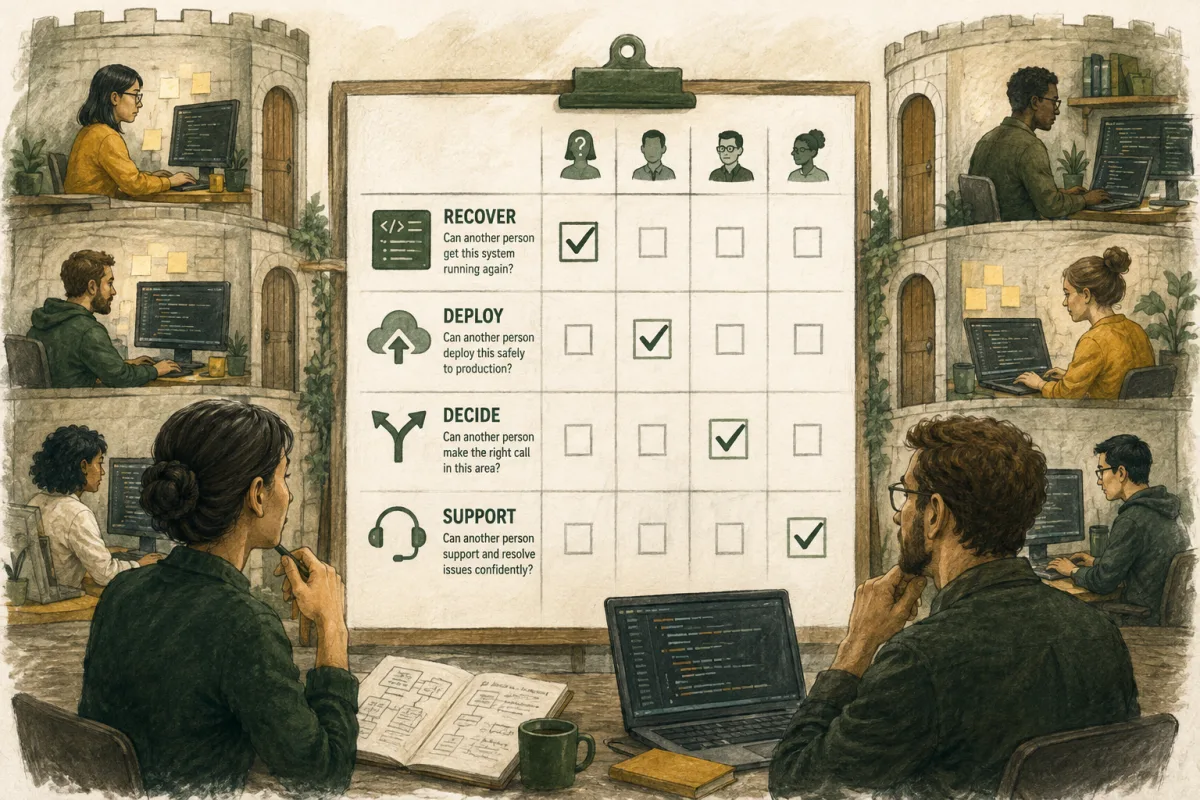
Useful evidence includes:
- a second owner can safely deploy and rollback;
- an incident can be triaged without the original expert;
- access can be granted and revoked through company control;
- a product or architecture decision can be reconstructed;
- customer commitments are visible to the accountable team;
- leave occurs without emergency interruption;
- work no longer waits in one approval queue;
- the original owner has time for higher-value work.
Do not declare victory because a wiki grew. The silo has reduced when another authorized person can act safely, the organization knows what remains concentrated, and the operating system keeps transfer current.
Frequently asked questions
How do you identify an engineering knowledge silo?
Look for critical work that waits for one person, changes only they can review, accounts only they control, incidents only they can resolve, or customer and architectural context that cannot be reconstructed.
Is documentation enough to remove a knowledge silo?
No. Documentation supports transfer, but another person must use the information during real work, make a decision, operate the system, and recover from failure. Rehearsal is stronger evidence than page count.
Should every engineer know every system?
No. The goal is sufficient resilience and shared ownership for critical work, not universal shallow familiarity. Prioritize by business impact, concentration, replaceability, and change frequency.
Can a fractional CTO fix knowledge silos?
A fractional CTO can own the risk map, operating changes, leadership accountability, and transition. The team must supply time and participate in real transfer; an executive cannot extract knowledge alone.
Sources and further reading
Turn research into a mandate
See the cost and hiring model before you shortlist.
Use the free calculator, then save a candidate search or post a transparent role when the mandate is ready.