Mobile product consulting
Mobile App Consultant: Services, Costs and Hiring Guide
Choose a mobile app consultant with a practical hiring brief, audit checklist, proposal scorecard and worked failure example. Plan scope, costs and handover.
- By
- Fractional CTO Experts
- Published
- 2026-09-10
- Reviewed
- 2026-09-10
- Reading time
- 15 minutes
- Start with the decision you need to make
- Consultant, development agency or fractional CTO?
- Write a mobile consulting brief that suppliers can price
- Evaluate native, cross-platform and web options fairly
- Inspect an existing app before funding a rewrite
- Worked example: the app says saved, but the record is missing
- Test real tasks, devices and accessibility
- Plan store review, privacy and release ownership
- Compare consulting costs through scope and acceptance
- Interview for evidence, judgment and continuity
A mobile app consultant helps a business make and carry out decisions about a mobile product: whether to build it, what to change, which technical approach fits, how to evaluate suppliers and how to operate the app after launch. Some consultants provide independent advice; others also sell design and development. Agree the decision, deliverables and implementation responsibility before comparing proposals.
This guide is for founders and product owners hiring mobile expertise for a new or existing iOS or Android app. It includes a practical brief, an audit checklist, a proposal scorecard and a hypothetical failure investigation. Fractional CTO Experts is an executive network and matching platform. You can request a shortlist and assess candidates against your product, technical needs and required availability. A match request does not establish that a particular specialist is available.
Start with the decision you need to make
An app idea, a missed release and a falling conversion rate need different engagements. Before looking for a consultant, write the decision the company cannot confidently make today. Examples include whether a mobile app is necessary, whether an existing codebase can support the next release, or whether two suppliers have priced comparable work. A useful engagement ends with better evidence for that decision and a person responsible for acting on it.
Describe the consequence of delay. Customers may be unable to complete an important task away from a desk. Support staff may be correcting records that failed to synchronise. The company may be paying for development without a reproducible release. Quantify the observed problem when records permit, while distinguishing confirmed facts from estimates and complaints that still need investigation.
Avoid specifying the answer inside the brief. Asking someone to prove that the app needs a rewrite discourages evaluation of repair, replacement and smaller changes. Instead, ask for options, constraints, evidence and a recommendation with reasons. The recommendation may be to postpone mobile development, improve a responsive website or stabilise a limited part of the existing product before adding features.
Name an internal sponsor who can make the resulting decision. A consultant cannot resolve a conflict between commercial priorities by silently choosing on the company's behalf. Record who approves scope, who controls the budget and who accepts the tradeoffs. If the problem includes executive ownership across several teams, compare the engagement with fractional CTO services.
Consultant, development agency or fractional CTO?
The labels describe different things, and providers sometimes combine them. A mobile consultant might be an experienced developer carrying out a technical assessment, a product adviser testing demand, or a specialist leading an implementation. An agency usually brings delivery capacity across several disciplines. A fractional CTO can own broader technology decisions and coordinate the mobile work with the rest of the business.
| Arrangement | Useful when | Confirm before hiring |
|---|---|---|
| Independent mobile adviser | You need a decision or second opinion before committing to delivery | Deliverable, evidence access, conflicts and implementation boundaries |
| Mobile development team | The product direction is sufficiently clear and delivery capacity is missing | Named team, testing, backend scope, release ownership and support |
| Specialist app auditor | An existing app has reliability, security, architecture or usability questions | Systems included, sampling limits, severity method and reproducible findings |
| Fractional CTO | Mobile decisions depend on wider architecture, suppliers, staffing or investment | Executive authority, reserved capacity, operating cadence and handover |
| Product or UX specialist | User needs and task completion are the principal uncertainty | Research method, participant fit, prototype scope and how findings affect delivery |
Ask whether the adviser earns revenue from a recommended implementation, platform or supplier. That relationship does not automatically invalidate the advice, but it should be visible. Request a recommendation that another capable team could evaluate and implement. If the report is useful only when you buy the provider's next package, clarify the missing information before accepting it.
Do not purchase every role automatically. A small, clearly bounded interface issue may need a short specialist engagement. An app with unreliable data, unclear ownership and several dependent suppliers may need coordination as well as coding. Separate these responsibilities so a lower headline price does not conceal work your internal team must supply.

Write a mobile consulting brief that suppliers can price
A useful brief gives each candidate the same context and asks for comparable outputs. Include the users, their main task, supported platforms, current stage, known failures, relevant integrations and the decision deadline. Explain which facts are uncertain. An honest unknown is more useful than a guessed requirement that becomes an expensive commitment later.
Use this copyable structure as the starting point:
- Business decision: We need to decide whether to repair, extend or replace the current mobile workflow.
- Users and task: Identify the people who use it, where they work and the result they must achieve.
- Current evidence: List support examples, release records, analytics, prototypes and accessible technical documentation.
- Constraints: State relevant devices, integrations, internal capacity, budget boundaries and contractual commitments.
- Required outputs: Ask for findings with evidence, evaluated options, delivery dependencies and an implementation brief.
- Acceptance: Name the reviewer, required walkthrough and information another team needs to use the work.
- Exclusions: Identify work such as implementation, specialist security testing or store submission that is separately scoped.
Provide access in stages. A qualification discussion may need anonymised screenshots and an architecture overview. A technical assessment may require a repository, test environment and relevant operational records. Use appropriate access permissions and agree how access ends. Avoid emailing shared administrator passwords as a substitute for individual accounts and accountable access management.
Ask candidates to identify what prevents a reliable estimate. A bounded discovery phase can be appropriate when the app cannot be built locally or the integration contracts are unclear. Its output should reduce named uncertainty. Define the next decision and the evidence required to make it, rather than accepting an open-ended research period with no usable deliverable.
Evaluate native, cross-platform and web options fairly
The framework decision should follow user tasks and operating constraints. Consider required device capabilities, background behaviour, accessibility, performance, team experience, release processes and the expected maintenance period. A shared codebase can reduce some duplicated implementation, but it does not remove platform-specific testing, store work or dependency maintenance.
Ask for a small, representative technical investigation when a critical capability is uncertain. A field application may depend on scanning, intermittent connectivity and a particular device fleet. A consumer application may depend on smooth interactions, notifications and purchases. Demonstrate the difficult workflow on representative devices before treating a polished home screen as proof that the technical approach fits.
Include backend and operational work in the comparison. Authentication, data changes, administration, support tooling, monitoring and external integrations often sit outside the phone interface. A mobile proposal that excludes them may still be useful, but the company must know who will deliver and operate those parts. Compare total delivery responsibility rather than counting screens or languages.
Preserve a written decision record. State the options considered, the requirements that determined the choice and the evidence that would justify revisiting it. This prevents a future team from repeating the same debate without learning from the original constraints. For wider structural questions, use a software architecture review alongside the mobile-specific investigation.
Inspect an existing app before funding a rewrite
Start by reproducing the build and one important user journey. Confirm which source revision produced the distributed app and whether the team can create a test release without relying on one person's laptop. A codebase that looks organised but cannot be released safely has a different problem from one with a poor interface and a dependable delivery process.
Trace a complete task across the app and its dependencies. For a booking product, that might include sign-in, availability, reservation, confirmation and cancellation. Record where state is stored, what happens when an operation fails and how support identifies the affected record. A finding should distinguish an observed failure from a potential risk or an untested assumption.
Ask the audit to prioritise findings by consequence, frequency, confidence and the cost of correction. Every recommendation should identify evidence, an owner and a verification method. Avoid accepting a list of unfamiliar libraries as proof that a rewrite is necessary. Older code can be maintainable; newer code can still lose data or conceal operational dependencies.
Compare at least the plausible options: targeted repair, staged replacement and broader rebuild. Include transition work, retained functionality, data compatibility, parallel operation and rollback constraints. A rewrite may be justified, but replacing the interface does not automatically solve unreliable business rules or unclear product decisions. A code audit can provide a focused technical input to this choice.

Worked example: the app says saved, but the record is missing
Consider an invented maintenance business testing a mobile inspection workflow. During a trial, technicians complete 100 inspections. The app displays a success message for all 100, but the office system contains only 94. These numbers are a hypothetical investigation, not a customer case study, a performance benchmark or a claim about any platform.
The first task is to reconcile the records. Give each inspection a stable identifier and compare the device record, queued operation, network request and server result. Determine whether the six missing records were never saved locally, never transmitted, rejected or accepted without a usable response. These are different failures and require different corrections.
Suppose four records remained in an unsent queue and two were rejected because the form version changed. The interface treated a local save as final completion without showing the remaining work. Repeatedly tapping the submit button also creates uncertainty about duplicates. Changing the success message alone would make the problem more visible but would not repair transmission or version handling.
The proposed correction needs a task-state model that users can understand: saved on device, waiting to send, accepted or requiring attention. Define retry behaviour, duplicate handling and recovery from rejected data. Test the workflow after closing the app, reconnecting, changing devices where supported and encountering the same failure again. Support needs enough information to investigate a record without asking the technician to recreate an entire inspection.
Android's offline-first architecture guidance describes local data and network data as distinct concerns and highlights the additional complexity of offline writes. Use that as technical context, then specify the actual business behaviour your app requires. An app that reads cached information has not necessarily solved reliable offline submission.
The acceptance test should reconcile completed tasks with accepted server records under the agreed failure conditions. Record expected exceptions separately. A crash-free session count would not detect every missing inspection, so choose measures that reflect the user's task as well as application stability.
Test real tasks, devices and accessibility
Ask for a test matrix connected to the intended audience. It should identify supported operating systems, device characteristics, network conditions and the most important journeys. Do not treat testing on a developer's newest phone as coverage of the customer environment. Include representative smaller screens and any managed or specialist devices that materially affect the product.
Check both the happy path and interruptions. Users can lose connectivity, deny a permission, switch apps, receive a call, restart a device or return after a session expires. The correct response depends on the task. Define what must be preserved, what may be retried and what explanation the user should see. Test those expectations rather than assuming framework defaults satisfy them.
Accessibility belongs in the acceptance criteria. Verify whether important controls have useful accessible names, whether text remains usable at larger sizes, whether focus moves sensibly and whether tasks can be completed with the relevant assistive technologies. Android's core app quality guidelines provide platform-specific quality checks. Translate applicable guidance into evidence for your own supported journeys.
Measure performance where it affects the task: launch, loading, input response, network waiting and completion. Ask the consultant to state the device and conditions used for measurements. A number from a fast laboratory device cannot establish how every customer experiences the app. Keep reproducible baseline results so later changes can be compared under similar conditions.

Plan store review, privacy and release ownership
Store submission is part of delivery, with its own dependencies and responsible owners. Identify who prepares the release, checks the listing, supplies review information and responds to questions. Keep the relevant business accounts and recovery arrangements under appropriate company control. Confirm access before a supplier relationship ends, when cooperation is easier to arrange.
Apple's App Review Guidelines explain the need for complete review access and hold developers responsible for third-party SDK behaviour. A consultant should check the current requirements applicable to the app and document the evidence used. No adviser can guarantee a review outcome or replace the platform's decision with a certificate of readiness.
Inventory the data the app and its integrated services actually handle. Compare observed behaviour with the product's disclosures and intended purpose. Ask who owns the privacy information, permission explanations and account-related workflows. Bring appropriately qualified specialists into questions that require jurisdiction-specific advice. A generic mobile consulting engagement should not imply that every legal or regulated issue has been independently assessed.
Plan for updates after the initial release. Dependencies change, operating systems evolve and backend changes can affect older installed versions. Define compatibility expectations, support responsibilities, incident communication and who can stop a rollout. The handover should include a demonstrated release process and recovery procedure, not just a folder containing the source code.
Compare consulting costs through scope and acceptance
There is no useful universal price for an undefined mobile engagement. A short proposal review, a production audit and hands-on rescue involve different access, responsibility and uncertainty. Request current prices for the same brief. Separate advisory fees from design, development, specialist testing, infrastructure, third-party services and ongoing support.
Use a comparison that makes assumptions visible:
| Comparison field | Evidence to request | Reason it matters |
|---|---|---|
| Scope and exclusions | Named journeys, platforms, systems and omitted work | A lower price may cover a smaller problem |
| People and capacity | Who performs the assessment and who implements changes | Senior sales involvement does not identify the delivery team |
| Deliverables | Example format, evidence standard and acceptance walkthrough | A report must support a decision and subsequent work |
| Access and dependencies | Required accounts, internal participants and waiting assumptions | Missing inputs can change timing and cost |
| Implementation relationship | Whether recommendations depend on buying further services | The company should understand commercial incentives |
| Handover and support | Release demonstration, documentation and response scope | Continuity costs can outlast the initial engagement |
Ask how changes are approved. If the audit reveals an inaccessible backend or undocumented payment integration, the provider should explain the consequence and offer an updated scope before expanding the work. Reserve budget for implementation only after distinguishing confirmed fixes from recommendations that still require investigation.
A fixed fee can suit a bounded assessment; reserved capacity can suit evolving delivery work. Neither arrangement guarantees value. Judge whether the engagement gives the business an actionable decision, reduces a meaningful risk or delivers an accepted capability. Downloads alone do not establish profitability: revenue, retention, acquisition cost and operating expense require their own evidence.

Interview for evidence, judgment and continuity
Give candidates one representative problem and ask how they would investigate it. A strong discussion separates known facts, possible causes and the next observation that would change the recommendation. Ask what they would need access to and what they could conclude without it. Confidence without a method is not a substitute for experience.
Request examples of relevant work with permission to share them. Clarify the candidate's actual contribution, the context and the limitations of any result. A successful consumer app does not automatically establish experience with a managed field-device fleet. Equally, a candidate need not have built an identical product if they can explain the relevant risks and demonstrate comparable judgment.
Finish with a handover exercise. Ask another team member to locate the repository, build a test version, explain a critical integration and follow the release notes. Record unresolved dependencies and their owners. This makes continuity observable and reduces the chance that a departing supplier takes essential operational knowledge with them.
For the first engagement, choose a bounded decision and an acceptance meeting with the sponsor and implementing team. Agree what happens after the recommendation: approve work, gather missing evidence or stop. When you request a mobile leadership shortlist, include that decision and the expertise required. It gives candidates a concrete problem to respond to and gives you a fair basis for comparison.

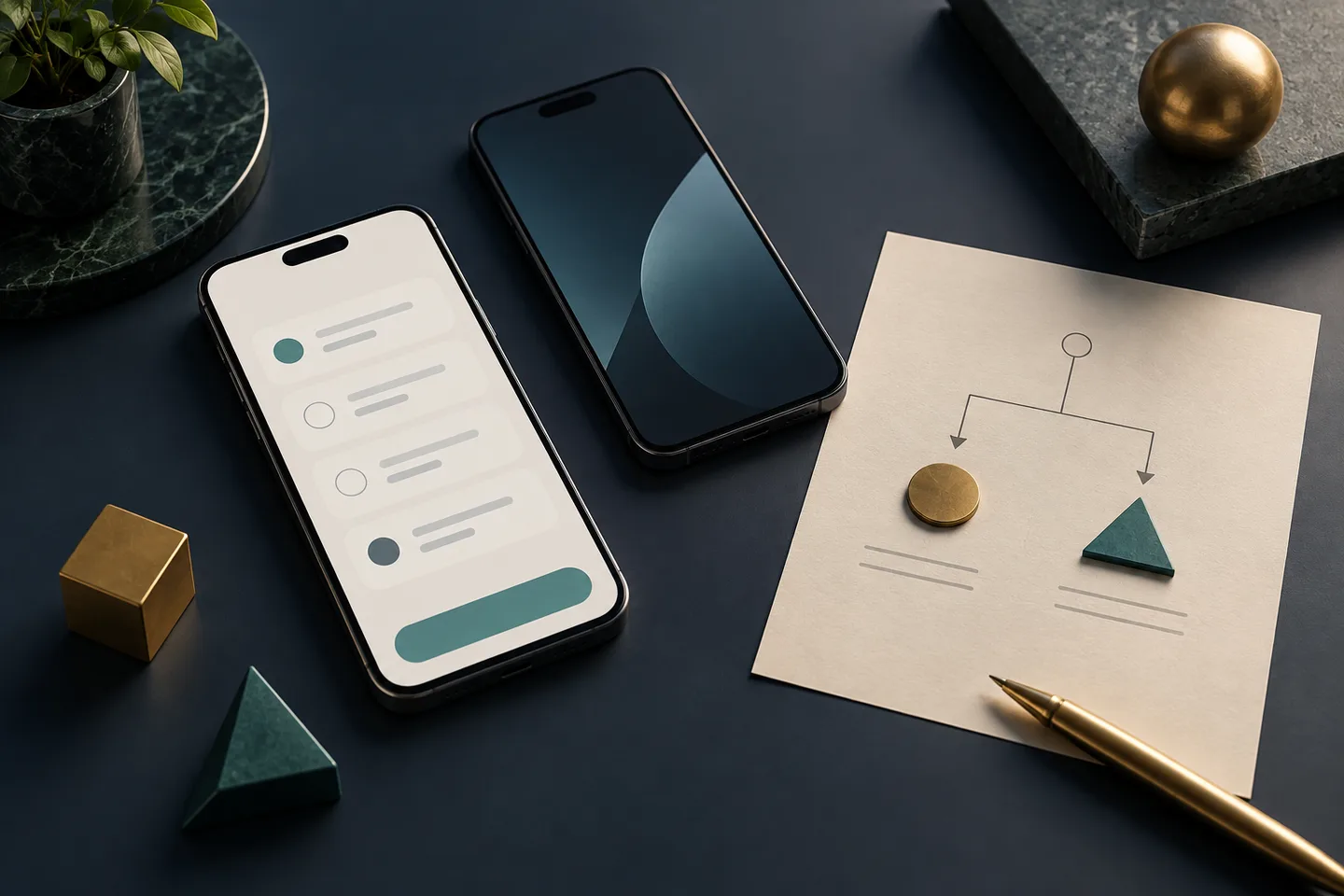
The examples and illustrations in this guide are explanatory, not evidence of client results. The images were generated with AI. Platform guidance was checked on the review date; verify the applicable requirements again before a release.
Frequently asked questions
What does a mobile app consultant do?
A mobile app consultant helps a business evaluate product, architecture, supplier and delivery decisions. Some provide independent advice and others also implement the work. Agree the specific decision, evidence, outputs and implementation responsibility before hiring.
How much do mobile app consulting services cost?
Request current proposals for the same brief and compare scope, capacity, outputs, exclusions and acceptance. Advisory fees, implementation, infrastructure and support are different costs. This guide does not provide a verified market rate card.
Do I need an app consultant or a development agency?
Use a bounded advisory engagement when the decision or evidence is missing. Use delivery capacity when the direction is sufficiently clear. An agency may provide both, so ask who performs each role and whether advice depends on purchasing later implementation.
Can a consultant guarantee App Store approval?
No. A consultant can investigate readiness, check current applicable requirements and help prepare a submission, but the platform decides the review outcome.
Should we rebuild an app that keeps failing?
Investigate representative failures and compare targeted repair, staged replacement and a broader rebuild. Include backend dependencies, data compatibility, transition work and the ability to release safely before choosing.
Sources and further reading