Food-service technology leadership
Food-Service CTO: Restaurant Technology and Hiring Guide
Plan restaurant technology leadership around orders, POS integration, vendors and service continuity. Includes a worked example and a phased hiring brief.
- By
- Fractional CTO Experts
- Published
- 2026-09-09
- Reviewed
- 2026-09-09
- Reading time
- 15 minutes
- When does a restaurant need a CTO rather than IT support?
- Map the order journey before choosing another platform
- Worked example: investigate a delivery-order mismatch
- Specify integrations in terms of behaviour and ownership
- Plan for an outage during service
- Evaluate vendors with a service-based scorecard
- Build a phased first engagement
- Measure whether the work improved operations
- Hire for the actual mandate and prepare the handover
- Questions restaurant owners ask about fractional technology leadership
A food-service CTO helps a restaurant group, catering business or food-ordering company make technology decisions that affect service, operating information and growth. The work can include choosing systems, connecting order channels, resolving reporting disagreements and governing a rollout across locations. A fractional engagement reserves part of an executive's time for a defined mandate; it does not automatically provide installation crews, round-the-clock support or restaurant operating management.
For an owner, the useful starting question is concrete: which decision is stuck, what happens during service because of it, and who must change how they work? This guide provides a practical decision framework, an invented reconciliation example, a vendor assessment and a staged engagement plan. Fractional CTO Experts is an executive network and matching platform. Use the framework to request candidates, then verify their relevant experience, proposed responsibilities and availability.
When does a restaurant need a CTO rather than IT support?
A single restaurant with a supported point-of-sale installation may primarily need dependable vendor support and a competent local technology provider. A CTO mandate becomes more useful when several systems, suppliers or locations create decisions that nobody owns end to end. Examples include expanding delivery channels, replacing a central application, acquiring another restaurant group or deciding whether to build a customer-facing product.
Distinguish recurring support from executive decision-making. A broken printer needs a response procedure and someone equipped to fix it. Choosing whether the business should standardise printers, networks and order workflows across twenty locations needs a different discussion about operating requirements, suppliers, cost and transition risk. One person may contribute to both, but the contract should not blur the two obligations.
Also distinguish a restaurant operator from a food-technology software company. A restaurant group typically buys and coordinates much of its operational software. A company selling ordering software to restaurants must govern a product, engineering team and customer commitments. Both can need senior technology leadership, but the candidate evidence and implementation resources differ. Ask applicants to explain their experience in the business model you actually operate.
| Situation | Likely primary need | Useful evidence from a candidate |
|---|---|---|
| One location with recurring device problems | Support ownership and reliable maintenance | Troubleshooting process, escalation coverage and vendor familiarity |
| Several channels produce conflicting order records | Integration and operating-process investigation | A clear method for tracing records and resolving responsibility |
| A group is selecting a replacement POS | Technology leadership with restaurant participation | Comparable procurement decisions, migration planning and site adoption |
| A company is building restaurant software | Product and engineering leadership | Relevant delivery, reliability and customer-support experience |
Map the order journey before choosing another platform
Walk through an actual order with the people who handle it. Record where it is created, accepted, prepared, collected or delivered, changed, cancelled and reconciled. Include the systems and manual work at each step. A kitchen supervisor's paper note or a manager's spreadsheet belongs in this map if it changes what happens to the order.
Choose a few representative journeys rather than drawing every possibility immediately. Start with an ordinary dine-in order, an online collection order and an order that changes after acceptance. Add other cases that matter to your operation, such as scheduled catering, split checks or a delivery partner cancellation. These examples expose disagreements that a diagram of software logos cannot explain.
For each handoff, identify the authoritative record and the receiving team's interpretation. An accepted order is not necessarily prepared; a prepared order is not necessarily collected; a captured payment is not necessarily the same as a reconciled bank settlement. Ask the operating and finance owners to agree their definitions. The CTO helps make the information contract explicit instead of choosing accounting definitions alone.
Do not assume that an integration exposes every field visible in a vendor's user interface. For example, Toast's orders webhook documentation describes order-update events and identifies information omitted from webhook messages. An implementation must check the actual payload and permitted access. That specific example illustrates why a sales demonstration is insufficient evidence for an integration design; it is not a recommendation that every restaurant adopt Toast.

Worked example: investigate a delivery-order mismatch
Consider an invented three-location restaurant group. During a sample evening, its delivery dashboard shows 120 accepted orders, the kitchen system records 118 completed tickets and the finance export contains 119 order references. These figures are deliberately illustrative. They are not customer results, an industry benchmark or proof that any particular product loses orders.
The first response should be to preserve the relevant records and compare like with like. Establish the location, time window, time zone and business-day rule used by each report. Confirm whether cancellations, refunds, test orders and orders completed after midnight are included. A difference in inclusion rules can create an apparent mismatch even when the underlying process behaved as designed.
Next, select identifiers that let the team follow one order through the systems. A human-facing ticket number may repeat at another restaurant or on another day. The integration owner should document the actual uniqueness rules and retain enough context to trace a record without exposing unnecessary customer information. Ask the supplier how a source identifier maps to the destination record.
Suppose the investigation finds one order cancelled before preparation, one accepted just before the reporting cutoff but completed afterwards, and one duplicate finance-export row. The team now has three separate issues: a reporting definition, a time-boundary treatment and a duplicate export. Buying a new ordering platform would not automatically resolve any of them. The appropriate changes depend on the confirmed causes.
Create a reconciliation worksheet with source reference, location, relevant timestamps, operational status, financial treatment, discrepancy category, owner and resolution. Avoid copying full payment details or customer conversations into a general spreadsheet. The worksheet should answer who investigates the exception and how closure is verified. Agree retention and access with the responsible business owners.
Finally, rerun the same comparison after the change and include new examples. A clean result on three handpicked orders is useful debugging evidence but weak rollout evidence. Review the actual mix of locations, channels, modifications and service periods that the change will affect. Keep unresolved differences visible rather than changing report definitions simply to make totals agree.
Specify integrations in terms of behaviour and ownership
An integration brief should describe what must happen, what can fail and who responds. Include the source of truth, supported operations, access requirements, change notifications and the treatment of exceptions. Ask for demonstrations of modification, cancellation and recovery flows. A successful new-order demonstration covers only one part of the operational requirement.
Have the implementation team explain how it handles repeated messages, interrupted processing and records that arrive later than expected. The exact mechanism depends on the supplier's interface and your system. A buyer does not need to dictate an architecture from a generic article, but should require a testable account of how duplicate actions and missing updates are detected and resolved.
Agree who monitors the connection outside the initial project. If a vendor changes a field or an access credential expires, identify the alert recipient, escalation path and person authorised to act. Clarify whether support includes the connector itself or only each supplier's individual product. An integration sitting between two contracts can otherwise become an ownership gap.
Keep access and exit arrangements practical. The business should know which accounts, credentials, repositories and configuration records exist, who controls them and how access is removed. Ask what can be exported if the relationship ends and how the export will be interpreted. Receiving a file is less useful than receiving a documented dataset that another authorised operator can understand.
Plan for an outage during service
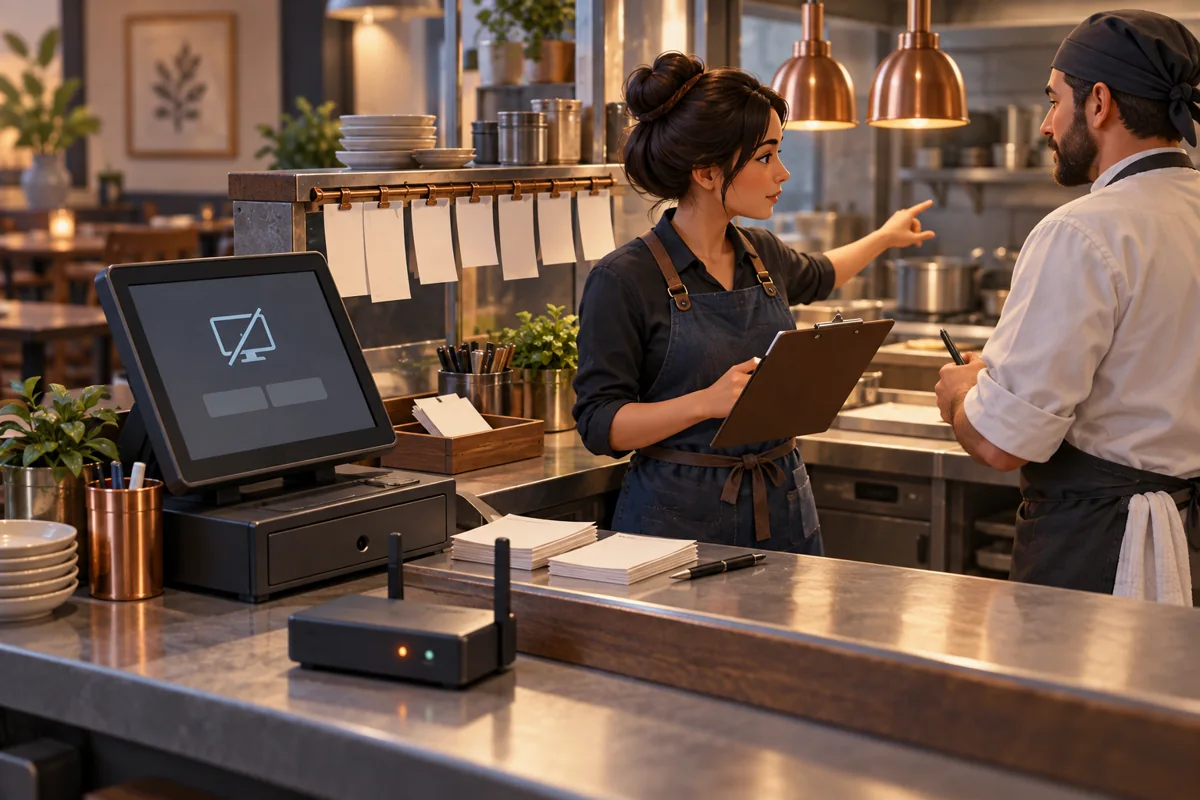
Restaurant technology has to work with the service environment. A recovery procedure that assumes an hour of quiet investigation may not fit a busy kitchen. Identify the decisions a duty manager must make when ordering, connectivity, payment or a kitchen display becomes unavailable. The procedure should distinguish a local device problem from a wider supplier incident.
Ask each relevant supplier which offline behaviours are supported for your configuration and contract. Do not assume that an offline terminal can accept every payment method or that a disconnected ordering channel will stop taking new orders. Document the actual capabilities and limitations, then verify the procedure with the people expected to operate it.
Create a bounded rehearsal during an agreed safe window. The operating lead should approve the scenario and stopping conditions. Walk through how staff recognise the failure, communicate with customers, avoid duplicate preparation, record necessary information and reconcile activity after restoration. Keep payment handling within the procedures approved for the business's actual payment setup.
The handback matters as much as the fallback. Name who decides normal operation has resumed, what must be reconciled and how unresolved orders are handled. Record lessons from the rehearsal and update staff instructions. A folder containing a recovery document is not evidence that the next shift can use it under pressure.
Evaluate vendors with a service-based scorecard
Begin vendor selection with the operating requirements and representative order journeys already collected. Ask vendors to demonstrate your cases using an agreed script. Keep a record of which behaviours are available now, which require additional products or access, and which are merely proposed. Separate a roadmap statement from a contractual commitment.
Compare the full arrangement over the same planning period. Include hardware, software, implementation, training, support, integration access, payment-related commercial terms and exit work where applicable. Request current written proposals rather than applying a generic price comparison to different configurations. Finance and the relevant advisers should review the commercial details that fall within their responsibilities.
| Evaluation area | Evidence to request | Decision owner to involve |
|---|---|---|
| Service workflow | Demonstration of representative orders and exceptions | Restaurant operations |
| Integration access | Current documentation, permissions and a bounded technical test | Technology and implementation owners |
| Support | Coverage, escalation procedure and supplier responsibility boundaries | Operations and procurement |
| Reporting | Sample exports with definitions and reconciliation results | Finance and operating analysts |
| Transition | Site plan, training approach, fallback and acceptance criteria | Site leaders and project sponsor |
| Exit | Export formats, account ownership and transition assistance terms | Technology, procurement and relevant advisers |
Use written decision notes to preserve tradeoffs. One option may be easier for existing staff while another supports a required channel better. Record why the selected benefit outweighs the accepted limitation, who accepted it and when to revisit the decision. This is more useful than assigning unexplained numerical scores that conceal disagreement.
Supplier relationships also need security ownership. PCI SSC explains that using third-party service providers does not remove an entity's responsibility for its own PCI DSS compliance. Identify which payment-related responsibilities remain with the business and which are assigned to providers, and obtain the relevant evidence. The exact assessment obligations should be confirmed with the parties responsible for your compliance programme; a CTO title or vendor badge is not a substitute.

Build a phased first engagement
A useful engagement begins with decisions and evidence, then moves into a bounded change. The following sequence is a planning example, not a promised implementation schedule. Site access, supplier dependencies and the state of existing records can change the duration. Agree review points where the sponsor can narrow, expand or stop the work.
During discovery, collect the system inventory, important contracts, support contacts, order journeys and recurring incidents. Observe how staff actually work and ask which tasks they repeat manually. The deliverable should identify a small set of consequential problems, the evidence supporting them and the owner of each next decision. Avoid treating a long list of possible technologies as a strategy.
During design, compare the credible options for the highest-priority problem. Include retaining the current system with a process or configuration change when that is a real option. Estimate effort and dependencies with the people who will implement the work. Document assumptions and uncertainty instead of presenting an unsupported fixed return on investment.
During the pilot, choose a representative location or workflow and define acceptance criteria in advance. Record what success means for staff, operations and information quality. Include exception handling and support readiness. A pilot that works only when the project team stands beside the terminal may reveal a training or operating gap rather than readiness for expansion.
At the expansion decision, compare the pilot's evidence with the differences at other sites. Check equipment, connectivity, menus, opening hours, staff capability and local operating practices where relevant. Decide which differences require another test. A multi-site rollout needs a repeatable process and clear site ownership, not simply permission to copy the first installation.

Measure whether the work improved operations
Choose measures tied to the original problem. For reconciliation work, consider unresolved exceptions over a defined set of records and the time required to investigate them. For a rollout, consider whether representative staff can complete the agreed tasks and whether support responsibilities are understood. Define the numerator, denominator and observation period before comparing results.
Keep operational context with the numbers. A quieter week, menu change or different mix of delivery orders can affect a comparison. Record those changes and avoid attributing every movement to the technology project. If the sample is too small or the periods are materially different, describe the evidence as preliminary and collect a more useful comparison.
Separate direct observations from estimated financial value. Time saved in a task does not automatically become a cash saving; the effect depends on how the business uses that capacity. Similarly, an avoided incident is difficult to value without a credible baseline. Present assumptions to the finance owner so the business can judge the estimate rather than treating a calculator output as a measured result.
Review outcomes with the people who perform the work. A dashboard may show faster completion while staff have quietly introduced a manual workaround elsewhere. Ask what became easier, what remained confusing and which exceptions still require informal help. Use those observations to refine the process and the next technology decision.
Hire for the actual mandate and prepare the handover
Ask candidates to walk through a comparable decision from discovery to operation. Request their own role, the choices considered, the constraints, the implementation participants and the evidence used to judge the result. Respect confidential information; an anonymised explanation can still show reasoning. A list of restaurant software brands alone does not establish executive judgement.
Use a short, realistic scenario in the interview. Present the invented mismatch described above and ask what the candidate would investigate before recommending a replacement system. Strong answers should surface definitions, identifiers, operating ownership and evidence needs. Assess whether they can explain the issue clearly to a restaurant manager as well as to an engineer.
Agree reserved capacity, meeting rhythm, site attendance, response expectations and decision authority. Clarify who supplies engineering, configuration, training and ongoing support. If the engagement is intended to become smaller after the pilot, write down the handover condition. For broader engagement questions, compare the fractional CTO service model and pricing considerations.
Before handover, review the decision log, system inventory, vendor contacts, access ownership, operating instructions, unresolved issues and next review dates. Ask the receiving team to demonstrate that it can find and use the information. Transfer responsibilities explicitly rather than relying on an informal promise that the consultant will remain available.

Questions restaurant owners ask about fractional technology leadership
Do we need custom restaurant software?
Start by testing whether existing supported products and process changes meet the requirement. Custom development creates an ongoing ownership obligation as well as an initial project. Ask what differentiates the business, why available options are inadequate and who will maintain the resulting software before approving a build.
Can AI solve our restaurant reporting problems?
First establish reliable definitions, source records and responsibility for exceptions. An AI-generated explanation of inconsistent data does not resolve the underlying mismatch. If an AI use case remains useful, define its permitted information, human review and evaluation criteria within the actual business workflow before expanding its use.
What should we put in a candidate request?
Include the business model, number and type of locations, main systems, decision to resolve, operating constraints, implementation resources and required attendance. State what evidence you want from comparable work and which outcomes will be measured. Request a shortlist using those details, then assess each candidate's proposed mandate directly.
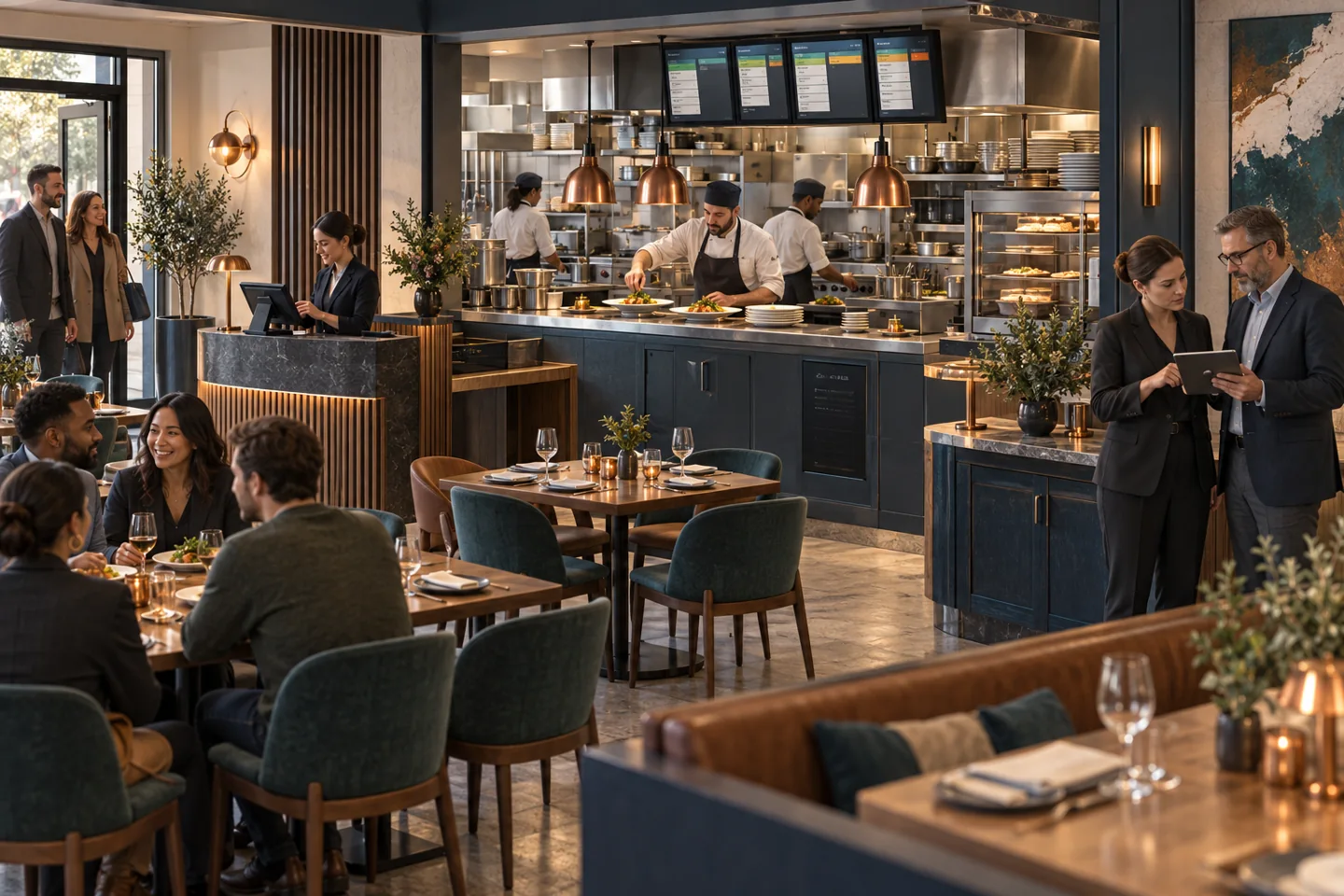
The illustrations on this page are AI-generated editorial scenes. The reconciliation example and phased plan are illustrative frameworks, not client case studies or promised results.
Frequently asked questions
What does a food-service CTO do?
A food-service CTO leads defined technology decisions involving restaurant systems, order channels, suppliers and rollout plans. Agree authority and implementation resources; a fractional executive does not automatically provide device support or a complete delivery team.
Can a fractional CTO choose our POS system?
A suitably experienced leader can organise requirements, compare options and coordinate technical evidence. Restaurant operations, finance and implementation owners should participate. Specify who recommends, approves, installs, trains and supports the selected system.
How much does a food-service CTO cost?
Request current proposals for the scope, reserved capacity, site attendance and responsibilities required. Compare executive fees separately from software, hardware and implementation costs. This guide does not provide a verified food-service rate card.
Can restaurant technology leadership be remote?
Some planning and vendor coordination can be remote. Service observation, equipment checks and site transitions may require on-site participants. Specify who performs those tasks and provides local support.
Should restaurants build custom software?
First test whether supported products and process changes meet the requirement. Custom development needs continuing maintenance and ownership. Define the unmet business need, alternatives and operating resources before committing.
Sources and further reading